Showing posts with label Carpegna. Show all posts

Saturday, May 14, 2016

CARPEGNA PALACE - GALLERY OF THE ACADEMY OF St. LUKE (second part)

GALLERIA DELL’ACCADEMIA DI S. LUCA

There are more than 1,000 paintings, about 300 sculptures, about 1500 drawings and a collection of prints and medals, some shown to the public, most in storage
Room of Academic Education
Selection of the numerous works of art by famous and not so famous artists who were annually presented and awarded at the closing ceremony of the public academic competitions at the Capitoline Hill in the eighteenth and nineteenth century
Collection of Plaster Casts
Opened in 2008
Five casts including bas-relief “Socrates defends Alcibiades at the Battle of Potidea” and “Portrait of Clement XIII Rezzonico (1758/69)” 1784/86 by Antonio Canova (1757/1822)
Seven casts including “Ganymede and the Eagle” 1817 by Bertel Thorvaldsen (1770/1844)
Two casts by Pietro Tenerani (1789/1869)
Also works by the Dutchman Mathieu Kessels (1784/1836), the Welsh pupil of Canova John Gibson (1790/1866), the German Emil Wolff (1802/79), Attilio Selva (1888/1970), Bernardo Tacca (1780/1826) and Giulio Tadolini (1849/1918)
Cabinet of Drawings
Three sets of tables on the study of perspective, anatomy, and the system of architectural orders, all dating back to the second half of the seventeenth century
Group of architectural drawings, spectacular in terms of design but also for the techniques of graphic representation, which documents the practice of donating samples to the institution, by statute, by the newly elected academic
Confidential Cabinet
Paintings from the Pinacoteca Capitolina (Capitoline Art Gallery) whose subjects in 1823 were judged 'not decent for being seen publicly' and then removed from the rooms, with the exception of the great Bacchus and Ariadne by Guido Reni, who was exhibited until 1841 and it is now located along the main staircase
These “scandalous” paintings were placed temporarily in a 'confidential cabinet' before being donated, between 1836 and 1845, to the Accademia di S. Luca for educational purposes
Collection of Works by Contemporary Academic Masters
The collections include the works of young artists deemed worthy of the prize competitions organized over the centuries by the Accademia di S. Luca
Mascarino Fund
253 architectural drawings, 150 of which related to Roman buildings, from the workshop of Ottaviano Nonni aka Ottaviano Mascherino (1524/1606), Prince of the Academy in 1604
Historical Archive and Sarti Library
Over 42,000 books donated to the City of Rome in 1877 by the favorite architect of the Torlonia family Antonio Sarti (1797/1880), important for the documentation of architecture and art history

Wednesday, May 11, 2016

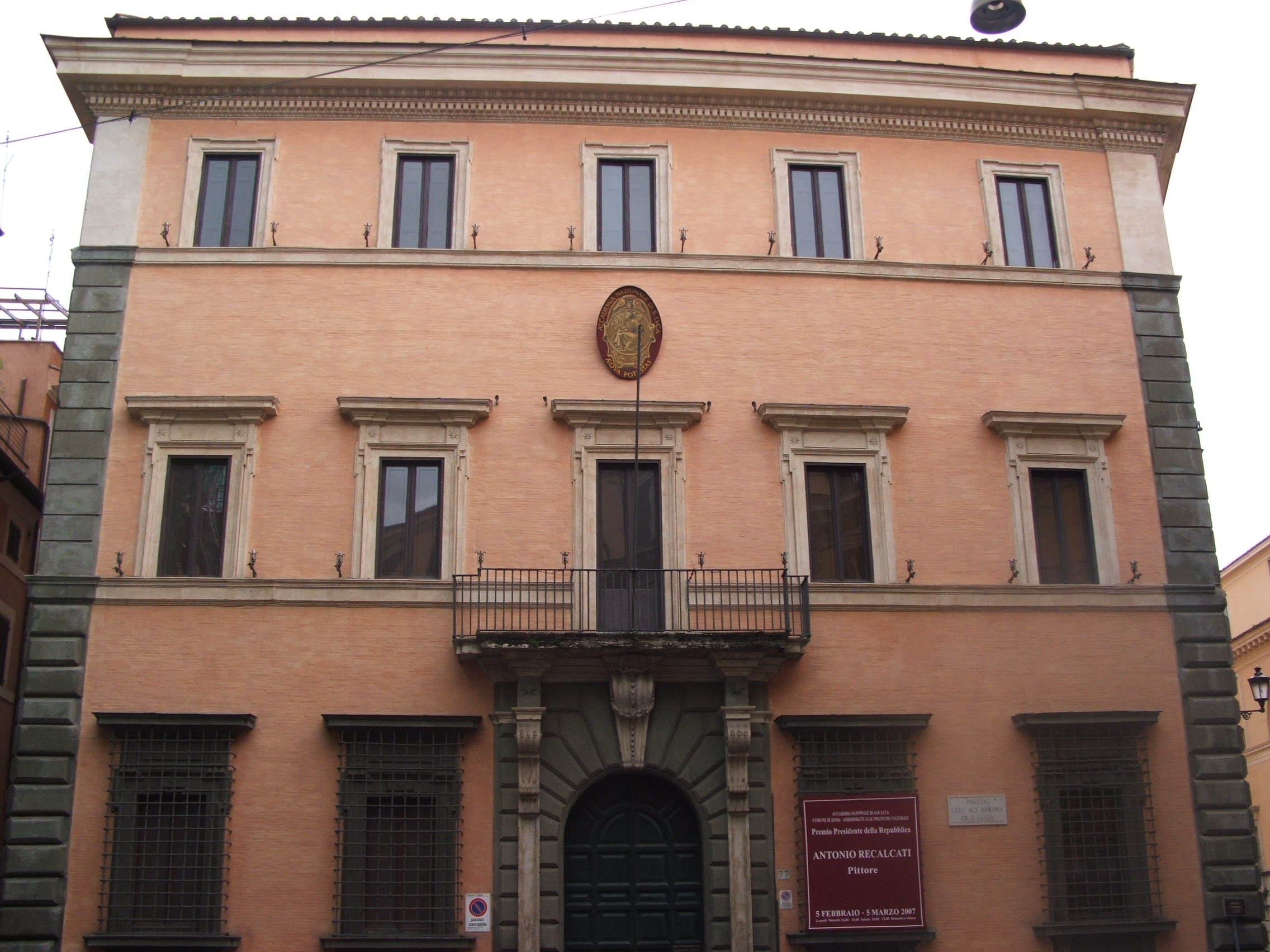
CARPEGNA PALACE - GALLERY OF THE ACADEMY OF St. LUKE (first part)

1577 maybe by pupils of Giacomo Della Porta (1533/1602) for the Vaini family originally from Imola
Renovated 1643/47 by Francesco Borromini (1599/1667) initially for count Ambrogio Carpegna, who had bought the building from the Vaini family, and later for Cardinal Ulderico Carpegna
The most beautiful element left of Borromini's work is the splendid PORTAL
“Of the designs of Borromini for the building very little was done, but there is a series of bold projects that anticipate the development of the eighteenth-century Italian palazzo” (Rudolf Wittkower)
Marquis Emilio Orsini de' Cavalieri Sannesi bought it and entrusted the completion and the structural adjustment in the years 1732/36 to Francesco Ferrari (active in Rome 1721/44)
Subsequently it passed into the property of the families Patrizi Naro and Colligola Monthioni
From mid-1800 until 1882 it housed the family of Luigi Pianciani, first mayor of Rome after the unification of Italy
1933/34 radical restructuring of the building under the direction of Gustavo Giovannoni (1873/1947) and Arnaldo Foschini (1884/1968) to adapt it as the headquarters of the Accademia di S. Luca (Academy of St. Luke)
When the headquarters were opened in 1934, the GROUND FLOOR was to house exhibitions of art and architecture with spaces reserved for keeping collections and funds of academic drawings and books. Also the upper floors were restored and connected with the new internal staircase
On the FIRST FLOOR there are the offices of the presidency and secretariat, conference room and the boardroom
In the SECOND FLOOR there are the Sarti Library, the Historical Archives and the administrative offices
The THIRD FLOOR houses the Gallery and the vault with the paintings not on display
The ACCADEMIA DI S. LUCA was an association of artists of Rome, established in 1577 but officially founded in 1593 by Federico Zuccari (about 1542/1609), who was also the first director (prince), with the desire to consider artists as much more than simple artisans
During the first years of activity the Academy ended up in the orbit of papal patronage, which dominated and controlled the institution
The Academy was named during the early seventeenth century after the Evangelist S. Luke because of his appointment as the patron of all painters. According to the legend, Luke was the author of the first portrait of the Madonna
In 1620 Urban VIII Barberini (1623/44) granted the right to the Academy to determine who could be considered an “artist” in Rome
The Academy was intended by many modern critics to give high education to the artists but at the same time to exercise direct control of the Church on them
The Principi dell'Accademia di S. Luca (Princes of the Academy of St. Luke) were eminent artistic personalities elected by the faculty. Among those who played this role there were people like Gian Lorenzo Bernini or Domenichino
Many important artists stayed outside and were never allowed in the circuit of the academy. For this reason alternative school of artists were established in Rome, objecting the way this official institution understood art. One of the most famous was the School of Bamboccianti