Showing posts with label Innocenzo Tacconi. Show all posts

Thursday, April 19, 2018

St. ANGELO IN THE FISH MARKET

S. ANGELO IN PESCHERIA
Diaconia (building for assistance and charity to the poor, the sick and pilgrims) dedicated to St. Paul, founded in the year 755, maybe on a previously existing church dating back to the fourth or sixth century, built in turn on the ruins of the PORTICO D’OTTAVIA
This information was taken from an inscription embedded on the left wall of the entrance room
In the twelfth century it was dedicated to S. Angelo and was named S. Angelo in Foro Piscium (St. Angel in the Forum of Fish) for the presence of the nearby fish market
Restored in 1583 by Martino Longhi the Elder (1534/91) and in 1599 by Giacomo Della Porta (1533/1602)
Other restorations in the years 1700, 1719, 1741, 1821
Last renovation in 1864 Alessandro Betocchi for Pius IX Mastai-Ferretti (1846/78)
“The engineer Alessandro Betocchi, also intervened on the outside: he knocked down the huts on the left side of the front of the Propylaeum with the aim to restore its original appearance, he destroyed the wall that was partially hiding the arch and carried out an excavations to bring to light the Roman walkway. Inside he also freed the three columns and the façade of the church was moved back from them. The façade was plastered with the aim to put even more emphasis on the difference with the Roman ruins” (Pier Paolo Racioppi)
In 1929 the roof with trusses was rebuilt after the collapse of the vault in 1928
Here the Roman Jews were forced to listen to the sermons of the Jesuits who wanted to convert them
1st CHAPEL ON THE RIGHT
Above the altar “Apparition of the Blessed Trinity to Sts. Cyrus and Lorenzo” by G.B. Brughi (1660/1730) pupil of Baciccio
Above the altar “St. Andrew” maybe by Marco Tullio Montagna (1594/1649) from Velletri, pupil of Federico Zuccari
On the right “The Calling of St. Andrew” in 1619 by Bernardino Cesari (1571/1622), brother of Giuseppe Cesari aka Cavalier d'Arpino
Frescoes “Stories of St. Andrew, Evangelists and saints” about 1599 maybe by Innocenzo Tacconi (active in Rome 1607/25)
Coat of arms in the floor in opus sectile (inlaid marble) of the University of Fishmongers who had the chapel restored in 1618. The fish symbol is accompanied by the deer, symbol of old nobility and the Capitoline geese, symbol of fidelity
MAIN ALTAR
“St. Michael” 1862 copy by Angelo Augero of the famous original by Guido Reni in S. Maria della Concezione
Under the altar “Early Christian sarcophagus” with relics of St. Cyrus of Alexandria
2nd CHAPEL ON THE LEFT
Above the altar “Madonna and Child with Angels” 1450 maybe by Benozzo di Lese aka Benozzo Gozzoli (1420/97)
He was called Gozzoli by Giorgio Vasari in the 1568 edition of his book dedicated to the lives of the artists, but all the other existing documents identify him as Benozzo di Lese
It is a fresco that was detached from the outer wall of the church and was moved here to be better preserved
“He worked with Ghiberti (...), but he was born to art with Fra Angelico: it is assumed with convincing evidence that he was his help during the work in the Convent of S. Marco in Florence, and worked with him in March of the year 1447 in the Vatican and in June of the same year in Orvieto, in the Chapel of S. Brizio in the Duomo. (...) It is also likely that he helped Angelico with the frescoes in the Chapel of Nicholas V in the Vatican painted in those years. Benozzo became independent late, in his thirties, and always under the influence of the mystical severity of his teacher. But also his familiarity with Ghiberti left in him a clear pattern: that loving attention to the world around him and his pleasant capacity of materializing Angelico's style” (Emma Micheletti - Dizionario Biografico degli Italiani Treccani)
1st CHAPEL ON THE LEFT - CHAPEL OF THE CROSS
“Wooden crucifix” of the sixteenth century
Above the entrance doors of the side aisles “St. Francis Caracciolo converts a courtesan” and “St. Francis Caracciolo adoration of the Eucharist” 1808 by Francesco Manno (1752/1831)
TO THE RIGHT OF THE PROPYLAEUM OF PORTICO D’OTTAVIA
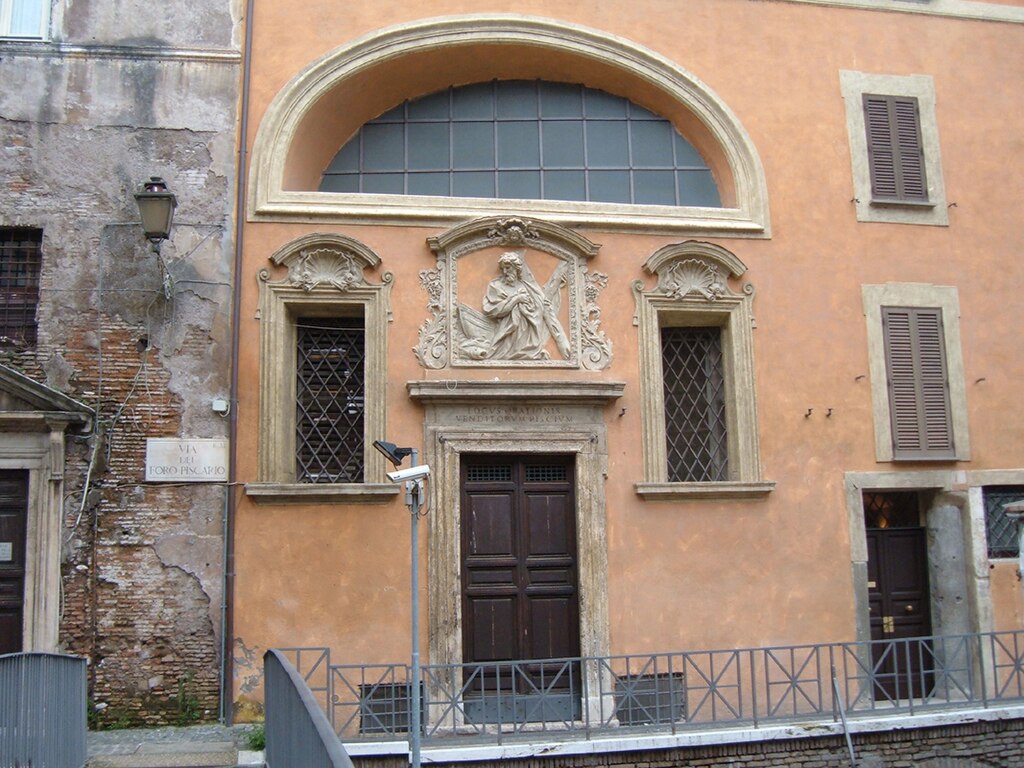
Oratory of St. Andrew of the Fishmongers 
1688/89 Filippo Tittoni
Façade with stucco restored in 1928
It was dedicated to St. Andrew, the apostle who was a fisherman
Inside the church “Busts of the Evangelists and of the Fathers of the Church” maybe by Lorenzo Ottoni (1648/1736) and Michel Maille aka Michele Maglia (active in Rome in the second half of the seventeenth century)
It is now owned by the Municipality of Rome and it is used for commercial activities

Thursday, October 10, 2013

BASILICA OF St. SEBASTIAN


BASILICA S. SEBASTIANO


First half of the fourth century as Basilica Apostolorum, the place where, according to tradition, the bodies of Sts. Peter and Paul had been transferred to in 258, at the time of the persecution of Valerian (253/260)

The bodies of Sts. Peter and Paul would have been returned to their tombs only with the construction of their basilicas, except for the two heads preserved in St. John Lateran

It is not attributed to Constantine (306/337) by the Liber Pontificalis (the earliest history book about the popes) as other circiformi basilicas (circus shaped churches) were and the attribution to Maxentius (306/312), who had his residence-villa complex nearby, has been suggested

Various renovations throughout the fifteenth century

Rebuilt 1608/13 using only the nave of the circus shaped early basilica for Cardinal Scipione Caffarelli Borghese (1577/1633) by Flaminio Ponzio (1560/1613) and Jan Van Santen aka Giovanni Vasanzio (1550/1621), who continued the work after the death of Ponzio and complied with its directives

Giovanni Vasanzio designed the FAÇADE and the wooden ceiling

It was a privileged place of prayer for saints like Bridget and her daughter Catherine of Sweden, Charles Borromeo and Philip Neri who inserted it in the Seven Churches Itinerary for pilgrims in the sixteenth century


1611 designed by Jan Van Santen aka Giovanni Vasanzio and executed by Vittorio Ronconi with the help of Annibale Durante, Flemish as Vasanzio, for gilding and coloring


The ceiling was restored by Pope Gregory XVI Cappellari (1831/46) of whom the coat of arms was added

FLOOR

Redone in 1957 in Verona marble


“Marble bust of Salvator Mundi” 1679/80 last masterpiece of the life of Gian Lorenzo Bernini (1598/1680)

It went missing already at the end of the seventeenth century and it was found by accident only in August 2001 in the convent adjacent to the Albani Chapel, where he was hidden and believed to be a work by Francesco Papaleo

It was one of the very few works he did for himself with no commission. Others were “The Truth” now at the Borghese Gallery and the “Bust of Costanza Bonarelli” now at the Bargello Museum in Florence

“Tomb of Altobello de Ense of Montecorvino” who died in 1615 by an unknown artist

This doctor was very active during the plague epidemics and he wanted to be buried here, perhaps for the traditional role of defender of the plague carried by St. Sebastian


1625/27 for Duke Maximilian I of Bavaria

“Tomb of Cardinal G.B. Francesco Maria Gabrielli” about 1700/20 by an unknown artist, from S. Bernardo alle Terme

Inside the chapel there are the following relics:

Spine of the Crown - A finger, a tooth and part of a rib of St. Peter - A tooth of St. Paul - A bone and an arm of St. Andrew - Part of the head and an arm of St. Fabian - The heads of Popes Sts. Callistus and Stephen - A cup of lead with ashes and bones of St. Fabian - An arm of St. Roch - Part of the head of Sts. Nereus, Achilleus, Avenisto, Valentine and Lucina martyrs - The arrow and the column of the martyrdom of St. Sebastian - The stone of “Quo Vadis?” with footprints believed to be of Christ

2nd ALTAR ON THE RIGHT

Dedicated to St. Frances of Rome

3rd ALTAR ON THE RIGHT

“St. Jerome Penitent” 1613 by Archita Ricci (active 1599/1619)


Dedicated to Pope St. Fabian (236/250) carried out 1706/12 for Clement XI Albani (1700/21) by Alessandro Specchi (1668/1729) and Filippo Barigioni (about 1680/1753) from the design of their master Carlo Fontana (1634/1714) or maybe of Carlo Maratta (1625/1713)

Bronze and wrought iron railing made in 1714

Above the altar “Statue of St. Fabian with angel” 1712 and “Putti” by the Sicilian Francesco Papaleo (about 1642/1718)

Below “Reliquary head of St. Fabian” by Filippo Barigioni

On the right “St. Fabian baptizes Philip the Arab” (244/249) about 1712 Pier Leone Ghezzi (1674/1755)

On the left “St. Fabian elected Pope” about 1710 by Giuseppe Passeri (1654/1714)

In the pendentives “Four medallions in stucco” with saints buried in the catacombs: Cecilia, Soter, Lucilla and Balbina


“Early Christian sarcophagus with Christ at the center between Sts. Peter and Paul, on the right Raising of Lazarus and on the left Capture of St. Peter”

Four antique columns of green Thessalian marble frame the tempera on wall “Crucifixion” 1609/14 by Innocenzo Tacconi (active in Rome 1607/25) a pupil of Annibale Carracci. He achieves an amazing neo-fifteenth century composition away from the canons of the nascent Baroque altarpiece

On the sides “Busts of Sts. Peter and Paul” 1608 by Nicolas Cordier (1567/1612)

On the right under the organ “St. Sebastian” 1618 by Pietro Sigismondi from Lucca


“Apparition of the Immaculate Conception to Sts. Jerome and Anthony” 1857 by the “purist” painter Cesare Fracassini (1838/68) from Orvieto, who still shows here the influence of Tommaso Minardi of whom he was a pupil of

3rd ALTAR ON THE LEFT

“St. Francis receiving the Stigmata” maybe by Girolamo Muziano (1532/92) covering remains of frescoes by Archita Ricci

2nd ALTAR ON THE LEFT

Dedicated to St. Charles Borromeo, defender of Milan from the plague

“St. Charles Borromeo adores the sacred nail” by Archita Ricci


1672 by Ciro Ferri (1634/89) for Cardinal Francesco Barberini, who succeeded Cardinal Scipione Borghese as commendatory abbot of the basilica

It is aligned with the saint's burial in the catacombs

“Recumbent figure of St. Sebastian” 1671/72 masterpiece by Giuseppe Giorgetti, brother of Antonio Giorgetti, maybe designed by Gian Lorenzo Bernini or, perhaps more likely, by Ciro Ferri

“This was his only masterpiece of great beauty that is another version of the type of Maderno's St. Cecilia, a statue derived from the Dying Slave by Michelangelo and imbued with an exquisite Hellenistic taste” (Rudolf Wittkower)

FURTHER ON IN THE LEFT WALL

“Inscription of the poem by Pope Damasus (366/384) in honor of the martyr Eutichius” engraved by Furius Dyonisius Philocalus, the only damasian inscription survived without fractures

“Much of the luck of Damasus' epigrams is due to the beauty of the letters, designed by Furius Dyonisius Philocalus, calligrapher of the Pope-poet. He created for these large sheets a particular font, derived from the classic square capital, which is distinguished from all other adopted by Christians for the high quality and careful preparation that preceded the writing of texts, arranged with great regularity and symmetry. Philocalus adopted different solutions to ensure that each of the lines would finish at the same point, such as as links, entries of small letters inside or alongside other letters, or the raising of T to save space” (Danilo Mazzoleni)

Above the inscription “White marble tabernacle” of the second half of the fifteenth century by an unknown artist

ROOM ORIGINALLY USED AS A SACRISTY

Frescoes on the ceiling “Lord and saints” and on a wall “Virgin with Sts. Sebastian and Lucina” first half of seventeenth century by Marco Tullio Montagna (1594/1649) from Velletri, student of Federico Zuccari

“Wooden Crucifix” late fifteenth century by an unknown artist. According to tradition it spoke to St. Philip Neri


Mausoleum of Lot's Sarcophagus

So called for the sarcophagus presenting different stages of working and a vivid polychromy

Platonia

Also known as the mausoleum of Quirino in which the Platoma was erroneously believed to be located. It was the large marble slab with the praise to the Apostles written by Pope Damasus (366/384). We only know it from medieval transcripts

Domus Petri

So called for a graffiti etched into the plaster. There are faded paintings

Mausoleum of the Urani

349, according to an inscription found here, while the name comes from another inscription with the word Uraniorum