Showing posts with label Musei Vaticani. Show all posts

Thursday, April 23, 2015

VATICAN MUSEUMS - APOSTOLIC VATICAN LIBRARY (second part)

Alexandrine Room
 
1690 for Alexander VIII Ottoboni (1689/91) to house the prestigious library of Queen Christina of Sweden

“It is here that between 1741 and 1747 were initially arranged the collections acquired by Benedict XIV for the collections of the Museo Cristiano; and it is here that in 1749 an inscription still on the western side of the Galleria mentions what is for the first time indicated by the name of 'Vatican Museum': a historical museum 'of Christian scholarship' (as it was described by the academic community on the eve of its Roman foundation), ANTIQUARIA SUPPELLECTILE AMPLISSIME EXORNATO” (Guido Cornini)

Frescoes “Episodes from the life of Pius VI Braschi (1775/99)” about 1818 by Domenico de Angelis (1735/1804) and Domenico del Frate (1765/1821)

English “Cope” of 3 m (10 feet) in red silk of the thirteenth century

Clementine Gallery


1732 for Clement XII Corsini (1730/40) divided into five sections by Pius VI
Originally it was an open loggia

Frescoes “Episodes from the life of Pius VII Chiaramonti (1800/23)” about 1818 by Domenico De Angelis (1735/1804) and Domenico Del Frate (1765/1821)

Section IV:

Porphyry sculpture “Two emperors in the act of embracing” a work of the late empire

Section V:

“Two statues of deities of the cult of Mithras” second or third century AD including that on the left with key in fist and rooster at the foot, attributes later referring to S. Peter

Profane Museum


Open in 1767 by Clement XIII Rezzonico (1758/69) in order to keep the Vatican medals
Vault “Minerva and Time” by the Roman Stefano Pozzi (1699/1768)


Ancient and extremely precious bronze heads of Roman emperors:

“Septimius Severus (193/211)”
“Caelius Balbinus”

“Roman mosaic with deer and birds” from Villa Adriana

“Head and arms of a statue of Athena chryselephantine”


EXIT SPIRAL STAIRS


1932 Giuseppe Momo (1875/1940)

Balustrade with bronze reliefs by Antonio Maraini (1886/1963)
Giuseppe Momo as architect of the Reverend Factory of St. Peter designed many buildings in the Vatican

These stairs inspired Frank Lloyd Wright for the stairs of the Guggenheim Museum in New York

Tuesday, April 21, 2015

VATICAN MUSEUMS - APOSTOLIC VATICAN LIBRARY (first part)

BIBLIOTECA APOSTOLICA VATICANA

Founded by Nicholas V Parentucelli (1447/55) in 1451 and made “official” by Sixtus IV Della Rovere (1471/84)

The building was erected in the years 1587/89 by Domenico Fontana (1543/1607) for Sixtus V Peretti (1585/90) dividing in two, the Belvedere courtyard by Bramante

About 800,000 printed volumes, 100,000 maps and engravings, 75,000 manuscripts, 70,000 archival volumes, more than 100,000 separate original documents, about 8,200 incunabula


Gallery of Urban VIII


Decoration begun by Giovanni Paolo Schor (1615/74) and resumed in 1756

Two “Planispheres” of 1529, one by Diego Ribera, and one by Giovanni da Verrazano, in which the New World was still largely “Terra Incognita”

“Celestial globe painted” 1567 by Giovanni Antonio Vanosio (1535/93) for Cardinal Marco Sittico Altemps
It was attributed to Giulio Romano for a misunderstood phrase written by Giorgio Vasari


Two Sistine Rooms


Walls


Lunettes

“St. Peter's Basilica according to the design of Michelangelo” and “Transportation of the obelisk in St. Peter's Square” 1590 by Giovanni Guerra (1544/1618) and Cesare Nebbia (1536/1614)

Four tiny fragments of the moon collected by the astronauts of the Apollo 11 mission and given to the pope by the U.S. President Richard Nixon
They are exhibited near a Vatican flag that was taken to the moon by the same astronauts

Small Gallery of the Library


“Hebrew Bible” 1295 by the Urbinate


Sistine Hall


1587/89 Domenico Fontana 80 x 16 m (262 x 53 feet)
It was the reading room of the library

Pendentives and lunettes “Views of Rome”

Between the windows “The book through the centuries” and “Glorification of the pontificate of Sixtus V”

The decoration was directed by Giovanni Guerra (1544/1618) and Cesare Nebbia (1536/1614) and executed by Paul Brill (1554/1626), Ventura Salimbeni (1568/1613), G.B. Ricci (about 1550/1624), Andrea Lilio (about 1555/1632), Orazio Lomi aka Orazio Gentileschi (1563/1639), G.B. Pozzo (1561/91), Avanzino Nucci (1552/1629) and others

“What Ventura Salimbeni had in mind was the unusual color effect, the originality in composition: he cared little for careful preparation and diligent execution. And since the enormous works done under Sixtus V and Clement VIII did not allow a careful examination of individual works, Salimbeni obtained the desired result: his work was chromatically distinguished from the other painters' and attracted the attention” (Hermann Voss)

The wooden cabinets of 1645 once contained manuscripts


Two Pauline Rooms


Prepared for Paul V Borghese (1605/21) for storing Greek codes

“Episodes from the Life of Paul V” 1620 by G.B. Ricci (about 1550/1624)

In Room II

“Machine to prepare papal bulls” invented by Donato Bramante (1444/1514)

Monday, April 20, 2015

VATICAN MUSEUMS - MUSEUMS OF THE APOSTOLIC VATICAN LIBRARY (second part)

Room of the Papyri
 
Built for Clement XIV Ganganelli (1769/74) in order to accommodate the “Papyri of Ravenna” dating from the sixth to the ninth century AD from various sources, of which however copies are exhibited

On the ceiling “Allegory of History” 1774 Anton Raphael Mengs (1728/79) ornamental decorations and frames Cristoforo Unterberger (1732/98)

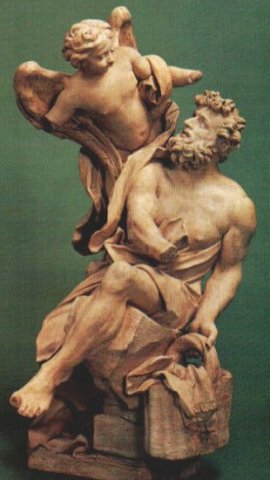
Models of the “Truth Unveiled by Time” and “Two Charities” by Gian Lorenzo Bernini (1598/1680) for the Monument of Pope Urban VIII in the Basilica of St. Peter

The model of Charity with four putti was executed for the first version of the monument in about 1627/28, the one with two putti for the second version of the years 1634/39

Models of the “Prophet Habakkuk” and “Daniel in the lions' den” also by Gian Lorenzo Bernini for the Chigi Chapel in S. Maria del Popolo

Model of “St. John the Baptist baptizing Jesus” by Alessandro Algardi (1598/1654) for a group of silver made in 1644 on the occasion of the election of Innocent X Pamphilj (1644/55)

The terracotta models kept in this room belonged to Cardinal Flavio Chigi, nephew of Alexander VII
They passed in 1918 to the Italian state and in 1923 they were donated by Benito Mussolini to Pius XI Ratti (1922/39) as an act of reconciliation between Italy and the Holy See


Sacred Museum


Designed by Paolo Posi (1708/76) for Benedict XIV Lambertini (1740/58) in order to accommodate early Christian relics

At the sides of the entrance statues: on the right “Lysias” and on the left “Aelius Aristides”

On the ceiling “Triumph of the Church” and “Triumph of Faith” 1757 by the Roman Stefano Pozzi (1699/1768)

Above the precious cabinets in walnut finished with gilded bronze are placed “Twenty-four bronze busts of cardinals librarians” made in 1783 by Luigi Valadier (1726/85)

Precious Christian and non-Christian ancient pieces:

Glass objects from the fourth century AD some from Ostia, amulets, Roman rings, oil lamps in terracotta, Byzantine seals and weights

“Silver plate” with hunting scenes of the fifth century AD

“Reliquary of Algeria” of the sixth century AD

Early Christian and Coptic textiles including “Sheets of the seven Greek martyrs” eighth or ninth century

“Mosaic with St. Theodore” about 1200 icon for traveling similar to those of the monasteries of Mount Athos

“Chest for the Head of St. Sebastian” ninth century, formerly in the church Ss. Quattro Coronati
“Acquamanile” in oriental style used, according to legend, by St. Lawrence to give baptism

Sunday, April 19, 2015

VATICAN MUSEUMS - MUSEUMS OF THE APOSTOLIC VATICAN LIBRARY (first part)


MUSEI DELLA BIBLIOTECA VATICANA

Room of the messages to Pius IX


1877, the messages for presents received by Pius IX (1846/78) used to be kept here
Byzantine liturgical vestments and fabrics

“Frontal of altar and elements in silk and golden silver threads” from the mass vestments of Clement VIII Aldobrandini (1592/1605) woven as tapestries by Guasparri di Bartolomeo Papini of the Florentine Grand Ducal Manufactures from cartoons of the years 1593/97 by Alessandro Allori aka Bronzino (1533/1607) a pupil of Agnolo di Cosimo aka Bronzino

Important “Original Greek marble bas-relief of a knight” of the fourth century BC


Chapel of St. Pius V


For St. Pius V Ghislieri(1566/72)

Frescoes “Stories of St. Peter Martyr” 1570 by Jacopo Zucchi (about 1542/96) designed by his master Giorgio Vasari (1511/74)

Objects of the treasury of the Sancta Sanctorum of the Lateran dating from the fourth to the eleventh century


Room of the Messages


It used to keep the messages for presents received by Leo XIII Pecci (1878/1903) and St. Pius X Sarto (1903/14)

Early Christian and Roman glass and enamels, ivories and metals from Medieval to Modern times:

“Glass” of the fourth century with scale-like marine animals from Cologne

“Disk” with the oldest depiction of Sts. Peter and Paul

“Enamels of Limoges” with stories of Christ from the old Basilica of St. Peter

“Diptych from Rambona” tenth century, from the Abbey of St. Mary Rambona in the province of Macerata in the Marche region

The name comes from the altar of the Bona Dea, which was replaced at the end of the ninth century with the Abbey

“Ivory pyx” from Milan, sixth century


Room of the Aldobrandini Wedding


Designed by Flaminio Ponzio (1560/1613) for Paul V Borghese (1605/21)

On the ceiling “Stories of Samson” 1607/08 by Guido Reni (1575/1642) who, during the same period, also the frescoed the ceiling of the HALL OF DAMES with the “Pentecost”

On the floor mosaic “Achilles drags Hector's body” third century AD

The room contains an impressive collection of paintings at least 1,800 years old:

Frescoes

Wedding scene with “The Marriage of Alexander and Roxane” also known as Nozze Aldobrandini (Aldobrandini Wedding) of the Augustan period found in 1605 by the Arch of Gallienus
It was preserved in the Villa Aldobrandini at Magnanapoli and since 1818 in the Vatican
It is one of the most beautiful and best preserved paintings that we have from antiquity

“Heroines of Tormarancia” third century AD found in 1816 in the ruins of a villa. There are various heroines of Greek tragedy represented

“Odyssey Landscapes” first century BC from the frieze of a room discovered in 1848 on the Esquiline Hill

“Cargo Ship with wheat” third century AD found in Ostia in 1865

“Processions of children” third century AD found in Ostia in 1868

Mosaics

“Garlands of leaves and fruits” from Villa Adriana in Tivoli

“Landscape and animals” from the Aventine Hill

Saturday, April 18, 2015

VATICAN MUSEUMS - ROOMS NEAR THE SISTINE CHAPEL (second part)

Sala Clementina
 Clementine Room

Frescoes on the vault and on the walls by the brothers Giovanni Alberti (1558/1601) and Cherubino Alberti (1553/1615) for Clement VIII Aldobrandini (1592/1605) with a decorative model of “perspective quadrature”

Here it is introduced for the first time in Rome the optical effect of the “broken” ceiling that will have a huge success in the incipient Baroque period
On the smaller walls “Stories of St. Clement” with a coastal landscape by Paul Brill (1554/1626)

“No one had hitherto ever seen in Rome or in any other place an illusionistic painting so big and so full of decorative invention. Indeed the Sala Clementina still represents the first example of exclusively illusionistic decoration of a large room, a conception that was later further developed by the Baroque style” (Hermann Voss)

The room is used for private audiences of the pope and here the body of John Paul II was exposed before the funeral


Sala Ducale  

Ducal Room


Two adjoining rooms that Gian Lorenzo Bernini (1598/1680) joined together with a wonderful invention of putti holding a curtain open between the two rooms, executed by Ercole Antonio Raggi (1624/86)

Vault

“Grotesque decorations” by G.P. Venale and “Landscapes with Four Seasons” maybe by Matteo Neroni aka Matteo da Siena (active 1567/92) or by Marco dal Pino aka Marco da Siena (c. 1525/87)

“The strength of Matteo da Siena was in the genre of landscape fresco in which the landscape is placed playfully in the invention of an overall decorative larger set, thus assuming a role, but of secondary importance. His landscapes, therefore, express something characteristic in a few strokes, they had, in short, a narrative function. The landscapes of the Four Seasons have met with much approval thanks mainly for this feature. Without giving up completely to the traditional marginal accumulation of details in landscapes, they are still enjoyable thanks to a certain simplicity and to the unitary nature of the setting” (Hermann Voss)

Walls

“Landscapes” by Paul Brill (1554/1626) and “Grotesque decorations” of the period of Benedict XV (1914/22) who had also the terra cotta floor substituted with a marble one


Cappella Paolina

Pauline Chapel

1537/40 Antonio Cordini aka Antonio da Sangallo the Younger (1483/1546) for Paul III Farnese (1534/49)

It was formerly used for conclaves, now it is used for weddings

On the side walls:

“Compared to previous representations of the same subject, Michelangelo introduces an important novelty: we don't see just angels around Christ, but obviously also groups of men and women identified as an army of chosen ones who had already crowned the Christ of the Last Judgment. Around 1540 St. Paul was at the center of the debate between reformers and conservatives. To authorize the Lutheran interpretation of salvation were his own writings, which were undergoing continuous and painstaking exegesis. Representing around 1543 in the very heart of the apostolic see, in full theological battle, those who are sanctified by 'faith that is toward me' as the vernacular translation of the Acts of the Apostles of his friend Antonio Brucioli recited, was an iconographical novelty and a clear stance in the debate on salvation, which was occupying him at that time with his friends of the school of Reginald Pole, convinced, as the Lutherans, that salvation was assured by a living faith and not by the exercise of works” (Antonio Forcellino)

“Crucifixion of St. Peter” 1542/1550, the last paintings by Michelangelo Buonarroti (1475/1564)

“The beauty, strength and harmony of St. Peter's muscles set in motion a theatrical machine that in gestures and facial expressions tell the feeling without giving anything to the decorum, the establishment, the hierarchical character recognition; especially without giving in anything to the story as fact confined to specific age. Michelangelo comes to a spiritual representation placed in an eternity which coincides with the perennial nature of faith. We are, remember, in the chapel that Paul III wanted to be destined for the conclave. Peter's gaze was therefore turned to the cardinals who elected the pope and it was the first thing the newly elected pope would have seen immediately after his election. Then Peter would remind that pope of his Church, made not of armed and powerful people but of people touched by devout faith” (Antonio Forcellino)

Other frescoes on the walls:

“Healing of St. Paul in the house of Ananias”, “Fall of Simon Magus” and “Stoning of St. Stephen” 1573/77 by Lorenzo Sabatini (about 1530/76)

“Baptism of the centurion” 1580/85 by Federico Zuccari (about 1542/1609) who also did the fifteen “Stories of Sts. Peter and Paul” and “Allegorical Nudes” on the vault

Friday, April 17, 2015

VATICAN MUSEUMS - ROOMS NEAR THE SISTINE CHAPEL (first part)

ROOMS NEAR THE SISTINE CHAPEL
 
Open to the public only with special permission


Sala Regia

Royal Room

1540/73 begun by Antonio Cordini aka Antonio da Sangallo the Younger (1483/1546). It is next to the Sistine Chapel and it was used to receive monarchs

Stucco coffered barrel vault by Pietro Bonaccorsi aka Perin del Vaga (1501/47)

Stuccos on the walls by Daniele da Volterra (1509/66)

All the paintings depict papal victories designed to remind the visiting monarchs of the papal primacy

Large historical frescoes

“Battle of Lepanto” and “Return of Gregory XI Beaufort (1370/78) from Avignon” 1571 and “Night of St. Bartholomew” 1572 by Giorgio Vasari (1511/74)

“Submission of Barbarossa to Alexander III Bandinelli (1159/81)” by Francesco de' Rossi aka Francesco Salviati (1510/63)

“Capture of Tunis” and “Henry IV in front of Gregory VII (1073/85)” and panel over the door with “Donation of Charlemagne” by Taddeo Zuccari (1529/66) with his brother Federico Zuccari (about 1542/1609)

“The culmination of the artistic activity of Taddeo Zuccari coincides with the work at the Sala Regia. (...) Of his Donation of Charlemagne both the pleasing arrangement of color and the cleverly harmonious composition were appreciated. (...) Overall it is hardly a masterpiece, but compared to the work of his competitors it is pleasant, thanks to the lightness and safety of the stroke. The Taking of Tunis also shows a similar mix of strengths and weaknesses. The fresco with Henry IV in front of Gregory VII, after the death of the artist, was completed by his brother, while the two allegorical figures above the door still betray the style of Taddeo” (Hermann Voss)

“Triumph of Faith over Unfaithfulness” by Lorenzo Sabatini (about 1530/76)

Smaller pictures

“Return of the provinces to Agapito” by Orazio Sammachini (1532/77)
“Donation of Ravenna” by Girolamo Siciolante da Sermoneta (1521/80)
“The offer of Pietro d'Aragona to Eugene III (1145/53)” by Livio Agresti (about 1508/79)
“Single perfect figures, such as the warrior standing in the left foreground, are isolated, while the protagonists of the scene do not reach the same level” (Hermann Voss)
Other paintings by Marco Pino aka Marco da Siena (about 1525/87)

Aula delle Benedizioni

Room of the Blessings

Next to the Royal Room above the Atrium of St. Peter, with the same size

Damaged fresco in the upper part “Boat of the apostles” 1627/28 by Giovanni Lanfranco (1582/1647) formerly in the passage to the Chapel of Sts. Michael and Petronilla in the Basilica of St. Peter, placed here in 1721 when it was substituted with a copy in mosaic by Pietro Paolo Cristofari (1685/1743). It had in turn replaced a 1605 fresco by the poor Bernardo Castello

Thursday, April 16, 2015

VATICAN MUSEUMS - SISTINE CHAPEL (seventh part)


Last Judgment
 
Clement VII Medici (1523/34) called Michelangelo Buonarroti (1475/1564) in 1534 to complete the decoration of the Sistine Chapel with the Last Judgment

After Clement VII's death his successor, Paul III Farnese (1534/49), decided to confirm Michelangelo for the job which he began only in April 1536, twenty-four years after the ceiling

Michelangelo painted 391 figures on a surface of about 200 m² (2,152 square feet)

He covered the wall with another brick wall slightly tilted upward toward the chapel (26 cm - 10 inches), so that the dust would deposit less easily on the surface and so that the distortions of perspective could be visually correct
Perhaps he also wanted to give a greater effect of looming presence. This decision was the reason of his quarrel with his friend Sebastiano Luciani aka Sebastiano Del Piombo

Originally there was the “Coronation of the Immaculate in an Assumption scene” by Pietro Vannucci aka Pietro Perugino (about 1450/1523) who had also painted, maybe with Domenico Ghirlandaio, the panels below with “Birth of Jesus” and “Finding of Moses”
There were also two lunettes with “Ancestors of Christ” by Michelangelo himself

The official opening was on Christmas Day of 1541 after five years of work

The central point is Christ's gesture in the act of judging
Some scholars speculate that maybe the face of Jesus is the portrait of his beloved pupil Tommaso Cavalieri who may have been rather portrayed in the face behind St. Bartholomew

“This head of Christ is reminiscent of the one of the Apollo Belvedere: the conception of divine which it embodies is thus modeled on a pagan matrix. His face does not reproduce the traditional model that we know from the icons of the Eastern Church, recognizable in every fresco apse of the churches of Rome, in Raphael's Dispute as in the Transfiguration. (...) For the first time an artist commissioned by the Pope has dared to paint an 'unpublished' face of Christ rather than his recognizable portrait. (...) As this could have happened just a hundred meters away from the chapel in which the true image of Christ imprinted on Veronica's veil was worshiped, we are not able to explain in all clarity. (...) Art is not oriented anymore toward relics but toward archaeological finds of antiquity, taken as examples for all forms of artistic expression. Painting a youthful and beardless Christ is easily justified considering the Christian art of late antiquity” (Heinrich W. Pfeiffer)

A rotary movement affects all figures except those in the two upper lunettes with flying angels bearing some of the symbols of the Passion:


Interestingly, the angels have no wings, perhaps to give the idea that angels are not so different from men after all
 
On the left the chosen ones who try to go to heaven. Below there are bodies resurrecting from death, including the face of Girolamo Savonarola, coming out of the ground

On the right the damned wrapped in a spiral, below them the boat with Charon

At the corner on the right there is the infernal judge Minos, to whom the artist, according to Vasari, gave the appearance of Biagio da Cesena, the papal master of ceremonies who was critical of Michelangelo
According to a sonnet by Pasquino Minos has the appearance of Cardinal Pierluigi Farnese, Pope Paul III's son and sodomite who raped the young Bishop of Fano, who then killed himself in shame
At the bottom on the left characters that represent the resurrection from death, two of them (one white and one black) helped with the Rosary. In the center a group of angels blowing their triumph with books of acts pure and impure

Close to Christ there is the Virgin Mary with her face down to avoid seeing his son in the act of judging: her power of intercession is now finished
Maybe Michelangelo represented the Virgin Mary with the face of his best friend Vittoria Colonna who may be have been represented in the face near St. Lawrence instead

Around Christ and the Virgin Mary there are saints:

St. Andrew with the Cross
St. Lawrence with the gridiron
St. Bartholomew, maybe with the face of Pietro Aretino, holding the skin, which depicts the face of Michelangelo

“Probably the artist wanted to express the idea that only losing the shell represented by the body, man could be saved from earthly torments. More recent research shows a parallelism between the flayed skin in the hands of St. Bartholomew, and a passage of Dante's Divine Comedy - Par, I, 19-24 - in which the flaying of Marsyas is interpreted as a sign of divine inspiration of the artist” (Frank Zöllner)

St. Peter, maybe with the face of Paul III, giving back to Christ the keys of the church that has no more reason to exist

St. Sebastian with bow and arrows

St. Blaise with iron combs, repainted by Daniele da Volterra


Humanity is represented nude because we will no longer be able to hide anything in the tragic condition of human existence before the Judgment

Michelangelo was such a living legend that no pope dared to censor the nudities in the painting while he was alive

Eventually in 1565, right after Michelangelo's death, his pupil Daniele da Volterra (1509/66) was asked to cover the genitals and he was then called for this “braghettone”, the “panty painter”
There were other interventions in the following twenty years and many more in the following centuries

The fresco was finally restored in the years 1990/94 but the repainting of censorship of the sixteenth century were left being considered historical

“With the elimination of all architectural and spacial frameworks, and free representation of the masses of nude figures in a structure not broken down in scenes, nor responding to proportional representation and perspective of Renaissance painting, Michelangelo canceled the consistency of the immense wall of the Sistine Chapel, translating into an indefinite sky, without any suggestion of depth, but animated by an unstoppable chain of dynamic impulses. The Judgment expresses a tragic view of the condition and destiny of humanity, which does not conceal the anxiety about extreme divine judgment. It interprets the spiritual tension of those years” (Carlo Bertelli, Giuliano Briganti, Antonio Giuliano)

“In this the specificity of the talent of the great Florentine painter and sculptor is expressed: in the fact that he applied to frescos with multiple figures an idea that essentially comes from the sculpture of one isolated figure. Herein lies the genius of the Last Judgment, and its difficulties for those who have tried to imitate it” (Hermann Voss)