Showing posts with label Alessandro Dori. Show all posts

Wednesday, September 13, 2017

RONDININI PALACE

PALAZZO RONDININI
Begun in 1750 by Gabriele Valvassori (1683/1761), who incorporated the Palace of Cavalier d'Arpino built by Flaminio Ponzio (1560/1613), made the NORTH WING and the FAÇADE ON VIA DEL CORSO
Finished 1761/64 by Alessandro Dori (active in Roma since 1744/d. 1772), who added the SOUTH WING and oversaw the interior of the house-museum of the Marquis Giuseppe Rondinini that until 1800 still kept the famous “Pieta Rondanini” (the misspelling of the name is commonly accepted) by Michelangelo Buonarroti now in Milan
The building is currently owned by Bank Antonveneta and hosts the Chess Club
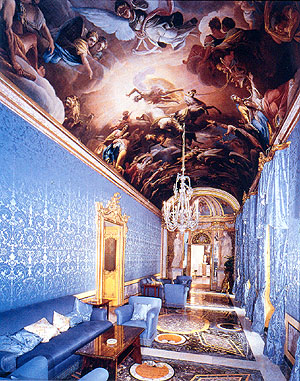
GALLERY
Incredible frescoed vault “Fall of Phaeton” 1772 by Jacques Gamelin (1738/1803)
“Among the strategies adopted to emphasize the prestige of the family, there is the relationship between antiquities and modern décor. Pieces of the Roman statuary such as columns, bas-reliefs, sarcophagi and statues were fused with stuccos and paintings, creating a living museum, where the classics became an additional ornament. Unlike other historic homes where the remains of the ancient collections were exhibited in galleries and private museums, here the relationship with archeology was part of everyday life, as well as being a good financial investment in times of crisis. Most of these pieces, however, were removed when Giuseppe Rondinini, the last heir, left the palace. (...) However, one can still feel the ancient preciousness of the rooms through illusionistic paintings, architectural views and depictions of mythological stories made​in the style of Bologna's squaring” (Rita Dietrich - L'Osservatore Romano)

Friday, October 31, 2014

VATICAN MUSEUMS - PIUS CLEMENTINUS MUSEUM - Introduction


MUSEO PIO-CLEMENTINO

Founded in 1771 by Pope Clement XIV Ganganelli (1769/74) who, like Pius VI Braschi (1775/99) after him, enriched the collection of sculptures begun at the time of Julius II Della Rovere (1503/13) in the Octagonal Courtyard

Clement XIV asked Alessandro Dori (active in Roma since 1744/d. 1772) and, after Dori's death, Michelangelo Simonetti (1724/87) to adapt the premises of the Palace of Innocent VIII Cybo (1484/92) which had been built in about 1487 by Giacomo da Pietrasanta

Clement XIV succumbed to Enlightenment and Absolutism in Europe and in 1773 he was virtually forced to suppress the Jesuit Order under the pressure of the European monarchies: maybe it's a coincidence, but no pope chose the name Clement ever again
He was buried first at St. Peter's Basilica and in 1802 his body was moved to the Basilica of the Holy Apostles in a monument by Antonio Canova

Pius VI ordered the construction of new rooms and unfortunately during these works frescoes by Pinturicchio, and Andrea Mantegna were lost

The architects wanted to quote and imitate Roman buildings such as the Pantheon in the Sala Rotonda (Round Room) or thermal rooms in the Sala a Croce Greca (Greek Cross Room)
When Michelangelo Simonetti died in 1787, Pius VI gave the job of finishing the project to Giuseppe Camporese (1763/1822), who reversed the museum route with a new access from the Greek Cross Room. That's why over the portal to the Round Room there is the sign Museum Pium and on the portal to the Square Vestibule there is the sign Museum Clementinum