Showing posts with label Melchiorre Caffà. Show all posts

Thursday, November 15, 2018

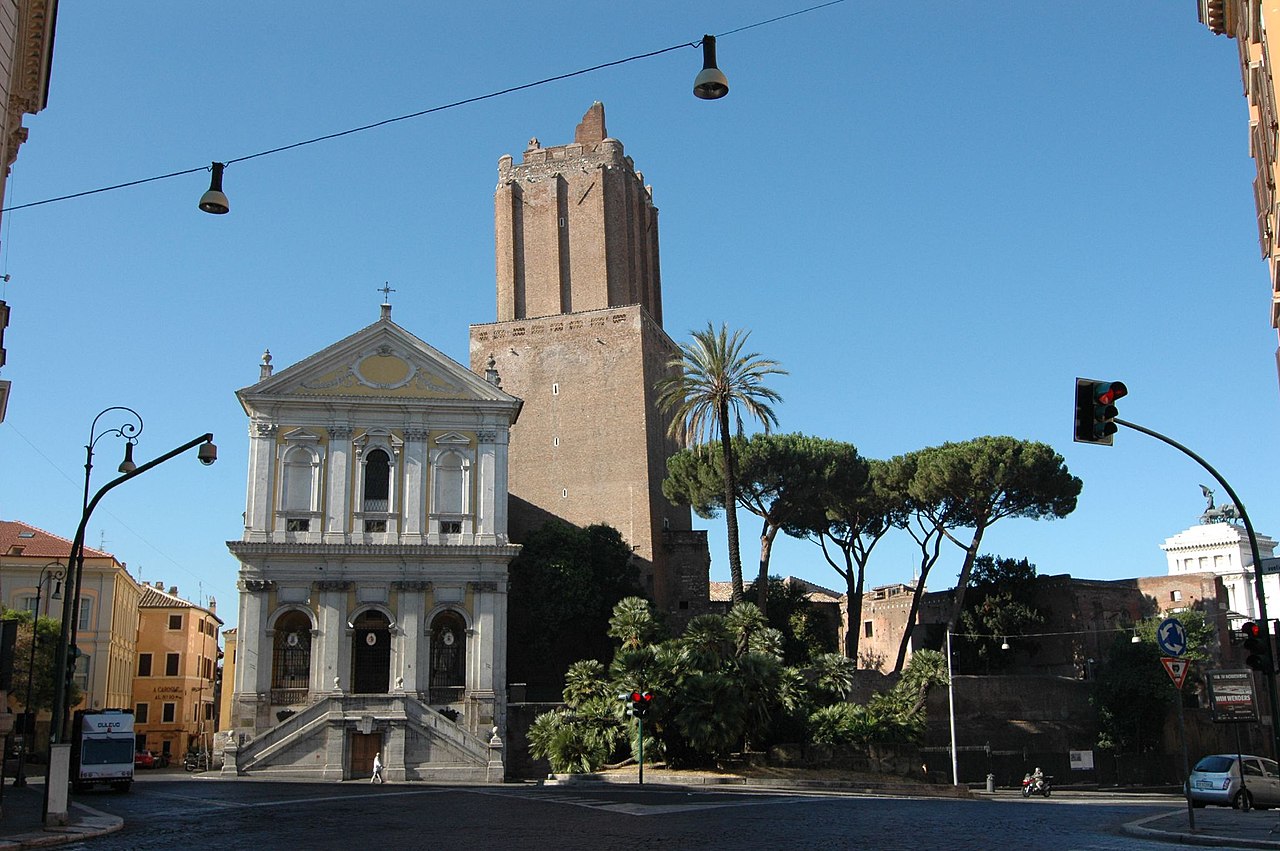
St. CATHERINE AT MAGNANAPOLI


S. CATERINA A MAGNANAPOLI 
Largo Magnanapoli
Established in 1575 for Portia Massimi as the church of the Convent of the Sisters of St. Catherine who had moved here from the house in Piazza S. Chiara
The reconstruction of the church began in 1608 by Carlo Maderno (1556/1629) but it was not completed
It was finally rebuilt in the years 1628/31 and 1638/41 by G.B. Soria (1581/1651)
The name comes from the linguistic deformation of Balnea Pauli, the baths of Paulus Emilius which were believed to be located nearby, more precisely, under the church of Sts. Dominic and Sixtus
The convent was destroyed to bring to light the structures of the Trajan's Market
DOUBLE STAIRCASE added at the end of the nineteenth century during excavation works in the area

Under the staircase
VOTIVE CRYPT OF THE FALLEN
1934 inscribed with the names of the Romans who died in World War I and II and “Bronze Crucifix” by Romano Romanelli (1882/1968)

PORCH
Plaster statues “St. Catherine” and “St. Dominic” about 1650 by Giovanni Francesco De Rossi (active 1640/77)

VAULT
“Glory of St. Catherine” 1700/12 by Luigi Garzi (1638/1721)

“The work, considered his masterpiece for the calibrated compositional structure, for the accurate execution and the uniform color range, constitutes a valid and original transposition on large areas of the ideas of Carlo Maratta and a vital link between the Roman decorations of the seventeenth and eighteenth centuries” (Giancarlo Sestieri)

1st RIGHT - CHAPEL OF THE MAGDALENE
“Communion of the Magdalene” 1706/07 by Benedetto Luti (1666/1724) maybe his first public work in Rome
He also painted the “Angels in adoration” in the vault, the only fresco he ever painted

“He emerged as an international ambassador of the Roman Rococo, with his personal pathetic and naturalistic style. (...) Even in the religious themes this Florentine painter often obtained convincing results, often marked (...) by an Arcadian and pastoral taste and a personal expressive sweetness with a Correggio flavor, particularly influential on the scene of the French Academy of Rome, to which he was bound by cordial relations” (Giancarlo Sestieri)

2nd RIGHT - CHAPEL OF ALL SAINTS
“The Virgin Mary intercedes for St. Catherine and glory of the saints” 1701/02 by Luigi Garzi (1638/1721)
Vault “Marriage of St. Catherine”, “Christ in Glory” and “Scene of Martyrdom” by Giuseppe Passeri (1654/1714)
3rd RIGHT - CHAPEL OF St. DOMINIC
“St. Dominic resurrecting a child” 1706 by Biagio Puccini (1673/1721)
Vault “St. Dominic and St. Francis adore the Cross”, “Glory of St. Dominic” and “Lady of the Rosary” by Giuseppe Vasconio (active half of 1600), a pupil of Guido Reni

DOME
In the lantern “Eternal God in glory” by Francesco Rosa (active from 1674/d. 1687)

MAIN ALTAR
Tabernacle in agate, lapis lazuli and gilt bronze 1787 by Carlo Marchionni (1702/86)
“Holy Spirit” and spectacular relief “Glory of St. Catherine of Siena” 1667 masterpiece by the Maltese Melchiorre Caffà (1636/67)

“St. Catherine shows a very sensitive spirituality, an almost morbid sensibility, in comparison to which the works of Bernini appear massive, firm and manly” (Rudolf Wittkower)


“Caffà is not 'original'. There is hardly any of his works that is not designed based on a pattern suggested by previous sculpture. Yet he showed a new concept of sculpture and a new expressive order in comparison with the older generation. His style is new. Seen in a broader historical context, he has a part in the great change of style and taste that occurred in the third quarter of the seventeenth century and therefore characterizes the beginning of the late Baroque style” (Rudolf Preimesberger - Dizionario Biografico degli Italiani Treccani)

Reliefs on the sides on the right “St. Rose of Lima” and on the left “St. Agnes of Montepulciano” 1755 by Pietro Bracci (1700/73)
Above the door of the presbytery two paintings with stories of St. Catherine: “St. Catherine surprised by her father while praying” and “St. Catherine chooses the crown of thorns” early 1700s by Giuseppe Passeri (1654/1714)
3rd LEFT - BONANNI-PRIMI CHAPEL
Above the altar “Madonna of the Rosary” 1702/03 masterpiece by Giuseppe Passeri

“Among the pupils of Maratta, the most original modernistic ideas, surpassing sometimes the master himself, were undoubtedly offered by Giuseppe Passeri. (...) While remaining tied to the dominant Baroque-Classicist style, he highlights a deep attraction for the materiality of Gaulli's lightness and a deep grasp of the dynamism of the chiaroscuro lighting technique of Lanfranco, the study of whom had been recommended to him by Maratta himself” (Giancarlo Sestieri)

At the sides funerary monuments:
On the left “Bust of Giuseppe Bonanni” and on the right “Bust of Virginia Primi” by the great Giuliano Finelli (1602/53)
Vault “Annunciation”, “Assumption” and “Nativity” by G.B. Speranza (about 1600/40)
Under the arch “Saints” by G.B. Ruggieri aka Battistino del Gessi (1606/40)
2nd CHAPEL ON THE LEFT
“The three archangels” by Giuseppe Passeri
“A splendid example of the transition from baroque classicism to the elegiac atmosphere of the early eighteenth century” (Laura Mocci)
Vault “Vision of St. John at Patmos”, “Eternal Father” and “St. Catherine and the Angel” and arch “Joseph and the Angel”, “Virgin in Glory” and “Liberation of St. Peter” frescoes about 1654 by Giovanni Paolo Schor (1615/74), maybe in collaboration with his brother Egidio Schor
1st LEFT - CHAPEL OF St. NICHOLAS OF BARI
“Vision of St. Nicholas of Bari” maybe beginning of 1700s by Pietro Nelli (active in Rome 1700/50), who maybe also painted the “Glory of Angels” in the vault
CORRIDOR BETWEEN CHURCH AND SACRISTY
Fragments of frescoes of the end of the fifteenth century “St. Bridget” and “St. Catherine of Alexandria” from the oratorio destroyed in the Thirties

Friday, March 16, 2018

St. AUGUSTINE (second part)

Left End Side of the Church
To the left of the main altar
Frescoes and stucco work on the ceiling “Stories of St. Monica” about 1585/90 by G.B. Ricci (about 1550/1624)
Frescoes on the side walls:
On the left “St. Monica comforted by a bishop” and “Vision of St. Augustine converted”, on the right “Conversion of St. Augustine” and “Death of St. Monica” in the altar wall “S. Navigio and S. Perpetua” other children of S. Monica about 1850 by Pietro Gagliardi (1809/90)
On the left “Tomb of St. Monica” (mother of St. Augustine) with sculpture maybe by Isaia da Pisa (active 1447/64) on the very strigillated sarcophagus in which St. Monica was originally buried after her death in 387 in Ostia waiting to embark with his son for Africa
The remains of the saint were moved during the restoration of Vanvitelli in the “Urn of ancient green marble” under the altar
On the right “Tomb of Cardinal Pietro Grifi” sixteenth century
Leftmost chapel
BONGIOVANNI CHAPEL
Three canvas: “Madonna appears to Sts. William of Aquitaine and Augustine” in the middle, “St. William of Aquitaine visited and healed by Our Lady” on the left and “St. Augustine ponders the mystery of the Trinity” on the right 1616, first public work in Rome and extraordinary masterpiece by the Baroque giant Giovanni Lanfranco (1582/1647)
The effect of optical illusion was diminished when the large tomb of Cardinal Lorenzo Imperiali was built and reduced the visibility of the chapel from the outside. Originally the effect was spectacular as only a balustrade was separating the chapel from the church
“In the vault Lanfranco built the first Baroque dome in Rome, transforming elements of Correggio illusionism in a style attributable to an influence of Annibale Carracci. The side paintings are instead dominated by a Caravaggio-like chiaroscuro atmosphere. A first version of the altar piece with only Christ crowning the Virgin (without God the Father) and a different location of the two adoring saints in the lower part, which did not please the clients and the Augustinians, is now in the Louvre” (Eric Schleier - Dizionario Biografico degli Italiani)
Marble decoration by Giovanni Maria Baratta (active since 1644/d. after 1679) with the statue of “St. Thomas of Villanova and Charity” outstanding masterpiece of Melchiorre Caffà (1636/67) finished by Ercole Ferrata (1610/86)
The poor Melchiorre Caffà died after completing St. Thomas and having sketched the woman who was executed by Ferrata who also sculpted the statues on the pediment
The chapel was dedicated to St. Thomas of Villanova after his canonization in 1658
“The female figure is not an anonymous woman of the people: in an act of poetic identification of the donor with the recipient, she appears in the traditional role of Charity. Placing her outside the central niche and turning her toward the saint, the artist has transformed her as a link between real life and the fictional world of art. Instead of worshiping a cult image the poor who pray here are encouraged to identify with the one who receives alms and to participate in charitable work of the active Church. These figures exhibit a super sensitive spirituality, an almost morbid sensitivity, compared to which the works by Bernini appear massive, strong and manly” (Rudolf Wittkower)
Reliefs in stucco “Miracles of St. Thomas of Villanova” about 1760 by Andrea Bergondi (active in Rome XVIII century)
In the upper right side “Tomb of Cardinal Lorenzo Imperiali with allegories of Fame, Time and Death” 1672 by Domenico Guidi (1625/1701)
The eagle flying out of the tomb represents the soul of the Cardinal
LEFT SIDE VESTIBULE
Four “Doctors of the Church” by Isaia da Pisa (active 1447/64) originally part of St. Monica's tomb
“Two busts of Augustinians” by Gaspare Sibilla (about 1723/82)
“Crucifix between Sts. Cosmas and Damian” in marble maybe by Luigi Capponi (active end of 1400s/beginning of 1500s)
Above the door relief with “Christ dead held by two angels” maybe by Giovanni Duknovich aka Giovanni Dalmata (about 1440/1510)
Oil paintings on the side walls and in the apse “Stories of St. John of Sahagún” about 1660 by artists of the Roman School
S. Apollonia was a martyr of the third century in Alexandria
She had her teeth torn before spontaneously throwing herself into the fire. That's why she was declared patron saint of the dentists
“S. Apollonia” about 1585 by Girolamo Muziano (1532/92)
On the right “Allegoric figure symbolizing Martyrdom” and on the left “Allegoric figure symbolizing Virginity” about 1660 works by Francesco Rosa (active since 1674/d. 1687) Roman pupil of Nicolas Poussin and Pietro da Cortona
Extraordinary oil painting “St. Clare of Montefalco” about 1751 by Sebastiano Conca (1680/1764)
St. Clare of Montefalco gives her heart to Christ in search of a place to plant the Cross, disturbing and morbid subject chosen by Sebastiano Conca for one of his last Roman works before returning to Naples
St. Clare was beatified in 1742, a period which was the arrangement of the chapel, and was canonized only in 1881
On the walls on the right “St. Clare in prayer” and on the left “Apparition of Christ to St. Clare” by an anonymous eighteenth-century artist
1643 Gian Lorenzo Bernini (1598/1680) for Angelo Pio. Bernini probably entrusted the construction of the chapel to Andrea Bolgi (1606/56)
Apse with frescoes and stucco “Angelic Glory” about 1643/49 by Guidobaldo Abbatini (1600/56)
The altarpiece “Assumption of the Virgin Mary” also by Abbatini was destroyed during the eighteenth century renovations by Vanvitelli
The image of the Madonna and Child on the altar is a copy of the “Madonna del Buonconsiglio” venerated in Genazzano
On the right “Tomb of Angelo Pio” about 1649 and on the left “Tomb of Baldassarre Pio” about 1643 maybe by Andrea Bolgi
Body of St. Benedict Martyr from the Catacomb of S. Callisto moved here in 1930
Bernini mingled here for the first time frescoes and stucco with an artifice that has made seem “actually true that fake that is nothing but fake”
“The awareness in architectural terms, of the problem of light may proceed from the primitive image of the altar of St. Bibiana and, as successive stages, with the monument of the Countess Matilda in St. Peter's, the Raymondi Chapel in S. Pietro in Montorio and the Pio Chapel in St. Augustine. (...) This would bring together works that have in common the purist choice of a single material, white marble, and derive from the experience tied to the constraints of the artistic formation of the sculptor and still are part of the fortune of white marble in Rome around 1630 when, at S. Carlino and Sts. Luke and Martina, the two main antagonists of Bernini lay the foundations of their architectural work, renouncing to the enrichment of colors, typical of Roman Mannerism” (Paolo Portoghesi)
Shocking “Madonna of the Pilgrims” 1603/04 (1606?) by Michelangelo Merisi aka Caravaggio (1571/1610) for Ermete Cavalletti
The Madonna is a portrait of Lena (perhaps also portrayed in the “Death of the Virgin” in the Louvre) holding her son Paul
She was a friend and lover of Caravaggio and because of her the bloody fight took place in Piazza Navona in July 1605 between Caravaggio and the notary Mariano Pasqualoni: Caravaggio seriously injured the notary and he was forced to flee to Genoa for three weeks during which his powerful protectors covered up the story
For the posture of the Virgin Mary Caravaggio was maybe inspired by the ancient sculpture Barbarian Woman or Tusnelda kept in Villa Medici at the time and now in Florence
For the purely classical features of the face and for the long neck perhaps Caravaggio was inspired by the statue of Jacopo Sansovino, the Madonna del Parto a few steps from here
Among the many extraordinary details of a piece of art that moves, engages and shakes the soul one could mention the superb high contrast of light on the face of the Child Jesus, who, also because of this, really manages to appear at once human and divine, as very few similar images in the world do
Also striking is the incredible consistency of the material of the white cloth, symbolizing the shroud of Christ, hanging from the right arm of the Virgin Mary, one of the many technical virtuosity of Caravaggio always fitting and meaningful, never an exercise in self-indulgence
“It still has in common with the Deposition and the Cerasi paintings the diagonal composition, the low eye level and the close-up vision. But the intense darkness of the space envelops the figures even more, it doesn't highlight them from the sculptural point of view as strongly as in Deposition. Whilst generally the Madonna of Loreto is represented enthroned in Her Holy House as she is carried by the angels, the Virgin Mary here is resting on the threshold of a house in Rome in front of two common pilgrims with bare and dirty feet. It was a completely new idea that caused a stir especially among the common people who had identified themselves in those two pilgrims. It is the most moving Caravaggio's painting from the human point of view, based as it is on the meeting, on the close proximity of the pilgrims pious and full of hope, representing the whole of humanity, with the Madonna and Child bringing love, blessing and redemption” (Erich Schleier)
On the right “St. William of Aquitaine” and on the left “St. Mary Magdalene” beginning of 1600s, all works by Cristoforo Casolani (1587/1629), a pupil of Cristoforo Roncalli aka Pomarancio
SACRISTY
1756/60 by Luigi Vanvitelli (1700/73) and Carlo Murena (1713/64) to replace the old sacristy incorporated into the convent. In the process Vanvitelli destroyed the Chapel of St. Helena with paintings by Daniele da Volterra
Outside the sacristy
To the right of the door of the sacristy “Bust of Panvinio Onofrio (1530/68)” by Gaspare Sibilla (about 1723/82)
Onofrio Panvinio was the founder of Christian archeology and modern ecclesiastical historiography. It was he who first dated from the sources the foundation of Rome on 21 April 753 BC
Above the door of the sacristy “Bust of Cardinal Guillaume d'Estouteville” patron of the church
Inside the sacristy
Above the door painting “Preaching of St. Augustine” maybe by Girolamo Muziano (1532/92)
In the ceiling “Baptism of St. Augustine” in 1887 by Pietro Gagliardi (1809/90)
Altar altarpiece “Alms of St. Thomas of Villanova” by Giovanni Francesco Romanelli (1610/62) from Viterbo, a pupil of Pietro da Cortona
Cabinets made out of wood from Brazil 1760
“Even in the sacristy, as in the works for the convent, the intervention of Vanvitelli is based on a classical and solemn style, with clean lines and harmonious proportions. The simple and almost austere design of the architectural is softened and made more elegant by curvilinear elements as the rounded corners, the clipei, the design of the floor” (Valeria Annecchino)
Angelic Library
Next to the church, the first library in Rome open to the public, founded in 1614 by the Augustinian Angelo Rocca. It is specialized in literature and philology
It became property of the Italian State in 1873
Since 1941 it is the headquarters of the ACCADEMIA LETTERARIA DELL'ARCADIA (Literary Academy of the Arcadia)
It contains about 200,000 volumes, 2,650 manuscripts and more than 1,000 incunabula
Francesco Borromini (1599/1667) designed in 1659 a new wing, executed in the years 1659/69 by Francesco Righi
It was enlarged in the years 1756/65 by Luigi Vanvitelli (1700/73) and Carlo Murena who designed on the first floor the room known as the “Vase”
The shelves in walnut wood date back to 1668
“Two pairs of celestial and terrestrial globes” 1599 and 1603 unique in Italy
FORMER CONVENT OF THE AUGUSTINIANS
Now it is the Palazzo dell'Avvocatura Generale dello Stato (Palace of the State Attorney General)

Tuesday, February 27, 2018

St. AGNES IN AGONE

S. AGNESE IN AGONE
In the eighth century a small chapel was built here, on the spot where, according to tradition, St. Agnes was exposed naked and was covered by her hair that had miraculously grown, only to be killed shortly afterwards
In 1123 the chapel was converted into a small basilica by Callistus II (1119/24) with entrance from today's Via dell'Anima
Reconstruction began in 1652 by Girolamo Rainaldi (1570/1655) and his son Carlo Rainaldi (1611/91) for Innocent X Pamphilj (1644/55)
Continued in the years 1653/57 by Francesco Borromini (1599/1667)
“While retaining the Greek cross plan designed by Rainaldi, Borromini demolished the previously built part of the façade and built it on a concave plant pushing it back towards the square. Two towers resting on the two side wings indicate the desire to enhance the light mass of the dome set on a high drum. Since then the type of the dome, the prototype of which dates back to that Michelangelo will see a progressive reduction of mass and a tendency to be thinner and slighter if taller” (Carlo Bertelli, Giuliano Briganti, Antonio Giuliano)
“The viewer feels drawn into the cavity of the façade above which looms the concave mass of the drum. Nobody can overlook the fact that Borromini, while employing the traditional grammar of motives, repeated here the spatial inversion of the façade of S. Ivo” (Rudolf Wittkower)
“In architecture Baroque religious art curved forms, concave and convex, appear more and more often to make communicable feelings and actions such as the bodily presence, the attraction, the embrace” (Paolo Portoghesi)
It was completed in the years 1657/72 by Carlo Rainaldi with advice, especially for the interior, by Gian Lorenzo Bernini (1598/1680) for Donna Olimpia Maidalchini Pamphilj after the death of her husband, the pope's nephew Camillo Pamphilj
It was owned by the Doria Pamphilj family until 1992 when it was granted to the Vicariate of Rome
BELL TOWERS
Antonio Del Grande (about 1625/79) and Giovanni Maria Baratta (known from 1644/d. after 1679) from a design by Francesco Borromini
“Glory of Paradise” 1670/89 by Ciro Ferri (1634/89) for G.B. Pamphilj
Despite the 19 years which he had had to paint it, Ciro Ferri was unable to complete the work and it was finished after his death by his pupil Sebastiano Corbellini
PENDENTIVES
Magnificent “Cardinal Virtues” 1668/71 first frescoes by G.B. Gaulli aka Baciccio (1639/1709):
From the right
Baciccio obtained the commission of the frescoes from the Pamphilj family thanks to Gian Lorenzo Bernini. When they were shown for the first time they were accused of “lust” for the sensuality and the attitude of some of the virtues
ABOVE THE DOORS
Between pairs of pilasters there are “Eight marble bas-reliefs with angels bearing the attributes of saints venerated in the church” 1658/59 by Ercole Ferrata (1610/86) and Domenico Guidi (1625/1701)
RELIEFS AND STATUES ON THE SEVEN ALTARS:
In the apses of the altars stuccos with “Angels and putti with attributes of the saints depicted in the marble reliefs below” by Alessandro Algardi (1598/1654) completed after his death by his pupils Domenico Guidi and Ercole Ferrata from designs by Ciro Ferri
Interestingly, the saints represented in the altars were all chosen from among the youngest martyrs of the Christian church
From the right
“Death of S. Alexius of Rome” in front of Innocent I (401/417) after being recognized by the parents 1660/63 by Giovanni Francesco Rossi (known 1640/77)
Statue of “St. Agnes” 1660 by Ercole Ferrata
Represents the moment when St. Agnes remained miraculously unharmed by the flames
The chapel is lined with ancient green Thessalian marble, which overlaps the ancient yellow marble pilasters with capitals of marble from Carrara. The false perspective is also made with extraordinary marbles such as coral breccia or bardiglio
“It reminds for certain aspects the S. Susanna by Duquesnoy, as also here the dress is relatively smooth and supports the structure of the body, while the head is derived as much from Duquesnoy as from classic Niobids. But no artist who worked in 1660 in the orbit Bernini could return to the classical purity of Duquesnoy in 1630. Following the example of the statues of saints by Bernini, Ferrata represented a transitory moment, we are witnessing a dramatic moment: the power of her prayers makes her immune from the holy fire. It creates a formal and emotional restlessness, in stark contrast with the purist trends of the thirties” (Rudolf Wittkower)
Stuccos with “Musical Angels” 1662/64 by Paolo Landini
In the side walls two pairs of “Alabaster oval medallions with faces of saints and popes” not precisely identified
“Martyrdom of St. Emerentiana” 1668/1709 by Ercole Ferrata who made the lower part. It was finished after his death in 1709 by Leonardo Retti (active 1670/1709)
Emerentiana was the foster sister of St. Agnes and she ended up being stoned to death during the funeral of her sister
“The clear and simple tripartite arrangement seems the result of a dogmatic application of Algardi's principles. While the type of the saint also shows here a careful study of the S. Susanna by Duquesnoy, and while some characters are clearly inspired by the relief of Attila, Ferrata returns for the figures of the attackers and of the mother and child to the most classic of Baroque painters, Domenichino. The sculptural principles applied by Retti in the upper half of the survey are in contrast with those of the lower half” (Rudolf Wittkower)
1720/21 from a design by Carlo Rainaldi executed by Francesco Moderati (about 1680/after 1724) with “Four columns of ancient green marble” maybe from the destroyed Arch of Marcus Aurelius on Via del Corso
“Three putti” by G.B. Maini (1690/1752) holding a cartouche with the phrase Among born of women there is none greater than John for G.B. Pamphilj (Innocent X) who had wanted the main altar to be dedicated to the saint who bore his name
“Angels” in 1856 stucco on the pediment by Antonio Della Bitta (1807/about 1879)
Altar “The two holy families” 1677/83 masterpiece by Domenico Guidi (1625/1701)
Continuing from the high altar towards left:
“Martyrdom of St. Cecilia” visited by Urbano (222/230) 1662/66 by Ercole Antonio Raggi (1624/86)
The relief was originally commissioned in 1660 to Giuseppe Peroni (about 1626/63), a pupil of Algardi who died leaving the life-size model that was taken up by Raggi
“The influence of Algardi is to be located in the middle division and in the differentiation between the calm faith of the pope and the excited crowd on the right. The individual style of Raggi is evident in the extremely elongated proportions of the figures, the slender build, the elegant movements as well as in the fall of drapery, which reveal a restless and nervous temperament. Contrary to Ferrata, Raggi refused the lessons learned by Domenichino. Compared to the terse composition of the relief of St. Emerentiana, the figures in the work of Raggi appear crowded in complicated groups almost confused. It goes to show his indifference for the classical dogma of clarity expressed with a minimum number of figures. On the other hand, the magnificent angel with a palm, absolutely Bernini-like shows the sweetness and tenderness of feelings, characteristic of the art of Raggi” (Rudolf Wittkower)
Statue of “St. Sebastian” 1717/19 by Pietro Paolo Campi (known 1702/40), a student of Pierre Legros
“St. Eustace among the beasts” 1666/69 by Melchiorre Caffà (1636/67)
The poor young Maltese sculptor died shortly after the start of the work which was finished by Ercole Ferrata with Giovanni Francesco Rossi in a rather academic way, a far cry from the plastic feeling of the brilliant Caffà
The model in terracotta of this relief is in Palazzo Venezia
“Caffà can be considered the most important personality of the generation after Bernini, but he died too young to achieve a leading position and to exert a role in the development of Italian sculpture. (...) His teacher, Ercole Ferrata, had introduced him to the style of Algardi, but far more decisive for him was the impression created by the works of Bernini: that character in them of final achievement was certainly of great importance for the process of maturation of the younger artist. Once convinced of the validity of the style now developed, he was bent on perfect it to virtuosity, soften it, refine it in aesthetic terms. (...) Since this, the oldest known of his works, Caffà goes beyond Ferrata, adopting the illusionistic 'bottom to top' typical of Bernini's reliefs. In the apparent recklessness of the model, in which constantly the level of projection changes, and in the dissolution of the constituent links, there is in embryo a new concept - which is late Baroque - of the relief” (Rudolf Preimesberger - Dizionario Biografico degli Italiani Treccani)
RIGHT OF THE ALTAR OF S. SEBASTIAN - CHAPEL OF S. FILIPPO NERI
Restored 1859 by Andrea Busiri Vici (1818/1911) with decorations by Annibale Angelini (1812/84)
Vault “Virgin Mary receives S. Filippo Neri in heaven (known as St. Philip Neri in English)” about 1663 by Francesco Allegrini (1587/1663)
From the chapel it is possible to enter the crypt of the monumental tombs of Pamphilj arranged in 1864 by Andrea Busiri Vici
LEFT OF THE ALTAR OF S. SEBASTIAN - CHAPEL OF St. FRANCES OF ROME
Here, according to tradition, the saint was baptized
Fresco “St. Frances of Rome assumed into heaven” by Francesco Cozza (1605/82)
Altar and baptismal font of St. Agnes consisting of a block of stone from the old oratory. At the sides “Angels” by Andrea Bolgi (1606/56)
Marble relief on the altar “St Frances of Rome shows the rule book flanked by an angel” by an artist of Algardi's school, maybe Domenico Guidi
ABOVE THE ENTRANCE
The Pope's body was buried in the crypt of the Pamphilj to the right of the altar. For days after his death the corpse had been in a warehouse for tools of the Basilica of St. Peter at the mercy of mice to the neglect of the family
Above beautiful “Choir” by Carlo Rainaldi 1659/62 with “Angels caryatids” by Domenico Poli and Isidoro Baratta
Organ of 1914 that replaced the seventeenth century one of which some elements were reused
1658/66, designed by Francesco Borromini
Fresco on the vault “Glory of St. Agnes” 1664 Paolo Gismondi aka Paolo Perugino (1612/85)
Frescoes in the presbytery “Stories of Mary” 1660 by Francesco Allegrini (1587/1663)
Angels and holy water fountain 1666 by Andrea Baratta (about 1595/1666)
CRYPT
Three rooms derived from the Circus of Domitian (81/96) with fornix (from fornix derives the verb fornicate) which is traditionally considered the brothel of the story of St. Agnes
The three rooms were rearranged in 1885 by Andrea Busiri Vici (1818/1911)
It is believed to be the place where, according to tradition, Saint Agnes was killed with a sword thrust in her throat immediately after she revived the young man who had fallen dead during an attempted rape against her
“Roman floor mosaic”
On the walls
“Traces of medieval frescoes” maybe of the thirteenth century, covered in 1893 by Eugenio Cisterna (1862/1933), who imitated the style of early Christian art deemed appropriate in those spaces, and perhaps inspired by the earlier thirteenth-century frescoes
Above the altar
Relief “Miracle of the hair of St. Agnes” designed in 1653 by Alessandro Algardi (1598/1654) and executed in 1663 by Giovanni Buratti