Showing posts with label Monuments of Rome. Show all posts

Wednesday, April 16, 2014

MONUMENT-FOUNTAIN TO THE GODDESS ROMA

MONUMENTO-FONTANA ALLA DEA ROMA
2003 by the Polish Igor Mitoraj (1944)
Travertine block of 1,200 tonnes (1,322 tons)
Fragmented face of the Goddess Rome imagined as a source of water
"Perhaps the fracture alludes to the mystery of the ancient world that shows itself to us in fragments, allusions, evocations such as reflections of a disappeared Atlantis" (Antonio Paolucci)

Tuesday, April 15, 2014

MONUMENT TO THE BREACH OF PIA GATE

MONUMENTO ALLA BRECCIA DI PORTA PIA
1895 architecture by Carlo Aureli with "Statue of Victory" by Giuseppe Guastalla (1867/1952)
The "Column" is ancient and it was found in 1875 in the Salita dei Crescenzi near the Pantheon in the area where the Baths of Nero used to be
The MARBLE WALL was added in 1920 by Adolfo Apolloni (1855/1923)
During the five hours of the battle of September 20, 1870 49 Italian Bersaglieri and 19 Papal Zuavi soldiers died
Rome was then occupied by the Italian army and became the capital of Italy
Pius IX Mastai-Ferretti (1846/78), who had already several times excommunicated the king and the Italian Government, on May 16, 1871 with the encyclical Ubi Nos renewed the excommunication and imposed on Catholics not to participate in the Italian elections

Monday, April 14, 2014

MONUMENT TO SEPTEMBER 11

MONUMENTO ALL'11 SETTEMBRE
2009, TWO ANCIENT ROMAN COLUMNS coming from the area of Montecitorio and left for years in storage
It was dedicated in the presence of the Speaker of the House of Representatives of the United States of America Nancy Pelosi
In a plaque there is an aphorism of the American writer George Santayana: "Those who cannot remember the past are condemned to repeat it"

Sunday, April 13, 2014

MONUMENT TO THE BERSAGLIERE

MONUMENTO AL BERSAGLIERE
1931/32 bronze statue and reliefs by the Roman Publio Morbiducci (1889/1963)
Architecture by Italo Mancini (1897/1971
 The project was personally selected by Benito Mussolini
On the sides of the foundation bas-reliefs in stone of Trani with characters and battles fought by the Bersaglieri Corps:
On the left "Bridge Goito, Luciano Manara and Porta Pia"

Saturday, April 12, 2014

MONUMENT TO THE CAIROLI BROTHERS

MONUMENTO AI FRATELLI CAIROLI
1872/78 Ercole Rosa (1846/94)
The monument was dedicated in 1883. The sculptor Ercole Rosa from the Marche region began this work when he was only 21 years old. He was later also the sculptor of the statue of Victor Emmanuel II in Piazza Duomo in Milan
The patriots brothers Enrico and Giovanni Cairoli fought in the campaign for the liberation of Rome in 1667 with other 76 volunteers
The campaign resulted in the defeat at Villa Glori when the 25-year-old Enrico Cairoli died fighting against the Swiss and German police of the pope. Giovanni Cairoli, who was two years younger than his brother, died in 1669 for the serious injuries suffered in the fight
"The modernity of some solutions embraced by Rosa, as the presence of the gun and the precise description of clothing, humble and true, the absence of any idealization in favor of a dramatic tone, show the sculptor's effort to portray the horror of the battle" (Institute of History of the Risorgimento in Rome)

MONUMENT TO ANITA GARIBALDI

MONUMENTO AD ANITA GARIBALDI
1932 Mario Rutelli (1859/1943)
In the base there is the tomb of Anita Garibaldi (1821/49) wife of Giuseppe Garibaldi
She was Brazilian and her real name was Ana Maria de Jesus Ribeiro. She died at age 28 while pregnant during the escape with her husband after the defeat of the Roman Republic in 1849

Friday, April 11, 2014

MONUMENT TO ALCIDE DE GASPERI

MONUMENTO AD ALCIDE DE GASPERI
2005 Maria Dompè (1959)
It was commissioned by the City of Rome on the occasion of the fiftieth anniversary of the death of the Italian political leader
The phrases engraved on the monument remind of his dream of European unification
The cars constantly parked in a no parking zone around the work hide it and prevent unfortunately the appreciation it deserves
Alcide De Gasperi (1881/1954) was one of the founding fathers of the Italian Republic and of the European Union
He was antifascist and believed in the secular state. In 1952 he rejected the Vatican's suggestion to form a government in alliance with the neo-fascists to prevent the success of the communists. Pius XII Pacelli (1939/58), in turn, refused to receive him at the Vatican on the occasion of the thirtieth anniversary of his wedding
He was born in the Trentino region and in Rome he lived simply in what is now Via Alcide De Gasperi, a few steps from the monument
He was an honest politician, armed with solid values, a rare flower sadly never bloomed again in the corrupt and treacherous swamp of Italian politics
"The memory function does not work on the past but on the future, as a stimulus to implement and enhance the moral legacy of the great statesman. Therefore, the monument embodied his thought, rather than portray him in an official capacity. Without rhetoric, it expresses his profound ideals, eternal and incorruptible as the memory. Bronze plates welcome a verdant meadow, 'essence' of the valleys of Trentino where he was De Gasperi born. The triangle indicates movement, energy, reachingthe new. The manifestos of the early avant-garde movements were full similar of signs, praising progress and confidence in its infinite potential. (...) From above, the structure resembles a kite, or a paper airplane: simple forms with which children have always shaped their dreams of freedom. The same dreams of De Gasperi, cast by Maria Dompè with the 'gravity of lightness', which connotes, always, her work" (Maria Egizia Fiaschetti - Web Site of Maria Dompè - www.mariadompe.com)

Thursday, April 10, 2014

MONUMENT TO TRILUSSA

MONUMENTO A TRILUSSA
1954 Lorenzo Ferri (1902/1975)
Trilussa was the pseudonym of Carlo Alberto Salustri (1871/1950) great Roman dialect poet
The monument was not liked very much and it was nicknamed "Lo sderenato de Trastevere" (Humpback of Trastevere). Guglielmo Guasta editor of the weekly satirical "Il Travaso" and friend of Trilussa published in 1958 a sonnet that ended like this: 
All bent down/ just like a sheep / he should thank God you don't see yourself / crouching down by the big fountain / if you would see yourself, my Trilussa, you wouldn't have taken it / and even if he had made you with no feet / you would have kicked his ass anyway!

MONUMENT TO TERENZIO MAMIANI DELLA ROVERE

MONUMENTO A TERENZIO MAMIANI DELLA ROVERE
1893 Mauro Benini (1850/after 1907)
Terenzio Mamiani Della Rovere (1799/1885) was a philosopher, politician and writer as well as a leading figure of the Italian Risorgimento
He was minister of Education and Senator of the Kingdom of Italy. He was a cousin of the poet Giacomo Leopardi

Wednesday, April 9, 2014

MONUMENT TO St. JOAN OF ARC

MONUMENTO A S. GIOVANNA D'ARCO
1935 Maxime Real de Sarte (1888/1954) French artist who was already dead when the monument was dedicated in 1954
The marble statue is a bit hidden but it has a unique and excitingly romantic flair with the long, spectacular hair
St. Joan of Arc (1412/31) reunified France during the Hundred Years War. She was burned alive as a heretic by the British and was canonized in 1920

Monday, April 7, 2014

MONUMENT TO St. CATHERINE OF SIENA

MONUMENTO A S. CATERINA DA SIENA
1961 statue of Francesco Messina (1900/95)
The structure of the monument was designed by Mario Loreti
Four marble bas-reliefs on the front with "Stories of St. Catherine" and the four more in the back with coats of arms of Azione Cattolica (Catholic Action), the Civic Committee, some municipalities in Italy and Monte dei Paschi di Siena (the bank of Siena), with their inscriptions
The dedication of Pius XII around the monument reads: Catharina senensis patriae decus religionisque tutamen, Catherine of Siena dignity of the homeland and defense of Religion
St. Catherine of Siena (1347/80) was canonized in 1461 and is the patron saint of Italy and Europe. She is buried in Rome in the church of S. Maria sopra Minerva, but the left thumb and head are preserved in the Basilica of St. Dominic in Siena and the left foot in the Church of Sts. John and Paul in Venice

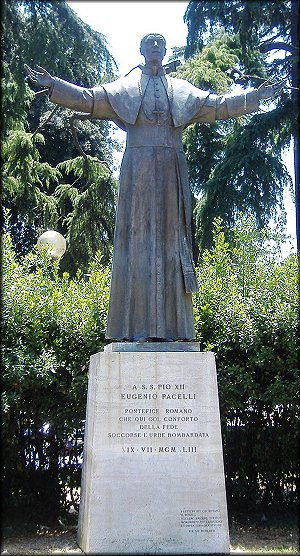
MONUMENT TO PIUS XII

MONUMENTO A PIO XII
1967 Antonio Berti (1904/90)
Funded by a subscription of the readers of the Roman newspaper Il Tempo to commemorate the visit of Pius XII Pacelli (1939/58) in the district of S. Lorenzo the day after the bombing of July 19, 1943
662 U.S. bombers and 268 fighters dropped about 4,000 bombs loaded with 1,060 tonnes (1,170 tons) of explosive caused the death of about 2,000 people, of which 1,674 have been identified for sure, in the district of S. Lorenzo
Many more Romans died under the Allied Forces bombs during the rest of the war

Friday, April 4, 2014

MONUMENT TO PIETRO METASTASIO

MONUMENTO A PIETRO METASTASIO
1886 by the Florentine Emilio Gallori (1846/1924)
Originally in Piazza S. Silvestro and moved here in 1910 not far from the Metastasio's birthplace in via dei Cappellari 30, and opposite the Oratory of the Philippines, the place of invention of the musical form known as oratorio, or opera with a sacred story with no action on stage
Pietro Metastasio (1698/1782) was a poet, librettist, playwright and priest. He is considered to be the reformer of opera. He wrote many librettos for oratori including The Passion of Jesus Christ which was so successful as to be set to music by no less than 35 composers between 1730 and 1790

MONUMENT TO NICOLA SPEDALIERI

MONUMENTO A NICOLA SPEDALIERI
1898 Mario Rutelli (1859/1943)
The monument was placed in front of S. Andrea Della Valle only in 1903 and then moved here in 1957 to make room for the fountain by Carlo Maderno
Nicola Spedalieri (1740/95) was a priest, philosopher and writer, author of "About Human Rights" of 1791. He rejected the deistic and atheistic character of the French Revolution, but he defended the rights of man proclaimed by it and he reckoned those rights as fundamentally Christian, considering the popular sovereignty as the foundation of government power

Thursday, April 3, 2014

MONUMENT TO MARCO MINGHETTI

MONUMENTO A MARCO MINGHETTI
1895 architecture by Giacomo Misuraca and sculptures by the Sicilian Lio Gangeri (1845/1913)
In the basement marble group "Politics and People"
Marco Minghetti (1818/86) was twice Prime Minister and Minister several times. In 1876 his government managed to balance the budget

MONUMENT TO IVAN VAZOV

MONUMENTO A IVAN VAZOV
2010 by the Bulgarian sculptor Minekov Velichko (1928)
Ivan Vazov (1850/1921) was a writer and is still considered the "patriarch" of the Bulgarian literature. He strove valiantly for the national cause of Bulgaria
The statue was inaugurated in the presence of both Italian and Bulgarian Presidents of the Council of Ministers

Wednesday, April 2, 2014

MONUMENT TO GUIDO BACCELLI

MONUMENTO A GUIDO BACCELLI
1931 Attilio Selva (1888/1970) from Trieste
Guido Baccelli (1830/1916) was Minister of Education and Minister of Agriculture several times from 1879 to 1903
He promoted the archaeological walk at Porta Capena, established the National Gallery of Modern Art and promoted the excavations of Pompeii and the Baths of Caracalla

Tuesday, April 1, 2014

MONUMENT TO GIUSEPPE GIOACHINO BELLI

MONUMENTO A GIUSEPPE GIOACHINO BELLI
1913 by the Sicilian Michele Tripisciano (1860/1913) on the fiftieth anniversary of the death of Giuseppe Gioachino Belli (1791/1863) the greatest Roman dialect poet
The stick in Belli's left hand was made of iron, fixed with cement and painted black, because the original wooden stick was regularly stolen

Friday, March 28, 2014

MONUMENT TO GIORDANO BRUNO

MONUMENTO A GIORDANO BRUNO
1887 Ettore Ferrari (1845/1929)
Bronze statue and pedestal of granite from Baveno
Dedicated in 1889 in the very same place where Giordano Bruno (1548/1600) was burned as a heretic on February 17, 1600
In the base EIGHT MEDALLIONS with faces of heretical thinkers and THREE PANELS with scenes from the life of Giordano Bruno: "The lesson at Oxford", "The Trial" and "The burning at the stake"
"Ferrari was committed to offer his work for free, creating a first draft that showed Bruno with his arm raised in the act of preaching and persuading to revolt. Rejected by the City Council, Ferrari had to change the statue, removing any reference to his revolutionary preaching and so conceiving the severe figure of the 'Philosopher Bruno'" (Alessandra Imbellone)

MONUMENT TO GIACOMO MATTEOTTI

MONUMENTO A GIACOMO MATTEOTTI
1974 stela "The idea, the death" by Jorio Vivarelli (1922/2008) commissioned by the Italian Social Democratic Party
It was built on the fiftieth anniversary of the death of the socialist deputy who was kidnapped in this spot by members of the fascist police. He had opposed Mussolini in the Parliament
"Vivarelli wanted to represent the dialectical passage from death to life. Death is at the base of the monument, from bone-like shapes as elongated bones that have polished kneecaps at both ends 'physical soaking in a tragic moment in Italian history' as defined by Vivarelli himself. Life is represented by the great chalice from which emerges the bud which, from the trunk, will give rise to a new plant ready to soar high in the sky, a message that reproduces artistically Matteotti's phrase 'You kill me, but the idea that is in me will never die'" (Web Site of the Foundation Jorio Vivarelli - www.fondazionevivarelli.it)