Showing posts with label Saverio Muratori. Show all posts

Thursday, February 8, 2018

INA-CASA VALCO St. PAUL NEIGHBORHOOD

QUARTIERE INA-CASA VALCO S.PAOLO
1949/52 urban project: Mario De Renzi (1897/1967) and Saverio Muratori (1910/73). 440 lodgings
Projects of the buildings: Saverio Muratori, Mario De Renzi, Mario Paniconi (1904/73), Giulio Pediconi (1906/99) and Fernando Puccioni
TORRI STELLARI (star-shaped towers) by Mario De Renzi
The area consists of almost 5 hectares (12.3 acres) with 440 lodgings for about 3,000 inhabitants and it was the first of the Piani-Casa (plans for homes) designed to give a home to the new Roman working class
The original town plan was not completed
“In the Valco San Paolo neighborhood it is clear how both the whole and the parts have a clear stylistic unity through careful control of the ways of dealing with the different types of buildings, but there is also space for a series of small service facilities for the neighborhood and for elements of urban design” (Mario Carotti - www.urbanistica.unipr.it)
“The limitation of this approach, very common in the interventions made ​​in those years, is to consider the neighborhood as a closed element, and then to solve within itself the aspects of architectural and urban planning. The balance of these values gets in fact to be completely changed when the neighborhood, often built in the outer fringe of the urban expansion, is absorbed by the town. The Valco S. Paolo is in fact today barely recognizable near the crammed constructions of Viale Marconi and the relationships between the elements, which were the basis of the project, appears to be irretrievably altered” (Piero Ostilio Rossi)
Friday, December 30, 2016

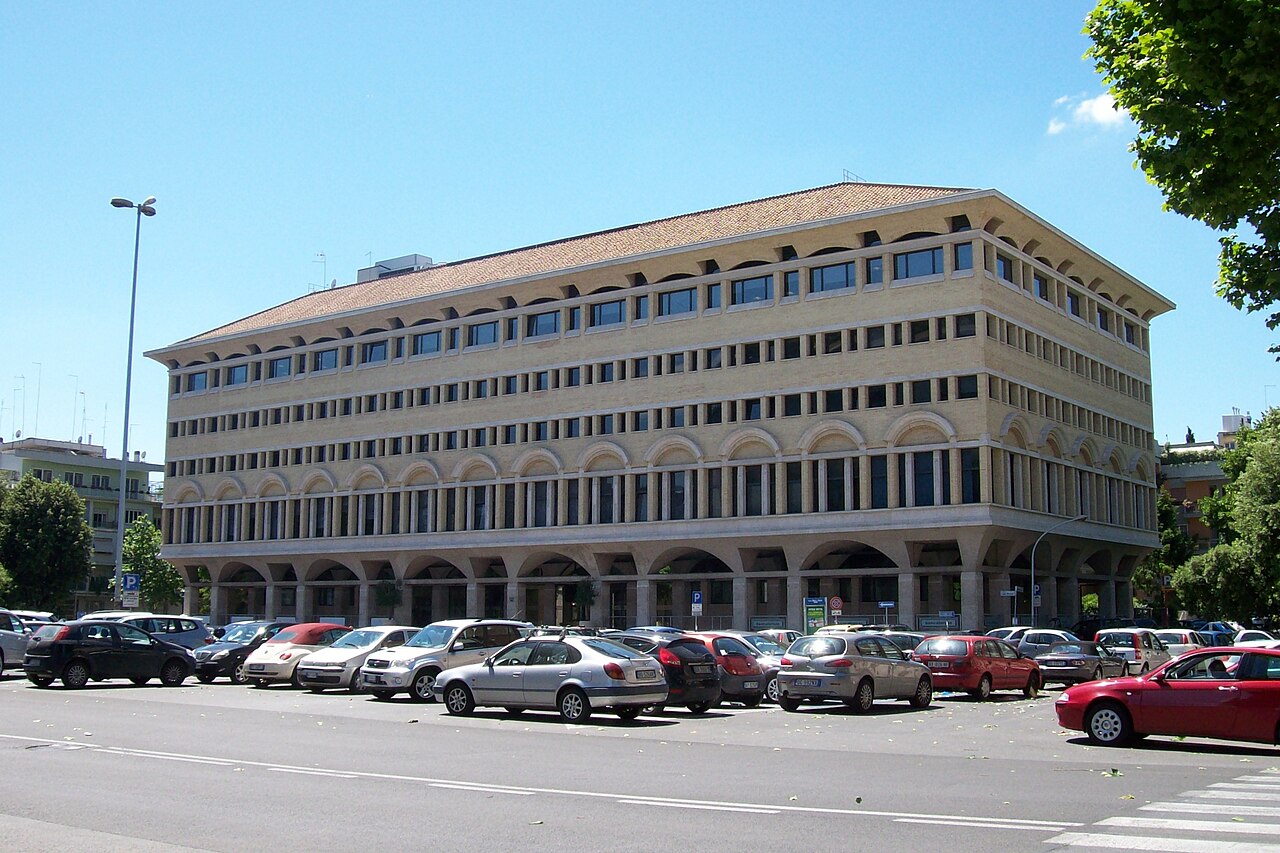
PALACE OF THE CHRISTIAN DEMOCRATIC PARTY

PALAZZO DELLA DEMOCRAZIA CRISTIANA
1955/58 designed by Saverio Muratori (1910/73). It was completed in 1962
It was the headquarters of the Italian party DEMOCRAZIA CRISTIANA (Christian Democracy) who ruled Italy and dominated the political scene for much of the second half of the twentieth century
It is also known as PALAZZO STURZO in honor of Don Luigi Sturzo priest and Italian politician, founder in 1919 of the Partito Popolare Italiano (Italian Popular Party)
“Saverio Muratori's program of 'engagement of traditional shapes in the patterns of the modern movement', was expressed in a lexical retrieval of historical and environmental values. And it is in this respect that the building of the headquarters of the Democrazia Cristiana was designed” (Giancarlo Cataldi)


“He developed the theme of the public building from the plant with a central courtyard to a clear overlap between hierarchical levels, with clear references to the classicism of the Roman late Renaissance palace, even in the rich design of the façades”(Alessandra Capanna - Dizionario Biografico degli Italiani Treccani)

Friday, October 9, 2015

EXHIBITION PALACES

PALAZZI DELL'ESPOSIZIONE


1938/40 Ludovico Quaroni (1911/87), Francesco Fariello (1910) and Saverio Muratori (1910/73) as the site for museums that were never built

Built in the same years as the other two buildings arranged symmetrically around the square

The columns in the galleries are made out of cipolin green marble

The building at No. 22 is largely occupied by the ITALO-AMERICAN INSTITUTE as well as by banks, shops and a restaurant

The building at No. 24 is home to offices including the TAX REGISTER OF THE MINISTRY OF FINANCE

“Together with Saverio Muratori and especially with Ludovico Quaroni, Francesco Fariello signed nearly all of those projects that became, in short, a benchmark for comparison and discussion for the new generations of architects active in Rome just before the Second World War. Major projects and, more importantly, evidence, each one of them, of a not superficial attention to what was happening in areas of high European culture, in Germany, Scandinavia, and that would be at the center of academic debate for many years to come; the work of Gropius, Asplund and Bonatz marks the stylistic hallmark of these years. Projects, against which, not only the younger architects, but also different and already established personalities as Arnaldo Foschini and Adalberto Libera will have to deal, equip, modify critical and theoretical positions, otherwise acquired” (Giorgio Muratore - archiwatch.wordpress.com)