Tuesday, October 24, 2017

SPADA PALACE - SPADA GALLERY (third part)

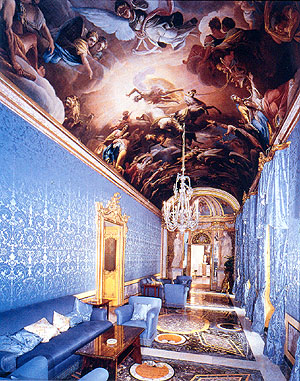
Room III
The room was known as GALLERY OF THE CARDINAL and was designed in the years 1636/37 by Paolo Marucelli (1594/1649)
Ceiling decorations “Four parts of the world, the four elements and the four seasons” 1698/99 by Michelangelo Ricciolini (1654/1715)
“Portrait of Youth” maybe by Annibale Carracci (1560/1609)
“Allegory of the Massacre of the Innocents” about 1639 and “Sacrifice of Iphigenia” 1640 by Pietro Testa (1612/50) Lucca engraver who committed suicide in the Tiber for disappointments in his painting career
“Astronomers” about 1645 and “Cain and Abel” by Niccolò Tornioli (1598/1651)
The Astronomers exalts the new astronomical discoveries and in particular the telescope of 1609 by Galileo Galilei
At the center of the picture is Nicolaus Copernicus showing the phases of the moon, to the left Ptolemy and Aristotle, and on the right the woman with the turban is Astronomy itself. Galileo Galilei (1564/1642) had recently died and this painting was a burning issue at the time
Some scholars saw a quote of the Narcissus attributed to Caravaggio in the man on the right looking into the telescope, as well as one of the reasons they would ascribe with certainty the Narcissus to Caravaggio
“The Vestal Virgins” about 1670 by Ciro Ferri (1634/89)
“Landscape” about 1555 by the visionary Niccolò dell'Abate (about 1510/71)
“There are two scenes socially opposite: the aristocratic wild boar hunting with knights and ladies in the foreground, and the popular procession with the greasy pole in the distance. The fantasy architecture that gives the entire composition a fairytale feel, refers to the Flemish landscapes and to those of Dosso Dossi” (Maria Lucrezia Vicini)
“Feast of Mark Anthony and Cleopatra” about 1701 by Francesco Trevisani (1656/1746) from Istria, with Cleopatra dissolving a pearl in wine to show her indifference to wealth
“In the episode, described with theatrical taste, are placed precious details that combine features of sixteenth-century Venetian tradition with those of Roman classicism” (Maria Lucrezia Vicini)
“Summer and Autumn” and “Spring and Winter” by Luigi Garzi (1638/1721)
“The Abduction of Aeneas” copy of Giacinto Campana (1600/about 1650) from the original by Guido Reni now in the Louvre. Reni himself revised this copy
“The Death of Dido” about 1631 by Giovanni Francesco Barbieri aka Guercino (1591/1666) composed almost like a scene out of the newly born Italian musical theater, also known as opera, the most comprehensive art form that would eventually spread throughout the world
“The work is remarkable for the scenographic vision and the richness of the costumes is made with plastic and coloristic sense, characteristics of the artist's work, learned from experiences in Veneto, Bologna and Ferrara” (Maria Lucrezia Vicini)
Two paintings of the same subject “Boreas Abducting Orythia” one by Francesco Solimena (1657/1747) and one by Giovanni Francesco Romanelli (1610/62) from Viterbo, a pupil of Pietro da Cortona
“Bacchus” by Pier Francesco Mola (1612/66)
“Spring or Flora” about 1680 by Carlo Cignani (1628/1719)
“Looting of a village” by Peter Snayers (1592/1666)
Very realistic “Portrait of young man” by a follower of Annibale Carracci
“View of a beach by moonlight” by Egbert van der Poel (1621/64)
“Death of Cleopatra” 1706 and “Death of Marcantonio” 1702 by Domenico Maria Muratori (1661/1742) for Cardinal Fabrizio Spada
“Christ and the Samaritan” about 1677 and the sketch of “Triumph in the name of Jesus” for the vault of the Chiesa del Gesù (Church of Jesus) by G.B. Gaulli aka Baciccio (1639/1709)
“S. Lucia's shoulders” about 1632 by Francesco Furini (1603/46)
In this very original painting S. Lucia holds a plate with her eyes which had been removed by the torturers. An opportunity for the Florentine Francesco Furini to show off his specialty: painting beautiful bare backs of women
“He preferred the female figure and created a kind of refined painting genre whose subject, inspired by the poems of chivalry, the biblical tradition and mythology, were appreciated by scholarly collectors. Deeply stimulated by the trip to Venice and the painting by Pietro da Cortona (working in Florence in 1637), Furini became in his maturity a painter increasingly fluid and soft” (Carlo Bertelli, Giuliano Briganti, Antonio Giuliano)
“Portrait of Angela Mignanelli” about 1730 by Marco Benefial (1684/1764)
“The smug expression of the face, not rigid, but natural and of remarkable psychological intensity is enhanced by using soft and pasty brush strokes which give brightness to the eyes, sweet and mysterious at the same time. (...) The artist seems to overcome the ways of Roman portraiture of the seventeenth-eighteenth century and get closer to the French one, anticipating more casual formal solutions that will be in vogue especially in the second half of 1700s at the hands of Mengs, Goya, and Pier Leone Ghezzi” (Maria Lucrezia Vicini)
“Landscape with windmills” 1607 by Jan Brueghel the Elder (1568/1625)
At the center of the room two globes 1616/22 by the Dutch cartographer William Bleau
“Statue of a philosopher sitting” of the beginning of the first century AD
Room IV
“David with the Head of Goliath” about 1610 by Orazio Lomi aka Orazio Gentileschi (1563/1639) from Pisa
About 50 cm (20 inches) of the painting in the lower part have been lost, where the body of Goliath was
“The painting, in which the hand of Agostino Tassi has been identified in the landscape, reflects the classicist ideals of Carracci's style, and the realistic ones that enrich the scene into several parts, as one can see in the rendering of the coat. A terse light affects the body of David, enhancing the volumetric characteristics, in memory of the original Tuscan Mannerist training of the painter” (Maria Lucrezia Vicini)
“Christ and the adulteress” and “Christ tempted by the devil” by Mattia Preti (1613/99)
Christ and the adulteress is a work of extraordinary visual impact and powerful religious significance. The dizzying cleavage of the adulterous woman stuns and draws the eye inexorably as Christ indicates it and watches us expliciting in the act the message of salvation by grace that disregards human works
The message is clear: God's mercy can save us from the sins of the flesh, even from such white and unavoidably erotic flesh
Isn't this cleavage after all so dazzling illuminated by the same light that comes from the right and that shines on Christ's face and also on the beautiful gesture of forgiveness of His left hand?
“La Pietà” by Orazio Borgianni (1578/1616)
“Allegory of Astronomy” by G.B. Magni aka Modenino (about 1592/1674)
Five paintings of the so-called Bamboccio Pieter Van Laer (about 1595/1642)
“The value of detectable anti-rhetorical realism in his paintings reveals a fundamental part of the culture of the Dutch painter in addition to his mastery in the use of light and shadow. His painting and that of his many followers - the Bamboccianti such as Jan Miel, Michiels Sweerts - proposed the discovery of a papal city not monumental, of a Rome that invited reflection on social policies” (Carlo Bertelli, Giuliano Briganti, Antonio Giuliano)
Three paintings in the so-called bambocciante style including “Death of the donkey” and the historical view “Revolt of Masaniello” by Michelangelo Cerquozzi (1602/60)
“Accents more distinctly typical of everyday life than the ones of Pieter Van Laer are detectable in the lively folklore scenes of Cerquozzi, also a follower of Laer, even if he developed an independent style facing also sacred subjects of large format, battles and still lifes” (Carlo Bertelli, Giuliano Briganti, Antonio Giuliano)
“The Holy Family with St. John the Baptist” and “Herodias with the head of St. John the Baptist” by Jean Valentin aka Valentin de Boulogne (about 1591/1632)
“St. John the Evangelist” by the Frenchman Nicolas Tournier (1590/post 1657)
“Market” about 1650 by Willem Reuter (1642/1681), influenced by Michiel Sweerts
“Allegory of Vanity” by Andrea Podestà (about 1608/before 1674)
“Capture of Christ” by a follower of Gherardo delle Notti, maybe Trophime Bigot (about 1579/1649)
“S. Cecilia” and “Madonna nursing the Child” by Artemisia Gentileschi (1593/about 1652)
“Worthy disciple of her father Orazio and highly regarded since 1614 in the Florentine art scene, she lived for a long time in Naples, where the local painting environment represented by artists like Cavallino and Caracciolo was deeply influenced by the Caravaggio's knowledge of Artemisia. She inherited from her father the taste for precious fabrics and a preference for the rendering of golden and firm flesh through a naturalistic study of shadows and lights rousing stunningly beautiful effects” (Carlo Bertelli, Giuliano Briganti, Antonio Giuliano)
“Both works have been painted in her youth and are characterized by the delicate and refined drawing of colors, for the firmness and for the expressive intensity of the two female figures, the result of the artistic experiences of his father” (Maria Lucrezia Vicini)
Plaster cast “Divine love defeats profane love” about 1630 maybe a model of the bas-relief at the Galleria Doria Pamphilj by the Flemish artist François Duquesnoy (1597/1643)

Friday, October 20, 2017

SPADA PALACE - SPADA GALLERY (second part)

GALLERIA SPADA
Opened to the public in 1927, closed in the forties and reopened in 1951 for the commitment of the great art historian Federico Zeri who reorganized it, trying to recreate the original appearance of this seventeenth-century private collection
Room I
The decorations on the ceiling and the frieze date back to 1777
“St. Jerome” and “Portrait of Cardinal Bernardino Spada” 1631 by Guido Reni (1575/1642), who maybe also painted the “Slave of Ripa Grande”
“Portrait of Cardinal Bernardino Spada” 1631 by Giovanni Francesco Barbieri aka Guercino (1591/1666)
“Cardinal Bernardino Spada during his papal legation in Bologna (1627-1631) had befriended several artists and especially Reni and Guercino. (...) Both became his official painters so much that he did not hesitate to introduce their skills to the Queen of France, Marie de' Medici, who immediately ordered them some important works. (...) In the painting by Reni the refined and vibrant rendition of the colors and the minute details revealed in the representation of the cardinal outfit, enhance his appearance and his aristocratic look smart and aloof” (Maria Lucrezia Vicini)
“David and Goliath” and “Portrait of Cardinal Bernardino Spada” in 1653 by Giovanni Domenico Cerrini (1609/81)
“Landscape” by Domenico Zampieri aka Domenichino (1581/1641)
“Portrait of Cardinal Fabrizio Spada” 1754 by Sebastiano Ceccarini (1703/83)
“Bacchus and Ariadne”, “Apollo and Daphne”, “Latona transforming shepherd into frogs” and “Mercury entrusts Bacchus to the nymphs” 1695/99 by Giuseppe Chiari (1654/1727), pupil of Carlo Maratta
Beautiful mythological tableaux reproducing episodes of Ovid's Metamorphoses with a delicate color taste and sensual compositional lightness
They could be considered a fitting visual counterpart to the sublime notes of many dramatic cantatas by Georg Friedrich Händel (1685/1759)
“Solomon worships idols”, “St. John of God cure the lepers” and various “Roman Emperors” by Lazzaro Baldi (about 1624/1703)
“Roman Charity” and “Sacrifice of Mirtillus” by Niccolò Tornioli (1598/1651) from Siena
“Cardinal Bernardino Spada in November 1643 bought seven paintings from Niccolò Tornioli, eclectic painter who could expertly merge Caravaggio's culture with the current Baroque of Pietro da Cortona. Of the seven paintings originally in the gallery, remain only four” (Maria Lucrezia Vicini)
Two “Still Life with small geniuses” 1714 by Onofrio Loth (1665/1715)
“Landscape with Figures” about 1660 and “Landscape with shepherds” about 1670 by Gaspard Dughet (1615/75)
Four “Battles” by the specialist in this genre Jacques Courtois aka Borgognone (1628/79)
“Portrait of Cardinal Benedetto Naro” about 1825 by Vincenzo Camuccini (1771/1844)
“St. Jerome in Penitence” about 1605 by G.B. Crespi aka Cerano (1567/1632)
Room II
The room was designed in the year 1636/37 by Gian Lorenzo Bernini (1598/1680)
Frieze by Pietro Bonaccorsi aka Perin del Vaga (1501/47) which was to serve as a model for the tapestries designed to cover the plinth of the Last Judgement in the Sistine Chapel
“The Visitation” maybe by Andrea d'Agnolo aka Andrea del Sarto (1486/1531)
“Portrait of a Man” by Leandro da Ponte aka Leandro Bassano (1557/1622) the son of the more famous Jacopo Bassano
“Portrait of Luca Stella Archbishop of Zadar” by Domenico Robusti aka Tintoretto (1560/1635), the son of the more famous Jacopo Tintoretto
“One of the last works by Domenico Tintoretto, excellent portraitist who manages to effortlessly mix components of the Veneto region culture with the one of Lombardy. In the background it's possible to see the city of Zadar where Luca Stella was archbishop from 1615 to 1624” (Maria Lucrezia Vicini)
“Passage of the Red Sea” and “Moses drawing water from a rock” plus four paintings of “Night scenes” by the very original Giovanni Andrea Danducci aka Mastelletta (1575/1655)
“The paintings with stories of Moses are early works made out of delicate pastel colors dating back to the 'bright' period of the painter and clearly reflect the influence of Bassano, of the culture of Ferrara and Bologna, of Dossi and Nicolò dell'Abate, with hints of Caravaggio, as can be noted in the figure of the wanderer with the donkey, at the center of the Passage of the Red Sea. To the same painter belong four other works to be referred to his 'dark' period adopted in the mature stage of its activity. They are very impressive nighttime scenes, with fairy-tale characteristics, inspired perhaps by the chivalry poems, that were staged a lot by theater companies between the sixteenth and seventeenth centuries, and where also there's no lack of reference to the painter Ludovico Carracci” (Maria Lucrezia Vicini)
Three portraits: “Notable”, “Botanist” and “King David” about 1570 by Bartolomeo Passerotti (1529/92)
“Portrait of Violinist” about 1515 by Tiziano Vecellio (Titian) (about 1490/1576)
“The astrologer” by Prospero Fontana (1512/97), father of Lavinia Fontana
“Three heads” maybe by Francesco Mazzola aka Parmigianino (1503/40)
“Cleopatra” about 1580 by Lavinia Fontana (1552/1614)
“Cardinal Nicolò Gaetani and a prelate” about 1580 by Bartolomeo Cesi (1556/1629)
Two tempera on two sides of a wooden panel with “St. Christopher” (recto) and “St. Luke” (verso) about 1510 by Amico Aspertini (1457/1552) from Bologna, who was heavily influenced by the painting of the north of Europe
“Way to Calvary” and “Eternal God Blessing” about 1495 by Marco Palmezzano (1459/1539)
“The Way to Calvary, taken from the Synoptic Gospels (Matthew, Mark and Luke), captures the particular moment in which Simon of Cyrene is forced to help Christ carry the cross, in a calm atmosphere albeit painful, where citations from Melozzo da Forlì in the framing of the composition blend with Bellini themes in the choice of colors with silvery tones and in the background landscape” (Maria Lucrezia Vicini)
“Portrait of young man” 1531 by the Dutchman Jan Van Scorel (1495/1562)
Vivid “Portrait of Julius III Ciocchi del Monte (1550/55)” by an anonymous sixteenth-century Roman artist
“Marble bust of Laocoon” maybe by Gian Lorenzo Bernini

Sunday, October 15, 2017

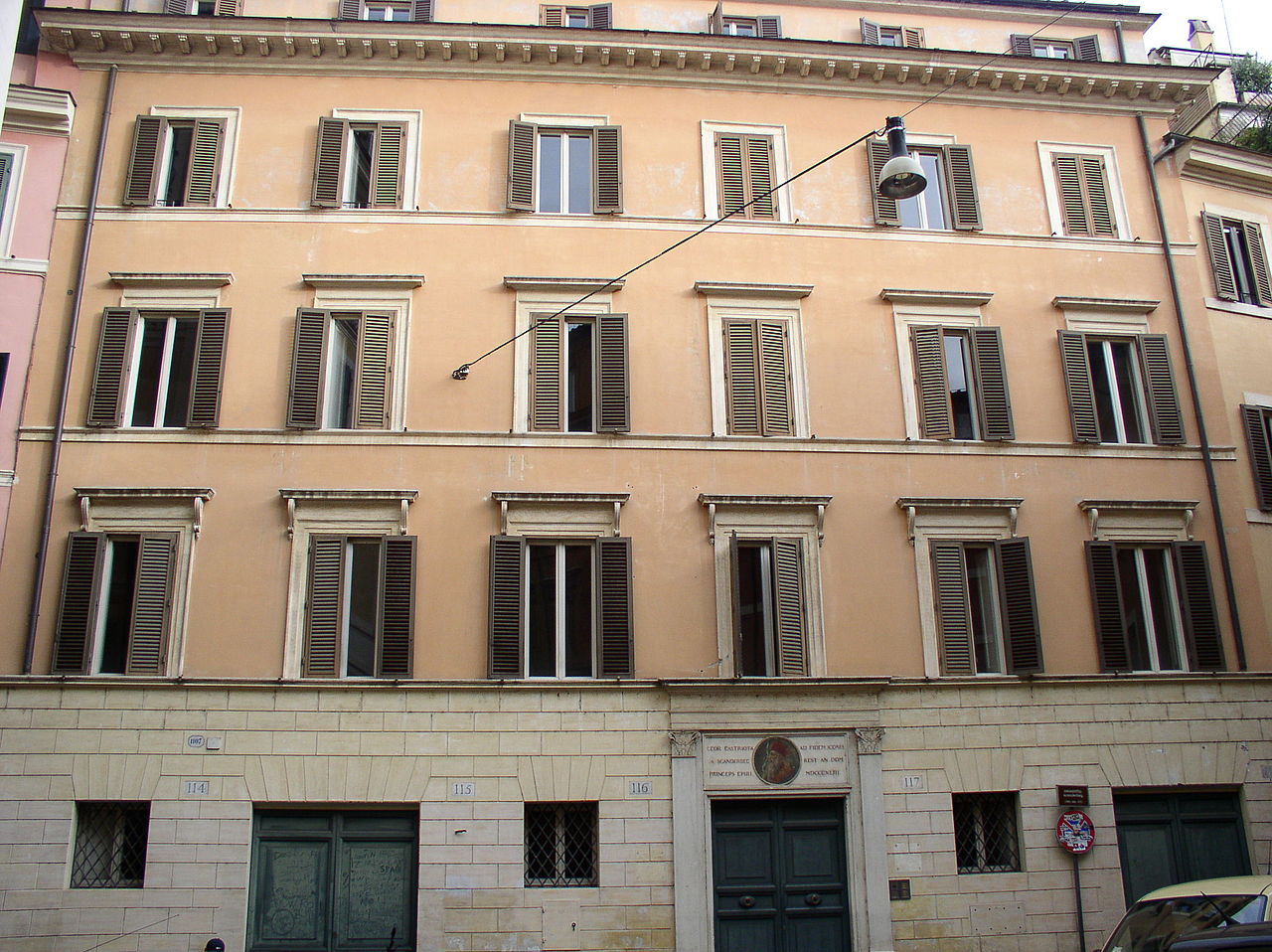
SPADA PALACE - SPADA GALLERY (first part)

PALAZZO SPADA
1548/50 for Cardinal Girolamo Capodiferro maybe by Giulio Merisi (1508/87) and Girolamo da Carpi (1501/56), most likely by Bartolomeo Baronino (1511/54)
FAÇADE decorated in stucco with eight statues of Roman characters (Trajan, Pompey, Fabius Maximus, Romulus, Numa, Claudio Marcello, Caesar and Augustus), and in the courtyard “Centaurs”, “Hunting fairs” and “Legendary divine couples” (Hercules and Omphale, Venus and Mars, Jupiter and Juno, Pluto and Proserpina, Amphitrite and Neptune, Minerva and Mercury) 1556/60 by Giulio Mazzoni (about 1525/after 1589)
“In parallel to the fashionable painted houses makes its way an architectural trend seen in Palazzo Spada or Villa Medici that will be assiduously attended throughout the course of 1500s and even later, whose unequivocal archetype is the Palazzo Branconio dell'Aquila designed by Raphael. Here the parallels with the makeshift theater sceneries leap clear to the eyes, highlighted by common ornamental vocabulary, full of classical references and full of busts, niches, plaques, medals, trophies, garlands, grotesques” (Antonio Pinelli)
It was bought in 1632 by Cardinal Bernardino Spada
Modified 1636/37 by Paolo Marucelli (1594/1649) and Vincenzo Della Greca (1592/1661)
Modified again in the years 1652/53 by Francesco Borromini (1599/1667) who added the incredible PERSPECTIVE GALLERY of 8.82 m (29 feet) that appears to be 35 m (115 feet) designed by the Augustinian father Giovanni Maria da Bitonto
“The idea seems to be derived from the theater (Teatro Olimpico) and we must not forget that it also has a respectable Renaissance ancestry. Bramante applied the same illusion principle to the choir of S. Maria presso S. Satiro in Milan, which must have been one of the first impressions of Borromini. The colonnade concept of Palazzo Spada is therefore not typically Baroque, or has an interest rather marginal in the work of Borromini. To overestimate its significance, as it often happens to those who consider Baroque as a style especially interested in optical illusion, is completely misleading” (Rudolf Wittkower)
In 1927 the Spada family sold it to the Italian government and it became the seat of the CONSIGLIO DI STATO (Council of State). On the same year the four rooms with the art gallery were opened to the public
FIRST FLOOR
Corridor of Bas-reliefs, Corridor of Stuccos and Hall of the General Audiences where there is the so-called “Statue of Pompey” found in about 1553 in Via dei Leutari and mistakenly believed the one before which Julius Caesar died

Wednesday, October 11, 2017

SORA PALACE

PALAZZO SORA
1503/10 maybe by Giuliano Leno for the Fieschi family, even if it has been wrongly attributed to Donato Bramante
It was later property of the Savelli family and in 1579 of Giacomo Boncompagni, Duke of Sora son of Pope Gregory XIII Boncompagni (1572/85)
It was restored in 1845
A third of the building was demolished in 1888 and a new façade was built on Corso Vittorio Emanuele II in imitation of the old one
Now it is a high school called ISTITUTO PROFESSIONALE STATALE PER L’INDUSTRIA E L’ARTIGIANATO CARLO CATTANEO (Professional Institute of State for Industry and Crafts Carlo Cattaneo)

SFORZA CESARINI PALACE

PALAZZO SFORZA CESARINI
1458/62 built for Cardinal Rodrigo Borgia, later Pope Alexander VI (1492/1503)
It was given as a sort of “bribe” to Cardinal Ascanio Sforza, who had supported Rodrigo Borgia in the conclave
The Cardinals Sforza and Della Rovere held the functions of Registrars of the Church here and the building was used as Chancellery until Leo X Medici (1513/21) moved the Chancellery offices to Palazzo Riario. Since then palazzo was known as the Old Chancellery
In 1697 the Sforza family intermarried with the Cesarini and since then they unified as Sforza Cesarini, current owners of the building
Modified 1730 by Pietro Passalacqua (1690/1748) with a new FAÇADE ON VIA DEI BANCHI VECCHI
FAÇADE ON CORSO VITTORIO EMANUELE II 1886/88 by Pio Piacentini (1846/1928) in a style that mimics the architecture of the sixteenth century

Monday, October 9, 2017

SERRISTORI PALACE

PALAZZO SERRISTORI
1555, Averardo Serristori ambassador of Tuscany during the reign of Pius IV Medici (1559/65) on the site of an earlier building that had belonged to Cesare Borgia, son of Pope Alexander VI Borgia (1492/1503)
It was the Embassy for the Medici family and later the Tuscan embassy in Rome until 1830 when it became papal barracks
On 22 October 1867 here took place the terrorist attack of Giuseppe Monti and Gaetano Tognetti that killed many Zouaves (soldiers of the pope) and destroyed a corner of the building. It should have been an act to support the campaign for the liberation of Rome resulted in the defeat at Villa Glori of 76 volunteers and the death of the Cairoli brothers
The two bombers were beheaded at the order of Pius IX the following year
Their story inspired the 1977 film by Luigi Magni In Nome del Papa Re (In the name of the Pope King) with Nino Manfredi
Since 1870 the building was still being used as a barracks by the Italian troops and in 1902 it was dedicated to Luciano Manara
After the First World War it was used by the municipality to accommodate the evicted
In 1929 it was granted to the Holy See, which had it restored by Alberto Calza Bini (1881/1957) to adapt it as school building
Now it is the ELEMENTARY, MIDDLE AND HIGH SCHOOL PIUS IX

Friday, October 6, 2017

SERLUPI CRESCENZI PALACE

PALAZZO SERLUPI CRESCENZI
1585 masterpiece by Giacomo Della Porta (1533/1602) for Ottaviano Serlupi Crescenzi
It was sold in 1744 to the Ruspoli family and in 1800 to the Lovatelli family
In the COURTYARD “Sarcophagus with two seasons at the sides and woman with scroll in the center” of the second half of the third century AD
“The most noble example of urban Roman architecture from the second half of the 16th century, the most classic” (Wart Arslan)
It is home to the so-called OSSERVATORIO POLITICO (Political Observatory), an institution of “political culture” that is supposed to promote “activities aimed at the formation of the new ruling class and the development of government programs for the social, economic and institutional modernization” but which is in fact another totally useless Italian institution, created for the use and the consumption of the caste of Italian politicians

Sunday, October 1, 2017

SCIARRA PALACE

Reconstruction as a palace of the homes of the Colonna family, of which the Sciarra constitute a branch
The palace was called Palazzo Sciarra in honor of Sciarra Colonna, who gave the famous “slap” of Anagni in 1303 to Pope Boniface VIII (1294/1303)
Reconstruction began after 1550, continued in 1610 maybe with Flaminio Ponzio (1560/1613) and ended in about 1641 with Orazio Torriani (about 1601/about 1657)
Library 1745 by Luigi Vanvitelli (1700/73) who restored also other rooms for Cardinal Prospero Colonna
Restoration in the years 1875/82 by Francesco Settimj (active 1875/88) and 1882/95 by Giulio De Angelis (1850/1906) who also built in the block of the building the Teatro Quirino (it had originally built in wood in 1871) the first theater of united Italy and the Galleria Sciarra
Giulio De Angelis reduced considerably the size of the building with the opening of Via Minghetti and the construction of theater and gallery
Beautiful PORTAL 1641 by Orazio Torriani which, according to popular tradition, was carved from a single huge block of marble
In the eighteenth and nineteenth centuries it was considered one of the four wonders of the city with Palazzo Farnese, Palazzo Borghese and the Caetani Staircase in Palazzo Ruspoli
In 2010 the work of restoration of the interior finished. It was sponsored by the FONDAZIONE ROMA (Rome Foundation), which has its headquarters in the building and made it home to temporary exhibitions with the nearby Palazzo della Cassa di Risparmio di Roma also called Palazzo Cipolla
The Rome Foundation has a permanent art collection in the palace with many important works ranging from the fifteenth century to present day. Most of the works have a close connection, for the subject or for the artists responsible for them, with the city of Rome, the focus of the activity of the foundation
Among the masterpieces:
 Tempera on wood “Imago Pietatis” about 1480/82 maybe by Piermatteo Lauro Manfredo aka Piermatteo d'Amelia (1446-48/about 1506)
“The attribution to the painter from Amelia is supported by iconographic and stylistic comparison with works of different nature, but of the same subject, in Orvieto and Terni. (...) This Christ shows, in the exquisitely linearity that pervades it, the close relationship with Florentine culture, to which refers indirectly also the clear luminosity similar to the one of Piero Della Francesca and the strong geometric presence of the uncovered tomb, which is the only spacial element of the work. (...) The strong plastic emphasis seems to prove the progressive approach of the artist towards Antoniazzo Romano, with whom he worked closely in the second half of the eighties in Rome” (Laura Auciello)
Oil on board “Pieta” by Marcello Venusti (about 1512/79)
Oil painting “Madonna reading and Child with Sts. Elizabeth and John the Baptist” by Francesco de' Rossi aka Francesco Salviati (1510/63)
Oil on canvas “Moses frees the daughters of Jethro” by Ciro Ferri (1634/89)
“The oldest sources document in the biography of the artist, his outstanding erotic inclinations: “He was very dedicated... to love... He painted with great assiduity, and delight, when surrounded by vague maidens was flattered by some sweet sight...” (Passeri) (...) It is interesting to examine his overwhelming production (...) of works for private buyers, partly still on the antiquities market, painted in fifty years of activity. They attest to a plurality of interests and to an eclectic background that would associate Caroselli to the naturalists of the third decade (Valentin, Régnier, Paolini), or to Venetian models, or even to the formal paradigms of the painters from Bologna (Annibale Carracci, Domenichino). An explicit archaic will determines in some of his most beautiful works (Madonna enthroned with the Archangels Michael and Raphael) an impressive neo-Renaissance scheme (the references are to Piero Della Francesca, Bronzino, Allori, to the sixteenth century Venetian painters), as a conscious attitude of rejection and failure against the triumphant baroque absolutism” (Anna Ottani Cavina - Dizionario Biografico degli Italiani Treccani)
Oil on canvas “Achilles meets Teti near the Centaur Chiron” by Bernardino Cesari (1571/1622) brother of the Cavalier d'Arpino
Oil on canvas “Landscape with Roman ruins” by the Flemish Willem Van Nieulandt II (1584/1635)
Oil on canvas “Landscape with idealized view of Rome” by the Flemish who settled in Rome Jan Frans van Bloemen aka Orizzonte (1662/1749)
Two oils on canvas “View of St. Peter's Square” and “View of Monte Cavallo” by Giovanni Paolo Pannini (1691/1765)
Oil on canvas “Portrait of Giacinta Orsini Boncompagni Ludovisi” by the great Pompeo Batoni (1708/87)
Oil on canvas “Start of the race of Berbers in Piazza del Popolo” by the English Thomas Jones Barker (1813/82)
There are also works of the twentieth century:
“Cabins in the Pontine Marshes” by Onorato Carlandi (1848/1939)
“Pollarole (Fight of commoners)” by Alberto Ziveri (1908/90)
“Training in Parioli” by Ferruccio Ferrazzi (1891/1978)
“Hunting the Tiger I” and “Hunting the Tiger II” by Marino Mazzacurati (1907/69)
“Lungotevere Ripetta” and “S. Giorgio in Velabro” by Francesco Trombadori (1886/1961)
Bronze sculpture “Twentieth Century” by Arnaldo Pomodoro (1926)
“Allstars” by Mario Schifano (1934/98)
“The room unvoiced” by Emilio Tadini (1927/2002)
“Mirror” by Enrico Baj (1924/2003)
“Michelangelo” Tano Festa (1938/88)

Saturday, September 30, 2017

SCAPUCCI PALACE

Built at the beginning of 1500s for Pietro Griffo Bishop of Forlì
It was restored in 1588 by Giovanni Fontana (1540/1614), brother of Domenico Fontana, for Gaspare Scapucci
During the restoration the TOWER OF THE MONKEY of 1014 was included in the building
It was linked to a legend that became famous when told in 1860 by the American novelist Nathaniel Hawthorne in his novel The Marble Faun:
Legend has it that in the palace lived a monkey who, one day, kidnapped the baby of his master in swaddling clothes, and took him to the top of the tower, making him stick out from the battlements, just for fun, at the risk of making him fall
The parents and the people who were there implored the help of Our Lady who rescued the baby: so the ape, at a call of the child's father, came back down the tower and into the house, carrying the baby safe and sound
From that day the father of the child wanted that a lamp would burn before a statue of the Virgin that he placed on top of the building, as a thanksgiving for the grace received

Friday, September 29, 2017

SCANDERBEG PALACE

PALAZZO SCANDERBEG
It was built in the fifteenth century
The palace is known for hosting for a few months in 1466 the Albanian hero Giorgio Castriota Scanderbeg (1405/68) who united the tribes of Epirus and Albania, and resisted attempts of the Ottoman Empire to conquer Albania for twenty-five years
The square named after Scanderbeg was the first case of a foreign name used in Roman toponymy
The building is now home to the
National Museum of Pasta
Private museum opened at the behest of Vincenzo Agnesi (1893/1977) the owner of the Agnesi company, pasta producer
The museum is closed for renovation at the time being
ELEVEN ROOMS with tools for the production of pasta and documents on the subject
The museum is strongly opposed by the Albanian community that believes the memory of his national hero is desecrated

SANGALLO MEDICI CLARELLI PALACE

PALAZZO SANGALLO MEDICI CLARELLI
1535/36 Antonio Cordini aka Antonio da Sangallo the Younger (1483/1546)
At his death it was sold to Migliore Cresci from Florence, mentioned in inscriptions along the five windows MELIOR DE CRESCIS CI FLORENTINUS
Between 1559 and 1565 the new owner decorated the entire façade with frescoes, including Medici crests and portraits of Giovanni and Giuliano de' Medici
The decoration remained in this condition until the end of the nineteenth century, when the plaster was replaced
On the façade there is a plaque honoring Cosimo II Duke of Florence (COSMO MEDICI / DUCI FLOREN II / PACIS ATQUE / IVSTICIAE CULTORI)
It was enlarged in the seventeenth century extending the façade
It passed to the Consulate of Tuscany and later to the Marini Clarelli family
It became a barrack for soldiers and it was eventually acquired by the municipality which has restored it

Monday, September 25, 2017

SALVIATI PALACE

PALAZZO SALVIATI
1520/27 Giulio Pippi aka Giulio Romano (1499/1546) for Filippo Adimari chamberlain of Pope Leo X Medici (1513/21)
Completed 1552/68 by Giovanni Lippi aka Nanni di Baccio Bigio (about 1513/68) for Cardinal Bernardo Salviati
From 1883 to 1943 it was the headquarters of the Military School of Rome
It was restored and enlarged in 1933
It originally faced the Leonino Port disappeared after the construction of the embankments of the Tiber
On October 16, 1943 1,022 Roman Jews were brought here, and two days later deported to Auschwitz. Only sixteen survived
In 1945 it was for a full year Hospital of the Canadian Armed Forces
Between 1946 and 1950 it was the Military Tribunal
Since 1971 is home to the Centro Alti Studi per la Difesa (Centre for High Defense Studies)
LIBRARY
Three rooms with ceilings decorated in 1883 with “Scenes of battles of the Risorgimento and other military episodes” and “Groups of plants and flowers” by Annibale Brugnoli (1843/1915)
CHAPEL
Paintings by Santi di Tito (1536/1603)

Sunday, September 24, 2017

SACCHETTI PALACE

PALAZZO SACCHETTI
1542 designed by Antonio Cordini aka Antonio da Sangallo the Younger (1483/1546) as his home
The unfinished building was sold in 1550 by his Sangallo's son, Orazio, to Cardinal Giovanni Ricci of Montepulciano treasurer of Paul III Farnese (1534/49)
Completed in 1552 maybe by Sangallo's student Giovanni Lippi aka Nanni di Baccio Bigio (about 1513/68) and his son Annibale Lippi (active in Rome in the second half of the XVI century)
NYMPHAEUM 1660 by Carlo Rainaldi (1611/91)
It belonged for nearly three decades until 1608 to the Ceoli family who enriched it with ancient sculptures and then sold it to Cardinal Scipione Caffarelli Borghese
Later it belonged to Cardinal Ottavio Acquaviva d'Aragona, and finally, from 1649, to the Sacchetti family of Florence who still owns it
The GARDEN of the palace was the first place in Rome where oleanders, very rare at the time, would be cultivated
Emile Zola chose the palace as the setting for his novel “Rome” even if with the fictitious name of Palazzo Boccanera
ATRIUM
Bas-relief “Presentation to the Senate of Caracalla by Septimius Severus (193/211)”
AUDIENCE HALL or HALL OF THE GLOBES
Masterpiece of Roman Mannerism “Stories of David” including “Bathsheba goes to King David” 1553/54 by Francesco de' Rossi aka Francesco Salviati (1510/63)
“Simulating illusionistically complex decorative systems made of architecture and painted sculptures, of fake easel paintings and tapestries (behind which is a conceptual plot of meanings resulting from the complicated web of allegorical, mythological and historical themes) Salviati gave another proof of the great expressive features of Mannerism”(Carlo Bertelli, Giuliano Briganti, Antonio Giuliano)
GALLERY
Copies of sibyls and prophets from originals by Michelangelo executed by Giacomo Rocca (1592/1605)
“Holy Family” and “Adam and Eve” by Pietro Berrettini aka Pietro da Cortona (1597/1669)
CHAPEL
Frescoes by Agostino Ciampelli (1565/1630)

Saturday, September 23, 2017

RUSTICUCCI PALACE

PALAZZO RUSTICUCCI
1584/88 Domenico Fontana (1543/1607) and Carlo Maderno (1556/1629) for Cardinal Girolamo Rusticucci, who also paid for the construction of new church of S. Susanna
To build the palace, the cardinal had bought all the buildings in the area except the house of an old woman, Mrs. Moscetti, who had categorically refused to sell it. The cardinal did, however, made his architects build the palace anyway, incorporating the property of the old woman who found herself with her house surrounded by a cardinal's palace
The original palace was built on the now disappeared Piazza Rusticucci which used to be between Via del Mascherino and Borgo Sant'Angelo
In the seventeenth century the palace became the property of the Accoramboni family
It was rebuilt approximately as it was here in 1950 with some original elements


RUSPOLI PALACE

PALAZZO RUSPOLI
Begun in 1556 by Giovanni Lippi aka Nanni di Baccio Bigio (about 1513/68)
Continued 1583/86 by Bartolomeo Ammannati (1511/92) for the Rucellai family from Florence who sold it in 1629 to the Caetani family
Completed 1633/37 by Bartolomeo Breccioli (?/1639)
Incorporates the former CINEMA ETOILE
Since 1713 it became property of the Ruspoli family who possess it still
It is the seat of the Fondazione Memmo and it hosts temporary exhibitions
STAIRCASE also known as Caetani Staircase 1640 by Martino Longhi the Younger (1602/60) with 120 steps each carved from a single piece of antique marble
In the eighteenth and nineteenth centuries it was considered one of the four wonders of Rome along with Palazzo Farnese, Palazzo Borghese and the entrance to Palazzo Sciarra
GALLERY ON THE SECOND FLOOR
Frescoes “Genealogy of the triumphs with deities and allegorical figures” 1589/92 by Jacopo Zucchi (about 1542/96) and busts

Monday, September 18, 2017

RUGGERI PALACE

PALAZZO RUGGERI
1588/91 Giacomo Della Porta (1533/1602) for the Ruggeri family
The stretch of Corso Vittorio Emanuele II in front of the palace corresponds to a stretch of the Via Papalis, the way the popes used to get from the Vatican to their palace near the Basilica of St. John Lateran or during important occasions and processions
When, from 1420 onwards, the popes went to live in the Vatican, the Via Papalis was tread by them in the days after the election to take symbolically possession as bishops of Rome of the throne in the Lateran Cathedral
HALLS OF HONOR and LOGGIA
“Fake painted tapestries with scenes of the Roman consul Gnaeus Pompey taken from Plutarch” and “Allegorical figures” painted at the end of 1500s by the brothers Giovanni Alberti (1558/1601) and Cherubino Alberti (1553/1615) for Pompeo Ruggeri
TWO ROOMS ON THE SECOND FLOOR
Frescoed frieze “Cycle with alternate stories of the Old Testament with allegorical figures” also by the Alberti brothers and Cristoforo Roncalli aka Pomarancio (1552/1626)

RUFFO GUGLIELMI PALACE

PALAZZO RUFFO GUGLIELMI
It was built in the sixteenth century for the Cybo family
It later belonged to the Altemps and to the Ruffo families who had in 1783 Kaiser Wilhelm II of Austria as their guest here
It then passed to the Guglielmi family of Vulci who did renovation in 1873 with Gaetano Koch (1849/1910)
It has been the headquarters of the Italian Democratic Party

Wednesday, September 13, 2017

RONDININI PALACE

PALAZZO RONDININI
Begun in 1750 by Gabriele Valvassori (1683/1761), who incorporated the Palace of Cavalier d'Arpino built by Flaminio Ponzio (1560/1613), made the NORTH WING and the FAÇADE ON VIA DEL CORSO
Finished 1761/64 by Alessandro Dori (active in Roma since 1744/d. 1772), who added the SOUTH WING and oversaw the interior of the house-museum of the Marquis Giuseppe Rondinini that until 1800 still kept the famous “Pieta Rondanini” (the misspelling of the name is commonly accepted) by Michelangelo Buonarroti now in Milan
The building is currently owned by Bank Antonveneta and hosts the Chess Club
GALLERY
Incredible frescoed vault “Fall of Phaeton” 1772 by Jacques Gamelin (1738/1803)
“Among the strategies adopted to emphasize the prestige of the family, there is the relationship between antiquities and modern décor. Pieces of the Roman statuary such as columns, bas-reliefs, sarcophagi and statues were fused with stuccos and paintings, creating a living museum, where the classics became an additional ornament. Unlike other historic homes where the remains of the ancient collections were exhibited in galleries and private museums, here the relationship with archeology was part of everyday life, as well as being a good financial investment in times of crisis. Most of these pieces, however, were removed when Giuseppe Rondinini, the last heir, left the palace. (...) However, one can still feel the ancient preciousness of the rooms through illusionistic paintings, architectural views and depictions of mythological stories made​in the style of Bologna's squaring” (Rita Dietrich - L'Osservatore Romano)

ROCCI PALLAVICINI PALACE

PALAZZO ROCCI PALLAVICINI
Beginning of the seventeenth century by Carlo Maderno (1556/1629) for the Rocci family from Cremona
From 1759 it belonged to the Discalced Carmelites who had their headquarters here with the church Sts. Teresa and John of the Cross
In the nineteenth century they moved to S. Maria della Vittoria, the church was demolished and the palace became property of the Pallavicini family
It was restored by Francesco Azzurri (1831/1901)