Showing posts with label Andrea Bergondi. Show all posts

Wednesday, March 21, 2018

St. ALEXIUS OF ROME

S. ALESSIO
Built in the eighth century over a previous building of the fourth century dedicated to St. Boniface
The name of Alexius, Roman saint of the fifth century, was added in the year 977 when some monks arrived from Damascus in the monastery attached to the church
The real name of the church is Ss. BONIFACIO E ALESSIO (Sts. Boniface and Alexius)
Rebuilt in 1217 (also the belfry) by Honorius III Savelli (1216/27)
Restored in 1582
Renovated in 1750 (also the façade) by Tommaso De Marchis (1693/1759) who was also the architect of Palazzo Mellini on Via del Corso
Restored 1852/60 for the Somaschi Fathers
Under the church there is archaeological evidence including an ancient well, perhaps belonging to the house of Senator Eufimiano father of St. Alexius
RIGHT NAVE
“Tomb of Eleonora Boncompagni Borghese” 1693 by G.B. Contini (1641/1723) with sculptures by Andrea Fucigna (about 1660/1711)
RIGHT TRANSEPT
“Icon of the Virgin Mary” thirteenth century, believed to have been brought here by St. Alexius himself
APSE
“Evangelists, Redeemer, and two angels” 1860 by Carlo Gavardini (1811/69)
These paintings were not very successful at the time, for their character “too gay”, not suitable for the church
Two little columns dating back to 1217. The one on the right is by Jacopo di Lorenzo di Cosma (first half of XIII century)
CRYPT
It is the only Romanesque crypt in Rome with canopy underneath which the relics of Thomas of Canterbury are kept
Frescoes XII/XIII century
“Column” believed the one of the martyrdom of St. Sebastian
2nd ALTAR ON THE LEFT
“S. Girolamo Emiliani introducing orphans to the Virgin Mary” end of 1600s/beginning of 1700s by Jean François de Troy (1679/1752)
De Troy was one of many French artists who worked in Rome in the first half of the eighteenth century and became part of the Roman art scene to such an extent as to become the prince of the Roman Academy of St. Luke in 1744
“By accepting a wide variety of jobs, not only for portraits, but also for religious and mythological compositions, De Troy became famous for his 'tableaux de mode', genre scenes inspired by the worldly and elegant salons he used to attend. (...) While conducting a brilliant social life, he continued his work as a painter creating such cards upholstery for the King of France, the altarpieces for the churches of Rome or smaller works for collectors” (Stéphane Loire)
“S. Girolamo Emiliani praying the Virgin Mary” 1860 by Carlo Gavardini (1811/69)
TO THE RIGHT OF THE ENTRANCE
Scenic baroque machinery in stucco and wood “Holy Stairs and St. Alexius” by Andrea Bergondi (active in Rome XVIII century) which houses the wooden staircase believed to be the one under which St. Alexius lived for seventeen years of his father's charity without ever being recognized
In the convent since 1941 there is the NATIONAL INSTITUTE FOR ROMAN STUDIES library with about 25,000 books about history, literature, archeology and urban planning in Rome

Wednesday, March 19, 2014

TOR DE' SPECCHI MONASTERY

MONASTERO DI TOR DE' SPECCHI
Founded in 1433 by St. Frances of Rome (S. Francesca Romana 1384/1440), whose real name was Francesca Bussa de' Leoni
Born into a noble family in Rome near Piazza Navona, she came to live in the Trastevere district when she was twelve years old after her marriage to a nobleman from the Ponziani family who had become rich with their job as butchers
"It was the strong personality of Francesca Ponziani and her exceptional charisma to make the Tor de' Specchi a unique case. Compared to other local institutions, which would soon become extinct, the founder posed the conditions of development and continuity of a centuries-old house that would be inserted deep into the urban context. The religious project of Francesca was original and innovative, because it tried to combine the essence of the monastic ideal with the values of lay spirituality: the Oblates were not of the world, but they lived in the world and history, through charity and active service in favor of their neighbor" (Website of the Oblates of St. Frances of Rome - www.tordespecchi.it)
The monastery was extended especially in the first half of 1600, after the canonization of St. Frances of Rome in 1608
It came to include the TORRE DEGLI SPECCHI (Tower of Mirrors), so named for the shape of the windows
On the FAÇADE
Relief "St. Frances of Rome and the Angel" 1756 by Andrea Bergondi (active in Rome XVIII century)
Above the door of the Holy Stairs, "Madonna and Child with Sts. Benedict and Frances of Rome" by an anonymous artist of the eighteenth century
Frescoes on the walls of the SCALA SANTA "Madonna and Child with Sts. Benedict and Frances of Rome" and "Christ leaving the tomb" maybe by Antonio Aquili aka Antonio Romano (about 1435-40/1508) and his school, including decorations of the seventeenth century
In the CLOISTER plaster copy of the statue "St. Frances of Rome and the Angel" 1850 by Pietro Galli (1804/77) a pupil of Bertel Thorvaldsen. The original is in the left upper apse of St. Peter's Basilica
OLD CHAPEL
Fully painted in about 1468 with the wonderful cycle of 25 panels "Stories of St. Frances of Rome" and the main panel "Madonna and Child with Sts. Benedict and Frances" maybe by Antoniazzo Romano and his school
"The cycle still shows strong ties with the medieval tradition for a taste for plain and simple narrative that flows between the tones of folk tale and the rigor of religious devotion, for the respect for the religious hierarchies through the proportional scale of the figures and for the limited ability in the foreshortening of the scenes. The component owing to Piero della Francesca is present in the faces, with simplified features in comparison with the faces painted by the artist from Borgo, and in the large landscape openings present in some scenes" (Anna Cavallaro)
On the altar "Madonna and Child with Sts. Benedict and Frances of Rome" by Antoniazzo Romano
"The frescoes are rather attributable to employees of Antoniazzo Romano's workshop who followed the style of the master, while it is relevant to Antoniazzo's hand of the Madonna and Child with Sts. Benedict and Francesca Romana on the altar for the similarity to the triptych of Subiaco from which the model of St. Benedict was taken. This cycle proves to be linked to the style of Piero della Francesca and Benozzo Gozzoli which Antoniazzo was following during the same years for his paintings on board, a language à la Piero della Francesca but simpler and more down to earth and a Benozzo Gozzoli style invigorated by the inspiration of the frescoes of S. Rosa in Viterbo" (Anna Cavallaro)
The cycle has been attributed to Antoniazzo Romano and his school by Roberto Longhi. Other scholars attributed it to Benozzo Gozzoli or to an unidentified follower of Piero della Francesca. Under each scene there are captions written in an interesting Roman Vulgar language of the fifteenth century
In a niche in the wall at the entrance dramatic "Inferno" probably painted after 1468 by an anonymous artist
ANCIENT REFECTORY
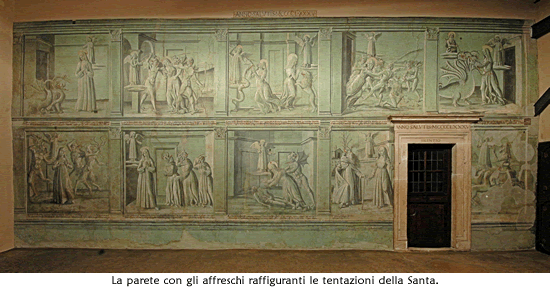
Wall frescoes in dominant green monochrome "Ten Temptations of St. Frances of Rome" maybe 1485 probably by different artists considering the diversity of style, maybe from the schools of Antoniazzo Romano and Benozzo Gozzoli
BAROQUE REFECTORY
First half of 1600s. On the walls "Fantasy landscapes of Roman countryside" dating back to mid-1700. On the back wall "Madonna and Child with Sts. John the Baptist and Catherine of the Wheel" by an anonymous artist of the eighteenth-century
CHOIR OF SS, ANNUNZIATA
Atrium of the eighteenth century painted with frescos. In one of the walls the tomb of St. Frances of Rome is embedded
WOODEN CEILING 1601 covered in gold and colors with a central wooden sculpture "St. Francis and the Angel"
On the WALLS "Angels" 1749 by Sebastiano Ceccarini (1703/83) and Lorenzo Gramiccia (1702/95)
ALTAR "Annunciation" by Alessandro Allori aka Bronzino (1533/1607) pupil of Agnolo di Cosimo aka Bronzino. Rich Baroque tabernacle on the altar. On the sides "Adoration of the Magi" and "Adoration of the Shepherds" by an anonymous artist of the seventeenth-century
LOWER CHURCH
Under the Choir of SS. Annunziata with identical dimensions. Originally known as S. MARIA DE CURTE attached to the monastery in 1594 with a different orientation not to have anymore access from the road
In the APSE panels in white and gilded stucco "Presentation in the Temple" and "Presentation of the Virgin" 1662. At the center "Madonna with Child" by an anonymous artist of the seventeenth-century enclosed in an elaborate cornice supported by gilded stucco angels