Showing posts with label Pietro Bracci. Show all posts

Thursday, April 12, 2018

St. ANDREW OF THE THICKETS

Described in 1192 in the sources as S. Andrea de Hortis (St. Andrew at the Parks) because, at the time, it was outside town
In the Middle Ages it belonged to the Scottish community in Rome
In 1585 it was donated by Pope Sixtus V Peretti (1585/90) to the Minims of S. Francis of Paola
It was rebuilt in 1604/12 for the Marquis Gaspare Del Bufalo by Gaspare Guerra (about 1560/1622) who also designed the façade up to the cornice
It was continued in the years 1653/67 by Francesco Borromini (1599/1667) for the Marquis Paolo Del Bufalo
Borromini worked on this church until his death and designed the APSE, the DRUM OF THE DOME without lantern that was never completed and the wonderful BELL TOWER that oscillates when the bells ring
For this reason it ended up being nicknamed the campanile ballerino (dancer bell tower)
“In this late stage of his evolution Borromini loved to soften the sharp lines of architecture with the rounded forms of sculpture and the cherubim-herms, a personal invention of his, very far from any classical model, fascinated him in this context. The upper element of the tower consists of four reversed volutes wonderfully elastic: on them a crown with sharp points is precariously balanced: all of it is a triumph of complex spatial relationships and a bizarre concept in which the top of the tower blends with the sky and with air” (Rudolf Wittkower)
“Bricks are used here to be finished by plaster, but the quality of the implementation, as well as having great significance because it highlights the technique of the various phases of construction, has a unique charm and is reminiscent of the unfinished works by Michelangelo. (...) Even for the tiburium Borromini had thought of some free ribs rising up, a foregoer of the freedom of plastic development made possible later on only by the technique of reinforced concrete” (Paolo Portoghesi)
It was completed in the years 1686/91 by Mattia De Rossi (1637/95)
Completed in 1826 by Pasquale Belli (1752/1833), designer of the plan of the new Basilica of St. Paul Outside the Walls
“Fourteen Stations of the Cross” 1818 of various Italian artists of Purist orientation and German artists of the circle of the Nazarenes including Johannes Veit (1790/1854) (1st) and his brother Philipp Veit (1793/1877) (5th), Giuseppe Capparoni (3rd and 11th) and others
In the church there is the tomb of the painter Angelica Kauffmann and of her husband Antonio Zucchi
AT THE SIDES OF THE ENTRANCE DOOR
On the right:
“Gravestones of the Duchess of Livia Grillo and of her daughter Maria Teresa Doria Tursi” in 1752 by the Genoese Francesco Queirolo (1704/62), a student of Antonio Corradini with whom he worked in the amazing Sansevero Chapel in Naples
On the left:
“Tomb of Cardinal Leopoldo Calcagnini” 1746/48 by Pietro Bracci (1700/73)
“From 1600 onwards the pyramid, a symbol of eternity, was used for an increasing number of tombs in Rome and in Italy and soon also in the rest of Europe; but the combination with a painting was never seen before the early 1700s. Even if in the personification of Fame Bracci used the traditional baroque language of forms, the spirit of these tombs is very different from the one of the Baroque period. What is expressed through the accessories of Bracci's monument, is the rather trivial certainty that the memory of the deceased will be kept alive for eternity” (Rudolf Wittkower)
“Temple of wood” painted 1674/79 by Guillaume Courtois aka Borgognone (1628/79)
Altarpiece “Baptism of Christ” 1683 and lunette “Eternal Father” by Ludovico Gimignani (1643/97)
On the left “St. Lucia” by Domenico Jacovacci and on the right “St. Agatha” by Marcantonio Bellavia
2nd RIGHT - CHAPEL OF St. MICHAEL
Altarpiece “St. Michael the Archangel”
On the left “Charity of St. Charles Borromeo”
On the right “Apparition of the Virgin to St. Frances of Rome” about 1657 all painted by Francesco Cozza (1605/82) excellent pupil of Domenichino
3rd RIGHT - CHAPEL OF S. FRANCIS DE SALES and BLESSED JOAN OF VALOIS
Altarpiece “St. Francis of Paola gives the cord of the Third Order to St. Francis de Sales and to the Blessed Joan of Valois” by Marcantonio Romoli pupil of Sebastiano Conca
On the left “Tomb of Cardinal Pier Luigi Carafa” about 1759 by Pietro Bracci (1700/73), designed by Paolo Posi (1708/76)
4th RIGHT - CHAPEL OF S. OLIVA
Altarpiece “Virgin Mary with the Blessed Gaspare De Bono and Nicolò Saggio” by Giuseppe Cades (1750/99)
On the left pillar “Tomb of Michaela Fauvet” d. 1845 by Giovanni Maria Benzoni (1799/1873)
PASSAGE TO THE CLOISTER
“Sts. Charles Borromeo and Frances of Rome intercede for the end of the plague” by Francesco Cozza
Opposite “Tomb of Mulai Akmet Prince of Morocco” 1739 by Filippo Baldi
1726/36 by Filippo Barigioni (about 1680/1753)
Altarpiece “St. Francis of Paola, with the insignia and the motto of the Order of the Minims” by Paris Nogari (about 1536/1601)
“Angels” and “Putti” in stucco by G.B. Maini (1690/1752)
High reliefs on the right “Ecstasy of St. Francis of Paola” by Pietro Bracci, on the left “Archangel Michael delivers the motto Caritas to St. Francis of Paola” by G.B. Maini
MAIN ALTAR
1728 Francesco Ferruzzi
DOME
“Redemption” and vault of the presbytery “Multiplication of the loaves and fishes” late 1600s by Pasquale Marini (about 1660/about 1712), a pupil of Carlo Maratta
PENDENTIVES
“Doctors of the Latin Church and Eastern Europe” also by Pasquale Marini even if by some scholars are attributed to Francesco Cozza
Paintings of the years 1691/1704:
On the left “Crucifixion of St. Andrew” by G.B. Lenardi
In the center “Death of St. Andrew” by Lazzaro Baldi (about 1624/1703)
On the right “Deposition from the Cross of St. Andrew” by Francesco Trevisani (1656/1746)
AT THE SIDES OF THE PRESBYTERY
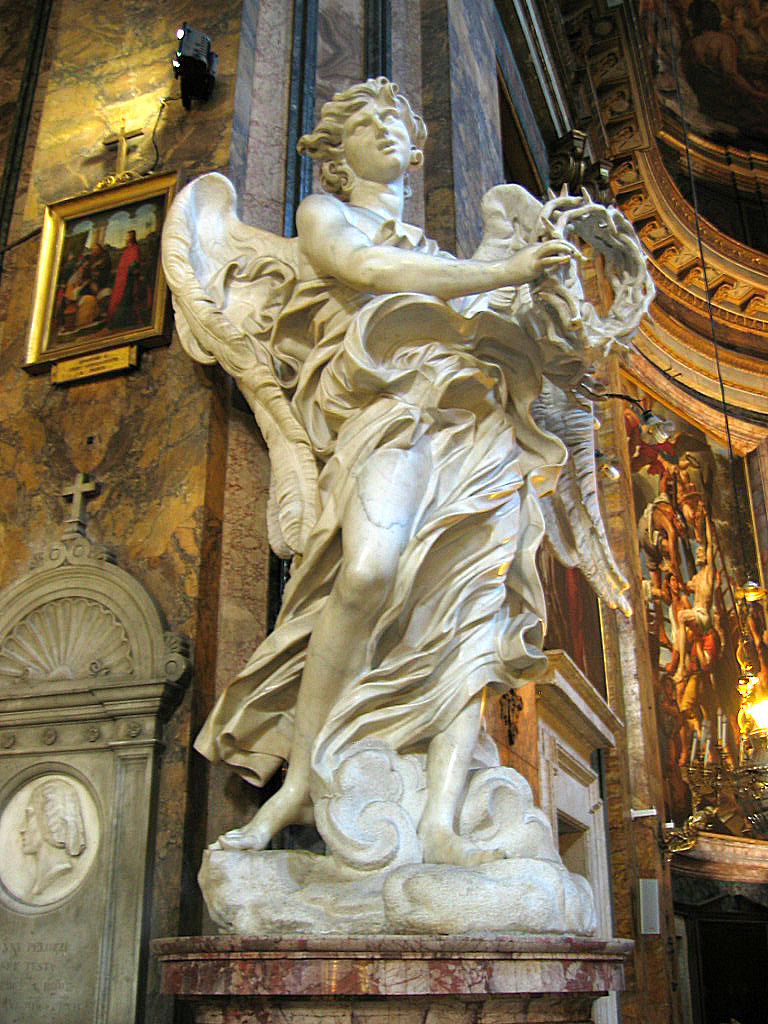
“Angel carrying Titulus Crucis with INRI inscription” and “Angel carrying Crown of Thorns” 1667/69 by Gian Lorenzo Bernini (1598/1680) for Clement IX Rospigliosi (1667/69)
The two marvelous masterpieces were donated to the church in 1729 by Prospero Bernini, the grandson of the master, who had bought them from the heirs of the pope who had them replaced with copies on Sant'Angelo's Bridge, not to save them from the weather, as it is usually said, but to have them shipped to Pistoia, his hometown
“The angel with the crown of thorns is pretty solid, and combines the drapery invested by the wind (which Bernini had previously used for the angels of St. Peter's Chair) with the drapery's bow boldly jutting out, which echoes the shape of the crown and almost divides the body in two. The other angel, holding the inscription, shows a highly emotional state of mind, almost neurotic, has very slender proportions and he is appropriately dressed in a robe whose folds are broken, they overlap, they roll up with restless, nervous trends” (Rudolf Wittkower)
Above the side doors of the presbytery “St. Andrew led to Martyrdom” and “Flagellation of St. Andrew” about 1707 maybe by Giovanni Antonio Grecolini (1675/1725)
LEFT TRANSEPT - CHAPEL OF S. ANNA
1749/51 Luigi Vanvitelli (1700/73) and 1822 Giuseppe Valadier (1762/1839) with his father Luigi Valadier (1726/85) to whom the entire work has recently been assigned
“St. Anne, St. Joachim and Mary child” 1759 by Giuseppe Bottani
Under the altar reclining statue of “St. Anna” 1750/52 by G.B. Maini (1690/1752)
Stucco and nineteenth-century reliefs by Luigi Fontana (1827/1908)
PASSAGE TO VIA CAPO LE CASE
“Tombstone tomb of the Prince from Lorraine Nicolò Simone” 1734 by Filippo Baldi
4th LEFT - Formerly SCARLATTI CHAPEL
Renewed in 1883 by Virginio Vespignani (1808/82)
“St. Joseph with the Child” 1632 by Francesco Cozza (1605/82)
On the right “St. Joseph adoring the Child” and on the left “Marriage of the Virgin” by Giuseppe Capparoni
1950 Marcello Piacentini (1881/1960)
“Our Lady of the Miracle” by Natale Carta (1790/1884)
The miracle in question was the apparition of Our Lady to the Jew Alfonzo Ratisbonne who had entered the church to admire the architecture and then ended up converting
Tabernacle by Alfredo Biagini (1886/1952)
Side paintings: “Apparition of the Virgin to Ratisbonne” and on the left “Baptism of the Jew” by Domenico Bartolini (1827/84)
On the altar of this chapel the Polish priest, who later became saint, Maximilian Kolbe celebrated his first Mass
He died in the concentration camp of Auschwitz in 1941, sacrificing himself instead of another prisoner. He had hidden some 2,000 Jews from the Nazis in his convent at Niepokalanòv
2nd LEFT - CHAPEL OF THE CROSS
1661/73 Giovanni Somazzi
Plaques in memory of the sailors who died in the two world wars
Vault “Eternal Father” maybe by Guillaume Courtois aka Borgognone (1628/79)
1st LEFT - CHAPEL OF THE VIRGIN MARY
Altarpiece “Virgin Mary with saints and donors” by an anonymous seventeenth-century artist
On the sides there are the oldest frescoes in the church: on the right “Nativity of the Virgin” and on the left “Annunciation” by Avanzino Nucci (1552/1629)
In the room before the entrance to the sacristy SMALL CHAPEL OF S. FRANCIS OF PAOLA 1723 with the painting “St. Francis of Paola in adoration of the Cross” 1722 by Giovanni Odazzi (1663/1731)
SACRISTY
“Crucifix” by Ludovico Gimignani (1643/97)
Vault “St. Francis of Paola in the ecstasy of the three crowns” by Giacomo Triga (1674/1746) pupil of Benedetto Luti
CAPITULAR ROOM
Fresco “Crucifix and St. Francis of Paola” about 1640 by Francesco Cozza (1605/82)
CLOISTER
Begun in the years 1595/99 by Gaspare Guerra (about 1560/1622), completed in 1734
“Six lunettes with stories of St. Francis of Paola” by Francesco Cozza and maybe Pasquale Marini (about 1660/about 1712), Augusto Rosa son of Salvator Rosa and Francesco Gherardi

Tuesday, August 9, 2016

CORSINI PALACE - CORSINI GALLERY (seventh part)

Room VI - Green Cabinet
“The room was one of the reception rooms of the apartment of Neri Maria and, together with the two following room, it was destined to receive guests. At the time of Cardinal Andrea Corsini (1735/95), who succeeded his uncle as the owner of the apartment, the room had undergone a series of transformations (1777/79). (...) The current structure of the hall dates back to 1907 when, to gain a greater exhibition space for portraits, the living room and the adjacent chapel were demolished” (Official Website of the Galleria Corsini - galleriacorsini.beniculturali.it)
“Marble head of Silenus” second century AD
“Bust of Pope Clement XII Corsini (1730/40)” by Pietro Bracci (1700/73) who immortalized precisely and mercilessly the severe and frowning grin of Pope Corsini
“Portrait of Cardinal Neri Corsini senior (1599/1678)” by G.B. Gaulli aka Baciccio (1639/1709)
Beautiful “Madonna and Child” by the specialist G.B. Salvi aka Sassoferrato (1609/85)
“Portrait of a Knight of the Order of Sts. Maurice and Lazarus” by Agostino Carracci (1557/1602) brother of Annibale
“In the painting movement which he founded with his brother and that had in his heart the Accademia dei Desiderosi (Academy of Desiring), later Incamminati (Walkers), he was the theoretician and the researcher. Of this critical attitude and interpretation of the formal values of the great masters are proof his engravings” (Enciclopedia Treccani)
Sketch by Francesco Cozza (1605/82) for the “Pieta” in Room II
“Portrait of Cardinal Giacomo Savelli” by Scipione Pulzone (about 1550/98)
“Pupil perhaps of Jacopino del Conte, he reached fame with his portraits of famous Roman people, inspired by the sixteenth-century Flemish portraiture, portrayed with great technical ability and virtuosic attention the physical characteristics and social attributes of the subjects” (Enciclopedia Treccani)
“St. Anthony of Egypt” by Antonio Allegri aka Correggio (1489/1534)
“Portrait of Cardinal Ferdinando de' Medici” school of Alessandro Allori aka Bronzino (1533/1607) pupil of Agnolo di Cosimo aka Bronzino
“Portrait maybe of Guercino” by Guido Cagnacci (1601/63), a pupil of Guido Reni but influenced by Caravaggio
“After a start vaguely influenced by Caravaggio he approached Guido Reni, accepting Venetian influences in a personal way. He did not disdain strong baroque effects only to compose himself eventually in a measured classicism” (Enciclopedia Treccani)
“Portrait of Luigi Scaramuccia” by Francesco Cairo (1607/65)
“Portrait of Cosimo Medici III” by the Flemish Giusto Susterman (1597/1681)
“Cantarini was the best student of Guido Reni and the only painter of his circle to be able to formulate a highly personal style: his rich palette, the colors slightly graduated and new inflections in the poses of the figures helped to introduce in Bologna the painting more delicate and intimate of the last decades of the seventeenth century. His influence is evident in particular with the work of his pupil Lorenzo Pasinelli, and of the younger Donato Creti” (Dwight C. Miller - Dizionario Biografico degli Italiani Treccani)
“In the self-portrait of Simone Cantarini the message is clear and direct: the viewer observes the painter who observes himself and wonders in the mirror pretending to look at the model. Art, therefore, is a mirroring of life, a pattern or a project to follow with passion and absolute dedication” (Sivigliano Alloisi)
“Portrait of a Man” copy from Francesco di Cristofano aka Francabigio (1484/1525)
“Portrait of a Man possibly Pietro Strozzi” by Pier Francesco di Jacopo Foschi (1502/67)
“Portrait of a Man” by the French Claude Lefebvre (1637/75)
“Portrait of Michele Peretti” about 1608 by Pietro Fachetti (1535/post 1616)
Michele Peretti was the great-nephew of Sixtus V Peretti (1585/90)
“While not free from the influence of Scipio Pulzone, this painting stands out for the richness of colors, dense and condensed in the game of the flesh which results in a plastic-linear firmness that is linked to a nagging of lights of enhanced accuracy. It is a testimony of a complex training in which the influence of Caravaggio's portraits are grafted onto a culture that is still affected by memories of Mantua, Flemish and even from Rubens” (Sivigliano Alloisi)
“Portrait of a Man” by Ottavio Leoni (1578/1630)
“Portrait of a Man” by Carlo Maratta (1625/1713)
“Portrait of a Man” by Bartolomeo Passerotti (1529/92)
“Portrait of a Man” by Franz Pourbus the Younger (1569/1622)
“Portrait of a Man” by an artist of the French school of the seventeenth century
“Portrait of a Nun” by an artist of the Bolognese school
“St. John the Baptist as a young man” by an artist of the Emilia school
“Portrait of two Young Princes” and “Portrait of a Woman” maybe by an artist of the Parma school
“Portrait of a Gentleman” by an artist of the Venetian school of the sixteenth century
“Jacob De Heush is one of the Italianate painters less sensitive to his culture of origin (...). His landscapes are affected by Salvator Rosa, but do not have the vigor and inventiveness of the Neapolitan painter. He mainly painted marine and deep bays animated by fantastic rocks, towers, canals and gesticulating figures who exercised a certain influence on the Roman painters of the next generation” (Sivigliano Alloisi)
“Shepherd with herd” by the Roman Andrea Locatelli (1693/1741)
“Landscape with marina and ruins”, “Landscape with marina and lighthouse”, “Landscape with cliff” and “Landscape with ruins” by Salvator Rosa (1615/73)

Friday, January 3, 2014

TREVI FOUNTAIN

FONTANA DI TREVI
1732/51 Nicola Salvi (1697/1751) for Clement XII Corsini (1730/40)
It was completed in the years 1751/62 by Giuseppe Pannini (about 1720/about 1810) (son of the painter Giovanni Paolo Pannini) after the death of Salvi in 1751
It is called "Trevi" maybe because it comes from an area formerly known as Trebium (country house) whose name has since disappeared or maybe because it is situated at the confluence of three roads (Trevio o Treio) the current Via Poli, Via Crociferi and Via delle Muratte
The water still comes from the AQUA VIRGO, the aqueduct built in 19 BC by Marcus Agrippa. The springs are at Salone, at the eighth mile of the Via Collatina towards Via Tiburtina, in the Ager Iucullanus between Rome and Tivoli
These springs are 20 km (12.4 miles) away and at a level of height above the fountain of just 6 meters (19 feet). There are no pumps, and water is driven only by force of gravity
It is the only one of the eleven ancient Roman aqueducts to have been always working with only short periods of closure
The aqueduct was restored by Hadrian I (772/795) and in 1453 by Leon Battista Alberti (1406/72) and Bernardo Rossellino (1409/64) for Pope Nicholas V Parentucelli (1447/55)
The great Renaissance architects embellished the old fountain located on the east side of the square (where now Via della Stamperia begins) in the style of their time
PROJECTS to modernize the fountain were entrusted to Giacomo della Porta (1533/1602), Gian Lorenzo Bernini (1598/1680) and Pietro Berrettini aka Pietro da Cortona (1597/1669), but they were never realized
The project by Bernini saw only the foundations completed and a basement. The Tomb of Cecilia Metella had been chosen by Urban VIII Barberini as the place from which building materials could have been taken to build the new fountain but fortunately the tomb was spared
Clement XI Albani (1700/21) restored the aqueduct in 1706, and Clement XII Corsini (1730/40) held a contest in 1732 which was won by Nicola Salvi out of 16 projects on display at the Quirinale Palace. The choice of Salvi was due to the insistence of Cardinal Neri Corsini, nephew of the pope, even though the Cement XII had also liked the project by Luigi Vanvitelli (1700/73)
It was inaugurated in 1744 by Benedict XIV Lambertini (1740/58), but it was only finally completed in 1762 for Clement XIII Rezzonico (1758/69) with all the sculptures
It occupies a whole façade of PALAZZO POLI formerly known as Palazzo Ceri
"It represents a perfect synthesis of architecture, sculpture and natural elements. The fundamental theme guiding the work of Salvi is the movement, the perpetual changing of things, of which water, by its very nature is a primary symbol. And the fountain is intensely animated in different parts: in the free-flowing and turbulent water flow, in the irregular shape of the cliff, in the groups of sculptures emerging from it. The magnificent architectural backdrop curtain is rooted in the cliff: Palladian in the lexicon, but rearranged in the articulation of its syntactic elements (see the crowning of the windows on the second order, which breaks the continuity of the cornice, or the free frieze in the attic) and vibrant in the chiaroscuro effect" (Carlo Bertelli, Giuliano Briganti, Antonio Giuliano)
"In the Trevi Fountain (...) the show of water finds its most complete and spectacular expression, from the blades of the central cylindrical cascade to the naturalistic configuration of the smaller bodies of water nested among the rocks, to the geometrical boundary of the basin, it is a continuous interplay of artifice and nature in which the travertine with its rough and chiaroscuro surfaces plays an important role as a mediator between marble's bright stillness and the vibrant race of the waters" (Paolo Portoghesi)
Group of "Ocean" on a shell chariot with "Two Mermen and two Winged Horses" executed at forst in stucco in 1741 by G.B. Maini (1690/1752) and later in marble in the years 1759/62 by Pietro Bracci (1700/73) who was given the task of finishing the work after the Maini's death
The two horses represent the sea respectively calm and rough and are provided with fins instead of hooves
"Bracci's Ocean a little frivolous, standing as a dancing teacher on a huge rockery shell is far from the spirit of the works of Bernini, as it is the picturesque character of the numerous rivulets, or the artificial union of conventional basins with natural rocks. However, the Trevi Fountain is the beautiful swan song of an era that owed all of his vital impulses to one great artist, Gian Lorenzo Bernini" (Rudolf Wittkower)
On the right "Health" 1759/62 and on the left "Wealth" 1759/62 by Filippo Della Valle (1698/1768)
"Very similar to the Temperance of the Corsini Chapel in San Giovanni in Laterano, even though they are a prelude to the incipient classicism for their greater simplicity and firmness of composition" (Carlo Bertelli, Giuliano Briganti, Antonio Giuliano)
RELIEFS:
On the right "Virgin indicating the location of the source to the Roman troops" by Andrea Bergondi (active in Rome XVIII century)
In the upper part FOUR ALLEGORICAL STATUES representing the seasons, carved in 1735, from left:
"Plenty of fruits" by Agostino Corsini (1688/1772)
"Fertility of fields" by Bernardino Ludovisi (about 1713/49)
"Gifts of Autumn" by Francesco Queirolo (1704/62) pupil of Antonio Corradini with whom worked in the amazing Cappella Sansevero in Naples
"Amenities of the meadows" by Bartolomeo Pincellotti (active since 1735/d. 1740) who also made the decoration of the cliff
CENTRAL INSCRIPTION with crest of Clement XII Corsini (1730/40) who commissioned the fountain and on the sides representations of "Fame" 1736 by Paolo Benaglia (?/1739)
The rococò elements of the fountain as the shell on which Ocean stands, for example, are entirely subordinate to a strong late baroque classic style that, despite the crowds and illegal vendors always present, never fails to fascinate and amaze
On the right of the fountain there is a large vase, known as "Asso di Coppe" (Ace of Cups), because it looks like one of the card of this suit. It is said to have been placed there by Salvi to prevent the sight of the fountain to a barber who was constantly criticizing his work from his shop
The tradition of throwing coins into the fountain hoping to return to Rome is perhaps connected with the Roman tradition disappeared at the end of 1800 of the fontanella degli amanti (little fountain of lovers): when a young man had to leave Rome he was accompanied by his girlfriend to the Trevi Fountain to make him drink the water with a new glass which, after the ceremony, was broken. This meant a wish for eternal love
The money being thrown into the water every year by tourists (in 2005 about € 900,000 were collected) is given to the Caritas diocesiana, a registered charity institution of the Vatican. They use it for charitable activities including a supermarket where homeless people can get food for free

Sunday, October 13, 2013

BASILICA OF Sts. JOHN AND PAUL

BASILICA SS. GIOVANNI E PAOLO
About 398 for the senator Bizante and his son Pammachius senator as well. Pammachius was a leading figure of the Christian community, a friend of St. Jerome and a saint himself for the Catholic Church
The church was built over the TITULUS PAMMACHI. According to a late tradition it was the Titulus of the two officers of Constantine (306/337) John and Paul. They would have been martyred and buried here in 362 during the persecution of Julian the Apostate (361/363)
It was damaged by the sack of the Goths of Alaric in 410, by an earthquake in 442 and by the Normans in 1084
Paschal II (1099/1118) rebuilt the MONASTERY and began the BELL TOWER which was completed in about 1150 for the Cardinal Giovanni dei Conti di Sutri along with the porch, which was maybe executed by Nicola d'Angelo
The foundations of the TEMPLE OF CLAUDIUS were kept as a base for the bell tower
The church was consecrated again in 1157
"Between 1099 and 1118 some monastic buildings were erected near the Church of Sts. John and Paul. The massive ruins of the Claudianum, an old water cistern built with large blocks, were used, creating a formidable defensive stronghold. The complex was further strengthened in the mid-thirteenth century, when the buildings were enlarged and the lower tower built fifty years before was raised to the imposing height it still has today" (Richard Krauutheimer)
Restored about 1199/1216 for Cencio Savelli later Pope Honorius III (1216/27)
In the years 1950/52 Cardinal Francis Spellman Archbishop of New York had the early Christian façade restored
Since 1946 with Cardinal Spellmann the church has always been the seat of the Cardinal Archbishop of New York. Before Spellmann the titular cardinal for 10 years (1929/39) was Cardinal Eugenio Pacelli, later Pope Pius XII (1939/58)
The current titular is Edward Michael Cardinal Egan Archibishop of New York
INTERIOR
Restoration 1715/18 Antonio Canevari (1681/1759) and Andrea Garagni for Cardinal Fabrizio Paolucci
Other minor changes were made later
The FLOOR dates back to the thirtheenth century, but it was almost completely rebuilt in the nineteenth century
OCTAGONAL VESTIBULE
At the beginning of the right nave "Busts of Cardinal Paolucci and Pope Innocent XII Pignatelli (1691/1700)" 1725 Pietro Bracci (1700/73)
1st ALTAR ON THE RIGHT
"St. Saturninus destroys the idol" 1716 by Marco Benefial (1684/1764)
CHAPEL OF St. PAUL OF THE CROSS second half of nineteenth with body of St. Paul of the Cross
AT THE CENTER OF THE NAVE
Plaque commemorating the site of the martyrdom of Sts. John and Paul
"Christ in Glory" 1588 by Cristoforo Roncalli aka Pomarancio (1552/1626)
MAIN ALTAR
Made out of a porphyry tub with relics of Sts. John and Paul
Above the altar "Martyrdom of St. John" 1726 by Giovanni Domenico Piastrini (1678/1740)
At the sides "Martyrdom of St. Paul" 1726 by Giacomo Triga (1674/1746) and "Conversion of Terenziano" 1726 Pietro Andrea Barbieri (1684/1730)
"Angels" in stucco 1726 by Pietro Bracci
AT THE END OF THE LEFT NAVE
Room with remarkable painting "Christ enthroned between six Apostles" about 1255
"The group of Apostles, inserted between arches, is rendered with such graphic emphasis that it is possible to perceive some trends already visible in the paintings in the chapel of St. Sylvester at the Basilica of Santi Quattro Coronati" (Enrico Parlato)
LEFT NAVE
Paintings by Aureliano Milani (1675/1749) and Tommaso Conca (1734/1822)
SACRISTY
Painting on wood "Madonna and Child with Saints" by Antonio Aquili aka Antoniazzo Romano (1452/1508)