Showing posts with label Roman Jewish. Show all posts

Tuesday, January 28, 2020

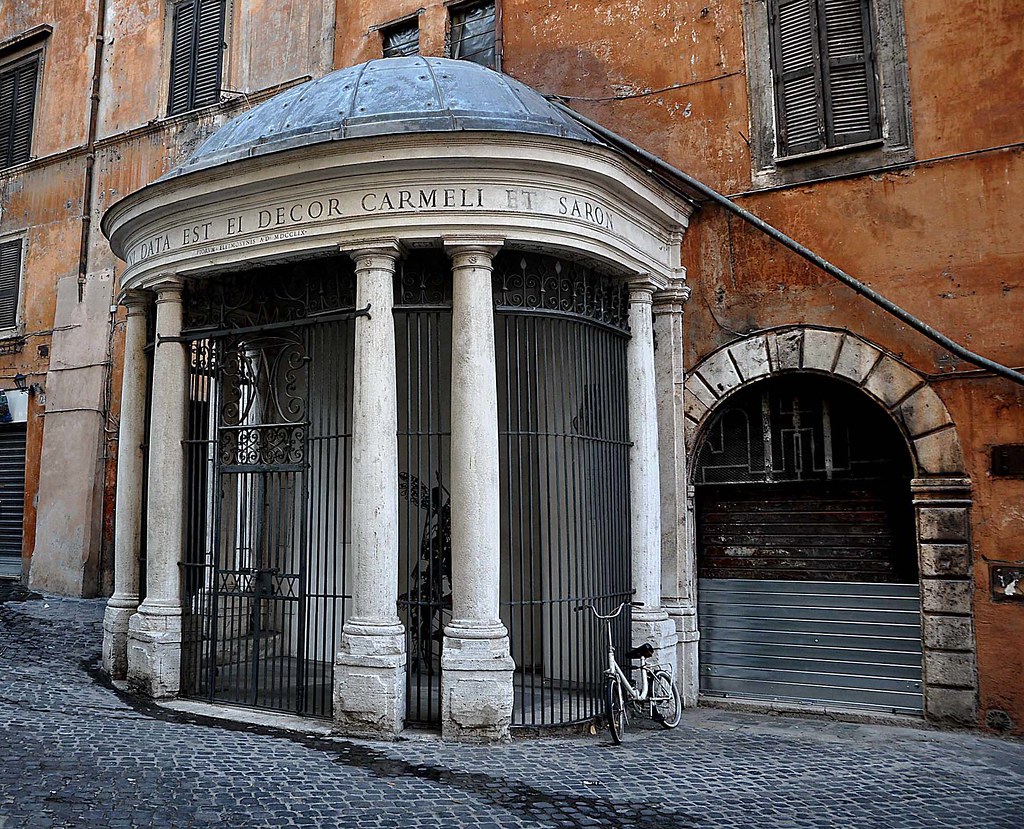
SMALL TEMPLE OF MOUNT CARMEL

TEMPIETTO DEL CARMELO
Piazza Costaguti

Built in 1759 as a small church with the name of S. MARIA DEL CARMELO used for Christian sermons forced on the Roman Jews who often would fill up their ears with wax so not to hear

1825 restoration for the rich Fratellini family, grocers who lived near the Ghetto

“It is inspired by the portico of S. Maria della Pace. It represents an evolution of the monumental shrines that besides being an object of devotion, ensured the night lighting because they were provided with lights that were kept always on. The image of the Virgin Mary is, in this case, placed in a chapel that would have the function of a church” (Alessandra Bartomioli)

It was a member of the Order of Carmelites, the Englishman St. Simon Stock, to create the feast of Our Lady, which was called del Carmine (of Mount Carmel), the most common form of the term Carmel, the mountain range of Palestine where monks following the example of the Prophet Eli used to live

Tradition has it that on the Carmel mountain range Our Lady appeared to St. Simon Stock on July 16, 1251

“For years, the agency Italia Nostra is fighting for its recovery, but every attempt of the Superintendent was blocked by the impossibility to access the building. The last occupant was a shoemaker, who was renting it from a mysterious owner. Before he died, in the seventies, he left the keys to a un unknown person. Now the temple has its rusty iron door tightly closed. There are two people who say they are renting it from a mysterious owner who had emigrated to Israel. But research conducted in Israel by the Superintendent to find him came to nothing. In the solution of the mystery, is now engaged the architect Arianna Cajano, who is about to begin a procedure called in legal jargon 'intervention in place', whereby the restoration of the monument will proceed and then the costs will be charged to the owner. If he will not turn up, the Temple will become public property” (Lauretta Colonnelli - Corriere della Sera - 16 January 2001)
The restoration was actually executed and the temple was entrusted to the Jewish community in Rome

Thursday, April 19, 2018

St. ANGELO IN THE FISH MARKET

S. ANGELO IN PESCHERIA
Diaconia (building for assistance and charity to the poor, the sick and pilgrims) dedicated to St. Paul, founded in the year 755, maybe on a previously existing church dating back to the fourth or sixth century, built in turn on the ruins of the PORTICO D’OTTAVIA
This information was taken from an inscription embedded on the left wall of the entrance room
In the twelfth century it was dedicated to S. Angelo and was named S. Angelo in Foro Piscium (St. Angel in the Forum of Fish) for the presence of the nearby fish market
Restored in 1583 by Martino Longhi the Elder (1534/91) and in 1599 by Giacomo Della Porta (1533/1602)
Other restorations in the years 1700, 1719, 1741, 1821
Last renovation in 1864 Alessandro Betocchi for Pius IX Mastai-Ferretti (1846/78)
“The engineer Alessandro Betocchi, also intervened on the outside: he knocked down the huts on the left side of the front of the Propylaeum with the aim to restore its original appearance, he destroyed the wall that was partially hiding the arch and carried out an excavations to bring to light the Roman walkway. Inside he also freed the three columns and the façade of the church was moved back from them. The façade was plastered with the aim to put even more emphasis on the difference with the Roman ruins” (Pier Paolo Racioppi)
In 1929 the roof with trusses was rebuilt after the collapse of the vault in 1928
Here the Roman Jews were forced to listen to the sermons of the Jesuits who wanted to convert them
1st CHAPEL ON THE RIGHT
Above the altar “Apparition of the Blessed Trinity to Sts. Cyrus and Lorenzo” by G.B. Brughi (1660/1730) pupil of Baciccio
Above the altar “St. Andrew” maybe by Marco Tullio Montagna (1594/1649) from Velletri, pupil of Federico Zuccari
On the right “The Calling of St. Andrew” in 1619 by Bernardino Cesari (1571/1622), brother of Giuseppe Cesari aka Cavalier d'Arpino
Frescoes “Stories of St. Andrew, Evangelists and saints” about 1599 maybe by Innocenzo Tacconi (active in Rome 1607/25)
Coat of arms in the floor in opus sectile (inlaid marble) of the University of Fishmongers who had the chapel restored in 1618. The fish symbol is accompanied by the deer, symbol of old nobility and the Capitoline geese, symbol of fidelity
MAIN ALTAR
“St. Michael” 1862 copy by Angelo Augero of the famous original by Guido Reni in S. Maria della Concezione
Under the altar “Early Christian sarcophagus” with relics of St. Cyrus of Alexandria
2nd CHAPEL ON THE LEFT
Above the altar “Madonna and Child with Angels” 1450 maybe by Benozzo di Lese aka Benozzo Gozzoli (1420/97)
He was called Gozzoli by Giorgio Vasari in the 1568 edition of his book dedicated to the lives of the artists, but all the other existing documents identify him as Benozzo di Lese
It is a fresco that was detached from the outer wall of the church and was moved here to be better preserved
“He worked with Ghiberti (...), but he was born to art with Fra Angelico: it is assumed with convincing evidence that he was his help during the work in the Convent of S. Marco in Florence, and worked with him in March of the year 1447 in the Vatican and in June of the same year in Orvieto, in the Chapel of S. Brizio in the Duomo. (...) It is also likely that he helped Angelico with the frescoes in the Chapel of Nicholas V in the Vatican painted in those years. Benozzo became independent late, in his thirties, and always under the influence of the mystical severity of his teacher. But also his familiarity with Ghiberti left in him a clear pattern: that loving attention to the world around him and his pleasant capacity of materializing Angelico's style” (Emma Micheletti - Dizionario Biografico degli Italiani Treccani)
1st CHAPEL ON THE LEFT - CHAPEL OF THE CROSS
“Wooden crucifix” of the sixteenth century
Above the entrance doors of the side aisles “St. Francis Caracciolo converts a courtesan” and “St. Francis Caracciolo adoration of the Eucharist” 1808 by Francesco Manno (1752/1831)
TO THE RIGHT OF THE PROPYLAEUM OF PORTICO D’OTTAVIA
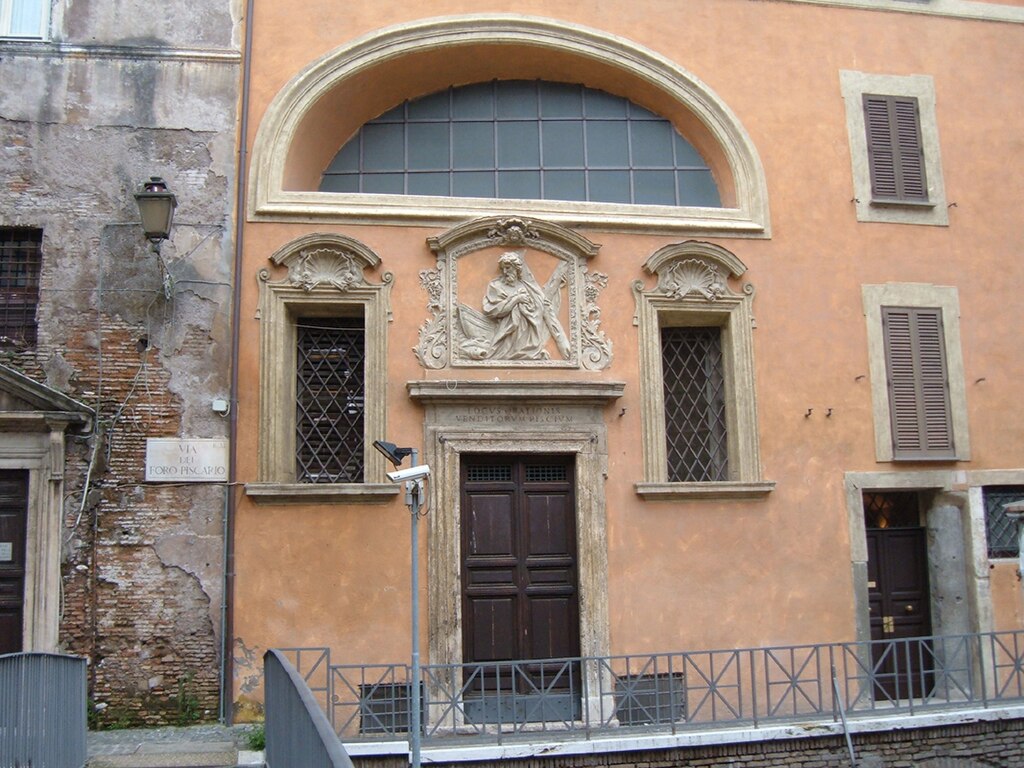
Oratory of St. Andrew of the Fishmongers 
1688/89 Filippo Tittoni
Façade with stucco restored in 1928
It was dedicated to St. Andrew, the apostle who was a fisherman
Inside the church “Busts of the Evangelists and of the Fathers of the Church” maybe by Lorenzo Ottoni (1648/1736) and Michel Maille aka Michele Maglia (active in Rome in the second half of the seventeenth century)
It is now owned by the Municipality of Rome and it is used for commercial activities