In ROOM XXXII new exhibition of the MATISSE ROOM with “Studies
for the Chapelle du Rosaire in Vence” 1949 by Henri Matisse (1869/1954)
The Chapel of the Rosary was his last and most important
sacred work made in the years 1950/54
“The comparison of the study, kept here, for the image of the
Madonna and the work actually executed demonstrates the transition from an
initial figure of Byzantine style to one that finds comparisons in Chinese art.
Vence's production of is for the master of Cateau Cambrésis, eighty-two at the
time, the ultimate goal of a lifetime devoted to the work as he himself wrote
in the publication dedicated to the chapel” (Andrea Pomella)
In the Matisse room is also exposed the colossal “Madonna in
limestone” by Lucio Fontana
(1899/1968)
“Christ in the Garden” by Mario
Radice (1898/1987)
Pastel on paper “The Mother”
by Umberto Boccioni 1907 (1882/1916)
Two decorated ceramics by Pablo Picasso
(1881/1973)
Oil on canvas “El
martyrdom de San Esteban” 1944 by José
Clemente Orozco (1883/1949)
“He is considered, with Rivera and Siqueiros, one of the most
important exponents of Mexican painting. From his early works he showed a
tendency to break ties with European art to reconnect to local issues and
pre-Columbian Mexico. The Mexican Revolution gave this trend a precise content
of a political and social development for his effective and creative power as
an artist. His work, dramatic, forceful, full of primal grandeur, found its
truest expression in the numerous and monumental frescoes in Mexico City”
(Enciclopedia Treccani)
Tempera on canvas “S. Martino”
1941 and “Talk: the disciples” 1936 by Mario Sironi
(1885/1961)
“The three figures are imposed on the scene with the
monumentality that is typical of megaliths. The matter of the pictorial is raw,
unrefined, almost similar to a cave painting. The solemnity is given by the unmoving
sense of suspended time that imprisons the characters within a framework of the
physical limits of pictorial support” (Andrea Pomella)
“Journey to
the Ecumenical Council” by the Colombian Fernando Botero (b. 1932)
Pastel on paper “Assumption”
1925 by Alberto Martini (1876/1954)
Relief in wax “Aetas
Aurea” 1886 (copy made after 1895) by Medardo Rosso
(1858/1928)
Oil on cardboard “Crucifixion”
1934 by Fausto Pirandello (1899/1975)
“The fall of the angel” 1963 by Marino
Marini (1901/80)
Oil on canvas “La danse
macabre” 1964 on paper and canvas “Triumph of
St. Thomas Aquinas” 1948/49 by Gino
Severini (1883/1966) study for the Catholic University of Fribourg
“Important member of the surrealist movement: from the mixture
of image and poetic words in the experiments of 'automatic writing' he created
his collages and collage-novels (La femme 100 têtes, 1929; Une semaine de
bonté, 1934), among the most representative works of Surrealist art. He also
produced sculptures (Capricorn, 1948) and objects trouvés and created
compositions and fantastic landscapes” (Enciclopedia Treccani)
Oil on canvas “Still Life”
1947 by Alberto Burri (1915/95)
“Crucifixion”
1927 by Gerardo Dottori (1884/1977)
“In 1929, along with Balla, Marinetti, Depero, Prampolini,
Luigi Colombo (Fillia), M. Somenzi, Guglielmo Sansoni (Tato), he signed the
aeropainting manifesto, inspired in part also by his research on the 'total'
landscape. His position in the second futurism was original and detached while
Prampolini and Fillia were pushing the research of the group towards a sort of “semi-surrealism”,
Dottori remained true to his lyrical and contemplative images, combining the
dynamism of the modern vision to the mystical sense of nature, following the
pictorial tradition of central Italy “ (Valerio Rivosecchi - Dizionario
Biografico degli Italiani Treccani)
“Supper at Emmaus” 1941 by Ardengo
Soffici (1879/1964)
Oil on canvas “Still life
among bottles, coat and hat” 1946 and oil on canvas “Church
Annunziatina in Rome” 1938 by Mario
Mafai (1902/65)
“With his wife Antonietta Raphael and Scipio he was one of
the creators of the 'Roman School' of painting, which was seen in 1930 as a
reaction against the rhetoric of the 'Novecento' (1900s) movement by
implementing a tonal painting, emotional and imaginative. After the first expressionistic
paintings his style became more balanced with compositions of flowers and
landscapes in which light, in the tonal relationships of color, creates forms
plastically. That was his more inspired period, yet not without its tensions
with the trends of contemporary art, revealing an almost underground
controversy in Demolition, a series of paintings that, in the elegiac
exaltation of the destroyed old houses, opposed fascist urban planning in Rome”
(Enciclopedia Treccani)
Model of the gigantic sculpture (20 m - 66 feet) “Resurrection”
1970/75 for the Paul
VI Hall by Pericle Fazzini (1913/87)
It was inaugurated in 1977 and, to put it together, the
entire church of S.
Lorenzo in Piscibus near St. Peter's Square was made available to
the artist
Huge bronze bas-reliefs “The Synod” by Lello Scorzelli (1921/1997)
“The idea of these figures arose from the constant and
emotional participation of the artist to the solemn ceremonies of the Council,
mingling among the multitude of believers, coming up to the highest hierarchy
of the Church and finally also absorbing expressions, gestures and traits of
two popes” (from the Editalia publication The Bronzes of the Synod)
Colorful ceramics and “Portrait
of Vrania G. (Study of a woman saint)” 1949 by Lucio Fontana (1899/1968)
Oil on canvas “Study for
death” 1947 by the American Franklin
Watkins (1894/1972)
“Jacob Lawrence was one of America's greatest 20th Century
artists with a spectacular flair for composition and social comment. His
brightly colored works are a blend of realism and abstraction and have a
kindred spirit with the oeuvres of Stuart Davis and Ben Shahn, but his
inventive eye places him with Monet in the pantheon of those artists gifted
with infinite riches of compositional creativity” (Carter B. Horsley -
www.thecityreview.com)
Colored lithograph on paper “Doves
(l'oiseau traversant le nuage)” 1957 by Georges Braque (1882/1963)
“He gave life to Cubism with Picasso and Apollinaire. His
activities in the period 1910/14 is characterized by extreme simplification of
the figurative elements and compositions, with frequent use of 'collage'. Among
the leading exponents of modern art movements, Braque is perhaps the more
'artist', i.e. the one that best knows how to incorporate into a pure formal
relations profoundly moving poetry” (Enciclopedia Treccani)
Two similar works in mixed media on canvas paper: “Crucifixion”
1968 and “Crucifixion”
tribute to Martin Luther King jr.” 1968 by Mirko (Mirko Basaldella) (1910/69)
Xylography
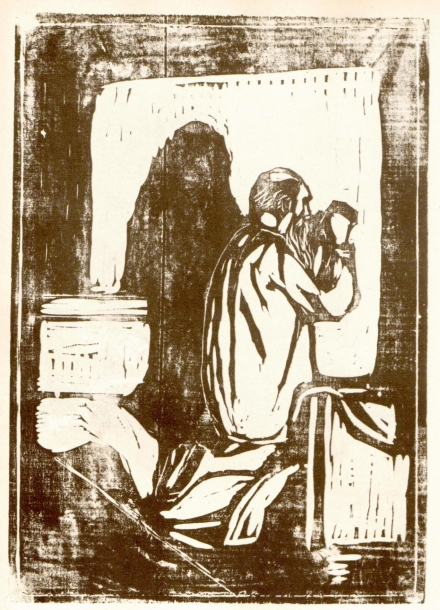
printed on Japanese wooden paper "Old man in prayer" 1902 by Edvard Munch (1863/1944). He represented his father as
he saw him coming home after a strong row with him
“The big dark shadow projected on the wall (...) performs the dual function of looming dark otherness and of silent partner. A presence that threats, protects an opens towards an unknown darkness. (...) Between 1897 and 1899 he retreated to Norway and dedicated himself especially to xylography, taking the achievements of Gauguin to the extreme” (Francesca Boschetti - Catalogue of the exhibit Bellezza Divina)
“The big dark shadow projected on the wall (...) performs the dual function of looming dark otherness and of silent partner. A presence that threats, protects an opens towards an unknown darkness. (...) Between 1897 and 1899 he retreated to Norway and dedicated himself especially to xylography, taking the achievements of Gauguin to the extreme” (Francesca Boschetti - Catalogue of the exhibit Bellezza Divina)
In the collection
there are also works by:
Paul Klee (1879/1940), Felice Carena (1879/1966), Giovanni Carnovali (aka il Piccio) (1804/73), Felice Casorati (1883/1963),
Henry Moore (1898/1986), Paul Gaugin (1848/1903), Francisco Goya (1746/1828), Giacomo Manzù (1908/91), Luciano
Minguzzi (1911/2004), Charles-Edouard Jeanneret aka Le Corbusier (1887/1965),
Vasilij Kandinskij (1866/1944), Arturo Martini (1889/1947), Amedeo
Modigliani (1884/1920), Giacomo Balla (1871/1958),
Emilio Greco (1913/95),
Franco Gentilini (1909/81), Carlo Levi (1902/75), Anselmo
Bucci (1887/1955), Achille Funi (1890/1972),
Giovanni Prini (1877/1958), Umberto Mastroianni (1910/98),
Ivan Meštrović (1883/1962), Giuseppe Capogrossi (1900/72), Otto Dix (1891/1969) and Oskar
Kokoschka (1886/1980)