Showing posts with label Collection of Religious Modern Art in the Vatican. Show all posts

Saturday, March 21, 2015

VATICAN MUSEUMS - COLLECTION OF RELIGIOUS MODERN ART (second part)

COLLEZIONE D’ARTE RELIGIOSA MODERNA
 

In ROOM XXXII new exhibition of the MATISSE ROOM with “Studies for the Chapelle du Rosaire in Vence” 1949 by Henri Matisse (1869/1954)

The Chapel of the Rosary was his last and most important sacred work made in the years 1950/54

“The comparison of the study, kept here, for the image of the Madonna and the work actually executed demonstrates the transition from an initial figure of Byzantine style to one that finds comparisons in Chinese art. Vence's production of is for the master of Cateau Cambrésis, eighty-two at the time, the ultimate goal of a lifetime devoted to the work as he himself wrote in the publication dedicated to the chapel” (Andrea Pomella)

In the Matisse room is also exposed the colossal “Madonna in limestone” by Lucio Fontana (1899/1968)

“Christ in the Garden” by Mario Radice (1898/1987)

Pastel on paper “The Mother” by Umberto Boccioni 1907 (1882/1916)

Two decorated ceramics by Pablo Picasso (1881/1973)

Oil on canvas “El martyrdom de San Esteban” 1944 by José Clemente Orozco (1883/1949)

“He is considered, with Rivera and Siqueiros, one of the most important exponents of Mexican painting. From his early works he showed a tendency to break ties with European art to reconnect to local issues and pre-Columbian Mexico. The Mexican Revolution gave this trend a precise content of a political and social development for his effective and creative power as an artist. His work, dramatic, forceful, full of primal grandeur, found its truest expression in the numerous and monumental frescoes in Mexico City” (Enciclopedia Treccani)

Tempera on canvas “S. Martino” 1941 and “Talk: the disciples” 1936 by Mario Sironi (1885/1961)


“The three figures are imposed on the scene with the monumentality that is typical of megaliths. The matter of the pictorial is raw, unrefined, almost similar to a cave painting. The solemnity is given by the unmoving sense of suspended time that imprisons the characters within a framework of the physical limits of pictorial support” (Andrea Pomella)

“Journey to the Ecumenical Council” by the Colombian Fernando Botero (b. 1932)

Pastel on paper “Assumption” 1925 by Alberto Martini (1876/1954)

Relief in wax “Aetas Aurea” 1886 (copy made after 1895) by Medardo Rosso (1858/1928)

Oil on cardboard “Crucifixion” 1934 by Fausto Pirandello (1899/1975)

“The fall of the angel” 1963 by Marino Marini (1901/80)

Oil on canvas “La danse macabre” 1964 on paper and canvas “Triumph of St. Thomas Aquinas” 1948/49 by Gino Severini (1883/1966) study for the Catholic University of Fribourg

Oil on canvas “Kruzifix” 1914 by Max Ernst (1891/1976)

“Important member of the surrealist movement: from the mixture of image and poetic words in the experiments of 'automatic writing' he created his collages and collage-novels (La femme 100 têtes, 1929; Une semaine de bonté, 1934), among the most representative works of Surrealist art. He also produced sculptures (Capricorn, 1948) and objects trouvés and created compositions and fantastic landscapes” (Enciclopedia Treccani)

Oil on canvas “Still Life” 1947 by Alberto Burri (1915/95)

“Crucifixion” 1927 by Gerardo Dottori (1884/1977)

“In 1929, along with Balla, Marinetti, Depero, Prampolini, Luigi Colombo (Fillia), M. Somenzi, Guglielmo Sansoni (Tato), he signed the aeropainting manifesto, inspired in part also by his research on the 'total' landscape. His position in the second futurism was original and detached while Prampolini and Fillia were pushing the research of the group towards a sort of “semi-surrealism”, Dottori remained true to his lyrical and contemplative images, combining the dynamism of the modern vision to the mystical sense of nature, following the pictorial tradition of central Italy “ (Valerio Rivosecchi - Dizionario Biografico degli Italiani Treccani)

“Supper at Emmaus” 1941 by Ardengo Soffici (1879/1964)

Oil on canvas “Still life among bottles, coat and hat” 1946 and oil on canvas “Church Annunziatina in Rome” 1938 by Mario Mafai (1902/65)

“With his wife Antonietta Raphael and Scipio he was one of the creators of the 'Roman School' of painting, which was seen in 1930 as a reaction against the rhetoric of the 'Novecento' (1900s) movement by implementing a tonal painting, emotional and imaginative. After the first expressionistic paintings his style became more balanced with compositions of flowers and landscapes in which light, in the tonal relationships of color, creates forms plastically. That was his more inspired period, yet not without its tensions with the trends of contemporary art, revealing an almost underground controversy in Demolition, a series of paintings that, in the elegiac exaltation of the destroyed old houses, opposed fascist urban planning in Rome” (Enciclopedia Treccani)

Model of the gigantic sculpture (20 m - 66 feet) “Resurrection” 1970/75 for the Paul VI Hall by Pericle Fazzini (1913/87)

It was inaugurated in 1977 and, to put it together, the entire church of S. Lorenzo in Piscibus near St. Peter's Square was made available to the artist

Huge bronze bas-reliefs “The Synod” by Lello Scorzelli (1921/1997)

“The idea of these figures arose from the constant and emotional participation of the artist to the solemn ceremonies of the Council, mingling among the multitude of believers, coming up to the highest hierarchy of the Church and finally also absorbing expressions, gestures and traits of two popes” (from the Editalia publication The Bronzes of the Synod)

Colorful ceramics and “Portrait of Vrania G. (Study of a woman saint)” 1949 by Lucio Fontana (1899/1968)

Oil on canvas “Study for death” 1947 by the American Franklin Watkins (1894/1972)

Tempera on paper “Builders No. 1” 1974 by the American Jacob Lawrence (1917/2000)

“Jacob Lawrence was one of America's greatest 20th Century artists with a spectacular flair for composition and social comment. His brightly colored works are a blend of realism and abstraction and have a kindred spirit with the oeuvres of Stuart Davis and Ben Shahn, but his inventive eye places him with Monet in the pantheon of those artists gifted with infinite riches of compositional creativity” (Carter B. Horsley - www.thecityreview.com)

Colored lithograph on paper “Doves (l'oiseau traversant le nuage)” 1957 by Georges Braque (1882/1963)

“He gave life to Cubism with Picasso and Apollinaire. His activities in the period 1910/14 is characterized by extreme simplification of the figurative elements and compositions, with frequent use of 'collage'. Among the leading exponents of modern art movements, Braque is perhaps the more 'artist', i.e. the one that best knows how to incorporate into a pure formal relations profoundly moving poetry” (Enciclopedia Treccani)

Two similar works in mixed media on canvas paper: “Crucifixion” 1968 and “Crucifixion” tribute to Martin Luther King jr.” 1968 by Mirko (Mirko Basaldella) (1910/69)

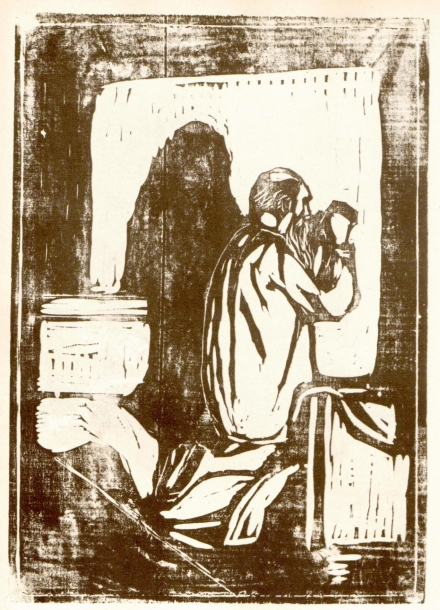
Xylography printed on Japanese wooden paper "Old man in prayer" 1902 by Edvard Munch (1863/1944). He represented his father as he saw him coming home after a strong row with him

“The big dark shadow projected on the wall (...) performs the dual function of looming dark otherness and of silent partner. A presence that threats, protects an opens towards an unknown darkness. (...) Between 1897 and 1899 he retreated to Norway and dedicated himself especially to xylography, taking the achievements of Gauguin to the extreme” (Francesca Boschetti - Catalogue of the exhibit Bellezza Divina)
In the collection there are also works by:

Paul Klee (1879/1940), Felice Carena (1879/1966), Giovanni Carnovali (aka il Piccio) (1804/73), Felice Casorati (1883/1963), Henry Moore (1898/1986), Paul Gaugin (1848/1903), Francisco Goya (1746/1828), Giacomo Manzù (1908/91), Luciano Minguzzi (1911/2004), Charles-Edouard Jeanneret aka Le Corbusier (1887/1965), Vasilij Kandinskij (1866/1944), Arturo Martini (1889/1947), Amedeo Modigliani (1884/1920), Giacomo Balla (1871/1958), Emilio Greco (1913/95), Franco Gentilini (1909/81), Carlo Levi (1902/75), Anselmo Bucci (1887/1955), Achille Funi (1890/1972), Giovanni Prini (1877/1958), Umberto Mastroianni (1910/98), Ivan Meštrović (1883/1962), Giuseppe Capogrossi (1900/72), Otto Dix (1891/1969) and Oskar Kokoschka (1886/1980)

Thursday, March 12, 2015

VATICAN MUSEUMS - COLLECTION OF RELIGIOUS MODERN ART (first part)


COLLEZIONE D’ARTE RELIGIOSA MODERNA

Opened 1973 at the behest of Paul VI Montini (1963/78)

About 800 works by about 250 artists in 55 rooms in the Borgia Apartment, included in the Borgia Tower and in the small Borgia rooms as well as in some rooms one floor below the Sistine Chapel
"We must re-establish the friendship between the Church and artists. (...) We have upset our friendship. (...) You have abandoned us a little bit,  you went far away, drinking at other fountains, looking legitimately to express other things; but not ours. (...) But (...) we also recognize that we gave you a little tribulation, because we have imposed you imitation as the main canon, to you who are creators, always lively, gushing of a thousand ideas and a thousand novelties. (...) Please forgive us! And then we have abandoned you too. We haven’t  explained our things, we have not introduced you in the secret cell, where the mysteries of God make man's heart jump for joy, for hope, for happiness, for intoxication" (Speech to the artists of Paul VI on May 7, 1964)

Oil on canvas “The Precursor” 1927/28 by Giulio Aristide Sartorio (1860/1932)

“The Colosseum” 1972, “Hand of the Crucifix” 1965 and three other works by Renato Guttuso (1911/87)

Oil on canvas “Finding of Moses” 1912 by Armando Spadini (1883/1925)

Oil on canvas “The Announcement (The Trinity)” 1960 and “Angelic landscape” by the master of surrealist art Salvador Dalì (1904/1989)

“Dali's surrealism has always maintained an individualistic character, alternately ironic and problematic, dreamlike. He gave a resounding personal version of Surrealistic activism, by acting openly with scandal and publicity stunts, insisting on the morbid character of his representation, supported by an exceptional technical ability” (Enciclopedia Treccani)

Huge bust “Pius XI” Ratti (1922/39) 1926 by Adolfo Wildt (1868/1931)

"The features that he considers essential are exaggerated (...) with an aggressive and moving emphasis, so that the natural measure is not enough and (...) he makes them larger than life so that they would be heroic, arrogant, unforgettable" (Ugo Ojetti)

"I want to sing, not tell, exalt, not describe" (Adolfo Wildt)

Oil on canvas “Clair de Lune” 1909 and cycle of fourteen evocative paintings of the “Via Crucis” (Stations of the Cross) 1901 by Gaetano Previati (1852/1920)
Previati painted the Stations of the Cross three times, but this is his most famous

“His use of color imprinted on canvas through a filamentous drafting, his fierce contrasts of light enveloping bodies and landscapes, create a disturbing and mysterious charm” (Andrea Pomella)

Six works including “The Crucifix (entre Dieu et le Diable)” 1943, “Christ and the painter” 1951 and “Pieta rouge” 1956 by Marc Chagall (1887/1985)

“French spelling for the name of the Russian painter Mark Šagal. Colorist bold and prestigious narrator suspended between reality and fairy tale, in the paintings, the favorite themes (a repertoire of images that combines human figures, animals, objects, landscapes) were joined by visions related to the biblical and evangelical world. Chagall executed many impressive engravings, he worked for the theater and created monumental works such as the murals for the Paris Opera (1963-64) and the Metropolitan in New York (1966), the windows for the cathedrals of Metz (1959-68) and Reims (1974)” (Enciclopedia Treccani)

“Pietà” about 1890 by Vincent Van Gogh (1853/90), incredibly beautiful and moving, very personal copy of an original painted by Eugene Delacroix in 1850 that Van Gogh only knew through a black and white lithograph
He painted two versions. The other, bigger is kept in the Rijksmuseum in Amsterdam
This one was donated to the Pope by the Diocese of New York

"Sometimes he too, like Gauguin, takes up the features of Christ, but not with the intent of self-celebration and awareness of a role, that of the artist, but to find instead complete harmony with Creation and, in the case of this Pieta, to be ideally supported by the 'Mater Dolorosa' (Sorrowful Mother). The most innovative forms of sacred art in the nineteenth and twentieth century thus were born inspired by a spiritual solipsism that goes beyond the limits of officialdom in expressive and deep free associations" (Anna Mazzanti – Catalogue of the exhibit Bellezza Divina)

“The painting is executed in the manner typical of Van Gogh: the shrill tones of color, the convulsive signs and the frantic pace of the stroke that seems to follow an order of force of the mind more than being based on certainty of reality” (Andrea Pomella)

"The painting by Delacroix conformed to tradition and followed the ways of earlier painters, including Rubens. With Van Gogh, however, there was total freedom to change any pattern, to the point of creating in this painting, not only the representation of the sacred scene, but also that of his emotions and his thoughts. His bright chromatism, the quick and almost choppy strokes of his brush are a way to express his feelings without barriers or filters. Again, as the great art historian Giulio Carlo Argan wrote, 'the pictorial material acquires an autonomous existence, exasperated and almost unbearable: the picture does not represent, it IS'. And so in his Pieta, upset and exacerbated, he gave us a piece of himself and of his tormented and hurt soul" (Grazia – From the blog Senza Dedica - senzadedica.blogspot.it/2015/04/vincent-van-gogh-pieta.html)

Famous bronze statue “The Thinker” by Auguste Rodin (1840/1917)

“Into the numerous busts and portraits of acute psychological insight, as well as into the monumental works, Rodin was able to impress the idea of movement, forcing the contrasts between full and empty, with effects of dynamism and vitality that made his work an essential reference point for the next generation” (Enciclopedia Treccani)

Oil on cardboard “Resurrection” by Émile Bernard (1868/1941). Reworking of a drawing by Michelangelo of 1532, maybe a preparatory drawing for the remaking of the fresco above the door of the Sistine Chapel, which had collapsed in 1523
“Bernard was one of the leaders of the symbolist French avant-garde (...). Pictorial language characterized by very expressive accents, with the heavy blacks contours of the figures, and the intense materiality in the application of color” (Micol Fort Catalogue of the exhibit Bellezza Divina)

Oil on canvas “Study for Velásquez Pope II” 1961 by the Irish artist Francis Bacon (1909/92)

“He received international attention after the Second World War, while maintaining an isolated position in his research that, even though it is figurative, it never becomes a story or an illustration. Distortion, fragmentation, isolation of the image are the pictorial means in a complex nexus of associations and working from various sources (poetry, drama, paintings of other authors, photography) create nightmarish presences, aggressive and violent. Critics have often pointed to the relations of Bacon's research with nihilism, existentialism, psychoanalysis, and in particular its affinity with positions at the edge of surrealism” (Enciclopedia Treccani)

“The man crucified” 1943 by Ottone Rosai (1895/1957)

“Landscape with farmhouse” 1935, “Still Life” 1943 and “Italian Still Life” 1957 by Giorgio Morandi (1890/1964)

“In paintings by Giorgio Morandi is manifested in the highest form that character of abstraction common in contemporary art. It gives a sense of perfect serenity, spiritual order of brightness, as the logical demonstration of a poetic intuition” (Palma Bucarelli)

Oil on masonite “Study for crucifixion” by the English Graham Sutherland (1903/80)

“Among the most significant exponents of the English avant-garde, he had considerable influence on the subsequent generations of artists. His early style, marked by a peculiarly English Expressionism, is gradually enriched by European expressionist experiences, abstract, cubist and surrealist, on which he built the most significant aspects of his imagination, as the search for murky and dark events, twisting of shapes, linear expansions, visions of landscapes” (Enciclopedia Treccani)

Oil on board “Psalmist David” by Corrado Cagli (1910/76)

Cycle of the “Miserere” and painting “Automne ou Nazareth” 1948 by Georges Rouault (1871/1958) one of the most important painters of religious art of the twentieth century

“The daughters of Lot III” 1940 by Carlo Carrà (1881/1966)

Bronze reliefs “The horrors of war” by Francesco Messina (1900/95) that echoes the cycle of etchings by Goya, The Disasters of War

Ten works including oil painting “Nativity” 1945/46, “Puppets” about 1930, oil on canvas “The Milan Cathedral from the rooftops” 1932, “Conversion of St. Paul” 1946 and “Piazza of Italy” by Giorgio de Chirico (1888/1978)

“In the Conversion of St. Paul the taste of telling everything is in the seemingly long-haired sky, in the opulence of the characters, in the bright colors, inflamed and intensely lived” (Andrea Pomella)

Oil on canvas “Trafalgar Square” 1935 by Filippo De Pisis (1896/1956)

“Chateuau de Saint Lager Brouilly” 1925 and “Sacred Heart” 1945 of the so-called 'cursed painter of Montmartre' Maurice Utrillo (1883/1955)

“Singer of Montmartre, the neighborhood where he was born and lived among alternate admissions to mental hospitals, Utrillo offers a rereading through his paintings tended to highlight the alienation of his psychological condition: scenes dominated by mostly deserted streets, at the most traveled by lonely men and women, surrounded only by imposing buildings and churches” (Andrea Pomella)