Showing posts with label Clemente Busiri Vici. Show all posts

Sunday, December 29, 2019

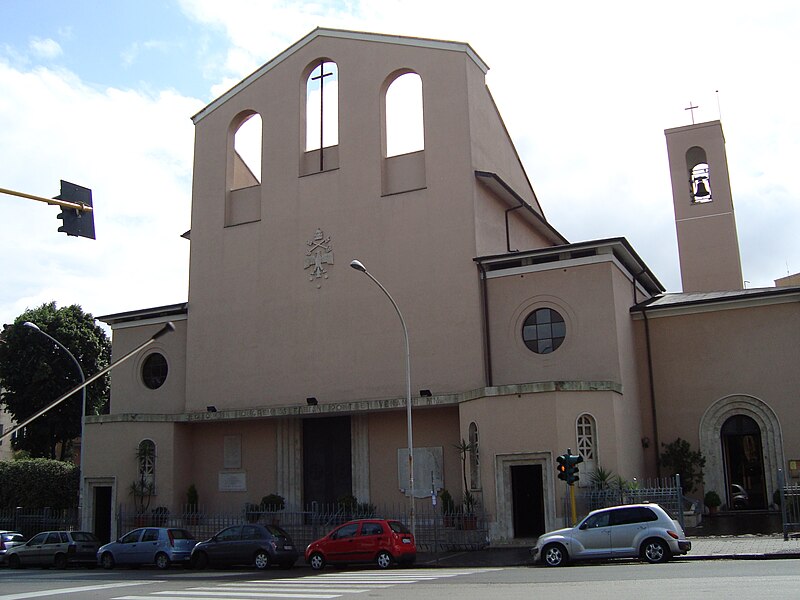
Sts. FABIANUS AND VENANTIUS

SS. FABIANO E VENANZIO
Piazza di Villa Fiorelli/Via Castrovillari - Tuscolano

1934 Clemente Busiri Vici (1887/1965)

It is the church of the people from Camerino, in the Marche region, who live in Rome

A plaque on the façade mentions August 15, 1943 when the church and its neighborhood were bombed by the Allies, killing about 100 civilians
The church was damaged in part. Pius XII Pacelli (1939/58) visited the church immediately after the bombing

Monday, December 16, 2019

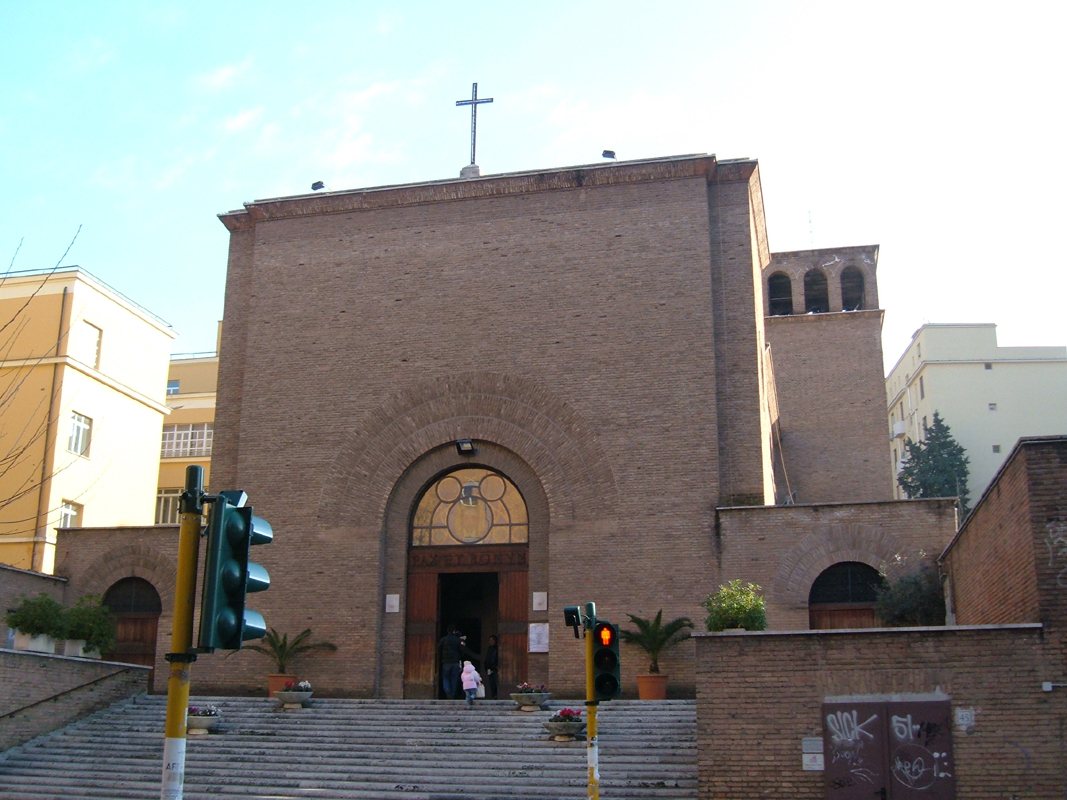
St. SATURNINUS

S. SATURNINO
Via Avigliana 3/Via Topino - Quartiere Trieste

1935 Clemente Busiri Vici (1887/1965)
Original and austere FAÇADE with a large apse

Under the MAIN ALTAR relics of St. Saturninus moved here in 1987 from the churches of Sts. John and Paul (body parts) and St. Peter in Chains (skullcap)

St. Saturninus was from Carthage and, according to tradition, was beheaded on Via Nomentana in the year 304 AD

Monday, February 25, 2019

St. HIPPOLYTUS OF ROME

S. IPPOLITO
1933/34 Clemente Busiri Vici (1887/1965) for Pius XI Ratti (1922/39)
It is managed by the diocesan clergy since 1985
“Stations of the Cross” 1934/38 by Domenico Mastroianni (1876/1962)

MAIN ALTAR
Altarpiece “Glory of St. Hippolytus” 1950 by Orazio Amato (1884/1952), who featured in the painting the faces of the Minor Capuchin Friars from Piedmont residing in the parish at the time
On the sides canvas “Eucharistic Miracle of St. Clare of Assisi” and “St. Lawrence of Brindisi” 1960 by Franco Casetti

TRANSEPT
Canvas “St. Francis of Assisi, patron saint of Italy with Pius XII kneeling” 1941, and “Our Lady of Lourdes” 1940 by Gustavo Solimene
Around the canvas “Ten artistic graffiti” 1965 by Luciano Vinardi who also designed the “Forty-three stained glass windows” of the church in the years 1963/64
“Bronze angels” by Corrado Vigni (1888/?)
When the foundations of a building nearby were dug, it was discovered a branch of the

Catacomba di S. Ippolito

Catacomb of St. Hippolytus
Entrance in Via dei Canneti
Explored by Antonio Bosio at the end of the sixteenth century and by G.B. De Rossi in the nineteenth century
Five levels of which only the median is accessible
It was badly damaged during World War II because it was used as a bomb shelter
The oldest part is the one that was dug around the UNDERGROUND BASILICA built by Pope Vigilius (537/555) around the tomb of the martyr Hippolytus (about 170/235)
In 1553 a “Statue of St. Hippolytus” was found which is now in the Vatican Library
It has been proved, however, by Margherita Guarducci that the statue is a reconstruction made in the third century AD of various statues of the second century AD, later completed with the missing parts by Pirro Ligorio (about 1513/83) who had found the statue

St. Hippolytus was a controversial figure of the Roman Church at the beginning of the third century AD, considered by the ancient sources as a priest, a bishop, a soldier, an anti-heretical writer, a theologian, an antipope and a martyr
He was exiled to Sardinia in the year 235 by the Emperor Maximinus Thrax (235/238) with Pope Pontian (230/235), with whom he had reconciled, having recognized him as the legitimate pope. Both died working in the mines

Saturday, August 25, 2018

St. BENEDICT


S. BENEDETTO
1936 Clemente Busiri Vici (1887/1965)
Only the outer walls remained standing after the bombing of the Allied Forces on March 3, 1944
It was rebuilt in 1949 and completed inside in 1953
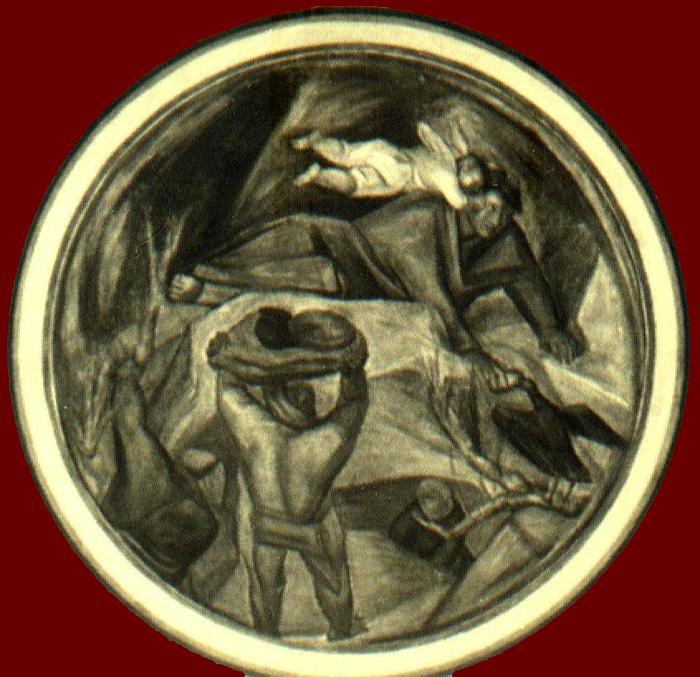
In the ceiling round panels “Stories of St. Benedict” by Ferruccio Ferrazzi (1891/1978)
“After a debut inspired by Segantini and a temporary, partial adherence to Futurism, he followed the neo-classicism of the Novecento (Twentyeth-Century) current, albeit mitigated with accents of Pre-Raphaelite origin. He thoroughly studied encaustic technique and he used it, especially in wall paintings” (Enciclopedia Treccani)
In the CHAPELS two paintings:
“Madonna and Child” 1951 by Silvio Consadori (1909/94)
 ”St. Joseph with Jesus teenager” 1953 by Luigi Filocamo (1906/88)
MAIN ALTAR
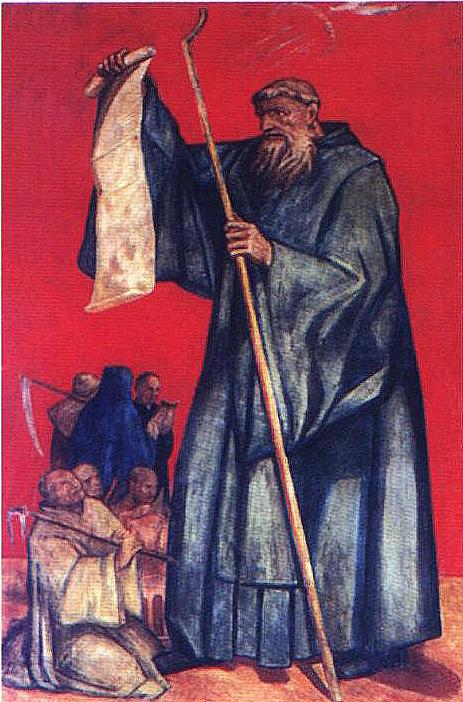
Canvas “St. Benedict” by Ferruccio Ferrazzi

Friday, March 3, 2017

PALACE OF PROPAGANDA FIDE - CHURCH OF THE THREE WISE MEN (third part)

Chiesa dei Re Magi
1660/66 masterpiece by Francesco Borromini (1599/1667)
It replaced the church built in 1634 by Bernini which was elliptical with a main entrance directly on Via di Propaganda
“It is a radical revision of the structures of St. Mary of the Seven Sorrows and of the Oratorio dei Filippini. Articulation is here in an order large and small derived from the Capitoline Palaces. A continuous system ties together all parts of the building in all directions. The line-skeleton structure has become of the utmost importance - there is almost no wall between the tall pillars! - and even the dome was sacrificed to the structure. No post-Renaissance building in Italy has come so close to the Gothic structural principles. It was truly a new and challenging solution and its compelling simplicity and logic ends properly Borromini's activity in ecclesiastical architecture” (Rudolf Wittkower)
Borromini's stuccos completed after his death by Francesco Fontana (1668/1708) Carlo Fontana's son
Subsequent interventions in 1815 and 1955 painted arbitrarily Borromini's surfaces
Restoration in 1955 by Clemente Busiri Vici (1887/1965) who got rid of some nineteenth-century additions
According to an unconfirmed anecdote Borromini would have taunt Bernini sculpting a papal Chigi coat of arms with the donkey ears on a corner facing the Palace of Bernini
The coat of arms was actually made and was present until at least 1722, when Filippo Juvarra (1678/1736) drew it. Bernini would have replied by carving a penis on the shelves of a balcony of his palace overlooking one side of the Palazzo di Propaganda Fide
 1st CHAPEL ON THE RIGHT
“Conversion of St. Paul” about 1634 by Carlo Pellegrini (1605/49) although some sources cite it as designed by Bernini
2nd CHAPEL ON THE RIGHT
“Madonna with Sts. Charles Borromeo and Filippo Neri” about 1665 by Carlo Cesi (1626/86)
MAIN ALTAR
“Adoration of the Magi” by Giacinto Gimignani (1606/81)
Above “Delivery of the Keys to St. Peter” about 1673 by Lazzaro Baldi (about 1624/1703)
Stuccos in the upper part and over the window of the choir by Cosimo Fancelli (1620/88)
2nd CHAPEL ON THE LEFT
“Crucifixion between Sts. Francis Xavier and Francesco di Paola” by Ludovico Gimignani (1643/97) son of Giacinto
1st CHAPEL ON THE LEFT
“The Calling of Sts. Peter and Andrew” 1634 by Andrea Camassei (1602/49) copy from the original of Giorgio Vasari
IN THE NICHES
“Six seventeenth-century busts of benefactors of the Congregation” of high quality and generic attribution to school of Alessandro Algardi with “Basis of black marble from Belgium” by Francesco Borromini

Tuesday, December 20, 2016

PALACE OF THE SAVINGS BANK OF ROME

PALAZZO DELLA CASSA DI RISPARMIO DI ROMA
1867/74 Antonio Cipolla (1822/74) in homage to the style of Antonio da Sangallo the Younger
In honor of its architect the palace is also known as PALAZZO CIPOLLA
It was built on the site of the destroyed Palazzo di S. Giacomo degli Incurabili from which the CAFFÈ VENEZIANO opened onto Via del Corso
From 1725 to 1868 it was a haunt of writers and Roman aristocrats
Restored 1933 by Alfredo Energici (1894/?) and Antonio Petrignani
Restored again by Clemente Busiri Vici (1887/1965) e Pompeo Coltellacci
It is now occupied by the FONDAZIONE MUSEO DI ROMA (Museum Foundation of Rome) that organizes temporary exhibitions
ROOM OF THE COUNCIL
Ceiling with painting “Saving, Abundance and Peace” of the second half of the nineteenth century by Domenico Bruschi (1840/1910)

Thursday, December 5, 2013

PONTIFICAL URBANIANA UNIVERSITY

COLLEGIO URBANO DI PROPAGANDA FIDE
About 1935 by Clemente Busiri Vici (1887/1965)
It houses the PONTIFICIA UNIVERSITÀ URBANIANA (Pontifical Urbaniana University) founded in 1627 by Urban VIII Barberini (1623/44)
Approximately 1,400 students from nearly 100 countries follow the courses of the University
In the LIBRARY there are about 350,000 books

Sunday, November 24, 2013

ROME FILM STUDIOS

CINECITTÀ
1937 Gino Peresutti (1883/1940)
Area of 400.000 m² (100 acres) with twenty-two studios for shooting movies
In Piazza di Cinecittà ISTITUTO NAZIONALE LUCE (National Light Institute) 1937 by Clemente Busiri Vici (1887/1965), Andrea jr. Busiri Vici, Arnaldo Regaglioli and Rodolfo Rustichelli
Now it is used as the headquarters of the Council of the Tenth Municipio (neighborhood) of Rome

Thursday, November 7, 2013

CATACOMB OF St. ALEXANDER

CATACOMBA DI S. ALESSANDRO
Discovered in 1854
One single floor
An inscription gave the name to the catacombs and the district at km 13 of Via Nomentana
The BASILICA was built in the second century in honor of the martyr St. Alexander and also in honor of St. Teodulo
The second phase of the Basilica dates back to the fourth century by Urso, Bishop of Ficulea and Nomentum
It is currently closed and in a state of neglect
CHURCH OF St. ALEXANDER
1937 Clemente Busiri Vici (1887/1965)