Masterpieces not included in the permanent exhibit and visible during temporary
exhibits
“Continence of Scipio” 1811 by Vincenzo Camuccini
(1771/1844)
“St. Stephen stoned and collected by pious
men” 1853, “Portrait of a Lady” 1859 and “A useless repentance” 1851 by Bernardo Celentano (1835/63)
“The first moments of the Sicilian Vespers”
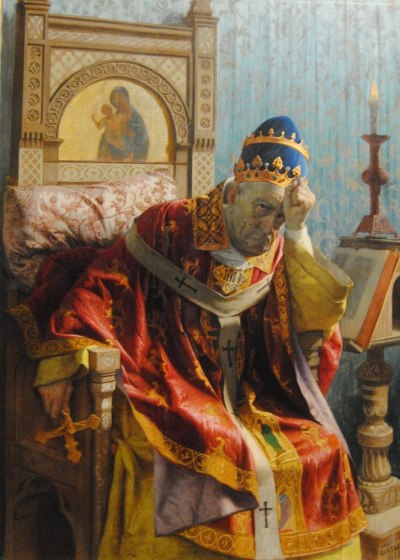
1852 and “Boniface VIII” Caetani (1294/1303) 1875 by Andrea Gastaldi (1826/89)
“In this work the painter, with a cultured
recovery, resurrected the ancient technique of encaustic melted wax. (...) The
vigorous papal theme, judged cryptic by some, was appreciated by Netti together
with the painting's “violent and intense coloration, often risky, highly
processed”, almost a relief” (Elena di Majo)
“Paolo and Francesca” about 1831 by Cosroe Dusi (1808/59)
“Atala” 1835 by Cesare
Mussini (1804/79)
“Revenge of the Amidei” 1861 by Eleuterio Pagliano
(1826/1903)
“Portrait of the engraver Giuseppe
Girometti”, “Francis I in the studio of Benvenuto Cellini” 1839 and “Meeting
Venus and Amphitrite” about 1854 by Francesco Podesti (1800/95)
“The Maggiolata” 1872 by Michele Rapisardi (1822/86)
“The funeral of Buondelmonte” 1860 by Saverio Altamura (1822/97)
“Bacchus and Ariadne” about 1840 by Natale Carta (1790/1884)
“The Coronation of Esther” 1840 by Vincenzo Morani (1809/1870)
“Charles VIII visiting Gian Galeazzo Sforza
who's dying in the castle of Pavia” 1816/17 by Pelagio
Pelagi (1775/1860)
“The death of Aldoino leader of the Goths”
1874 by Dario Querci
(1831/1918)
“Portrait” about 1820 by Henry Raeburn (1756/1823)
“Leap of the young Albanian woman” 1833 by Filippo Agricola (1795/1857)
“Portrait of Victoria Caldonia” about 1830 by
Franz Ludwig Catel
(1778/1856)
“The Choir of the Capuchins” about 1820 by Vincenzo Chialli (1787/1840)
“Scene from Julius Caesar” 1861 by Pietro Gagliardi (1809/90)
“Portrait of Cardinal Vicar Count of
Somaglia” 1786 by Gaspare Landi (1756/1830)
“Portrait of Ferdinand VII of Bourbon”
about 1813 by Vicente López Portaña (1772/1850)
“Portrait of Cardinal Antonio Tosti” about
1839 by Francesco Coghetti (1801/75)
“View of Rome from Monte Mario” 1857 by Ippolito Caffi (1809/66)
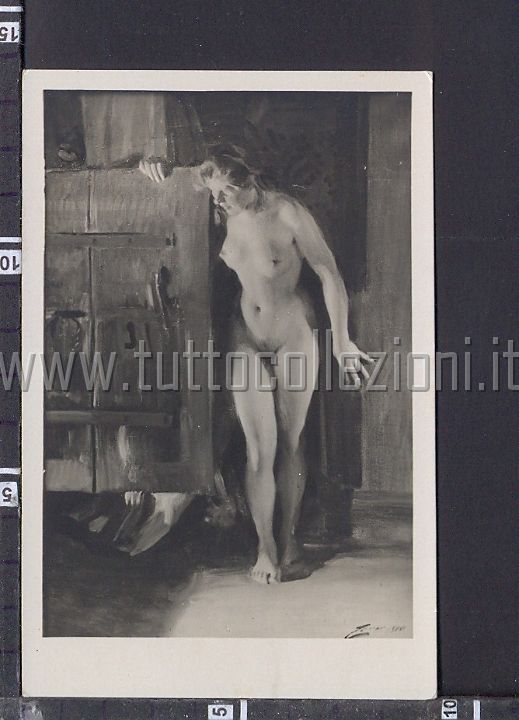
“Academy of male nude” first decade of 1800
by unknown artist of the French school
Five small landscapes including “Forio in
Ischia” 1878 and a “Study of Woman in Montemurlo” about 1862 by Vincenzo Cabianca (1827/1902)
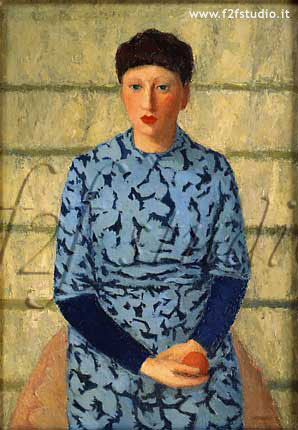
“One can detect especially in the choice of
colors and in the serene and rigorous brightness of the blue the proximity of
ways and feel with Borrani and Sernesi, around the same time concentrated on
the blinding light and on the broad essential spaces, almost abstract, of the
Castiglioncello Farm” (Anna Villari)
Portraits bust “Daughter” 1859/62 by Hiram Powers (1805/73)
“Towards Ardea” and “Ripa Grande” 1848 by Nino Costa (1826/1903)
“In 1853, newly appointed young professor at
the Accademia di Belle Arti in Florence, Ciseri began work on the great
altarpiece dedicated to the Martyrdom of the Maccabees, for the Florentine
church of S. Felicita, winning work in Vienna in the Universal Exhibition of
1873. (...) Compared to the canvas, the cardboard has its variants not only in
the position of the figure but also in a pictorial style of refined derivation
from Ingres, (...) suggestions that will be partly lost in the final painting,
completed when Ciseri began to approach new realistic and descriptive instances”
(Anna Villari)
“Small dome at the Cascine” about 1860 by Raffaello Sernesi (1838/66)
“St. Catherine” 1888 by Alessandro Franchi
(1838/1913)
Five paintings by Stefano
Ussi (1822/1901): “Feast of Mohammed in Tangiers” 1879, “Arab Fantasia”
about 1879, “Reception at the Italian Embassy in Morocco” about 1879, “The son
of the Governor Ben Anda with the escort of honor” about 1879 and “The expulsion of the Duke of Athens” about
1900
“It is the most obvious result of the
influence of Domenico Morelli, whose choral works are the heirs of the complex
narrative structures of Romantic painting, but where personalities are
characterized individually and acts directly represented in the objective
demonstrative role in the story, rather than in the various ethical or
sentimental reactions to it, in a strong emphasis on scenic verisimilitude”
(Carlo Bertelli, Giuliano Briganti, Antonio Giuliano)
“Camels in the royal estate of S. Rossore”
about 1883 and “Houses of Pannocchio in Castiglioncello” about 1862 by Odoardo Borrani (1833/1905)
“Portrait of the girlfriend” 1863 by Pietro Saltini (1839/1908)
“In the absolute masterpiece by Monteverde
the drama of the scientist-father who experiments on his son the smallpox
vaccine, fought between the certainty of its discovery and the fear of harm to
the child, could not but arouse strong emotions. It was the contrast between
knowledge and belief, which was foreshadowed in the work, including the right
to research and morality. Monteverde had focused the subject and had given a
vivid image that strikes imagination and feelings. He was successful this time,
with realistically essential language, focusing on the contrast between the
darting nude of the unsuspecting child and the concentration of the father who
is cutting into the tender flesh” (Francesco Locatelli)
“Sewers” 1865 by Domenico
Induno (1815/78)
Two sketches of biblical scenes by Giovanni Carnovali (detto il Piccio) (1804/73)
“Bather” 1844 by Francesco Hayez (1791/1882)
He was able to be very successful with the
moderate eroticism of this and other bathers, all having as a model the Bathsheba
at the Bath of 1834
Two landscapes “At the source” about 1865 and “At the
Fountain” about 1868 by Antonio Fontanesi (1818/82)
“The jester to the bed of his dying wife”
1863 by Guglielmo Stella
(1828/88)
Three landscapes by Massimo D'Azeglio (1798/1886)
“His views were inserted in the noble
tradition of seventeenth-century heroic landscape of Carracci and Domenichino.
In his paintings literary and historical episodes are set in beautiful and
majestic landscapes in which the small figures are immersed, almost surmounted
by the scene” (Carlo Bertelli, Giuliano Briganti, Antonio Giuliano)
“Vittorio Amedeo II in Carmagnola” 1863 and
“The Marriage of Beatrice of Portugal” 1865/70 by Enrico
Gamba (1831/83)
“The Valley of Pusino” 1874 by Vittorio Avondo (1836/1910)
“The Civic Guard comes out of the Ducal
Palace on July 4, 1848” about 1849 by Luigi Bisi (1814/86)
About 300 paintings by Filippo Palizzi (1818/99) mainly
of animals, landscapes and portraits of common people and soldiers, donated to
the Gallery, one of the earlier groups of paintings to become part of the
collection
“The paintings are organized by subject
(costumes, animals, plants, landscapes, Renaissance subjects, genre scenes) to
highlight Palizzi's research on the natural truth, the basis of his artistry”
(Elena di Majo)
“The port of Venice” about 1890 and “The
terrace” 1865/67 by Edoardo Dalbono (1841/1915)
“Dalbono studied in an environment of high
artistic and cultural level among the most important currents of the Italian
southern paintings styles, from 'paesismo' of Posillipo painters to the
naturalism of Palazzi. (...) The painting depicts a portrait of middle-class
family - perhaps the family of the painter himself - to which the intimacy of
the scene in a setting of true Neapolitan urban tenements as well as the
affectionate tone of the dedication give a particular flavor of near-photographic
naturalness” (Elena di Majo)
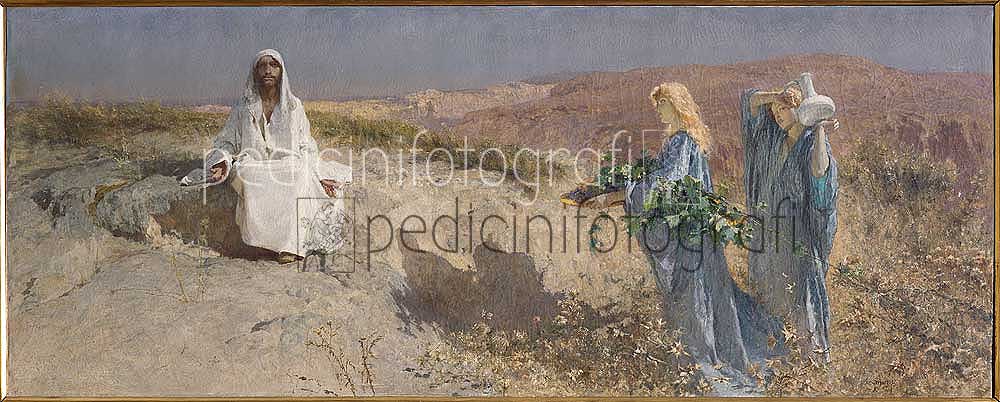
Twelve paintings by Domenico Morelli (1826/1901):
"He
expressed here his desire to sublimate form in an evanescent drafting of
colors, to be interpreted as spiritual analogy of sacred subjects, now in line with
the widespread symbolist trend. Morelli’s sacred paintings, having developed within
the aesthetics of realism, in fact converted the attention given to naturalism
to a kind of spiritualism intensely lived, either cultivating visions from the
East or, as in this case, adhering to the poetic of moods" (Carlo Sisi – Catalogue
of the exhibit Divina Bellezza)
“The monks (Good
Friday)” 1880, “Embalming of Christ” 1868, “The body of St. Mary of Egypt found
by the Angels” about 1875, “Self-portrait”, “Head of an angel” 1895, “Portrait
of woman in red” about 1855, “Study of a figure” 1874, “Pater Noster (The
Sermon on the Mountain)” about 1895,
“Christ in the Desert” 1895, “Christ watches
over the apostles” 1900 and the unfinished sketch
“The triclinium after the orgy” about
1860
“The sketch documents the careful
preparation of the subject, it helps to understand how important the rendition
of light would have been in the painting; just as important as the
archaeological truth in a trend of painting seen mainly as historical and
natural truth” (Anna Maria Damigella)
Bronze bust “Domenico Morelli” about 1893 by
Mario Rutelli (1859/1943)
“In formal choices of subjects, initially of
religious kind, and, since the sixties, also of neopompeian and realist kind,
Maldarelli remained anchored until his maturity to the neoclassical academic
model of the finiteness and the punctilious accuracy of figures and objects
represented. It was not so much reflected in the Naples area, where the
unfinished style of Morelli was more appreciated, as much as beyond the Alps,
connecting directly to the trend of the business of ‘pompiers’ painters
inaugurated in France by Jean Leon Gérôme and being successful throughout
Europe and North America” (Isabella Valente - Dizionario Biografico degli
Italiani Treccani)
“Chatting in Piazza Piscinula” 1865 and “Atrium
of St. Mary Major” about 1866 by Michele Cammarano
(1835/1920)
“In the months he spent in Venice Cammarano
painted some landscapes and views of the lagoon, with firm structures of
lighting effects, and one of his masterpieces: Piazza S. Marco, an episode of
virtuosity for its brilliant display of night effects, but also for being an
authentic slice of life of bourgeois society of the time” (Osvaldo Ferrari -
Dizionario Biografico degli Italiani Treccani)
“Greek chorus” 1875/77 by Francesco Netti (1832/94)
“The notes of color - various shades of blue
in the tunics with red flowers, notes of luminous white of which Sciuti had
become a master learning from the lessons of Morelli - are the means to give
vivacity, warmth and communicative power to the scene. (...) Stella described
the inspiration of Sciuti from the ancient world as a “happy medium” between
the epic Gérôme and the idyllic of Alma Tadema” (Anna Maria Damigella)
Three paintings by Gioacchino
Toma (1836/91): “The orphan viaticum” 1877, “The guard at the foundling
wheel” 1877, “The novel in the convent” 1888
“The weakling” about 1878 and “Portrait of
Carlo Chiarandà” 1883 by Antonio Mancini
(1852/1930)
“Head of a Woman” 1833 by Tommaso De Vivo (1790/1884)
“Ferrari finished in 1887 the model of
Giordano Bruno, which, cast in bronze, would be erected two years later in
Campo de' Fiori, where the philosopher was burned at the stake on February 17,
1600. Monument par excellence of the Italian anticlericalism, feeding on the
Garibaldi and republican tradition, in the fight against the “obscurantism” of
the Church and for the freedom of thought, Giordano Bruno was the subject of
bitter controversy” (Alessandra Imbellone)
“The Eulalia completely lacks any polemical
or protest tone. Although the figure on the cross recalls the group Cum
Spartaco Pugnavit by Ferrari or the Spartacus of 1873 by Louis Ernest Barrias,
in this work of Franceschi drama is entirely absent. The grace and eroticism of
the half-naked martyr was also noted by Cecioni, who wrote: 'Beautiful woman
and beautiful drapery, she is not a true dead martyr (...) not even if she
could have tried, she could have died in a more graceful attitude'“ (Stefania
Frezzotti - Dizionario Biografico degli Italiani Treccani)
“The flight of Pope Eugene IV Coldumer
(1431/47)” 1883 by Pio Joris (1843/1921)
Bronze portraits “Cecilia Metella” 1882 by Giulio Tadolini (1849/1918)
“Alexander VI Borgia (1492/1503) and the
Venetian ambassador” 1883 Francesco Jacovacci (1838/1908)
“Oath of Brutus over the body of Lucretia”
about 1884 by Jules-Emile Pichot
Bronze statue “From the passage of Veii”
1895 by Carlo Lorenzetti
(1858/1945)
Bronze statue of “Autumn” 1877 by Giovanni Battista Amendola
(1848/87)
“Marina with fishing boats” about 1885 by Achille Vertunni (1826/97)
“Ruins of a world that was” about 1890 by Federico Cortese (1829/1913)
“Acclaimed for his painting style rich of
sudden short, strong strokes, with vibrant colors and full of light,
characterized by dry and meaningful narrative even when he represented
narrative anecdotes. His attention to the humble and simple people, in the
tradition of Palizzi, aligned him to the latest trends in landscape painting,
with an alert attention, as well as sympathetic, even though never pathetic, to
the world of humble workers. He was indeed representing them with respect, as living
witnesses of ancient traditions and vigor” (Anna Villari)
Two terracotta statues “The departure of
the proscribed” 1882 and “The Return of the Soldier” 1882 by Costantino Barbella
(1852/1925)
Statues “A surprise on the stairs” 1882 by Adriano Cecioni (1836/86)
“Also known as 'A reflection of Botticelli's
art' for the obvious compositional and formal reference to the master of the
Renaissance, the work transposes consciously in the genre painting style, the
learned tradition of fifteenth-century Tuscany, in the wake of that
pre-Raphaelite culture that in those years was being spread in the Roman
cultural circles around Nino Costa” (Elena di Majo)
“Life and Death” 1895
and “An enlarged detail of Life and Death” 1895 by Arturo
Viligiardi (1869/1936)
“The subject, chosen by Viligiardi himself,
would be a symbolic representation of Life and Death through a contemporary
realist scene, set in the Piazza del Duomo in San Gimignano (...), with careful
adjustments of the point of view to narrow a perspective suitable for a close
up of two antithetical realities, a funeral and a wedding, on two opposing
staircases” (Anna Maria Damigella)
“The peddler” 1882 and “Dad is back” 1884 by Egisto
Ferroni (1835/1912)
“View of the Arno River” about 1890 by Lorenzo Gelati (1824/95)
“Don Quixote and Sancho Panza” 1891 by Giovanni Fattori (1825/1908)
In this painting there is a beautiful
alternation of light and shade in the dry and barren landscape where the
gesture of the hero of Cervantes is drawn, tragic, foolish and grand at the
same time
“Work emblematic of the artist's production
of the eighties which, although linked to purely pictorial instances of
'Macchiaioli' genre, was gradually acknowledging humanitarian and social
tensions in its narrative choices” (Matteo Lafranconi)
“Olive trees with farm girl and buffalos”
about 1910 by Mario Puccini (1869/1920)
“Pass the procession” 1883 by Francesco Gioli (1846/1922)
“Autumn Evening” 1901 by Luigi Gioli (1854/1947)
“Seeding of wheat in Tuscany” 1882 and “Summer”
1896 by Niccolò Cannicci (1846/1906)
Extremely bright vision of women and
children full of dazzling colors and reflections, almost a desire to exorcise
with the purity of the sun the sad times that he had lived three years before,
by imprisonment in the psychiatric hospital of Siena because of a nervous
breakdown
“A pine forest in S. Rossore” 1875/77 by Giuseppe Benassai (1835/89)
“Waiting for the bride and groom” about
1883 and “El Liston” 1884 by Giacomo Favretto (1849/87)
“The female nude is a topic rare in Venetian
painting of the nineteenth century and very rare in the Favretto's works. After
the bath (...) is thus a significant work, whose success with critics and
audiences has never failed. (...) The scene is an everyday one, colloquial.
Favretto chooses soft intonation, lit by the bright timbres: the red scarf of
the woman, the jacket with the color of lapis lazuli, the white cloths. (...) A
learned work that shows a reached balance between study of the true and courtly
ancestry of the image, derived from Titian” (Maura Picciau)
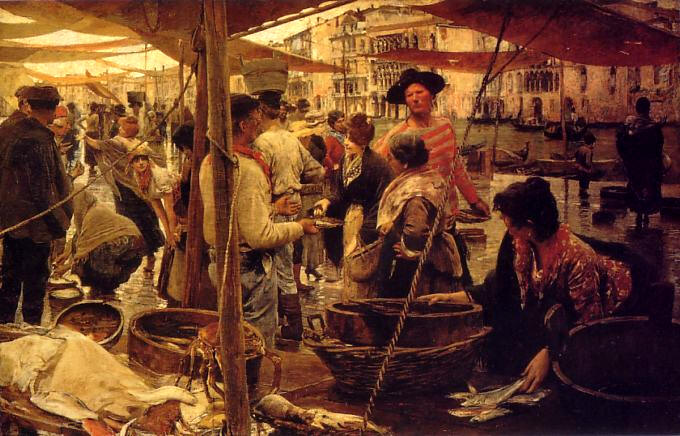
“In the Old Fish Market Tito's boldness of
foreshortening and perspective, which approximates to figures almost enough to
penetrate into the scene in tents fluttering like sails, manifested a profound
new character: a slice of real life, a vivid realism” (Maura Picciau)
“Grand Canal” 1882 by Alberto Pasini (1826/99)
“The view by Pasini is appreciated for
pictorial quality and elegance of the colors. On the left side and in shadow,
the prospect of the building in perspective shifts the focus slightly to the
right, where the sun illuminates the red buildings and red poles that are
reflected on the water” (Maura Picciau)
“Chioggia” 1894 by Leonardo
Bazzaro (1853/1937)
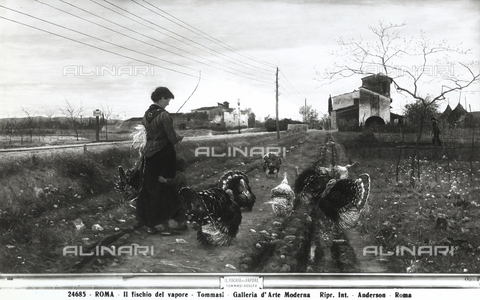
In The Word of God there is a very
interesting focus almost photographic of the woman in the foreground with a beautiful
emphasis on the black color of her dress
“Grand Canal” 1888 by Guglielmo Ciardi (1842/1917)
“Caught in the act” 1884 by Angelo Dall’Oca Bianca
(1858/1942)
“Moon on the tables of an inn” 1884 and “Effect
of the moon” 1890 by Mario de Maria (1852/1924)
“Winter” 1890, “Rest” about 1891 and “Survivors”
about 1914 by Pietro Fragiacomo (1856/1922)
“The breakfast of the gondolier” 1892 and “Wedding in Venice” 1897 by Alessandro Milesi
(1856/1945)
“It is a minor Venice, but full of life,
with a touch of Manzonian humanity. (...) Milesi is describing here his own
world with involvement. Executed with a loose hand tuned to a dull palette in
which the white dress of the bride becomes a focal point, the work reveals a
complex architecture and dynamics made of cross-references colors and creative
diagonals” (Maura Picciau)
“Return from fishing” about 1900 by Hendrik Willem Mesdag (1831/1915) celebrated Dutch
landscape painter
“Sick child” 1889/93 by Medardo Rosso (1858/1928)
“Painter from Piedmont pupil of Andrea
Gastaldi, author of a landscape kind of painting thick and pasty, intensely
bright and color-robust” (Matteo Lafranconi)
“In the evening” 1890 and “The prelude to
the evening” 1897 by Bartolomeo Bezzi (1851/1923)
“The scene is told with the narrative vein
typical of illustrations. Virtuosity in the rendering of detail, which is the
signature style of Quadrone, was often poorly tolerated by critics more
favorable to impressionists painting, but it ensured a successful commercial
use for the artist. Quadrone debuted with paintings of neo-gothic ambience at
first and then 'neosettecentesco' (neo-1700s), but, in fact, he achieved fame
only in the eighties with hunting scenes and similar subjects of gender, mostly
small, painted using the tip of the brush with unmistakable, brilliant
narrative flair” (Paola Lodola)
“The first to leave” 1884 by Stefano Bruzzi (1835/1911)
“The Lonely Statues” 1883 by Marco Calderini (1850/1941)
“Quiet” 1883 and “Monte Rosa” 1896 by Eugenio Gignous (1850/1906)
Bronze sculpture “The Plow” 1888 by Davide Calandra (1856/1915)
“Mommy” about 1908, “Self Portrait” 1911, “Butterflies”
1906, “Japanese Lilies” about 1906 and “Dahlias” 1910 by Gaetano Previati (1852/1920)
“Flowery meadows” 1900/03 by Giuseppe Pellizza da Volpedo
(1868/1907)
“Winking, without complexes, to the trendy
European social depictions in an intimate and bourgeois low key, anecdotally
descriptive also of the dramas, large and small, of a social class at the
height of its historical parable” (Matteo Lafranconi)
“Vain” 1901 by Umberto
Coromaldi (1870/1948)
“Portrait of a young girl” about
1890 and “Juliet's funeral” 1888 by Scipione Vannutelli
(1834/94)
Juliet’s Funeral is almost a tableau that
reminds of an opera stage setting and that seems to revive an updated detailed
courtly scene typical of the International Gothic style
“In
the portrait, the identity of which is unknown, the color contrast of purple
and black in clothes and in the original hat on the light green background of
the marbled curtain adds a touch of elegance to the posing reflective girl,
helping to define her superior social position but also to suggest her own
rarefied world of melancholy” (Elena di Majo)
“A white cap” 1901 by Lino Selvatico (1872/1924)
“Sad Journey” 1883 by Raffaele Faccioli
(1845/1916)
Statue “The Cricket” 1880 by Giovanni Biggi (1847/1913)
“Portrait of Maria Hardouin Duchess of
Wales” 1890/91 by Giulio Aristide Sartorio
(1860/1932)
“The awakening of dawn” 1913/14 by Adolfo De Carolis (1874/1928)
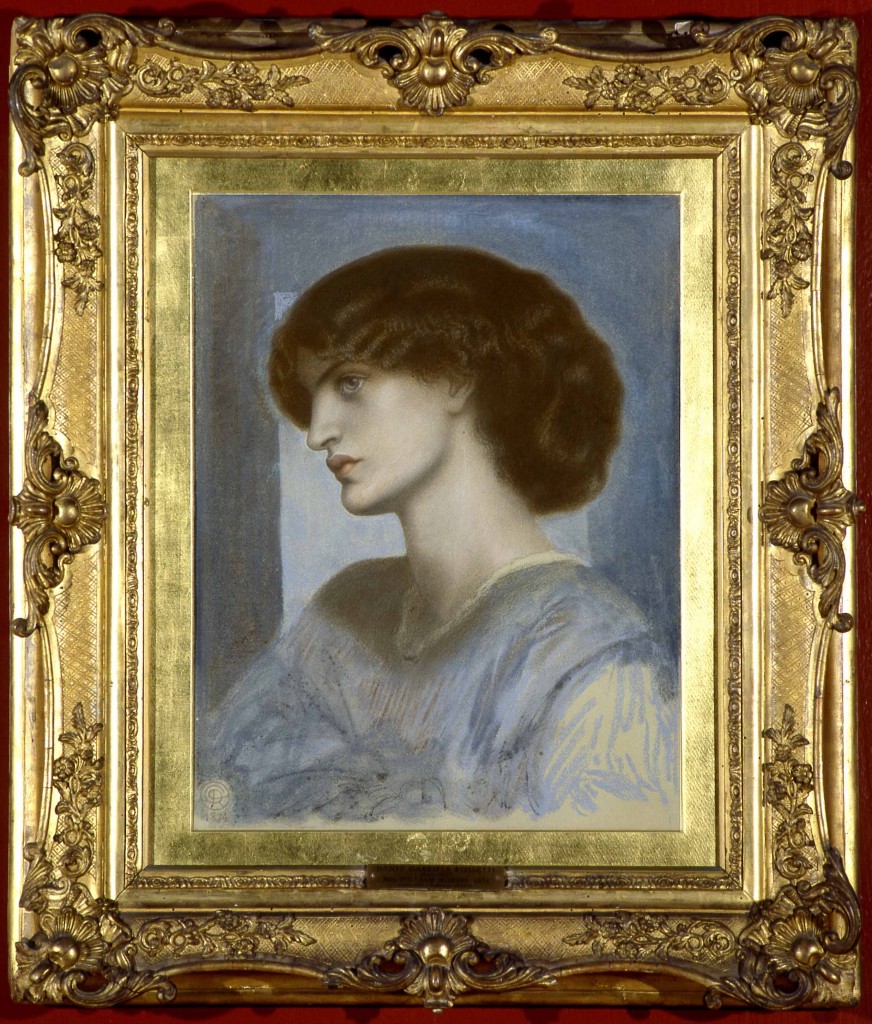
“The pastel portrays Jane Burden, wife of
the painter William Morris. She became the subject for the artist of a
tormented and obsessive erotic passion (...) as well as the prototype of the
female image in most of his paintings. (...) A face unusual in England and not
absolutely comparable to that of an English woman, but rather that of a Greek
ionic woman” (Stefania Frezzotti)
Bronze group “Manufacturers” 1907 and
marble sculptures “Dream of a little girl” about 1925 and “Little girl at the
seaside” 1930 by Arturo Dazzi (1881/1966)
“Serra combines in the Apparition a stately
neo-fifteenth century composition with the embodiment of the figures, subject
of a rigorous study from life. (...) In this careful investigation of the true
Serra strove to replicate the beautiful Umbrian landscape with the outlined
hill of Assisi in the background” (Elena di Majo)
Statue “Susanna” 1894 by Francesco
Fabj-Altini (1830/1906)
Pupil
of Adamo Tadolini and Pietro Tenerani, he was also the
author of a mausoleum in S. Gregorio al Celio,
of the statues above the entrance of the Verano
Cemetery and of various sculptures in the Basilica of St. Paul
Marble bust “St. Francis” 1925 by Adolfo Wildt (1868/1931)
“In the emaciated face of St. Francis, with
the head tilted down, one can detect, according to the stylistic features
typical of the artist, his style of sacred art with references to the Middle
ages” (Lidia Velani)
“Variations on midnight” 1908/09 by Luigi Conconi (1852/1917), magic vision halfway
between dream and reality
“Morning Departure” 1899 by Luigi Selvatico (1871/1938)
“Equilibrium between the disruptive
denunciation of social realism and a more subdued narrative of a minor Venice”
(Matteo Lafranconi)
“The
Chopin Nocturne I Op. IX” about 1908 and “Ascension” 1911 by Vittorio Grassi (1878/1958)
Scultura “Ignara mali (Unaware of Evil)”
1893 by Adalberto Cencetti (1847/1907)
“Seclusion” 1904 by Umberto Prencipe (1879/1962)
“Idillius” 1882 and “Transport of a block
of travertine” 1897 by Giuseppe Raggio (1823/1916)
“The harvest of almonds” 1885/88 by Alfredo Ricci (1864/89)
“The Bronze Age” by Franz von Stuck (1863/1928)
In this extraordinary
and extremely sensual nude the Swedish painter, one of the best European
interpreters of the genre in the early twentieth century, engages in dazzling
light effects
“The sprightly old man” about 1903 and “Irene” about 1910 by Ignacio
Zuloaga y Zabaleta (1870/1945)
“While true to the introspective psychology
and the imprint of his own most famous production, Zuloaga with this more
intimate and pictorially less violent subject, moves away from the grim and
exaggerated realism, often prone to the grotesque with which he had described
types and scenes of a picturesque Spain in the process of dissolution” (Matteo
Lafranconi)
“Moonlight” 1910/11 by Otto Valstad (1862/1950)
“Reader” 1911 by Marta
Stettler (1870/1945)
“The dew (the Roses)” about 1910 by Émile Claus (1849/1924)
“Tea in the morning” 1904 by Igor’ Emmanuilovič Grabar
(1871/1960)
“Farmers of the Carpathian Mountains in the
village church” 1909 by Wladislaw Jarocki (1879/1965)
“The Window” 1910 by Stanislav Julianovič Žukovskij (1873/1944)
“Visit of condolence” about 1910/11 by Christian Krohg (1852/1925)
“Portrait of his wife” 1905 by Konrad Kržižanovskij
(1872/1922)
Very original symbolic subject with window
view from inside and lit with a dim light allowing, however, a glimpse of the
garden at dusk
“Country festival” about 1905/10 by Filipp Andreevič Maljavin
(1869/1940)
“Patching Hungarian” 1906 by Iszák Perlmutter (1866/1932)
“Vagrants and Beggars” about 1900/10 by Ramon de Zubiaurre y Aguirrezabal (1882/1969)
“Pasture” 1906 by Heinrich
Von Zugel (1850/1941)
“The hearth” 1910, “Mother” 1912, “Women at Night” 1926, “Roman Bull” 1936 and “Roman Carter”
1936 by Ferruccio Ferrazzi (1891/1978)
“Mother, like the paintings of his first
fervent learning period, is dependent from a strong and symbolic tension
influenced by Segantini and the Central European painting style, learned by the
young painter from the school of Max Roeder, a German artist working in Rome”
(Mario Quesada)
“The musicians” about 1905/10 by Raoul-Henry Dreyfus
(1878/1965)
“Winter” about 1907 by Eugenio Laermans (1864/1940)
Extremely original
painter and engraver born in Brussels where he also died. He used to paint
clear and defined color areas in scenes with farmers solemn and grotesque at
the same time
“Portrait of a Woman (summer night)” 1910, “Late”
about 1910 and “Portrait of General Paolo Sodani” about 1916 by Camillo Innocenti (1871/1961)
“The fat and lean” 1899, “Outside Porta S. Giovanni” 1911 and “The lost”
1912 by Enrico Lionne (1865/1921), witty
caricature artist, author of scenes set in popular contexts
“Can-Can” about 1911 by Giuseppe Cominetti
(1882/1930)
Pointillist painter who, in this work,
paints wonderfully with ethereal layers of light and color-changing lawn and
sky
Four paintings by
Armando Spadini (1883/1925):
“In the study” 1909, “The breakfast
(figures)” about 1911, “Portrait of Mrs. Teresa Mauri Nunes” about 1917 and “Children
with Fan” about 1913
“The younger sister” 1911 by Plinio Nomellini (1866/1943), fascinating and
mesmerizing family portrait ardently and vividly colored
Statue “Similia similibus” about 1913 by Eugenio Maccagnani (1852/1930)
He resumed styles of
Tuscan Renaissance sculptors in the context of the beginning of 1900s when he
was the protagonist in European sculptural portraiture, maybe cold, but always
attentive to the psychology of the individuals portrayed
“Elderly Women” 1909 by Felice Casorati (1883/1963)
“The dead chestnut tree” 1908 by Llewellyn Lloyd (1879/1949)
English artist who studied Pre-Raphaelite
painters and updated them with his Symbolism
“Flowers” 1909 and “Susanna” about 1924 by Felice Carena (1879/1966)
Bronze sculpture “Buffaloes” about 1910 by Duilio Cambellotti
(1876/1960)
Bronze sculpture “Portrait of a Woman” 1901 by Giovanni Prini
(1877/1958)
“Portrait of Antonio Mancini” about 1902 by
John Singer Sargent (1856/1925)
Sargent was a great American painter born
in Florence from parents who were U.S. citizens. He went for the first time in
the U.S. only twenty years of age
Collection donated by the merchant and
patron of Surrealist and Dada art Arturo Schwarz comprising over 470 works
“Level Crossing+Easter eggs” 1915 by Francesco Cangiullo
(1884/1971)
“War-feast” 1925 and “Moon Prism” about
1931/32 by Fortunato Depero (1892/1960)
Black and white photos “Naked
Women”, paintings and sculpture including the plaster with net “Venus”
1937 by Man Ray (1890/1976) surrealist
photographer from Philadelphia
“The face depicted, which allegorically
refers to time, consisting of fruits and plants, is reminiscent of Arcimboldo's
bucolic fantasies and the metamorphosis that is the leitmotif of the artist's
work” (Maria Giuseppina di Monte)
“Solidification du fantôme” 1936 and “La chanoinesse
noire” 1947 by Max Bucaille (1906/?)
Two untitled works from about 1930 and “Soap
Bubble Set” about 1960 by Joseph Cornell (1903/1972)
“The eye and the human spirit” 1930 by Alberto Martini (1876/1954)
Acrylic on canvas “Untitled” 1970 by the Spanish Eduardo Urculo (1938/2003)
“Chez la modiste” 1941 by Pierre Roy (1880/1950)
“Influenced by De Chirico, from 1919 Pierre
Roy is dedicated to a personal interpretation of metaphysical poetry presenting
in his paintings, in absurd juxtapositions, meticulously painted objects, with
results close to trompe-l'œil. While participating in the twenties to some
surrealist exhibitions, Roy will remain essentially alien to the activities of
the movement” (Sabrina Spinazzè)
“Ardengo Soffici passed through various
avant-garde experiences, from futurism to cubism, becoming a fervent advocate
and supporter of each movement, only to return, in the first post-war period,
to the traditional positions for which, after all, his temperament, his
healthily provincial attitude and his witty Tuscan humour had always felt a
longing. (...) Cézanne, among the masters of Paris, was the one whose teaching
has been the most fruitful for him, much to re-emerge from time to time in his
best paintings” (Encilopedia Treccani)
“Nude” about 1927 and “The Family” 1930 by Mario
Sironi (1885/1961)
“There are strong references to the
twentieth-century poetry of the family seen as the core foundation of modern
Italian society. Sironi style emerges rough and blunt, and reaches here the
synthesis of the poetic message through compact shapes and an essential color
range” (Mariastella Margozzi)
“Horses” 1927 and “Woman with Dog” 1938 by Carlo Carrà (1881/1966)
“Village” 1936, “Landscape” 1943, “Landscape
with rustic house” about 1944 and “Still Life” 1946 by Giorgio
Morandi (1890/1964)
“Village is placed in Morandi's activity
after a moment of obvious tendency to distort the image and at the beginning of
a fruitful period in which the artist takes up the theme of the landscape. The
solid installation of these compositions, the rigorous balance between form and
color underscore Morandi's desire to transcend the effects of naturalistic
images and to join the representation of a vision remembered and intellectually
purified” (Mariastella Margozzi)
“Portrait of Emilio Cecchi” 1916 by Leonetta Cecchi Pieraccini
(1882/1977)
“Spring in Verona” about 1917 by Umberto Moggioli (1886/1919)
“The Badiaccia” 1938, “Village with pergola”
1938 and “Priests” 1933 by Ottone Rosai
(1895/1957)
“Autumn Campaign” about 1924 and “Road to
Clusone” 1929 by Arturo Tosi (1871/1956)
“Landscape on the River Ema” 1927 by Raffaele De Grada
(1885/1957)
“Land” 1924 by Anselmo
Bucci (1887/1955)
Sculpture “Figure of a man lying (Siesta)”
1932 by Vitaliano Marchini (1888/1972)
Sculpture in terracotta “Sleeping Woman”
about 1929 and terracotta portrait of “Lucosius” about 1935 by Marino Marini (1901/80)
“I wish I could proclaim the sweetness of
fixing on canvas ecstatic souls laying still, motionless and mute things, long
looks, deep and clear thoughts, a life of joy and not of vertigo, a life of
pain and not of anguish” (Felice Casorati)
“Waiting” 1934 by Cagnaccio
di S. Pietro (Natale Scarpa) (1897/1946)
“The Red House” 1923 by Roberto Melli (1885/1958)
“Masks” 1922
by Gian Emilio Malerba (1880/1926)
“In the painting there is still something of
the formation of Malerba during Symbolism and the Secession of the beginning of
the century, as the female figure dressed in black on the right, derived from
Van Stuck, reveals. A taste for the theatrical masks of the commedia dell'arte,
after the metaphysical precedent will enjoy much favor in the twenties in the Plastic
Values, Magic Realism and Novecento (Twentieth century) movements” (Stefania
Frezzotti)
“Sunday Reading” about 1926 by Achille Funi (1890/1972)
“Annunciation” 1927 by Bruno Croatto (1875/1948) beautiful luminosity effects in an
introspective study of religious solemnity
He was a Venetian painter with an ever
evolving style. He trained at the school of Alfredo Salvini and, after passing
through the experiences of the Vienna Secession and the Magical Realism, ended
up to paint in a soft, clear and richly chromatic style
“He was in 1927, one of the promoters of the
group Novecento Toscano (Tuscan Twentieth Century). After his beginning
following Armando Spadini's postmacchiaiolo style, he eventually developed a
personal style with a meandering and dense tract often marked by intimate and
clear notations of light. He created sets and costumes for the Maggio Musicale
Fiorentino (1937-53) and taught stage design at the Academy of Florence
(1941-45)” (Enciclopedia Treccani)
“La Rusticana” about 1938 and “The Source”
1934 by Mario Broglio (1891/1948)
“Rest” 1930 and “The Dove” 1934 by Gisberto Ceracchini (1889/1982)
“The simplicity of religious feeling had
found a natural expression in the archaic paintings of Ceracchini who from the
forties will focus almost exclusively on sacred art and decoration of churches”
(Stefania Frezzotti)
“Lake Trasimeno (the estuary)” 1934 by Riccardo Francalancia
(1886/1965)
“The fishermen of the Holy Spirit” about
1924 by Ubaldo Oppi
(1889/1942)
“Landscape classic” 1925 by Renato Paresce (1886/1937)
“Palisade” 1934 by Primo
Sinopico (Raul De Chauren Corrias) (1889/1949)
“Bust of a Young Man” 1927 by Arturo Martini (1889/1947)
“Self-portrait in the Paris studio” 1934/35
and “Diana
asleep” about 1933 by the brilliant Giorgio
de Chirico (1888/1978)
“Still Life” about 1929 and “Naked
Woman” about 1942 by Gino Severini
(1883/1966)
“The artist, Matisse scholar, gives an
eloquent interpretation here. The Nude, however, is not without cubist or neo-cubist
inflections, resulting in a composition that sums up precisely the Matisse
decorative style and the articulation of form” (Mario Ursino)
“Noon
colonial” 1936 by Pippo Oriani (1909/72)
“Mother and daughter” 1940 by Massimo Campigli (1895/1971)
“Still Life in a storm” 1938, “Still Life
(September in Venice)” 1930, “Still life with bottle and glass” 1933 “River
Seine, the autumn” 1934 by Filippo De Pisis
(1896/1956)
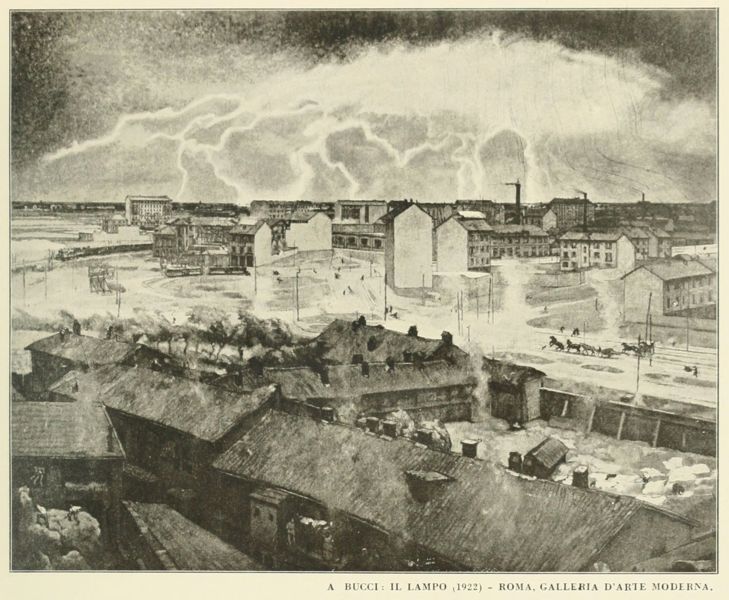
“Lightning” 1921 by Anselmo
Bucci (1887/1955). Snapshot of a chilling vision of industrial suburbs
between the wars
“Inexhaustibly varied in its themes, often
covered with a fine sense of irony, Bucci's painting is, as he liked to say,
the search 'of the true halo of poetry'. 'I have never tried to lie in a style,
but tell the truth in everyday language' he wrote” (Archimagazine)
“Girl reading (girl with open book)” about
1922 by Gino Rossi
(1884/1947)
“It is certainly a classic example of the
production of the painter who associates to the Novecento (Twentieth-century)
style evident metaphysical and magical realism feelings” (Fabio Fabiola)
“Messina's realism reminiscent of old times
is expressed in this work that portrays a young fisherman from Genoa, Galletto,
in a compositive expression which refers to the Shepherd by Vincenzo Gemito, in
the nervousness of the snappy forms of a Mediterranean teenager” (Livia Velani)
Bronze group “Affrico and Mensola” 1932/33
by Libero Andreotti
(1875/1933)
“Descent of paratroopers (aeropainting
parachute)” 1942 by Tullio Crali (1910/2000)
“Peasant Woman” 1938 by Giuseppe Capogrossi (1900/72)
“Portrait” 1934 and “The Bride” 1934 by Emanuele Cavalli (1904/81)
“The storm” 1930 by Gianfilippo Usellini (1903/71)
“Portrait of Nino Bertoletti” about 1925/29
by Amerigo Bartoli Natinguerra (1890/1971)
“Self
Portrait” about 1945 by Carlo Levi (1902/75)
“He joined in a European figurative form
ideologically neutral which is accompanied by his influences from traditional
Italian culture in the reference to the fifteenth century art and Piero Della
Francesca” (Stefania Frezzotti)
Plaster sculpture “Girl dreaming” about 1946 and
paintings “Portrait of Mario” about 1928 by Antonietta
Raphaël Mafai (1895/1975)
“Portrait of Stefano” 1928 and “Still Life
(Still Life with blackboard)” 1936 by Fausto Pirandello
(1899/1975), son of the great writer Luigi Pirandello
“In this juvenile work portraying Stefano,
elder brother of the artist, Pirandello already expresses that sense of unease
and anxiety that will be later his prominent theme. And he also displays a
mastery of the color palette applied with the spatula that shows a clear
maturation from his earliest period (1923-26) as a result of his stay in Paris”
(Stefania Frezzotti)
“The Café Royal Saint-Germain” 1948 by Toti Scialoja (1914/98)
“Portrait of the mother” 1930 by Scipione (Gino Bonichi) (1904/33)
“The corporal works of mercy (Visiting the
Sick)” 1931 by Guglielmo Janni (1892/1958)
“Painting” about 1935 by Atanasio Soldati (1896/1953)
Sculpture in stone “Abandon” about 1941 by Gino Colognesi (1899/1972)
Wood sculpture “Figure of a man (Man of
Buchenwald)” 1944/48 by Marino Mazzacurati (1907/69)
Bronze sculptures “David” about 1937 and “Chimera” about 1945 by Mirko
(Mirko Basaldella) (1910/69) Afro's brother
Carlo De Veroli was the sculptor of ten
statues at the Stadio dei Marmi, near the
Stadio Olimpico
“Pietro”
1938 and “The death of a young man” 1933/34 by Alberto
Ziveri (1908/90)
Two polychrome glazed terracotta sculptures
“Hermaphrodite”
and "Harpy" about 1939 by Leoncillo
Leonardi (1915/68)
“The first hour” 1930 by Orazio Amato (1884/1952)
“Gathering of people in the square (Order
of assembly)” 1934 by Contardo Barbieri (1900/96)
“Return of the legionnaires” 1940 by Giovanni Barbisan (1914/88)
Two reliefs in cement mortar colored to
imitate terracotta “The protection of the mother and child” 1940 by Luciano Minguzzi (1911/2004)
“Nude with black veil” 1941 and “Rosa, who
sleeps with sunflowers” about 1942 by Renato Birolli (1905/59)
“Girls
in Palermo” 1940, “The Goat” 1952, “Triumph of Death” 1943 and “Battle
and wounded horses” 1943 by Renato Guttuso
(1911/87)
Terracotta sculpture “Naked Woman” about 1954 by Giovanni Ciliberti (1897/1978)
“Sheperds of the island” 1940 by Giuseppe Migneco (1908/97)
Bronze sculpture “Hiroshima # 2” 1961 by Umberto Mastroianni
(1910/98)
“Labourers on the bandwagon” 1952 by
Giuseppe Zigaina (1924)
He is a painter, writer and director from
the Friuli region, friend and exegete of the great Italian movie director Pier
Paolo Pasolini. Example of the neo-realist style that had emerged in the Venice
Biennale in 1950 as an alternative to abstract art
“The big fishing” 1949 by Antonio Corpora (1909/2004)
“Window (fruitbasket)” 1950/52 by Luciano Gaspari (1913/2008)
“Highway at Night” 1951 by Titina Maselli (1924/2005)
“Figure No. 3” 1951/52 by Ennio Morlotti (1910/92)
“Squero site” 1947 by Armando Pizzinato
(1910/2004)
“Inside” 1948 by Giuseppe
Santomaso (1907/90)
“The chair and the cat” 1952 by Antonio Scordia (1918/88)
“Revolt” 1948 by Giulio
Turcato (1912/95)
“I was referring to the climate of revolt
that was alive among us during the German occupation (...). The revolt had
started from Rome, Naples was already liberated and it took four months for the
Americans to land at Anzio” (Giulio Turcato)
“Still Life” 1948 by Afro (Afro Basaldella) (1912/76)
“The neocubist decomposition tends to
reconstruct imaginary figures in a kind of abstract Surrealism” (Giorgio De
Marchis)
“Margutta (Triptych)” 1951 by Concetto Maugeri (1919/51)
“Nude Caryatid” 1951/52 by Alberto Viani (1906/89)
“Daphne” 1955 by Corrado
Cagli (1910/76)
“Surface
018” 1948 and “Surface 022” 1949 by Giuseppe Capogrossi
(1900/72)
In Surface 022 the comb or fork appears: it
was the characteristic element ever present in the works of this Roman artist
“Composition” 1950 and “Rossoverde” 1963 by
Carla Accardi (1924)
“Two circular form No.2” 1962 by Robert Adams (1917/84)
“Construction of wood in brown, black and
white” about 1962 by Victor Pasmore (1908/98)
“Framework
sculpture” about 1968 by Gastone Novelli (1925/68)
“Monument to polar exploration” 1964 by Achille Perilli (1927)
“The world of Alechinsky is anxious,
narcotic, illegal, nonsensical but fun if you manage to keep the distance”
(Eugène Ionesco)
“Square composition with horse” about 1938
by Jackson Pollock (1912/56)
“About Venice” 1958/59 by Tancredi Parmeggiani (1927/64)
“Woman” 1963 by Enrico
Baj (1924/2003)
“Riding” 1965 by Gianni
Ruffi (1938)
Three works including “Cabinet with
reflections in the mirror and figure elements” 1963 by Tano
Festa (1938/88)
There are also other works by Nino Franchina, Mino Guerrini,
Rufino Tamayo, Wilfredo
Lam, Hans Bellmer, Bruno Capacci, Oscar Domìnguez, Augustin Cardenas, Leonora Carrington, Arshile Gorky, Maurice Henry, Philippe Hiquily, Ragnar von Holten, Edouard Jaguer, Humphrey Jennings, Jiři Kolář, Dora Maar, Leo Malet, Wolfgang Paalen, Roland Penrose, Kurt Schwitters, Valerio Adami, Pietro Consagra, Arman (Armand Fernandez),
John Chamberlain,
Lucio Del Pezzo,
Luca Maria Patella and
Giosetta Fioroni




.jpg)






.jpg)








.jpg)