Showing posts with label Città del Vaticano. Show all posts

Thursday, January 16, 2020

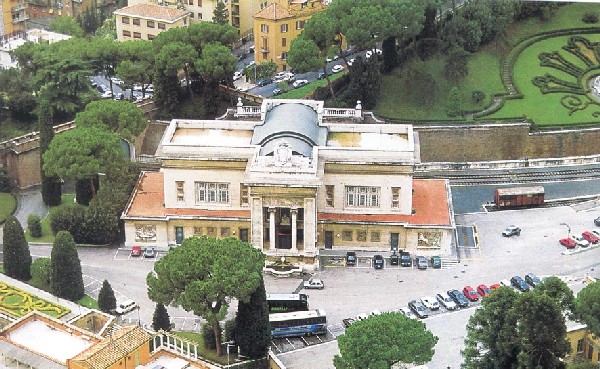
VATICAN CITY TRAIN STATION

STAZIONE DEL VATICANO
Piazzale della Stazione del Vaticano - Città del Vaticano

1929/33 Giuseppe Momo (1875/1940), architect of the Reverenda Fabbrica di S. Pietro, the Reverend Factory of St. Peter

“Giuseppe Momo was a professional expert also in technical and structural issues, destined to become the architect of the dramatic transformation of Vatican City. (...) His approach to formal problems, after a brief period when he followed the Liberty style, was marked by a strong eclecticism. It's pretty amazing his ability to move competently in architectural repertoire inherited from past eras, choosing from time to time with ease and without privileging any period, the building type best suited to solving problems effectively present for the function and history of the sites, for the technical innovations and, not least, for the symbolic importance of these buildings” (Daniela Fonti)

Marble reliefs and sculptures “Thought” and “Action” by Edoardo Rubino (1871/1954)
The sumptuous marble decoration of the interior was designed for the meetings that the pope should have had welcoming his guests, but that actually never happened

Inside “Four huge black monolithic columns “ from the Apuan Alps

It was used for passenger traffic only on very few occasions and much more for freight traffic although now even that is reduced to zero

The first pope to use the station Vatican was John XXIII (1958/63), on October 4, 1962, for his pilgrimage to Loreto and Assisi, on the eve of the Ecumenical Council

John Paul II (1978/2005) despite having traveled by train many times around the world, used the Vatican station only once, on January 24, 2002 to reach Assisi in a special pilgrimage together with representatives of the various religions of the world for the Day of Prayer for world peace

It has been several years that the building has been divided into three floors and transformed in the DEPARTMENT STORE OF THE VATICAN where are sold apparel products and leather high fashion, expensive watches, perfumes, computers and even alcohol and cigarettes, all with prices at least 20% lower than in Italy, since there are no taxes to be paid in the Vatican
Only employees of the Vatican and members of the clergy can shop in this store and, a short distance, they can also get gas at the GAS PUMP OF THE VATICAN where they save about 25% compared to Italy

Tuesday, December 17, 2019

St. STEPHEN OF THE ABYSSINIANS

S. STEFANO DEGLI ABISSINI
Città del Vaticano

Maybe originally built in the fifth century at the time of Leo I the Great (440/461) 
Restored in the eighth century at the time of Hadrian I (772/795)

It is also known as S. Stefano Maggiore (St. Stephen Major) or S. Stefano degli Indiani (St. Stephen of the Indians)

In 1479 Sixtus IV Della Rovere (1471/84) gave it to the Coptic monks coming from Abyssinia and known, at that time, as Indians

Restructured and reduced in size in 1706 by the Roman Antonio Valeri (1648/1736) for Clement XI Albani (1700/21) 
Restored in the years 1927/28 and 1931/33 by Gustavo Giovannoni (1873/1947)

“Jambs and lintel” of the entrance portal made out of ancient Roman marble sculpted again and modified at the end of the twelfth century

“Ancient columns” embedded in the right wall maybe moved here in the twelfth of thirteenth century

RIGHT ALTAR
“S. Silverius Pope” by Biagio Puccini (1673/1721)

MAIN ALTAR
“St. Stephen stoned” by an unknown seventeenth-century artist

Saturday, September 14, 2019

St. PEREGRINE

S. PELLEGRINO
Via dei Pellegrini - Città del Vaticano

Mentioned for the first time by sources at the end of the eighth century
Restored in 1590
Archaeological excavations have uncovered paintings dating back to the ninth century
Alexander VII Chigi (1655/67) officially gave it in 1657 to the Swiss Guards who later abandoned it, so that it was transformed into a chicken coop

It was later restored for the Swiss Guards and now it is the CHAPEL OF THE CORPS OF POLICE OF THE STATE OF VATICAN CITY (Corpo della Gendarmeria)

“This small sacred place unknown to most people is full of history and evokes extraordinary impressions. First and foremost impressions of pilgrimages. Peregrinus, a Roman priest who made Gaul a Christian land in the late third century, is the titular saint of the chapel and one can easily understand why. For those who came from the North in their penitential journey ad limina Petri (to the threshold of Peter), the first encounter with Rome used to take place here. (...) The walls are full of frescoes with the name and emblem of the captains of the Swiss Guard, the armed corps in defense of the person of Pope Julius II instituted in 1506. One of them hit me in a special way, dating back to 1527. The mentioned person is the captain Gaspar Rost. And here suddenly the terrible May 1527, the Sack of Rome is evoked. 14,000 lansquenets, in good part Lutherans, led by Georg Frundesberg, gave the assault to the Apostolic Palace. To defend it there are 147 Swiss. It was a fierce confrontation, spear against spear, sword and dagger against sword and dagger. At the end of the atrocious butchery all the Swiss Guards of the Pope had died. Among others, Captain Gaspar Rost who was slain with his soldiers to allow Pope Clement VII to retire with his court in the untakeable Castel Sant'Angelo” (Antonio Paolucci - L'Osservatore Romano, May 30, 2010)

Thursday, February 19, 2015

VATICAN MUSEUMS - GALLERY OF THE CANDELABRA (fourth part)


Section V
 
5 “Young girl running” so-called Atalanta Barberini classicist work of the first century BC from the Greek original of 460 BC by an artist of the circle of Pasitele or work of Hadrian's period (117/138) from original in severe style of about 500 BC
It was in the Barberini collection and it was purchased in 1772
The short one-shoulder chiton (tunic) indicates probably a female athlete during the competitions in honor of Hera in Olympia

9 “Nymph” second century AD from an original of the fourth century BC with head not relevant
It was found by Gavin Hamilton in 1769 at Hadrian's Villa and it was initially believed to be Nemesis, the goddess of vengeance
The heavy tunic with flap was called apoptygma

25 “Young satyr flautist” second half of the first century AD from the original of the early Hellenistic period inspired by Praxiteles, from the Villa of Domitian in Sabaudia
Purchased by the Vatican Museums in 1806, the statue is characterized by the transverse flute known in antiquity as oblique tibia or tybicen

26 “Ganymede or Narcissus” found in 1800 in Tor Boacciana near Ostia
On the side there is an inscription with a name in Greek characters, perhaps that of the sculptor
The child who wears only a chlamys (short cloak worn by men), has his legs crossed in the typical attitude of the statues of Praxiteles or Lysippus

32 “Little black slave with toiletry objects” second century AD from an original of the third century BC
It was purchased in 1772 and it probably comes from La Storta on the Via Cassia. The head is ancient but not relevant. The toilet articles are the strigil and a cruet for oil used after athletic exercise

36 “Baby Hercules” mid-second century AD from Hellenistic original of the end of the third century BC from the Villa of the Quintili
The act of pouring wine from a bottle is the result of a modern restoration

42 “Statue of Pan” from the original in Polyclitean style

50 “Circular Altar” second or first century BC from Tor Colombaro on Appian Way at Frattocchie
There is a scene of sacrifice in the presence of Mercury


Section VI


1 “Statue of Diana” Beirut-type Berlin with body and head from two different Roman copies of Greek originals: body by Kephisodotos of the beginning of the fourth century BC, head from an original of the fifth century by an artist of the circle of Phidias
Maybe it comes from the Port of Trajan in Fiumicino


8 “Sarcophagus with the myth of Endymion” about 150/160 AD found in 1776 in the Vigna Casali near St. Sebastian's Gate
Selene descends from the chariot of the moon and discovers the beautiful hunter Endymion asleep

9 “Mars” second century AD found in 1780 at the Basilica of St. Mark's and rebuilt as a model of Mars Ultor (the avenger of the death of Julius Caesar) of the Temple of Augustus in the Forum

14 “Ganymede with the eagle” from Urbisaglia (Urbis Salvia) at Macerata in the Marche region
In 1779 the sculptor Ferdinando Lisandroni assembled it using parts of various ancient statues

18 “Statue seated with lyre” first half of the second century AD from a late Hellenistic original. It was found in 1777 in the Tomb of Cecilia Metella

24 “Niobid on the run” copy of the Hadrian's period from a very famous Hellenistic original. It was found in 1794 in the Cesarini estate in Torvajanica
It was purchased in 1804 by the Vatican Museums

27 “Milestone” of the fifth mile of the Appian Way placed by Maxentius (306/312)

32 “Persian fighter” copy of the Hadrian's period from the group of the so-called Small Attalid Votive Offering erected by Pergamum in the Acropolis of Athens as a votive offering in the second century BC
It was found during the construction of Palazzo Medici now Palazzo Madama

35 “Sarcophagus with rape of two daughters of Leucippus by the Dioscuri” about 150/180 AD. It was purchased in 1771 by the Vatican Museums

36 “Sleeping Eros” second century AD from an original of the third century BC
Some scholars have interpreted it as Anteros the negative opposite of love passion

37 “Funerary statue of Pompeia Attia” first century AD, found in 1851 on the Appian Way and named after an inscription found in the same place
The head of the first century BC is not relevant and it was added in 1800

Friday, January 16, 2015

VATICAN MUSEUMS - GREGORIAN ETRUSCAN MUSEUM (first part)


MUSEO GREGORIANO ETRUSCO

Founded by Gregory XVI Cappellari (1831/46) in 1837
Objects found during excavations since 1828 in southern Etruria, then part of the Papal State

After 1870, there were few acquisitions of archaeological collections, but all important such as the Collection Falcioni (1898), the donations of Benedetto Guglielmi (1935) and Mario Astarita (1967), and the purchase of the Giacinto Guglielmi's collection (1987)

The museum is located along the Gregorian Egyptian Museum in the Palace of Innocent VIII Cybo (1484/1492) about 1487 by Giacomo da Pietrasanta and in the annex building of the time of Pius IV Medici (1559/65)


Room I - Protohistory


First Iron Age in Etruscan Latium (IX/VIII century BC) and oriental and archaic artifacts (VII/VI century BC)

“Biconical urn” expression of Villanovian civilization of the ninth century BC from the Necropolis of Osteria in Vulci

“For the closure a bowl was used or a ceramic reproduction of a helmet. The latter was the only form of customization for an urn otherwise free of any characterization in an anthropomorphic sense, a tendency which later would assume particular importance in certain cultural areas” (Web site of the Vatican Museums - mv.vatican.va)

“Hands plated in bronze” seventh century BC used in early attempts at reproduction of the human figure by the Etruscan artists who were working with bronze

“Spheroidal amphora and chair in tubular elements” seventh century BC in laminated bronze

“Often the urn (the so-called Canopic jar) was placed on a chair like this one or, more frequently, on a throne with a circular back. All this, together with the furnishings of the funeral, was buried inside a large jar (dolio) or 'ziro'“ (Web site of the Vatican Museums - mv.vatican.va)

“Hut-urn” first half of the ninth century BC from the Tomb of Montecucco in Castel Gandolfo

“The cinerary hut-shaped urn is one of the ossuaries typical of early Iron Age in Etruscan Latium (IX-VIII century BC), with isolated examples in Sabina and Campania. The special design of this urn, that wants to recall the home of the deceased, has a symbolic meaning. It is also a fundamental model for understanding the domestic architecture of these old huts, which had an oval or rectangular, more rarely circular, plan with the entrance door on the short side” (Web site of the Vatican Museums - mv.vatican.va)

“Archaic Chariot” 550/540 BC in laminated and cast bronze on a wooden modern reconstruction


Room II – Necropolis of Sorbo and Giulimondi Tomb


Items from an excavation carried out in the years 1836/37 in the Necropolis of Sorbo at Cerveteri, by the General Vincenzo Galassi and the Archpriest of Cerveteri, Alessandro Regolini
To these items, discovered in at least nine tombs, were added the items found by Giovanni Pinza in 1906 in the Giulimondi Tomb

In the FRIEZE “Stories of Moses and Aaron” by Federico Fiori aka Barocci (1535/1612), Federico Zuccari (about 1542/1609) and his brother Taddeo Zuccari (1529/66) with their workshops

Regolini Galassi tomb (about 650 BC) discovered intact: “Bib” and “Fibula” of gold. The fibula was an ancient and much more ornate version of a modern pin, used to block and decorate garments

“I believe that today we can definitely recognize an Egyptian birthright regarding the type and symbolism of the Regolini-Galassi's “Bib” although, considering the historical and decorative repertoire, it is likely that it reached Etruria through Levantine mediation” (Maurizio Sannibale)

The bucchero black ceramic was usually thin, used by the Etruscans to produce vessels. Around the inkpot Etruscan letters are engraved

“For many decades the idea has grown that the Etruscan Orientalizing constituted only a tumultuous confluence of exotic goods, given in exchange for raw materials and products to the new rich of the West, who obviously did not share in the culture that had produced those same goods. Today, we think that things can be worked out differently, as it is said in the introduction to the exhibition 'Etruscan Princes between Mediterranean and Europe': the Orientalizing phenomenon was not only commercial but it also imported ideas” (Maurizio Sannibale)

Objects from the Calabresi Tomb about 650 BC including “Calabresi urn”, an urn in overpainted red clay

Objects from the Giulimondi Tomb about 690 BC