Showing posts with label Vaticano. Show all posts

Thursday, January 16, 2020

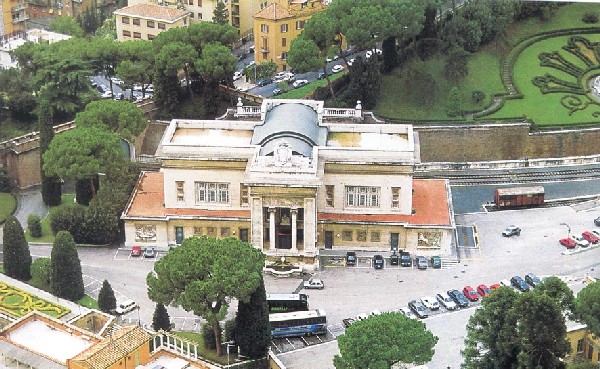
VATICAN CITY TRAIN STATION

STAZIONE DEL VATICANO
Piazzale della Stazione del Vaticano - Città del Vaticano

1929/33 Giuseppe Momo (1875/1940), architect of the Reverenda Fabbrica di S. Pietro, the Reverend Factory of St. Peter

“Giuseppe Momo was a professional expert also in technical and structural issues, destined to become the architect of the dramatic transformation of Vatican City. (...) His approach to formal problems, after a brief period when he followed the Liberty style, was marked by a strong eclecticism. It's pretty amazing his ability to move competently in architectural repertoire inherited from past eras, choosing from time to time with ease and without privileging any period, the building type best suited to solving problems effectively present for the function and history of the sites, for the technical innovations and, not least, for the symbolic importance of these buildings” (Daniela Fonti)

Marble reliefs and sculptures “Thought” and “Action” by Edoardo Rubino (1871/1954)
The sumptuous marble decoration of the interior was designed for the meetings that the pope should have had welcoming his guests, but that actually never happened

Inside “Four huge black monolithic columns “ from the Apuan Alps

It was used for passenger traffic only on very few occasions and much more for freight traffic although now even that is reduced to zero

The first pope to use the station Vatican was John XXIII (1958/63), on October 4, 1962, for his pilgrimage to Loreto and Assisi, on the eve of the Ecumenical Council

John Paul II (1978/2005) despite having traveled by train many times around the world, used the Vatican station only once, on January 24, 2002 to reach Assisi in a special pilgrimage together with representatives of the various religions of the world for the Day of Prayer for world peace

It has been several years that the building has been divided into three floors and transformed in the DEPARTMENT STORE OF THE VATICAN where are sold apparel products and leather high fashion, expensive watches, perfumes, computers and even alcohol and cigarettes, all with prices at least 20% lower than in Italy, since there are no taxes to be paid in the Vatican
Only employees of the Vatican and members of the clergy can shop in this store and, a short distance, they can also get gas at the GAS PUMP OF THE VATICAN where they save about 25% compared to Italy

Friday, January 16, 2015

VATICAN MUSEUMS - GREGORIAN ETRUSCAN MUSEUM (first part)


MUSEO GREGORIANO ETRUSCO

Founded by Gregory XVI Cappellari (1831/46) in 1837
Objects found during excavations since 1828 in southern Etruria, then part of the Papal State

After 1870, there were few acquisitions of archaeological collections, but all important such as the Collection Falcioni (1898), the donations of Benedetto Guglielmi (1935) and Mario Astarita (1967), and the purchase of the Giacinto Guglielmi's collection (1987)

The museum is located along the Gregorian Egyptian Museum in the Palace of Innocent VIII Cybo (1484/1492) about 1487 by Giacomo da Pietrasanta and in the annex building of the time of Pius IV Medici (1559/65)


Room I - Protohistory


First Iron Age in Etruscan Latium (IX/VIII century BC) and oriental and archaic artifacts (VII/VI century BC)

“Biconical urn” expression of Villanovian civilization of the ninth century BC from the Necropolis of Osteria in Vulci

“For the closure a bowl was used or a ceramic reproduction of a helmet. The latter was the only form of customization for an urn otherwise free of any characterization in an anthropomorphic sense, a tendency which later would assume particular importance in certain cultural areas” (Web site of the Vatican Museums - mv.vatican.va)

“Hands plated in bronze” seventh century BC used in early attempts at reproduction of the human figure by the Etruscan artists who were working with bronze

“Spheroidal amphora and chair in tubular elements” seventh century BC in laminated bronze

“Often the urn (the so-called Canopic jar) was placed on a chair like this one or, more frequently, on a throne with a circular back. All this, together with the furnishings of the funeral, was buried inside a large jar (dolio) or 'ziro'“ (Web site of the Vatican Museums - mv.vatican.va)

“Hut-urn” first half of the ninth century BC from the Tomb of Montecucco in Castel Gandolfo

“The cinerary hut-shaped urn is one of the ossuaries typical of early Iron Age in Etruscan Latium (IX-VIII century BC), with isolated examples in Sabina and Campania. The special design of this urn, that wants to recall the home of the deceased, has a symbolic meaning. It is also a fundamental model for understanding the domestic architecture of these old huts, which had an oval or rectangular, more rarely circular, plan with the entrance door on the short side” (Web site of the Vatican Museums - mv.vatican.va)

“Archaic Chariot” 550/540 BC in laminated and cast bronze on a wooden modern reconstruction


Room II – Necropolis of Sorbo and Giulimondi Tomb


Items from an excavation carried out in the years 1836/37 in the Necropolis of Sorbo at Cerveteri, by the General Vincenzo Galassi and the Archpriest of Cerveteri, Alessandro Regolini
To these items, discovered in at least nine tombs, were added the items found by Giovanni Pinza in 1906 in the Giulimondi Tomb

In the FRIEZE “Stories of Moses and Aaron” by Federico Fiori aka Barocci (1535/1612), Federico Zuccari (about 1542/1609) and his brother Taddeo Zuccari (1529/66) with their workshops

Regolini Galassi tomb (about 650 BC) discovered intact: “Bib” and “Fibula” of gold. The fibula was an ancient and much more ornate version of a modern pin, used to block and decorate garments

“I believe that today we can definitely recognize an Egyptian birthright regarding the type and symbolism of the Regolini-Galassi's “Bib” although, considering the historical and decorative repertoire, it is likely that it reached Etruria through Levantine mediation” (Maurizio Sannibale)

The bucchero black ceramic was usually thin, used by the Etruscans to produce vessels. Around the inkpot Etruscan letters are engraved

“For many decades the idea has grown that the Etruscan Orientalizing constituted only a tumultuous confluence of exotic goods, given in exchange for raw materials and products to the new rich of the West, who obviously did not share in the culture that had produced those same goods. Today, we think that things can be worked out differently, as it is said in the introduction to the exhibition 'Etruscan Princes between Mediterranean and Europe': the Orientalizing phenomenon was not only commercial but it also imported ideas” (Maurizio Sannibale)

Objects from the Calabresi Tomb about 650 BC including “Calabresi urn”, an urn in overpainted red clay

Objects from the Giulimondi Tomb about 690 BC

Tuesday, October 22, 2013

St. MARTHA'S HOUSE

CASA DI S. MARTA
1992/96 Louis D. Astorino (1948)
The house is also known by its Latin name: DOMUS SANCTAE MARTAE
Astorino was the first and only American architect to design a building in Vatican City
It replaced the Hospice of St. Marta built in 1891 by Leo XIII Pecci (1878/1903) to accommodate any cholera patients. The epidemic hit many Italian cities but it eventually spared Rome and so the building was destined for the homeless of Borgo and Trastevere as well as for pilgrims
  During World War II it was a safe place to live in for the ambassadors to the Holy See for those countries with which Italy had broken off diplomatic relations such as United States of America, Great Britain, France, Belgium, Yugoslavia and Poland
It is now the hotel where since 2005 the college of cardinals who take part in the conclave to elect new popes stays
In ordinary time it is used to lodge prelates living temporarily in Vatican City
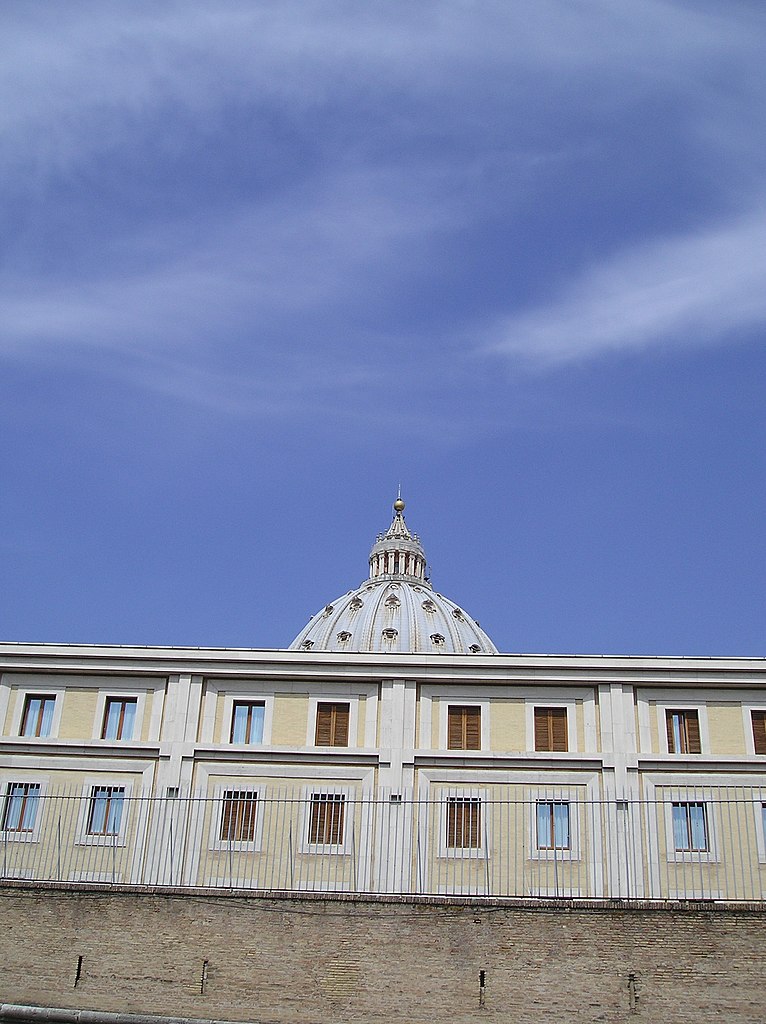
Its construction has caused a lot of controversy for the height higher than that of the previous building of 4.25 m (14 feet). This has limited the best perspective from Italian territory on the drum of Michelangelo's dome of the Basilica of St. Peter