Showing posts with label Giuseppe Momo. Show all posts

Thursday, January 16, 2020

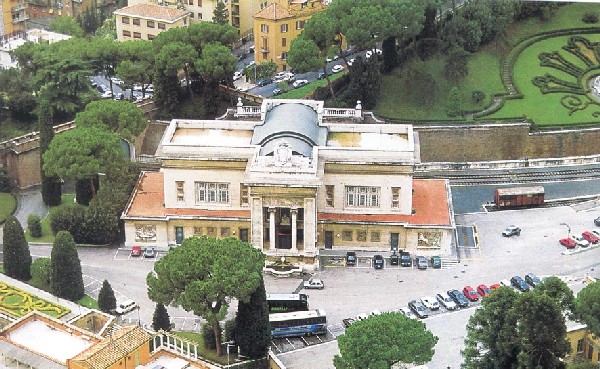
VATICAN CITY TRAIN STATION

STAZIONE DEL VATICANO
Piazzale della Stazione del Vaticano - Città del Vaticano

1929/33 Giuseppe Momo (1875/1940), architect of the Reverenda Fabbrica di S. Pietro, the Reverend Factory of St. Peter

“Giuseppe Momo was a professional expert also in technical and structural issues, destined to become the architect of the dramatic transformation of Vatican City. (...) His approach to formal problems, after a brief period when he followed the Liberty style, was marked by a strong eclecticism. It's pretty amazing his ability to move competently in architectural repertoire inherited from past eras, choosing from time to time with ease and without privileging any period, the building type best suited to solving problems effectively present for the function and history of the sites, for the technical innovations and, not least, for the symbolic importance of these buildings” (Daniela Fonti)

Marble reliefs and sculptures “Thought” and “Action” by Edoardo Rubino (1871/1954)
The sumptuous marble decoration of the interior was designed for the meetings that the pope should have had welcoming his guests, but that actually never happened

Inside “Four huge black monolithic columns “ from the Apuan Alps

It was used for passenger traffic only on very few occasions and much more for freight traffic although now even that is reduced to zero

The first pope to use the station Vatican was John XXIII (1958/63), on October 4, 1962, for his pilgrimage to Loreto and Assisi, on the eve of the Ecumenical Council

John Paul II (1978/2005) despite having traveled by train many times around the world, used the Vatican station only once, on January 24, 2002 to reach Assisi in a special pilgrimage together with representatives of the various religions of the world for the Day of Prayer for world peace

It has been several years that the building has been divided into three floors and transformed in the DEPARTMENT STORE OF THE VATICAN where are sold apparel products and leather high fashion, expensive watches, perfumes, computers and even alcohol and cigarettes, all with prices at least 20% lower than in Italy, since there are no taxes to be paid in the Vatican
Only employees of the Vatican and members of the clergy can shop in this store and, a short distance, they can also get gas at the GAS PUMP OF THE VATICAN where they save about 25% compared to Italy

Friday, April 20, 2018

St. ANNE OF THE GROOMS

S. ANNA DEI PALAFRENIERI
Begun in 1572 by Jacopo Barozzi aka Vignola (1507/73) for the Confraternity of the Palafrenieri (Grooms)
Finished in 1583 after his death by his son Giacinto Barozzi (about 1535-40/after 1584)
It was the first church in Rome to have an elliptical plan
It was the church of the palafrenieri (grooms) or the papal sediari (carriers of the papal chair), people that supported the gestatorial chair of the pope and accompanied the pope's carriage
In 1929, following the Conciliation between the Italian state and the church, S. Anna became the parish church of the Vatican and Pius XI Ratti (1922/39) assigned it to the Swiss Guards, designating for the palafrenieri the church of S. Caterina della Rota
FAÇADE
1700/31 Alessandro Specchi (1668/1729), who also added the portal, the balustrade and the bell towers
DOME
1763 by Giovanni Domenico Navone (active since 1706/d. 1770)
Above the doors stucco panels 1746 by G.B. De Rossi
NEAR THE ENTRANCE
“Plaque in memory of the Marquis Del Grillo Onofrio (1714/87)”
He was an eccentric character famous for his practical jokes, a member of the palafrenieri and immortalized in the great 1981 film Il Marchese del Grillo directed by Mario Monicelli with the comedian Alberto Sordi. His tomb is in the church of S. Giovanni dei Fiorentini
ON THE WALLS
Four frescoes “Scenes from the life of St. Anna” by Ignazio Stern (1679/1748)
MAIN ALTAR
“S. Anna and the Virgin Mary girl” 1927 copy by Arturo Viligiardi (1869/1936) from an original by Alessandro Franchi
Outside to the left of the church there is the unknown but extraordinary FOUNTAIN OF THE BEES by Francesco Borromini (1599/1667) who had also prepared a project for the façade of the church
To the right of the church S. ANNA's GATE 1931 by Giuseppe Momo (1875/1940)
It is the church of the SWISS GUARDS in Vatican territory
The Swiss Guards are currently 110 and are at the service of the pope since 1506
During the sack of Rome in 1527 they saved the life of Clement VII Medici (1523/34): 147 died and only 42 survived, escaping with the pope in Castel Sant'Angelo
To be admitted to the corps one must be male, have Swiss citizenship, be of Catholic faith, have served in the Swiss army obtaining a certificate of good conduct, be between 18 and 30 years of age, have minimum height of 174 cm (5.7 feet), being unmarried (marriage is only permitted for corporals and higher ranks), have a certificate of professional capacity or high school diploma and be ready for a minimum service of 25 months

Thursday, April 23, 2015

VATICAN MUSEUMS - APOSTOLIC VATICAN LIBRARY (second part)

Alexandrine Room
 
1690 for Alexander VIII Ottoboni (1689/91) to house the prestigious library of Queen Christina of Sweden

“It is here that between 1741 and 1747 were initially arranged the collections acquired by Benedict XIV for the collections of the Museo Cristiano; and it is here that in 1749 an inscription still on the western side of the Galleria mentions what is for the first time indicated by the name of 'Vatican Museum': a historical museum 'of Christian scholarship' (as it was described by the academic community on the eve of its Roman foundation), ANTIQUARIA SUPPELLECTILE AMPLISSIME EXORNATO” (Guido Cornini)

Frescoes “Episodes from the life of Pius VI Braschi (1775/99)” about 1818 by Domenico de Angelis (1735/1804) and Domenico del Frate (1765/1821)

English “Cope” of 3 m (10 feet) in red silk of the thirteenth century

Clementine Gallery


1732 for Clement XII Corsini (1730/40) divided into five sections by Pius VI
Originally it was an open loggia

Frescoes “Episodes from the life of Pius VII Chiaramonti (1800/23)” about 1818 by Domenico De Angelis (1735/1804) and Domenico Del Frate (1765/1821)

Section IV:

Porphyry sculpture “Two emperors in the act of embracing” a work of the late empire

Section V:

“Two statues of deities of the cult of Mithras” second or third century AD including that on the left with key in fist and rooster at the foot, attributes later referring to S. Peter

Profane Museum


Open in 1767 by Clement XIII Rezzonico (1758/69) in order to keep the Vatican medals
Vault “Minerva and Time” by the Roman Stefano Pozzi (1699/1768)


Ancient and extremely precious bronze heads of Roman emperors:

“Septimius Severus (193/211)”
“Caelius Balbinus”

“Roman mosaic with deer and birds” from Villa Adriana

“Head and arms of a statue of Athena chryselephantine”


EXIT SPIRAL STAIRS


1932 Giuseppe Momo (1875/1940)

Balustrade with bronze reliefs by Antonio Maraini (1886/1963)
Giuseppe Momo as architect of the Reverend Factory of St. Peter designed many buildings in the Vatican

These stairs inspired Frank Lloyd Wright for the stairs of the Guggenheim Museum in New York