Showing posts with label Luigi Valadier. Show all posts

Thursday, April 23, 2015

VATICAN MUSEUMS - APOSTOLIC VATICAN LIBRARY (second part)

Alexandrine Room
 
1690 for Alexander VIII Ottoboni (1689/91) to house the prestigious library of Queen Christina of Sweden

“It is here that between 1741 and 1747 were initially arranged the collections acquired by Benedict XIV for the collections of the Museo Cristiano; and it is here that in 1749 an inscription still on the western side of the Galleria mentions what is for the first time indicated by the name of 'Vatican Museum': a historical museum 'of Christian scholarship' (as it was described by the academic community on the eve of its Roman foundation), ANTIQUARIA SUPPELLECTILE AMPLISSIME EXORNATO” (Guido Cornini)

Frescoes “Episodes from the life of Pius VI Braschi (1775/99)” about 1818 by Domenico de Angelis (1735/1804) and Domenico del Frate (1765/1821)

English “Cope” of 3 m (10 feet) in red silk of the thirteenth century

Clementine Gallery


1732 for Clement XII Corsini (1730/40) divided into five sections by Pius VI
Originally it was an open loggia

Frescoes “Episodes from the life of Pius VII Chiaramonti (1800/23)” about 1818 by Domenico De Angelis (1735/1804) and Domenico Del Frate (1765/1821)

Section IV:

Porphyry sculpture “Two emperors in the act of embracing” a work of the late empire

Section V:

“Two statues of deities of the cult of Mithras” second or third century AD including that on the left with key in fist and rooster at the foot, attributes later referring to S. Peter

Profane Museum


Open in 1767 by Clement XIII Rezzonico (1758/69) in order to keep the Vatican medals
Vault “Minerva and Time” by the Roman Stefano Pozzi (1699/1768)


Ancient and extremely precious bronze heads of Roman emperors:

“Septimius Severus (193/211)”
“Caelius Balbinus”

“Roman mosaic with deer and birds” from Villa Adriana

“Head and arms of a statue of Athena chryselephantine”


EXIT SPIRAL STAIRS


1932 Giuseppe Momo (1875/1940)

Balustrade with bronze reliefs by Antonio Maraini (1886/1963)
Giuseppe Momo as architect of the Reverend Factory of St. Peter designed many buildings in the Vatican

These stairs inspired Frank Lloyd Wright for the stairs of the Guggenheim Museum in New York

Tuesday, October 15, 2013

LATERAN BAPTISTERY

BATTISTERO LATERANENSE
Real name S. GIOVANNI DELLA FONTE (St. John of the water spring)
Built about 313/318 for Constantine (306/337) over a villa of the first century AD and a thermal bath of the second century AD, which was used to warm up the water for the baptismal immersions
Modified extensively for Sixtus III (432/440)
Last renovations:
1540 when the dome was replaced by a lantern
1629/35 by Domenico Castelli (1582/1657)
1657 with the external frieze of Francesco Borromini (1599/1667)
1967
It was the principal Baptistery in Rome and it has always been used for baptisms from antiquity to now seamlessly
ENTRANCE opened by Pope Gregory XIII Boncompagni (1572/85) for the Jubilee of 1575
IN THE CENTER
"Green basalt tank" with a lid decorated with bronze friezes "Baptism of Jesus" and "Baptism of Constantine" by Ciro Ferri (1634/89)
The Liber pontificalis says that there was a large basin of porphyry covered in silver with the golden statue of the lamb of God in the middle. Water was poured into the tank from a phial of gold and from seven deers of silver while on the edges there were the statues, of Jesus and St. John the Baptist also made of silver
"Eight columns of porphyry" dating back to Constantine's times placed here about 100 years later, at the time of Sixtus III (423/440)
DRUM
"Apparition of the Angel to Zacharias", "Visit of Mary to St. Elizabeth", "Birth", "Circumcision", "The Baptist in the Desert", "Preaching", "Baptism of Jesus" and "Beheading" modern copies of the originals 1639/45 by Andrea Sacchi (1599/1661) now in the Lateran Palace
"He wanted to strip his style of any frill. Studying Raphael, he attained a degree of simplicity which is exactly the classic Italian counterpart to the development of Nicolas Poussin in those years" (Rudolf Wittkower)
ON THE WALLS
"Stories of Constantine" by pupils of Andrea Sacchi:
"Apparition of the Cross" by Giacinto Gimignani (1606/81)
"Enthronement of the Cross and destruction of idols" early work by Carlo Maratta (1625/1713)
Door with ancient bronze panels, originally placed at the top of the Holy Stairs
"Statue of St. John the Baptist" Luigi Valadier (1726/85)
CHAPEL OF St. RUFINA
Corresponding to the narthex of Sixtus III (432/440)
Transformed in 1154 by Anastasius IV (1153/54)
In the little apse on the left mosaic of the fifth century with "Phytomorphic motifs with crosses"
In the little apse on the right "Madonna" maybe by G.B. Salvi aka Sassoferrato (1609/85)
High above the entrance to the baptistery marble bas-relief "Crucifixion" maybe by Andrea Bregno (1418/1503)
The "Bases of the two columns" come from the Temple of Venus Genetrix in the Forum of Caesar
640 by Pope John IV (640/642) built to bury the remains of some saints (Venantius, Anastasius, Mauro and others) from Dalmatia whence he himself came
In the apse and in the arch mosaics from about 650, restored 1826/28:
Above "Saviour between two angels"
Below "Virgin"
On the right "St. Peter, John the Baptist, Bishop Donnione and John IV"
On the left "Sts. Paul, John the Evangelist, Venantius and Pope Theodore I (642/649)"
MAIN ALTAR by Carlo Rainaldi (1611/91)
On the sides "Cenotaphs of Cardinal Adriano Ceva and of his nephew Cardinal Francesco Adriano Ceva" by Giuliano Finelli (1602/53)
On the left "Plate of Cardinal Ceva" 1650 by Francesco Borromini
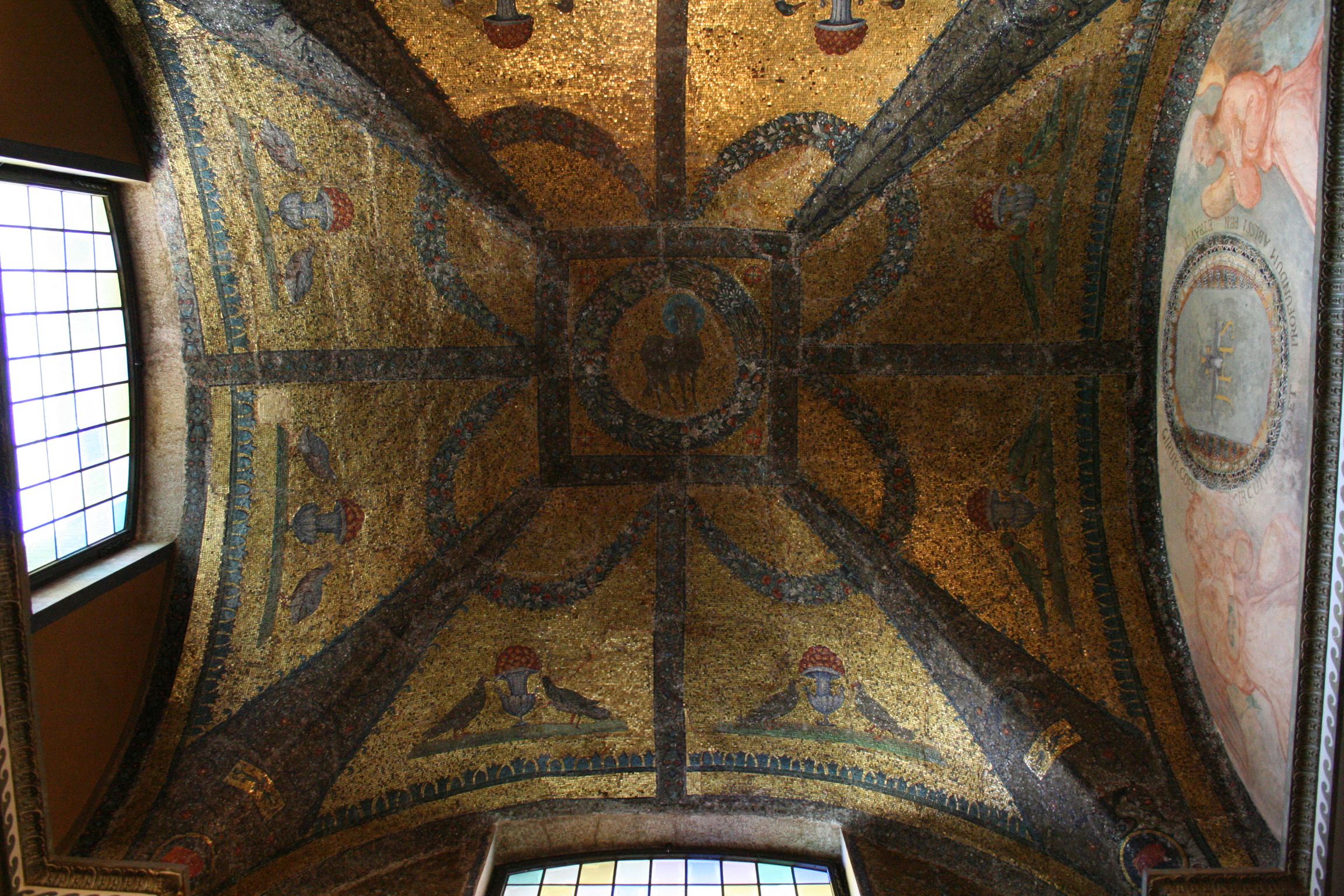
CHAPEL OF St. JOHN THE EVANGELIST
"Bronze doors" 1196 that sound like an organ when they are opened or closed
In the vault mosaic about 450 "Agnus Dei, birds and vases"
"Statue of St. John the Evangelist" maybe by Taddeo Landini (about 1550/96)
On the left "Funeral relief" by Luigi Capponi (active end of 1400s/beginning of 1500s)
Frescoes 1597/1601 by Antonio Tempesta (about 1555/1630) and Agostino Ciampelli (1565/1630)
Stuccos by Ambrogio Buonvicino (about 1552/1622)