BASILICA S. CLEMENTE
Domus of the second half of the second century built next to a public building before the fire of AD 64 during Nero's reign. It is likely that this public building became later the MINT moved here by Domitian (81/96) from the original site on the Arx, according to some inscriptions from the time of Hadrian (118/138)
In the second century a MITHRAEUM, a place of worship for the followers of the mystery religion of Mithraism, was built in a courtyard of the domus and then maybe it became the domus ecclesia of Clement who was, according to tradition, a freed slave banned in Crimea under Trajan (97/118)
Clement apparently converted many people in Crimea and seventy-five churches were built after his preaching. Trajan, then, ordered Clement to be thrown into the sea with an anchor around his neck
After these events, each year on the anniversary of his death, the sea used to recede two miles, to reveal a shrine built "miraculously" that contained the bones of the martyr and allow the faithful to visit
He was later identified with his namesake Pope Clement I (88/97) the fourth pope, whose relics were brought to Rome by the Sts. Cyril and Methodius in 867 and kept in the basilica built, according to tradition, in the fourth century above the domus ecclesia
Sources on St. Clement are very fragmented and confusing, and perhaps add up in one personality two different Clements who lived in the first century AD
The first reliable news that the church was active, however, date back only to 417/418
After the fire of 1084 the Norman church was buried underground to support the new basilica built in the years 1118/25, raised 5 m (17 feet) higher than the old basilica
Because of the religious persecution in Ireland, it was granted in 1677 to the Irish Dominicans who still keep it today
1118/1125 commissioned by Paschal II (1099/1118)
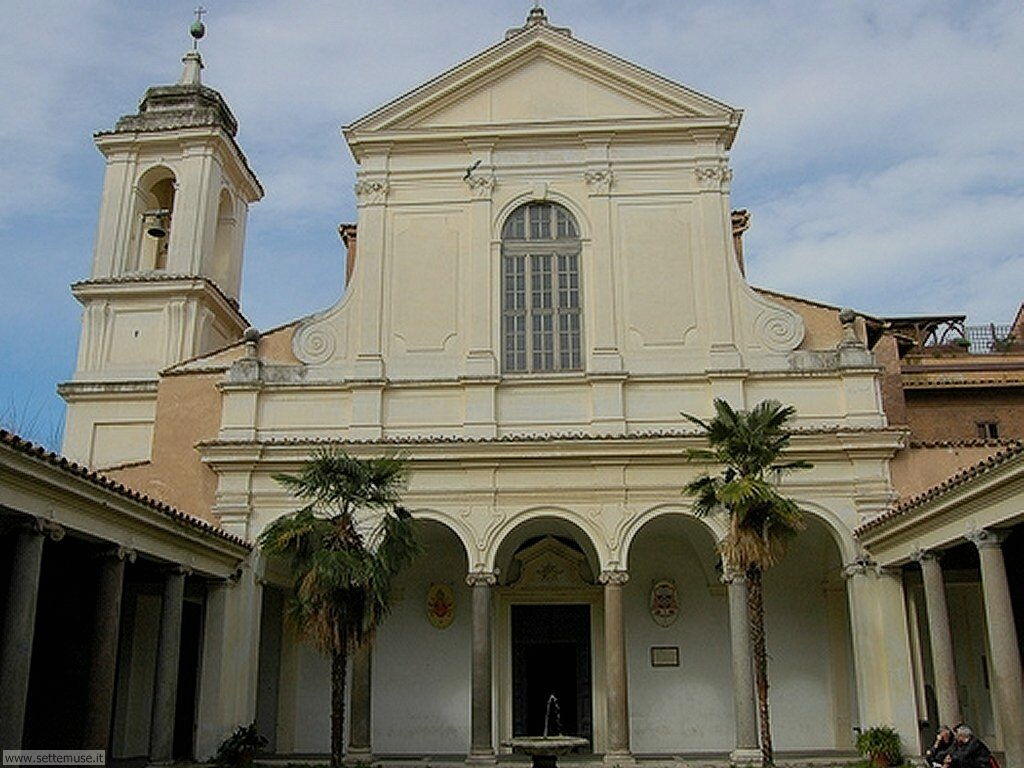
PORCH built in the eight or ninth century preceding the COURTYARD with portico on the four sides with a FAÇADE built in 1715/19 designed by Carlo Stefano Fontana (active 1700/about 1719), Carlo Fontana's son and Francesco Fontana's brother
BELL TOWER seventeenth century formerly located on the opposite side
Today's internal appearance of the church dates back to 1713/19 when Carlo Stefano Fontana gave it a late-baroque touch for Clement XI Albani (1700/21)
The liturgical apparatus known as "cosmatesco" in this church is the best preserved among those existing in Rome. It is the best example of the work of the first generation of the Cosmati's family and became the canonical type followed in Rome and in the Lazio region
There have been at least seven Cosmati, belonging to four different generations living between the twelfth and thirteenth century, famous for their architectural work, for their sculptures, but most of all for their mosaics and decorations in opus sectile especially for religious buildings
Their ability as mosaicists was such that even today the techniques used by these masters and their imitators are referred to as cosmatesque
On the PORTAL "Fragment of lintel with the name of the Roman Emperor Trajan"
Above the portal eighteenth-century "Cantoria" made of wood gilded and painted
COSMATESQUE FLOOR
Discs known as porfiretici (rotae), made of red porphyry from Egypt
In the center of the floor "Tombstone of Cardinal Vincentius Laureus" who died in 1592
CEILING
1715 designed by Carlo Stefano Fontana with fresco "Glory of St. Clement" 1714/19 masterpiece by the Roman Giuseppe Chiari (1654/1727) one of the favorite pupils of Carlo Maratta
FRESCOES ON THE WALL ABOVE THE CORNICE
Pietro Rasina "St. Cyril" and "St. Methodius" in the counter-façade
Pier Leone Ghezzi (1674/1755) on the right "Martyrdom of St. Ignatius in the Colosseum"
Giovanni Domenico Piastrini (1678/1740) on the right "Trajan sentences St. Ignatius to be eaten by the beasts"
Giacomo Triga (1674/1746) on the right "St. Ignatius takes his leave from St. Polycarp, bishop of Smyrna, before embarking for Rome"
Tommaso Chiari (1665/1773) Giuseppe Chiari's brother, on the right "Death of St. Servolo"
Giovanni Odazzi (1663/1731) on the left "Translation of the body of St. Clement"
Sebastiano Conca (1680/1764) on the left "Miracle of the spring of water by St. Clement in Crimea", "Apparition of the Angel" and "Miracle of the spring of water"
Pietro de Pietri (1663/1716) on the left "St. Clement presents the veil to St. Domitilla"
Giovanni Antonio Grecolini (1675/1725) on the left "Martyrdom of St. Clement"
RIGHT NAVE
1st RIGHT - CHAPEL OF St. DOMINIC
Ancient precious marble pieces framing "Ecstasy of St. Dominic" and on the left "Resurrection of the young Napoleone Orsini" by an unknown eighteenth century artist, pupil of Sebastiano Conca
On the right "Miracle of St. Dominic in S. Sisto Vecchio" 1715 Sebastiano Conca (1680/1764)
ENTRANCE TO THE SACRISTY
In the vault "Glory of St. Servolo" by Pietro Rasina
CHAPEL OF Sts. CYRIL AND METHODIUS
1882/86 with relics of St. Cyril
Paintings "Stories of Sts. Cyril and Methodius" by Salvatore Nobili (1865/1919) with, at the center, an eighteenth-century copy of the extremely famous religious image "Madonna of prayer" by G.B. Salvi aka Sassoferrato (1609/85)
ON THE RIGHT END SIDE OF THE PRESBYTERY
"Monument to Giovanni Francesco Brusati" who died in 1485 (nephew of Cardinal Roverella) Luigi Capponi (active end of 1400s/beginning of 1500s) and "Funerary monument of Cardinal Bartolomeo Roverella" who died in 1476 by Giovanni Duknovich aka Giovanni Dalmata (about 1440/1510) with maybe the help of Andrea Bregno (1418/1503)
Below the monument, fresco "Particular Judgment" from the eleventh century, moved here from the narthex of the lower basilica
AT THE END OF THE RIGHT NAVE - CHAPEL OF St. JOHN THE BAPTIST
"Statue of St. John the Baptist" end of 1500 maybe by an unknown artist follower of Andrea Sansovino and frescoes "God Father between two musical angels" and "Beheading of St. John the Baptist" maybe by Jacopo Zucchi (about 1542/96)
ON THE RIGHT PIER OF THE ARCH
Aedicula with relief "Cardinal Giacomo Caetani adoring the Virgin Mary" 1299, maybe by an artist from the school of Arnolfo di Cambio (about 1245/1302)
CENTRAL NAVE
At the center of the nave SCHOLA CANTORUM moved here from the lower church adapted in the twelfth century with polished elements of Proconnesio marble executed in Constantinople or Rome by Byzantine artisans
They are dated to about 534 under Pope John II (533/535), the first pope who changed his name (he was called Mercury): his coat of arms is reproduced in the monogram plutei. It is the most significant document of the proto-byzantine sculpture in Rome and one of the most important of the Byzantine world from the period of Justinian
MAIN ALTAR
Fenestella confessionis (window to allow contact with the relics) with inside relics of Sts. Clement and Ignatius of Antioch
Two AMBOS (podiums for Bible readings) and spiral cosmatesque CANDLESTICK
PRESBYTERY
Cosmatesque "Ciborium" and "Cattedra" (chair) of the twelfth century
APSE
High quality mosaic about 1130: "Crucifix with twelve doves between the Virgin and St. John, deers drinking from the Four Rivers of Paradise (Pison, Gihon, Tigris and Euphrates) and four doctors of the Western Church (Sts. Augustine, Jerome, Gregory and Ambrose)" bearing no iconographic connection whatsoever with any other mosaic crosses ever made before
At the base the titulus says: "We represented the Church of Christ with this grapevine which the Law dries up but which the Cross makes green"
BELOW THE ARCH
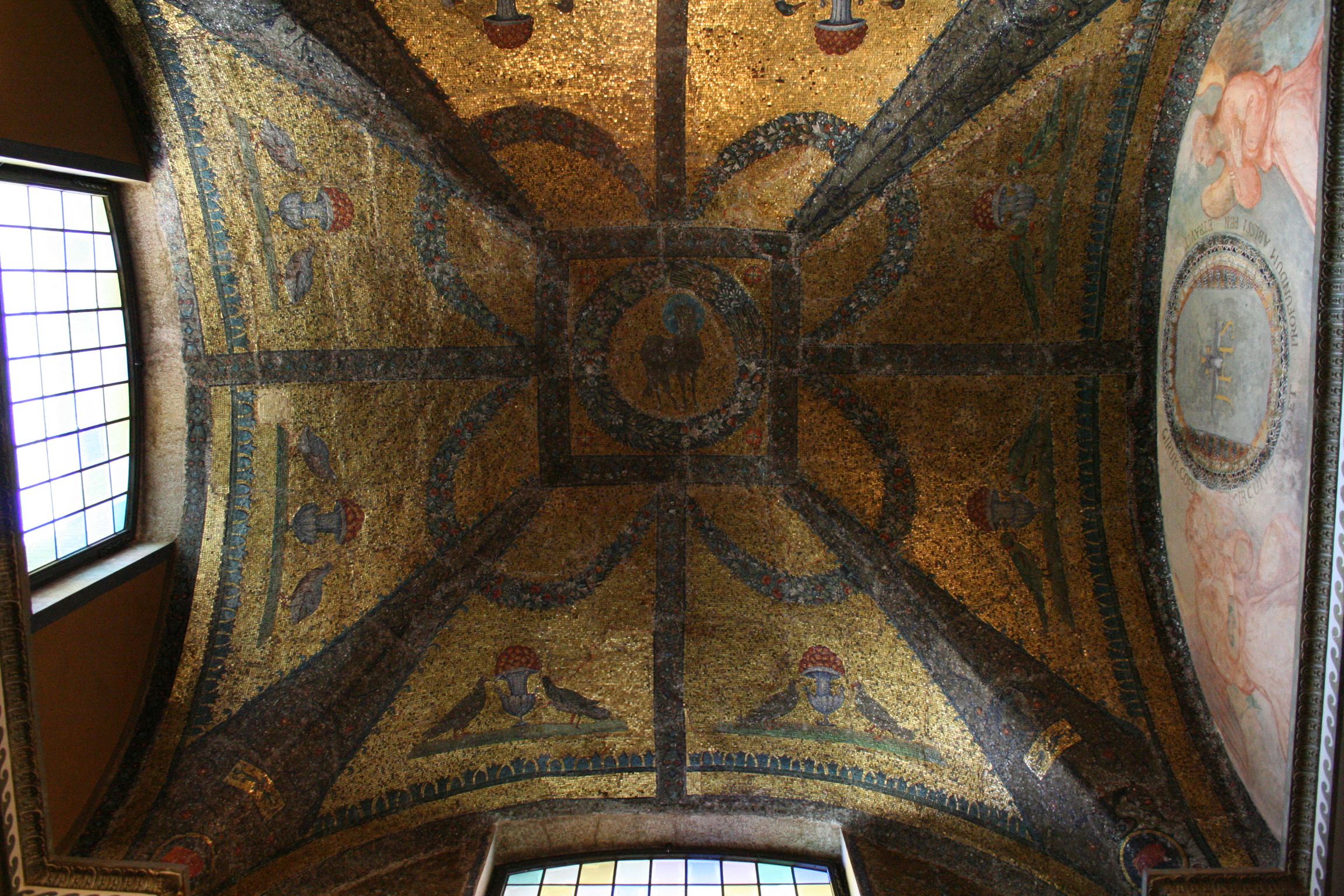
"Garlands of flowers and fruit originated from jars with a central Christological monogram (Chrismon) between the letters A and Ω
TRIUMPHAL ARCH
"Christ with the symbols of the Evangelists", on the right "Sts. Peter and Clement with Jeremiah and the city of Jerusalem", on the left "Sts. Lawrence and Paul with Isaiah with the city of Bethlehem"
IN THE LOWER PART
"Agnus Dei with twelve sheep". Under the mosaic fresco "Christ, the Virgin and the Apostles" early fourtheenth century
LEFT NAVE
Ceiling of the nave "Coronation of the Virgin" of the eighteenth-century by Pietro Rasina
AT THE END OF THE LEFT NAVE - CHAPEL OF THE HOLY SACRAMENT
"Madonna of the Rosary among the Sts. Dominic and Catherine" 1714 by Sebastiano Conca (1680/1764)
Outside on the right "Madonna and Child with St. John" 1580 Jacopo Zucchi (about 1542/96)
Entrance arch on the right "Jeremiah" and on the left "Isaiah" about 1617 and, inside, on the left "Stigmata of St. Francis" and on the right "Charity of St. Charles Borromeo" all attributed to artists of the Carracci school
On the left wall "Monument of Cardinal Antonio Venier" who died in 1479 maybe by the school of Isaia da Pisa (active 1447/64) or Andrea Bregno (1418/1503) with ancient columns and capitals reshaped in the early sixth century
CHAPEL OF St. CATHERINE OF ALEXANDRIA
Frescoes 1428/31 masterpiece of Masolino da Panicale (about 1383/1440) for Cardinal Branda Castiglioni in collaboration with other Florentine artists (Masaccio? Paolo Uccello? Domenico Veneziano?). They brought to Rome of the new, revolutionary Renaissance style
"He was the point of reference for those Florentine painters who dared not to look at Masaccio, at his dramatic humanity. For them the direction of "modern" was represented by Masolino, by his peaceful spirit" (Carlo Bertelli, Giuliano Briganti, Antonio Giuliano)
Outside the Chapel "St. Christopher", "Annunciation", "Apostles"
Vault "Doctors of the Western Church and Evangelists"
Right wall "Stories of St. Ambrose: birth, appointment as bishop of Milan, leaving the house of the rich, his study room and death"
Left wall "Stories of St. Catherine of Alexandria: refusal to worship idols, dispute with the 50 philosophers of Alexandria, conversion, beheading, the miracle of the sprocket wheel and the miraculous transportation of the body to Sinai"
Probably fourth century AD. The first reliable news that the church was active, however, date back only to 417/418
Rediscovered in 1818 and excavated 1857/70 at the behest of Joseph Mullooly, prior of St. Clement
Excavation completed 1912/14
The recent renovations and restorations have greatly enhanced the pleasure of visiting this incredible place, quintessential in its representation of Rome's overlapping layers of history
NARTHEX
One fresco of the ninth century "Blessing Christ and Saints" and two frescoes of the eleventh century: "Miracle of St. Clement" with "St. Clement, the patron de Rapiza Beno and his family" below, and "Translation of the relics of St. Clement"
CENTRAL NAVE
On the left frescoes of the time of Leo IV (847/855) "Assumption"
Below "Apostles"
On the sides "Leo IV (with square nimbus of living) and St. Vitus"
Alongside "Crucifixion" (with Christ alive) "Maries to the tomb", "Descent of Christ into Limbo", "Marriage of Cana"
On the left wall frescoes "Legend of St. Alexis" end eleventh or early twelfth century, with, on the upper register "Christ enthroned between angels and saints"
It is the very first Italian vernacular with "dirty word" fili de le pute: the prefect Sisinnio angry about the conversion and the vow of chastity of his wife Theodora, followed her with some soldiers. When he found her in a room while attending a mass celebrated by Pope Clement, he ordered his arrest, but God did not allow it and blinded Sisinnio and his soldiers. The soldiers found themselves dragging a column believing they were dragging Theodora. The prefect remained blind until his return home
Above "St. Clement in the holy throne"
"The Stories of the Saints Clement and Alexis are an isolated masterpiece. Toesca sees in them a vague memory of the Hellenistic murals; there is undoubted influence from the Ottonian miniature. The painter seems to have proposed to transpose in the scale of the wall not only the narration, but the refined linear and coloristic range of illuminated manuscripts. It is therefore a well educated kind of painting, combining cleverly different cultural experiences, and however intended to popularize its contents, to stimulate the imagination and the feelings among the most sensitive of the faithful" (Giulio Carlo Argan)
RIGHT NAVE
Mid-wall niche with eight or ninth century fresco "Madonna Enthroned with Child"
Further down the nave "Sarcophagus with Phaedra and Hippolytus" first century AD
LEFT NAVE
Remains of a TOMB MAYBE OF St. CYRIL
The most important mission that was entrusted to the brothers Cyril and Methodius of Thessalonica was the one with the Slavs of Moravia and Pannonia. The ruler of Moravia, Rostislav, who later died as a martyr and was venerated as a saint, asked the Byzantine Emperor to send missionaries to his country, hiding behind religious motivations, his political concern of the German presence in his kingdom
Cyril accepted the invitation and, once arrived, he began to translate passages from the Gospel of John inventing, according to a tradition not scientifically established, a new alphabet called Glagolitic (from "глаголь" which means "word"), now better known as the Cyrillic alphabet. It is the alphabet used to write various Slavic languages: Belarusian, Bosnian, Serbian, Bulgarian, Macedonian, Russian, Ruthenian, Serbian and Ukrainian as well as other non-Slavic languages
In 867 Cyril and Methodius went to Rome to have some of their followers ordained priests. Adrian II (867/872) ordained Methodius and approved their translations of the Bible and liturgical texts into Slavonic. Cyril also gave him the relics of St. Clement, which he had found in Crimea
In 869, during his stay in Rome, Cyril died and was buried in the Basilica of St. Clement. Methodius later returned to Moravia
BAPTISTERY AND CONSIGNATORIUM
The baptistery of the time of John II (533/535) was found during recent excavations north of the basilica in the cellar of the monastery. Another small room was found, hypothetically considered the Consignatorium, or the place where Confirmation was administered
Rectangular building with short side of 29.60 m (97 feet) made of large blocks of tufa, made out of rooms with vaults and walls of mixed materials. It is likely it was the mint
It is separated from another building with a narrow gap
The inner courtyard of this second building was transformed into a mithraic temple maybe in the second quarter of the third century
Ara marble reliefs "Mithras and the bull, snake and two dadofori" third or fourth century AD