Showing posts with label Giovanni Odazzi. Show all posts

Sunday, September 22, 2019

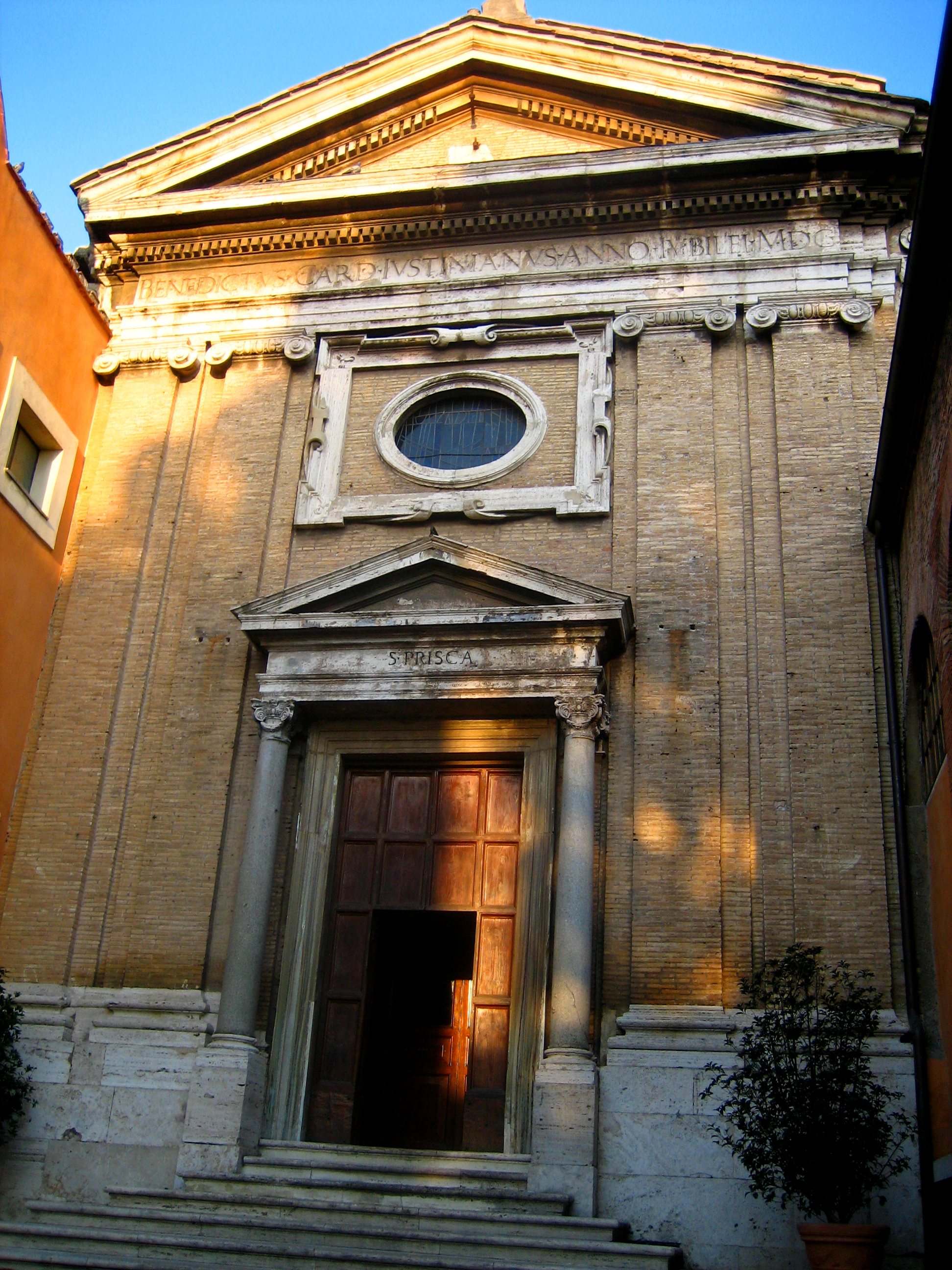
St. PRISCA

S. PRISCA
Via di S. Prisca 11

According to tradition, it was the house of Aquila and Priscilla, parents of Prisca who was beheaded in the period of Emperor Claudius (41/54). Aquila and Priscilla would have housed here St. Peter and St. Paul
Oratory of the third century which became a church in the fifth century, when there is the first mention of the TITULUS PRISCAE
Restored in 772 by Adrian I (772/795) and at the time of Paschal II (1099/1118)
Shortened in 1456 by Callistus III Borgia (1455/58)

In the years 1599/1600 Carlo Lambardi (1545/1619) for Clement VIII Aldobrandini (1592/1605) reduced the size of the preexisting building, restored nave, chancel and confession, rebuilt the façade and enlarged the square

“The brick curtain and the planned simplification of forms with the portal flanked by Ionic columns supporting a simple triangular pediment, reflect the character 'as an oratory' (Antinori) of the church, which is also to be found in the pictorial decoration of the building, carried out by the Florentine Anastasio Fontebuoni” (Enrico Parlato - Dizionario Biografico degli Italiani Treccani)

In 1728 Clement XIII Rezzonico (1758 /69) restored the interior

In 1935 restoration at the behest of the Augustinians monks to whom the church had been assigned

A fragment of the Forma Urbis, the marble map of the beginning of the third century AD, shows the presence of the BATHS OF LICINIUS SURA located west of St. Prisca
Licinius Sura was a friend of Emperor Trajan (98/117)

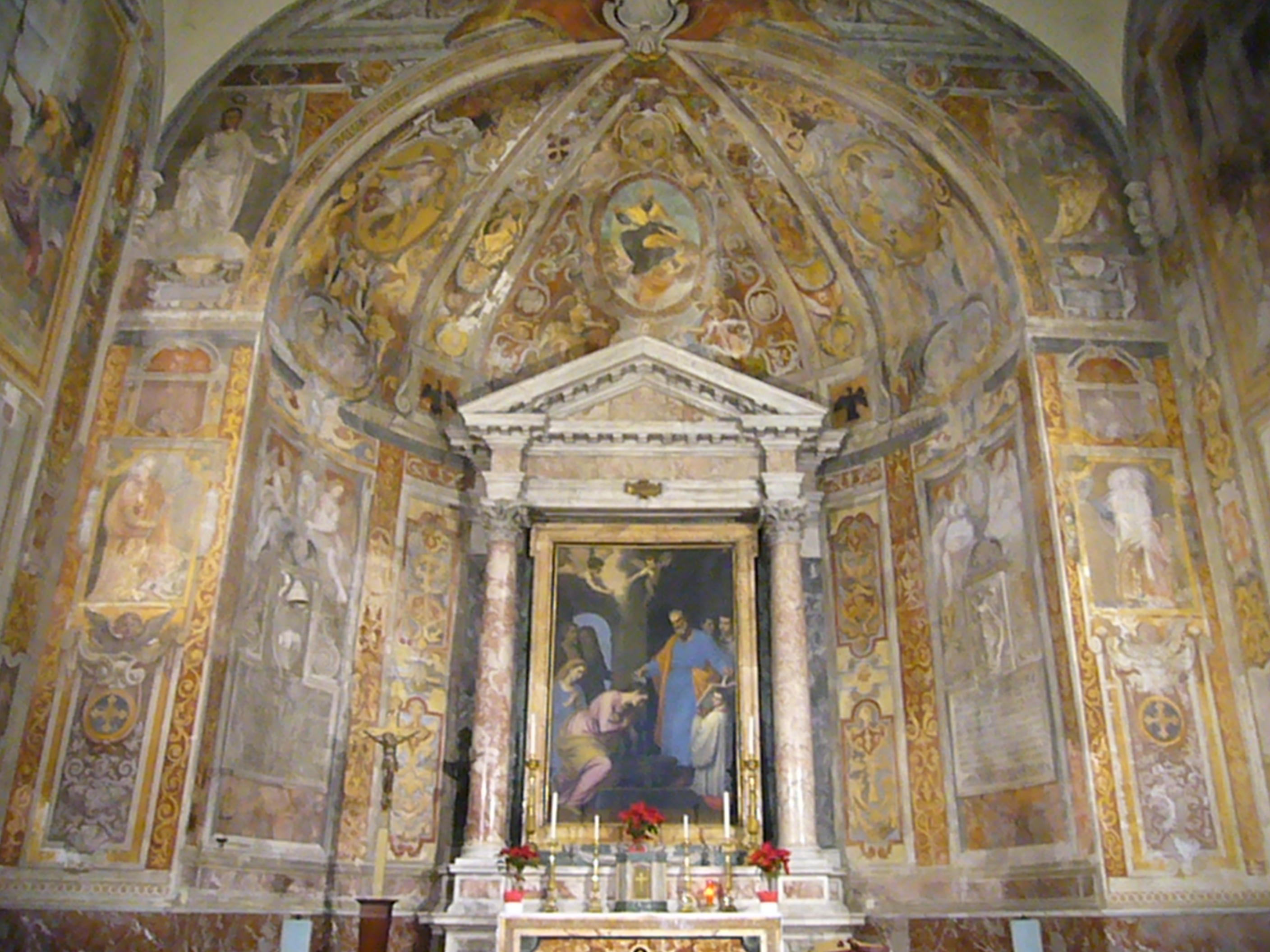
WALLS OF THE CENTRAL NAVE frescoes “Saints and angels with instruments of the Passion of Christ” and WALLS OF THE APSE “Stories of the martyrdom of St. Prisca” of the beginning of 1600s by Anastasio Fontebuoni (1571/1626)

ON THE RIGHT
“Composite capital” of the Antonine period mistakenly believed the baptismal font used by St. Peter to baptize St. Prisca, placed here in 1948 with clasp and bronze group “Baptism of Jesus” by Antonio Biggi (1904 /66)

MAIN ALTAR
Altarpiece “Baptism of St. Prisca” about 1600 by Domenico Crespi aka Passignano (1559/1638)
Above the door of the tower “Annunciation” of the fifteenth century

SACRISTY
“Immaculate Conception and Angels” maybe by Giovanni Odazzi (1663/1731)


Mitreo di S. Prisca

Mithraeum of St. Prisca

Building dating back to about 95 AD to the north of the church, converted into a house in about 110 with a great apsidal nymph to the south
Maybe it was the HOUSE OF LICINIUS SURA friend of Trajan (98/117)

At the end of the second century a building with two aisles was added in the south (maybe the titulus) and the mithraeum that would be violently destroyed in about 400, probably by Christians intolerant to the cult of Mithras 
Discovered in 1934 and excavated in the years 1953/66 by Dutch archaeologists

DIFFERENT PHASES OF THE BUILDING:
1) House of the first century AD with a four-sided portico

2) Apsidal nymphaeum of the time of Trajan (98/117)

3) Building with two naves of the second century AD, where was the original titulus
4) Rooms adapted at the end of the second century AD to the cult of Mithras with frescoes showing the “Seven degrees of initiation” and “Image of Mithra with Saturn lying” in stucco, where the stucco was applied over some amphorae

Saturday, August 25, 2018

St. BERNARD AT THE BATHS


S. BERNARDO ALLE TERME
Built in the years 1598/1602 for Caterina Nobili Sforza S. Fiora, nephew of Julius III Del Monte (1550/55), using one of the four corner towers of the ancient enclosure of the Baths of Diocletian (284/305) built from 298 to 306 AD
The tower was maybe a Sphaeristerium, a gym for some ball game, or a room for reading and studying
Restorations for the consolidation of the dome were carried out in 1857: the lantern of the sixteenth century that burdened too much the ancient dome was taken off
It is dedicated to the Burgundian St. Bernard of Clairvaux (1090/1153) the founder of the Cistercian Order
It is also known as the Church without Windows

DOME (diameter 22 m - 72.2 feet)
Along the perimeter “Eight statues of saints” in stucco over 3 m (10 feet) tall, about 1599/1602 masterpiece of Camillo Mariani (1567/1611)

“He was born in Vicenza and in the study of Rubini he had the inestimable advantage of going through the discipline of the school of Alessandro Vittoria. Shortly after his arrival in Rome he made these noble figures of monumental saints, his masterpieces. The Venetian touch is visible to all but it was strengthened with a new emphasis and a fine psychological insight, so that these works raise well above the average contemporary production and are linked to the intensity of the transitional style in painting in which we find crystallized the true spirit of the great reformers” (Rudolf Wittkower)

“Camillo Mariani was instrumental in the formation of another great sculptor, Francesco Mochi, who, some scholars speculate, might have been a young assistant of the master in S. Bernardo. Mindful of the painting of the Venetian masters such as Veronese, Titian and Tintoretto, Mariani here realizes 'the achievement of monumentality combined with naturalness, the bright distinction of matter combined with a noble stylization' (Nava Cellini). It is a style that would leave a deep imprint in the Roman scene and it would be a source of inspiration and reflection for many seventeenth-century sculptors, including Bernini himself” (Sergio Lombardi)

ALTAR ON THE RIGHT
“Vision of St. Bernard” about 1705 by Giovanni Odazzi (1663/1731), a pupil of Baciccio
In 1718 Odazzi was commissioned to add a lunette in the upper part of the painting, which was originally rectangular. The addition is well connected and the painted angels help to give a buoyancy to the composition

“Odazzi, faithful follower of Baciccio, shows here that he was influenced by the master in the figures of angels and in the bright colors he used, as well as in the setting of the theatrical scene” (Sergio Lombardi)

The painting is flanked by two beautiful columns in verd antique (ancient green) marble from the Baths of Diocletian
ON THE 5th PILLAR ON THE RIGHT
“Tomb of S. Giovanni della Barrière” 1626 with painting maybe by Andrea Sacchi (1599/1661)
BEHIND THE MAIN ALTAR
At the sides canvas “Death of Joseph” second half of seventeenth century by anonymous and “Madonna of Loreto” beginning of seventeenth century by Carlo Saraceni (1579/1620)
UNDER THE 3rd NICHE ON THE LEFT
Carlo Finelli from Carrara was part of a family of sculptors including the great Giuliano Finelli precious collaborator of Bernini in the extraordinary group of Apollo and Daphne in the Galleria Borghese

ALTAR ON THE LEFT
In 1730 Giovanni Odazzi was commissioned to add, just like in the opposite painting, a lunette in the upper part
This painting, like the one in front, is flanked by two beautiful columns in verd antique (ancient green) marble from the Baths of Diocletian

To the right of the Presbytery
Family chapel of the Nobili, built in 1647 for Vincenzo Nobili, grandson of Caterina Nobili Sforza
“Statue of St. Francis in Ecstasy” about 1647 by Giacomo Antonio Fancelli (1619/71), who also sculpted the statue of the Nile in the Fountain of the Four Rivers in Piazza Navona
On the left “Tomb of the painter Johann Friedrich Overbeck (1789/1896)” 1869 by the German Karl Hoffmann (1815/86), his friend and collaborator
On the walls “Busts of Nobili family members: Vincenzo junior, Pierfrancesco, Sforza, Roberto and Vincenzo” who had initiated the construction of the chapel, 1647/49 by Giacomo Antonio Fancelli who also made the rich stucco decoration of the ceiling that frames the painting “St. Francis in Glory with Angels” and “Angels with Instruments of the Passion” in the square panels 1897 by Mario Adami
The altars on the left and on the right exhibit considerable seventeenth century frontals in scagliola, a type of fine chalk that mimics inlaid marble

Sunday, April 22, 2018

St. ANTHONY OF EGYPT

S. ANTONIO ABATE
Built in the fifth century as S. Antonio Cata Barbara over the BASILICA OF JUNIUS BASSUS of the fourth century
Founded in 1308 with its current name near the eponymous hospital of the years 1263/66
Rebuilt in 1481 for Sixtus IV Della Rovere (1471/84)
Russian Catholic Church with Byzantine Slavonic Rite dedicated to St. Anthony of Egypt (about 251/356) hermit and founder of asceticism
St. Anthony of Egypt is usually shown next to a pig because the devil appeared to him in that form and he has therefore become protector of animals: every January 17 was celebrated here the blessing of the animals but, due to the heavy traffic in Via Carlo Alberto, it now takes place in front of the nearby church of S. Eusebio
FAÇADE
Remade in 1932 by Antonio Muñoz (1884/1960) with magnificent Romanesque portal of the old hospital about 1265 maybe by Vassalletto
INTERIOR redone in about 1730
BEGINNING OF THE RIGHT NAVE - CHAPEL OF S. TERESA
1583 by Domenico Fontana (1543/1607)
DOME
Frescoes in the drum about 1585 by Niccolò Circignani aka Pomarancio (about 1520/98)
APSE
“Crucifixion” by Giovanni Odazzi (1663/1731)
The church was incorporated by the PONTIFICAL RUSSICUM COLLEGE
1928/29 by Antonio Muñoz

Monday, March 7, 2016

BARBERINI PALACE - NATIONAL ART GALLERY (twenty-sixth part)

Room XXXIII - Fabrizio and Fiammetta Lemme Donation. Designing Great Art

Preparatory sketches for paintings on canvas in the nave of St. Clement executed in the years 1711/16 including “Glory of St. Clement” by Giuseppe Chiari (1654/1727) for the ceiling of the church
“As it has been pointed out, the central figure is derived from the assumption of Annibale Carracci in S. Maria del Popolo, but the reference point is the Allegory of Mercy painted by Carlo Maratta in Palazzo Altieri in 1676. Fidelity to the text of his teacher borders here on plagiarism, or perhaps indicates the use of the original cartoons, in the group of two putti supporting the anchor down” (Lorenza Mochi Onori)
“Stories of St. Clement and St. Ignatius of Antioch” for the walls of the church by some of the best painters in Rome in the second decade of 1700s:
“Death of S. Servolo” by Tommaso Chiari (1665/1773) brother of Giuseppe
“Among the works of this cycle it is one of those that show 'more intensely maratta-like' features. With a composition of light classical approach proposing 'in decidedly eighteenth century tone, the golden language of Raphael'. The peculiar character of this sketch that marks also other works by De Pietri (for example, the Madonna and Child with Saints in S. Maria in Via Lata) is this intimate aspect, and it is one of the most original outcomes of Maratta's period' (Casale)” (Lorenza Mochi Onori)

“Martyrdom of St. Clement” by Giovanni Antonio Grecolini (1675/1725)
“Translation of the body of St. Clement” by Giovanni Odazzi (1663/1731)
“The sketch shows less freshness than the final version as a fresco. Some indecisions show up affecting mainly the faces of St. Clement and the prelate behind. The prelate knelt before the body of St. Clement recalls a figure of G.B. Gaulli, the St. Nicholas, in the altarpiece in St. Mary Magdalene, which inspired Odazzi some other times as well” (Lorenza Mochi Onori)
“Trajan condemning St. Ignatius of Antioch” by Giovanni Domenico Piastrini (1678/1740)
“St. Ignatius of Antioch meets St. Polycarp in Smyrna” by Giacomo Triga (1674/1746) pupil of Benedetto Luti
“Giacomo Triga, little-known pupil of Benedetto Luti, a virtuoso of the Pantheon, worked for the Patrizi and the Theodoli families, and in some Roman churches such as the Basilica of Sts. John and Paul, St. Francis of Paola and S. Marcello al Corso” (Lorenza Mochi Onori)
“Martyrdom of St. Ignatius of Antioch” by Pier Leone Ghezzi (1674/1755)
“As Casale mentioned, this painting by Ghezzi in the Clementine series is presented as 'the less academic and more whimsical of the group' and 'hard to the limits of unpleasantness. But original' due 'to an compositional vehemence impatient of conventions and rules of composition” (Lorenza Mochi Onori)
“Miracle of St. Clement in the Crimea” by Sebastiano Conca (1680/1764)
“It has been emphasized the differentiation of this sketch from the rest of the series for both the bright colors with respect to the general preference for crayon-like colors, and for the adoption of a small size that allows the presence of several figures without creating a scrum. ( ...) It as also noted by Casale (1998) that it is the masterpiece of the clementine series, a work in which the author reconciles the update on Maratti's reforms with a style that 'shows an early Rococo expression' (Sestieri)” (Francesca Mochi Onori)
The “Abandonment of Moses” and the “Sacrifice of Isaac” by Domenico Corvi (1721/1803) from Viterbo
They are models for the paintings in the side chapel of the Virgin of Seven Sorrows in S. Marcello al Corso, showing with their bright colors the influence of Corrado Giaquinto's painting
Extraordinary “Assumption of the Virgin” by Ludovico Mazzanti (1686/1775) a Gaulli's student, sketch for the 1720 fresco on the ceiling of the left transept of S. Ignatius
“Death of S. Joseph” 1712 by Francesco Trevisani (1656/1746) from Istria
It is a study for the altarpiece of the second chapel on the right in the church of St. Ignatius
Sketch of “Last meeting of Sts. Peter and Paul” for the 1766 canvas in the church of S. Lucia al Gonfalone, and preparatory sketch of '“Adoration of the Magi”, a work in S. Giuseppe alla Lungara, by the Sicilian Mariano Rossi (1731/1807)
“In the Last meeting of Sts. Peter and Paul mix, in a studied intersection of levels that follow the development of the action, relations with the work of Corrado Giaquinto but, as Giancarlo Sestieri pointed out, in an 'extreme simplification of form, based on an essentially linear conciseness' and 'developed especially in the footsteps of Marco Benefial and Francesco Mancini'“ (Lorenza Mochi Onori)
“Allegories of the four elements: water, air, fire and earth” 1767/68 by the Roman Stefano Pozzi (1699/1768) for the lunettes of the vault of a Cabinet in the Palazzo Doria Pamphilj

Tuesday, November 24, 2015

ALBANI DEL DRAGO PALACE

PALAZZO ALBANI DEL DRAGO

1587/90 Domenico Fontana (1543/1607) for Muzio Mattei
Completed and extended along Via XX Settembre (known then as Strada Pia) from 1707 onwards by Alessandro Specchi (1668/1729) for Cardinal Alessandro Albani, with the addition of the lookout tower
In mid-1800 it was acquired by Queen Maria Cristina widow of Ferdinand VII of Spain, and, at her death, by the Prince Del Drago
Now it is the property of the company Servizi Interbancari, provider of Italian credit card services
In the corner of the crossroad of the Four Fountains there is the fountain with a lion representing the Arno River
Frescoes by Giovanni Paolo Pannini (1691/1765) and Giovanni Odazzi (1663/1731)
In a room on the second floor there are frescoes copies of those found in ancient tomb of the Nasonii on Via Flaminia

Monday, September 23, 2013

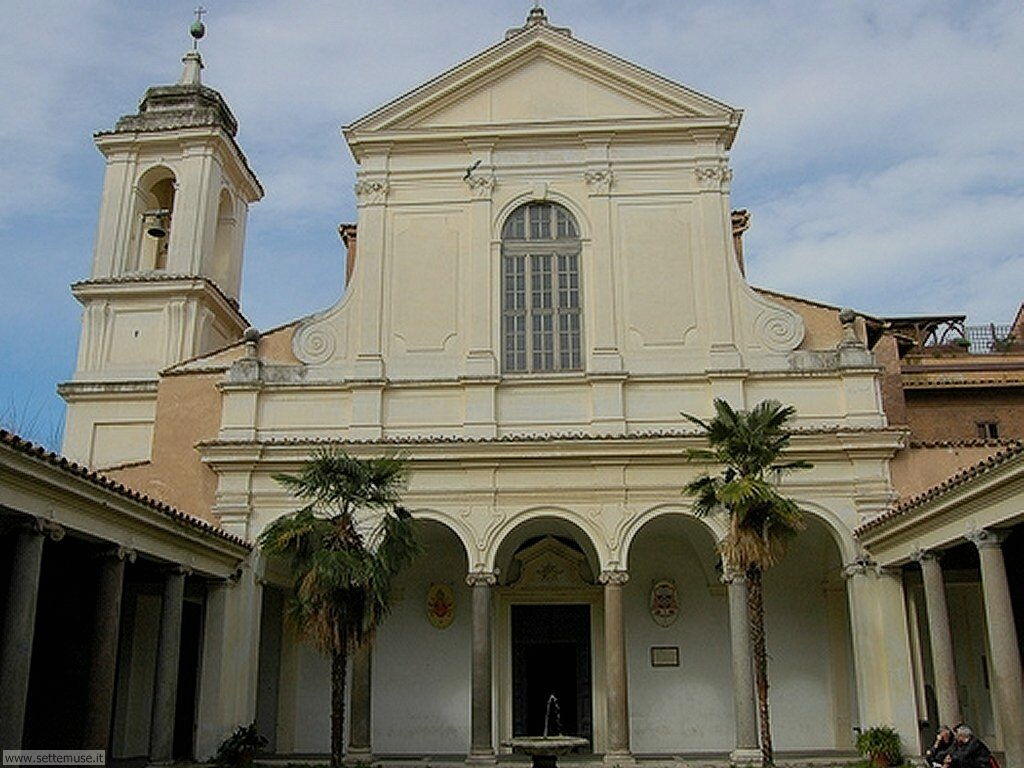
BASILICA OF St. CLEMENT

BASILICA S. CLEMENTE
Domus of the second half of the second century built next to a public building before the fire of AD 64 during Nero's reign. It is likely that this public building became later the MINT moved here by Domitian (81/96) from the original site on the Arx, according to some inscriptions from the time of Hadrian (118/138)
In the second century a MITHRAEUM, a place of worship for the followers of the mystery religion of Mithraism, was built in a courtyard of the domus and then maybe it became the domus ecclesia of Clement who was, according to tradition, a freed slave banned in Crimea under Trajan (97/118)
Clement apparently converted many people in Crimea and seventy-five churches were built after his preaching. Trajan, then, ordered Clement to be thrown into the sea with an anchor around his neck
After these events, each year on the anniversary of his death, the sea used to recede two miles, to reveal a shrine built "miraculously" that contained the bones of the martyr and allow the faithful to visit
He was later identified with his namesake Pope Clement I (88/97) the fourth pope, whose relics were brought to Rome by the Sts. Cyril and Methodius in 867 and kept in the basilica built, according to tradition, in the fourth century above the domus ecclesia
Sources on St. Clement are very fragmented and confusing, and perhaps add up in one personality two different Clements who lived in the first century AD
The first reliable news that the church was active, however, date back only to 417/418
After the fire of 1084 the Norman church was buried underground to support the new basilica built in the years 1118/25, raised 5 m (17 feet) higher than the old basilica
Because of the religious persecution in Ireland, it was granted in 1677 to the Irish Dominicans who still keep it today
1118/1125 commissioned by Paschal II (1099/1118)
PORCH built in the eight or ninth century preceding the COURTYARD with portico on the four sides with a FAÇADE built in 1715/19 designed by Carlo Stefano Fontana (active 1700/about 1719), Carlo Fontana's son and Francesco Fontana's brother
BELL TOWER seventeenth century formerly located on the opposite side
Today's internal appearance of the church dates back to 1713/19 when Carlo Stefano Fontana gave it a late-baroque touch for Clement XI Albani (1700/21)
The liturgical apparatus known as "cosmatesco" in this church is the best preserved among those existing in Rome. It is the best example of the work of the first generation of the Cosmati's family and became the canonical type followed in Rome and in the Lazio region
There have been at least seven Cosmati, belonging to four different generations living between the twelfth and thirteenth century, famous for their architectural work, for their sculptures, but most of all for their mosaics and decorations in opus sectile especially for religious buildings
Their ability as mosaicists was such that even today the techniques used by these masters and their imitators are referred to as cosmatesque
On the PORTAL "Fragment of lintel with the name of the Roman Emperor Trajan"
Above the portal eighteenth-century "Cantoria" made of wood gilded and painted 
COSMATESQUE FLOOR
Discs known as porfiretici (rotae), made of red porphyry from Egypt
In the center of the floor "Tombstone of Cardinal Vincentius Laureus" who died in 1592
CEILING
1715 designed by Carlo Stefano Fontana with fresco "Glory of St. Clement" 1714/19 masterpiece by the Roman Giuseppe Chiari (1654/1727) one of the favorite pupils of Carlo Maratta
FRESCOES ON THE WALL ABOVE THE CORNICE
On the right "Stories of St. Ignatius of Antioch", on the left "Stories of St. Clement" 1711/16 by the best painters in Rome in the early eighteenth century:
Pietro Rasina "St. Cyril" and "St. Methodius" in the counter-façade
Pier Leone Ghezzi (1674/1755) on the right "Martyrdom of St. Ignatius in the Colosseum"
Giovanni Domenico Piastrini (1678/1740) on the right "Trajan sentences St. Ignatius to be eaten by the beasts"
Giacomo Triga (1674/1746) on the right "St. Ignatius takes his leave from St. Polycarp, bishop of Smyrna, before embarking for Rome"
Tommaso Chiari (1665/1773) Giuseppe Chiari's brother, on the right "Death of St. Servolo"
Giovanni Odazzi (1663/1731) on the left "Translation of the body of St. Clement"
Sebastiano Conca (1680/1764) on the left "Miracle of the spring of water by St. Clement in Crimea", "Apparition of the Angel" and "Miracle of the spring of water"
Pietro de Pietri (1663/1716) on the left "St. Clement presents the veil to St. Domitilla"
Giovanni Antonio Grecolini (1675/1725) on the left "Martyrdom of St. Clement"
RIGHT NAVE
1st RIGHT - CHAPEL OF St. DOMINIC
Ancient precious marble pieces framing "Ecstasy of St. Dominic" and on the left "Resurrection of the young Napoleone Orsini" by an unknown eighteenth century artist, pupil of Sebastiano Conca
On the right "Miracle of St. Dominic in S. Sisto Vecchio" 1715 Sebastiano Conca (1680/1764)
ENTRANCE TO THE SACRISTY
In the vault "Glory of St. Servolo" by Pietro Rasina
CHAPEL OF Sts. CYRIL AND METHODIUS
1882/86 with relics of St. Cyril
Paintings "Stories of Sts. Cyril and Methodius" by Salvatore Nobili (1865/1919) with, at the center, an eighteenth-century copy of the extremely famous religious image "Madonna of prayer" by G.B. Salvi aka Sassoferrato (1609/85)
ON THE RIGHT END SIDE OF THE PRESBYTERY
"Monument to Giovanni Francesco Brusati" who died in 1485 (nephew of Cardinal Roverella) Luigi Capponi (active end of 1400s/beginning of 1500s) and "Funerary monument of Cardinal Bartolomeo Roverella" who died in 1476 by Giovanni Duknovich aka Giovanni Dalmata (about 1440/1510) with maybe the help of Andrea Bregno (1418/1503)
Below the monument, fresco "Particular Judgment" from the eleventh century, moved here from the narthex of the lower basilica
AT THE END OF THE RIGHT NAVE - CHAPEL OF St. JOHN THE BAPTIST
"Statue of St. John the Baptist" end of 1500 maybe by an unknown artist follower of Andrea Sansovino and frescoes "God Father between two musical angels" and "Beheading of St. John the Baptist" maybe by Jacopo Zucchi (about 1542/96)
ON THE RIGHT PIER OF THE ARCH
Aedicula with relief "Cardinal Giacomo Caetani adoring the Virgin Mary" 1299, maybe by an artist from the school of Arnolfo di Cambio (about 1245/1302)
CENTRAL NAVE
At the center of the nave SCHOLA CANTORUM moved here from the lower church adapted in the twelfth century with polished elements of Proconnesio marble executed in Constantinople or Rome by Byzantine artisans
They are dated to about 534 under Pope John II (533/535), the first pope who changed his name (he was called Mercury): his coat of arms is reproduced in the monogram plutei. It is the most significant document of the proto-byzantine sculpture in Rome and one of the most important of the Byzantine world from the period of Justinian
MAIN ALTAR
Fenestella confessionis (window to allow contact with the relics) with inside relics of Sts. Clement and Ignatius of Antioch
Two AMBOS (podiums for Bible readings) and spiral cosmatesque CANDLESTICK
PRESBYTERY
Cosmatesque "Ciborium" and "Cattedra" (chair) of the twelfth century
APSE
High quality mosaic about 1130: "Crucifix with twelve doves between the Virgin and St. John, deers drinking from the Four Rivers of Paradise (Pison, Gihon, Tigris and Euphrates) and four doctors of the Western Church (Sts. Augustine, Jerome, Gregory and Ambrose)" bearing no iconographic connection whatsoever with any other mosaic crosses ever made before
At the base the titulus says: "We represented the Church of Christ with this grapevine which the Law dries up but which the Cross makes green"
BELOW THE ARCH
"Garlands of flowers and fruit originated from jars with a central Christological monogram (Chrismon) between the letters A and Ω
TRIUMPHAL ARCH
"Christ with the symbols of the Evangelists", on the right "Sts. Peter and Clement with Jeremiah and the city of Jerusalem", on the left "Sts. Lawrence and Paul with Isaiah with the city of Bethlehem"
IN THE LOWER PART
"Agnus Dei with twelve sheep". Under the mosaic fresco "Christ, the Virgin and the Apostles" early fourtheenth century
LEFT NAVE
Ceiling of the nave "Coronation of the Virgin" of the eighteenth-century by Pietro Rasina
AT THE END OF THE LEFT NAVE - CHAPEL OF THE HOLY SACRAMENT
"Madonna of the Rosary among the Sts. Dominic and Catherine" 1714 by Sebastiano Conca (1680/1764)
Outside on the right "Madonna and Child with St. John" 1580 Jacopo Zucchi (about 1542/96)
Entrance arch on the right "Jeremiah" and on the left "Isaiah" about 1617 and, inside, on the left "Stigmata of St. Francis" and on the right "Charity of St. Charles Borromeo" all attributed to artists of the Carracci school
On the left wall "Monument of Cardinal Antonio Venier" who died in 1479 maybe by the school of Isaia da Pisa (active 1447/64) or Andrea Bregno (1418/1503) with ancient columns and capitals reshaped in the early sixth century
CHAPEL OF St. CATHERINE OF ALEXANDRIA
Frescoes 1428/31 masterpiece of Masolino da Panicale (about 1383/1440) for Cardinal Branda Castiglioni in collaboration with other Florentine artists (Masaccio? Paolo Uccello? Domenico Veneziano?). They brought to Rome of the new, revolutionary Renaissance style
"He was the point of reference for those Florentine painters who dared not to look at Masaccio, at his dramatic humanity. For them the direction of "modern" was represented by Masolino, by his peaceful spirit" (Carlo Bertelli, Giuliano Briganti, Antonio Giuliano)
Outside the Chapel "St. Christopher", "Annunciation", "Apostles"
Vault "Doctors of the Western Church and Evangelists"
Altar wall "Crucifixion"
Right wall "Stories of St. Ambrose: birth, appointment as bishop of Milan, leaving the house of the rich, his study room and death"
Left wall "Stories of St. Catherine of Alexandria: refusal to worship idols, dispute with the 50 philosophers of Alexandria, conversion, beheading, the miracle of the sprocket wheel and the miraculous transportation of the body to Sinai"
Probably fourth century AD. The first reliable news that the church was active, however, date back only to 417/418
Rediscovered in 1818 and excavated 1857/70 at the behest of Joseph Mullooly, prior of St. Clement
Excavation completed 1912/14
The recent renovations and restorations have greatly enhanced the pleasure of visiting this incredible place, quintessential in its representation of Rome's overlapping layers of history 
NARTHEX
One fresco of the ninth century "Blessing Christ and Saints" and two frescoes of the eleventh century: "Miracle of St. Clement" with "St. Clement, the patron de Rapiza Beno and his family" below, and "Translation of the relics of St. Clement"
CENTRAL NAVE
On the left frescoes of the time of Leo IV (847/855) "Assumption"
Below "Apostles"
On the sides "Leo IV (with square nimbus of living) and St. Vitus"
Alongside "Crucifixion" (with Christ alive) "Maries to the tomb", "Descent of Christ into Limbo", "Marriage of Cana"
On the left wall frescoes "Legend of St. Alexis" end eleventh or early twelfth century, with, on the upper register "Christ enthroned between angels and saints"
Next on the left "Legend of St. Clement and Sisinnio" end eleventh or early twelfth century
It is the very first Italian vernacular with "dirty word" fili de le pute: the prefect Sisinnio angry about the conversion and the vow of chastity of his wife Theodora, followed her with some soldiers. When he found her in a room while attending a mass celebrated by Pope Clement, he ordered his arrest, but God did not allow it and blinded Sisinnio and his soldiers. The soldiers found themselves dragging a column believing they were dragging Theodora. The prefect remained blind until his return home
Above "St. Clement in the holy throne"
"The Stories of the Saints Clement and Alexis are an isolated masterpiece. Toesca sees in them a vague memory of the Hellenistic murals; there is undoubted influence from the Ottonian miniature. The painter seems to have proposed to transpose in the scale of the wall not only the narration, but the refined linear and coloristic range of illuminated manuscripts. It is therefore a well educated kind of painting, combining cleverly different cultural experiences, and however intended to popularize its contents, to stimulate the imagination and the feelings among the most sensitive of the faithful" (Giulio Carlo Argan)
RIGHT NAVE
Mid-wall niche with eight or ninth century fresco "Madonna Enthroned with Child"
Further down the nave "Sarcophagus with Phaedra and Hippolytus" first century AD
LEFT NAVE
Remains of a TOMB MAYBE OF St. CYRIL
The most important mission that was entrusted to the brothers Cyril and Methodius of Thessalonica was the one with the Slavs of Moravia and Pannonia. The ruler of Moravia, Rostislav, who later died as a martyr and was venerated as a saint, asked the Byzantine Emperor to send missionaries to his country, hiding behind religious motivations, his political concern of the German presence in his kingdom
Cyril accepted the invitation and, once arrived, he began to translate passages from the Gospel of John inventing, according to a tradition not scientifically established, a new alphabet called Glagolitic (from "глаголь" which means "word"), now better known as the Cyrillic alphabet. It is the alphabet used to write various Slavic languages: Belarusian, Bosnian, Serbian, Bulgarian, Macedonian, Russian, Ruthenian, Serbian and Ukrainian as well as other non-Slavic languages
In 867 Cyril and Methodius went to Rome to have some of their followers ordained priests. Adrian II (867/872) ordained Methodius and approved their translations of the Bible and liturgical texts into Slavonic. Cyril also gave him the relics of St. Clement, which he had found in Crimea
In 869, during his stay in Rome, Cyril died and was buried in the Basilica of St. Clement. Methodius later returned to Moravia
BAPTISTERY AND CONSIGNATORIUM
The baptistery of the time of John II (533/535) was found during recent excavations north of the basilica in the cellar of the monastery. Another small room was found, hypothetically considered the Consignatorium, or the place where Confirmation was administered
Rectangular building with short side of 29.60 m (97 feet) made of large blocks of tufa, made out of rooms with vaults and walls of mixed materials. It is likely it was the mint
It is separated from another building with a narrow gap
The inner courtyard of this second building was transformed into a mithraic temple maybe in the second quarter of the third century
Ara marble reliefs "Mithras and the bull, snake and two dadofori" third or fourth century AD