Showing posts with label Camillo Mariani. Show all posts

Saturday, August 25, 2018

St. BERNARD AT THE BATHS


S. BERNARDO ALLE TERME
Built in the years 1598/1602 for Caterina Nobili Sforza S. Fiora, nephew of Julius III Del Monte (1550/55), using one of the four corner towers of the ancient enclosure of the Baths of Diocletian (284/305) built from 298 to 306 AD
The tower was maybe a Sphaeristerium, a gym for some ball game, or a room for reading and studying
Restorations for the consolidation of the dome were carried out in 1857: the lantern of the sixteenth century that burdened too much the ancient dome was taken off
It is dedicated to the Burgundian St. Bernard of Clairvaux (1090/1153) the founder of the Cistercian Order
It is also known as the Church without Windows

DOME (diameter 22 m - 72.2 feet)
Along the perimeter “Eight statues of saints” in stucco over 3 m (10 feet) tall, about 1599/1602 masterpiece of Camillo Mariani (1567/1611)

“He was born in Vicenza and in the study of Rubini he had the inestimable advantage of going through the discipline of the school of Alessandro Vittoria. Shortly after his arrival in Rome he made these noble figures of monumental saints, his masterpieces. The Venetian touch is visible to all but it was strengthened with a new emphasis and a fine psychological insight, so that these works raise well above the average contemporary production and are linked to the intensity of the transitional style in painting in which we find crystallized the true spirit of the great reformers” (Rudolf Wittkower)

“Camillo Mariani was instrumental in the formation of another great sculptor, Francesco Mochi, who, some scholars speculate, might have been a young assistant of the master in S. Bernardo. Mindful of the painting of the Venetian masters such as Veronese, Titian and Tintoretto, Mariani here realizes 'the achievement of monumentality combined with naturalness, the bright distinction of matter combined with a noble stylization' (Nava Cellini). It is a style that would leave a deep imprint in the Roman scene and it would be a source of inspiration and reflection for many seventeenth-century sculptors, including Bernini himself” (Sergio Lombardi)

ALTAR ON THE RIGHT
“Vision of St. Bernard” about 1705 by Giovanni Odazzi (1663/1731), a pupil of Baciccio
In 1718 Odazzi was commissioned to add a lunette in the upper part of the painting, which was originally rectangular. The addition is well connected and the painted angels help to give a buoyancy to the composition

“Odazzi, faithful follower of Baciccio, shows here that he was influenced by the master in the figures of angels and in the bright colors he used, as well as in the setting of the theatrical scene” (Sergio Lombardi)

The painting is flanked by two beautiful columns in verd antique (ancient green) marble from the Baths of Diocletian
ON THE 5th PILLAR ON THE RIGHT
“Tomb of S. Giovanni della Barrière” 1626 with painting maybe by Andrea Sacchi (1599/1661)
BEHIND THE MAIN ALTAR
At the sides canvas “Death of Joseph” second half of seventeenth century by anonymous and “Madonna of Loreto” beginning of seventeenth century by Carlo Saraceni (1579/1620)
UNDER THE 3rd NICHE ON THE LEFT
Carlo Finelli from Carrara was part of a family of sculptors including the great Giuliano Finelli precious collaborator of Bernini in the extraordinary group of Apollo and Daphne in the Galleria Borghese

ALTAR ON THE LEFT
In 1730 Giovanni Odazzi was commissioned to add, just like in the opposite painting, a lunette in the upper part
This painting, like the one in front, is flanked by two beautiful columns in verd antique (ancient green) marble from the Baths of Diocletian

To the right of the Presbytery
Family chapel of the Nobili, built in 1647 for Vincenzo Nobili, grandson of Caterina Nobili Sforza
“Statue of St. Francis in Ecstasy” about 1647 by Giacomo Antonio Fancelli (1619/71), who also sculpted the statue of the Nile in the Fountain of the Four Rivers in Piazza Navona
On the left “Tomb of the painter Johann Friedrich Overbeck (1789/1896)” 1869 by the German Karl Hoffmann (1815/86), his friend and collaborator
On the walls “Busts of Nobili family members: Vincenzo junior, Pierfrancesco, Sforza, Roberto and Vincenzo” who had initiated the construction of the chapel, 1647/49 by Giacomo Antonio Fancelli who also made the rich stucco decoration of the ceiling that frames the painting “St. Francis in Glory with Angels” and “Angels with Instruments of the Passion” in the square panels 1897 by Mario Adami
The altars on the left and on the right exhibit considerable seventeenth century frontals in scagliola, a type of fine chalk that mimics inlaid marble

Wednesday, October 9, 2013

BASILICA OF St. PUDENTIANA

BASILICA S. PUDENZIANA
Founded according to tradition, by the sisters Pudenziana and Praxedes in the house of their father, Senator Pudens. They belonged to the powerful Acilius Glabriones family
According to tradition Senator Pudens hosted here St. Peter as well as St. Paul who baptized his children
Built as TITULUS PUDENTIS in a house where in the second century a thermal plant was built
A hall of this spa called Thermae Novatianae or Thimotinae from the names of Pudens' sons was transformed at the end of the fourth century in a Christian Basilica by the priests Massimo, Ilicio and Leopard at the time of Pope St. Siricius (384/399)
The first mention historical mention dates back to 384
Restored at least five times from the eighth to the nineteenth century
It is 4 meters (12 feet) below the level of Via Urbana, the ancient Vicus Patricius
Romanesque BELL TOWER of the thirteenth century
FAÇADE
1870 by Antonio Manno for Cardinal Luciano Bonaparte with almost vanished remains of frescoes by Pietro Gagliardi (1809/90)
PORCH
Built in the sixteenth entury with "Frieze with vegetal motifs and Pudenziana, Praxedes, Pudens and St. Shepherd" of the eleventh century. The church was maybe originally dedicated to this misterious St. Sheperd
It is the National Church of the Philippines
INTERIOR
Trasformed in 1588 by Francesco Capriani aka Francesco da Volterra (1535/94) for the Cardinal Enrico Caetani 
In the COUNTER FAÇADE two canvas:
On the right "St. Augustine" by Giacinto Gimignani (1606/81)
On the left "Baptism of St. Pudens" by Avanzino Nucci (1552/1629)
2nd RIGHT - ANSIDEI CHAPEL
1690 "Our Lady of Mercy" end of sixteenth century, copy of the sacred icon in S. Maria in Trastevere
On the left "Nativity of Mary" and on the right "Nativity" 1690 both works of Lazzaro Baldi (about 1624/1703) who also painted the pillars with the "Annunciation" and lunettes
3rd RIGHT - St. BERNARD CHAPEL
Eighteenth century stuccos
On the altar, "St. Bernard and the Virgin" by anonymous painter of the nineteenth century
On the left side "Christ exchange heart with St. Catherine of Siena" and on the right "Vision of St. Benedict" Michele Cippitelli eighteenth century painter known only for these two paintings
DOME
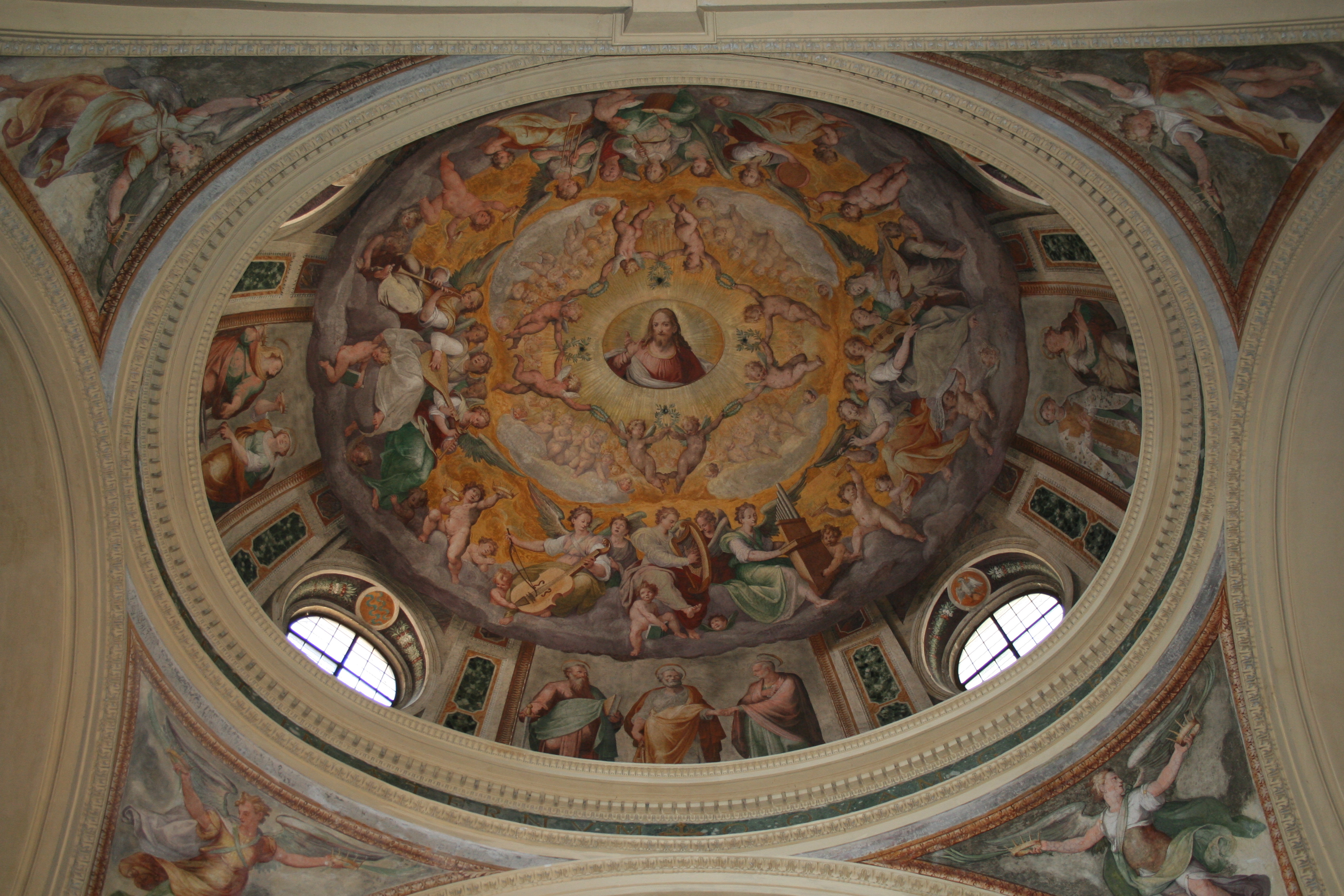
Designed by Francesco Capriani aka Francesco da Volterra, the first dome in Rome with an elliptical cross section
"Paradise" 1587/88 and pendentives "Angels with symbols of martyrdom" by Niccolò Circignani aka Pomarancio (about 1520/98)
MAIN altar
"Glory of S. Pudenziana" and at the sides "S. Novato" and "S. Timothy" 1803 by Bernardino Nocchi (1741/1812)
The altar rests on a coffin in which a piece of wood is kept on which, according to tradition, St. Peter would have celebrated mass
APSE
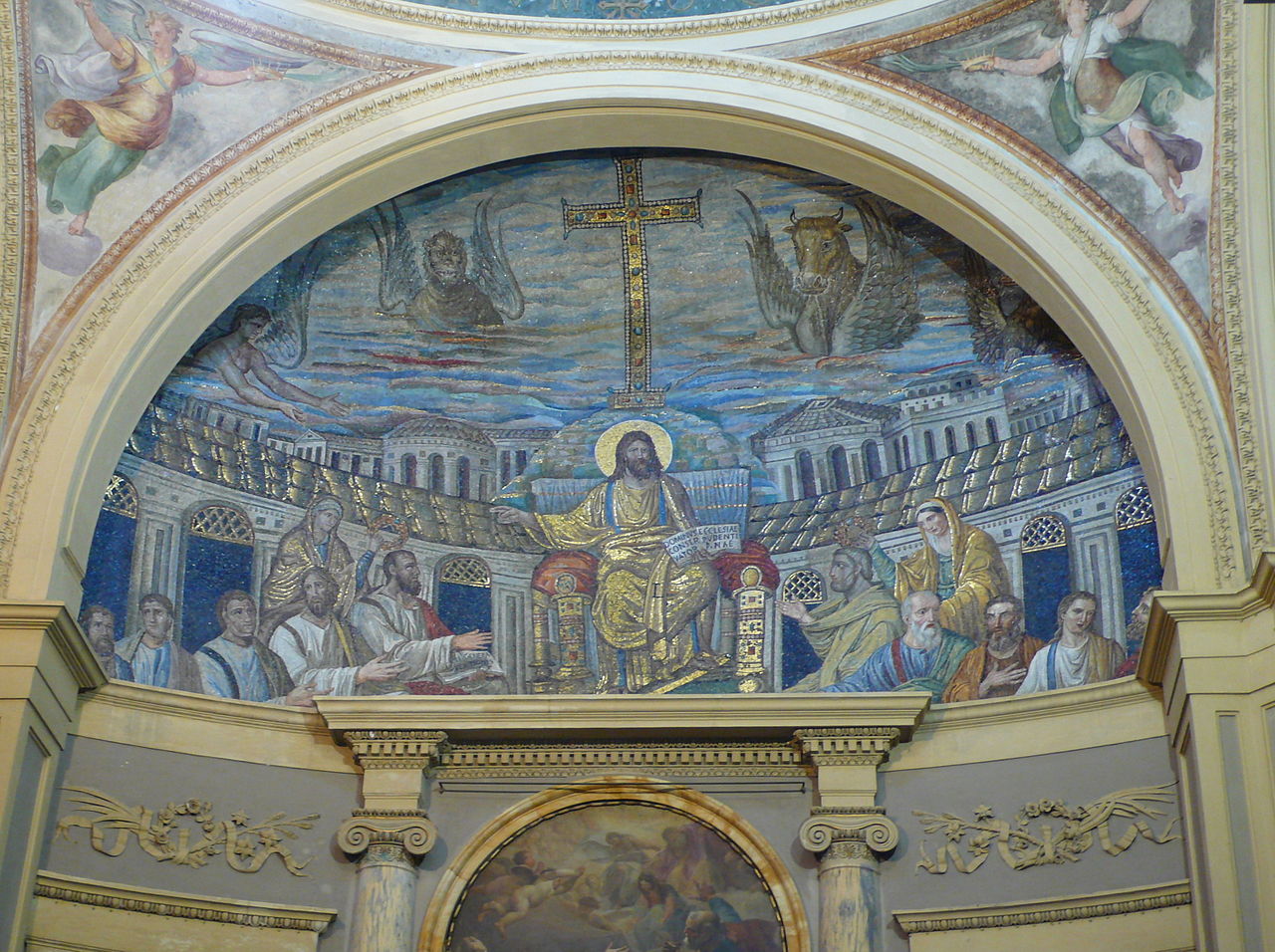
Incredible mosaic of the early fifth century, time of Emperor Honorius (395/423), badly cut in 1588. It is the oldest Christian monumental mosaic existing in the world
The two women maybe represent the churches of Jews and Gentiles, mistaken for the two saints because of the erroneous medieval translation of the writing in Jesus' hand: Ecclesiae Pudentianae means of Pudens not of Pudenziana who maybe never existed
The symbols of the four evangelists, the Tetramorfo or the assembly of the four Gospels considered as a single work, appears here for the first time ever
The buildings represented are perhaps those of the north side of the Vicus Patricius
The scene has been interpreted as Parousia or Second Coming of Christ
"Along with iconographic motives of Syrian-Palestinian origin as the figure of Christ, this work of extraordinary pictorial intensity exhibit strong Hellenistic-Roman accents. The scaling perspective, the definition of volumetric and plastic characters, the characterization of the intense and serene faces corresponds to the typical ways of the so-called Theodosian revival" (Carlo Bertelli, Giuliano Briganti, Antonio Giuliano)
CHAPEL AT THE END ON THE LEFT (Chapel of St. Peter)
Marble group "Handing the keys" 1596 by G.B. Della Porta (1542/1602)
IN THE LEFT NAVE
"Funeral memorial of Onorato Caetani" maybe 1592 by G.B. Della Porta. Onorato Caetani was the general of the papal troops at the Battle of Lepanto
Further on the left CAETANI CHAPEL
Transformation of the chapel of St. Pastor considered to be the first place of worship of the Church of Pudens, begun by Francesco Capriani aka Francesco da Volterra and finished after his death (1595) by Carlo Maderno (1556/1629) who also did the two "Funeral monuments of Cardinal Enrico, on the left, and the Duke Filippo Caetani", on the right with bust maybe by Pietro Paolo Naldini (1619/91), who replaced the one of Camillo Caetani Patriarch of Alexandria
Stuccos by G.B. Della Porta and Giovanni Antonio Parracca aka Valsoldo (?/1642-46)
In the vault mosaics by Paolo Rossetti (?/1621) designed by Federico Zuccari (about 1542/1609)
On the altar relief "Adoration of the Magi with, in the background, Battle of Lepanto" about 1599 by Pietro Paolo Olivieri (1551/99) finished by Camillo Mariani (1567/1611), masterpiece of manneristic sculpture
In the niches "Statues of the cardinal virtues" about 1650 by Francesco Mari and other Bernini's pupils
On a step to the left of the altar is the mark of a wafer that, according to tradition, fell from a priest's hands who had had doubts about the dogma of the Eucharist
On the left side of the nave
"Sts. Pudenziana and Praxedes bury the martyrs" 1634 by Antonio Tanari (1590/1635)
SACRISTY
In the vault "Conversion of William of Aquitaine" 1625 by Filippo D'Angeli aka Filippo Napoletano, formerly attributed to Domenichino
MARIAN ORATORY
Frescoes "Madonna and Child with Saints" and, in the vault, "Lamb and symbols of the Evangelists" of the time of Gregory VII (1073/85)
LUSSUOSA CASA REPUBBLICANA
Luxurious Republican Home
Beneath the basilica
Wall in opus incertum and floor work in earthenware with inserted fragments of colored stones 150/100 BC, overlapped by another mosaic floor with fragments of colored marble of 40/20 BC
Above the house a BIG BRICK BUILDING was erected at the time of Hadrian (117/138) with large rooms covered by cross vaults
Later (c.160/180) another building with longitudinal tunnels was attached to the old one, maybe substructures for a THERMAL BUILDING located upstairs, the one occupied by the church today