Showing posts with label Passignano. Show all posts

Sunday, September 22, 2019

St. PRISCA

S. PRISCA
Via di S. Prisca 11

According to tradition, it was the house of Aquila and Priscilla, parents of Prisca who was beheaded in the period of Emperor Claudius (41/54). Aquila and Priscilla would have housed here St. Peter and St. Paul
Oratory of the third century which became a church in the fifth century, when there is the first mention of the TITULUS PRISCAE
Restored in 772 by Adrian I (772/795) and at the time of Paschal II (1099/1118)
Shortened in 1456 by Callistus III Borgia (1455/58)

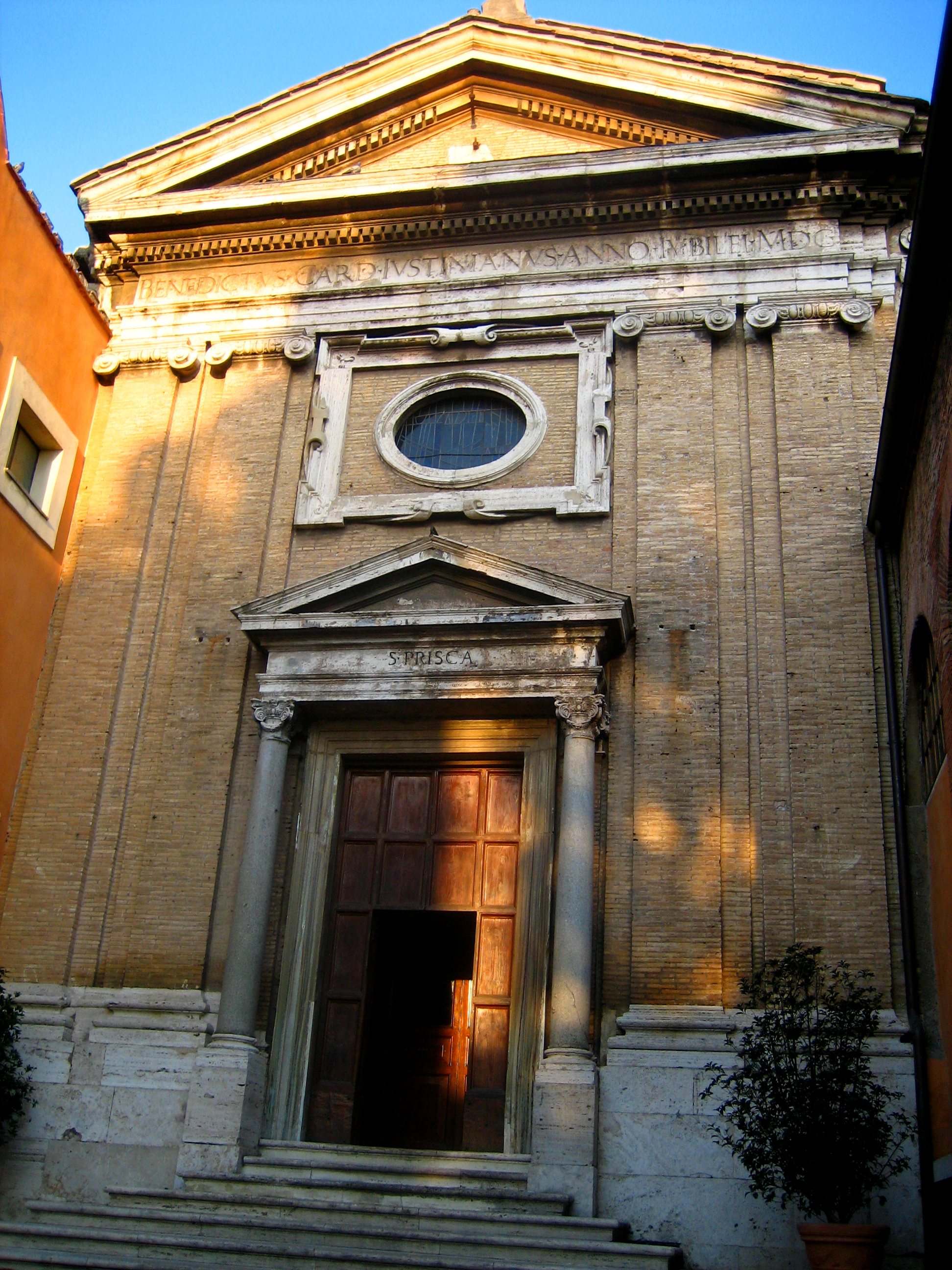
In the years 1599/1600 Carlo Lambardi (1545/1619) for Clement VIII Aldobrandini (1592/1605) reduced the size of the preexisting building, restored nave, chancel and confession, rebuilt the façade and enlarged the square

“The brick curtain and the planned simplification of forms with the portal flanked by Ionic columns supporting a simple triangular pediment, reflect the character 'as an oratory' (Antinori) of the church, which is also to be found in the pictorial decoration of the building, carried out by the Florentine Anastasio Fontebuoni” (Enrico Parlato - Dizionario Biografico degli Italiani Treccani)

In 1728 Clement XIII Rezzonico (1758 /69) restored the interior

In 1935 restoration at the behest of the Augustinians monks to whom the church had been assigned

A fragment of the Forma Urbis, the marble map of the beginning of the third century AD, shows the presence of the BATHS OF LICINIUS SURA located west of St. Prisca
Licinius Sura was a friend of Emperor Trajan (98/117)

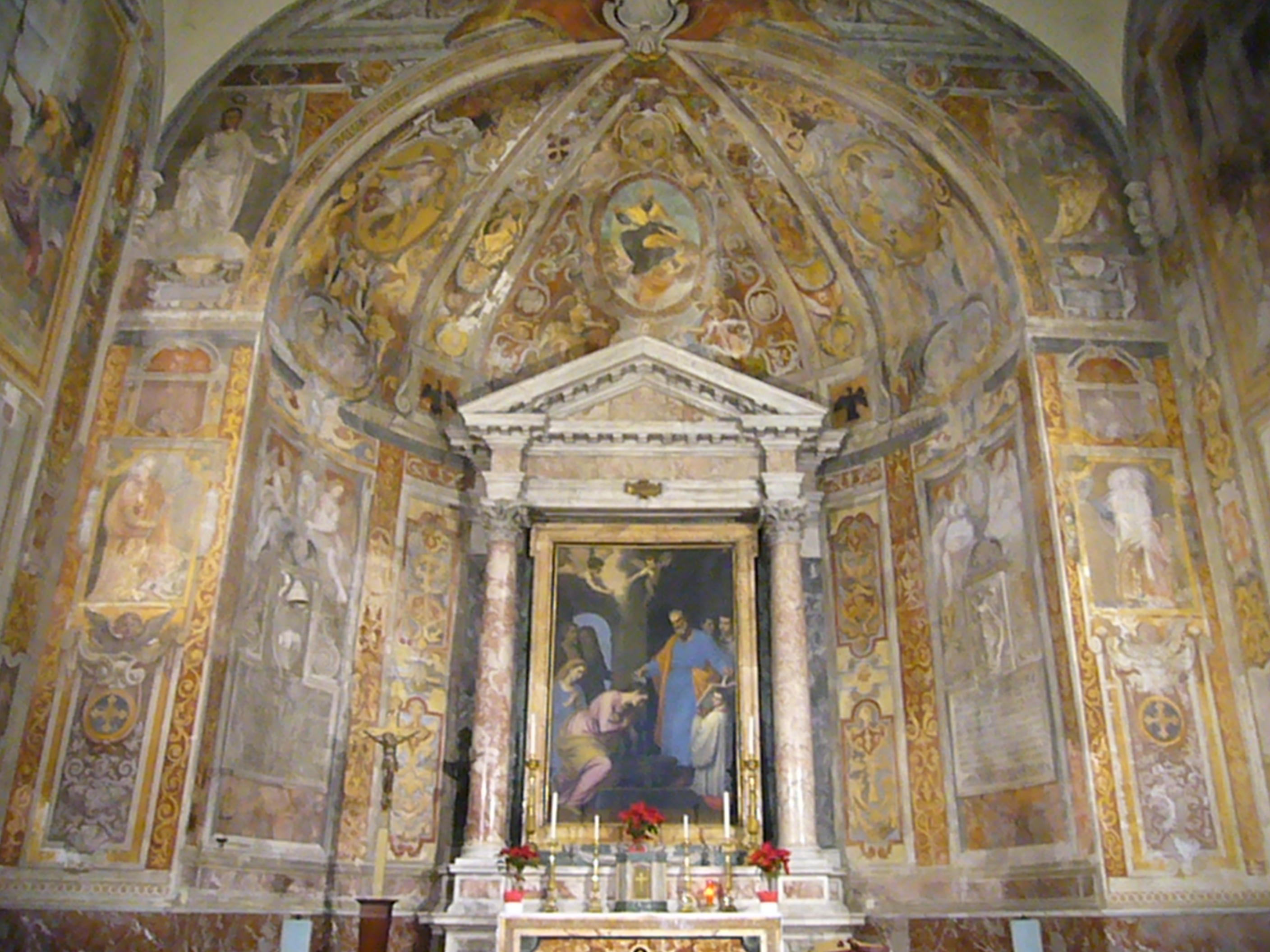
WALLS OF THE CENTRAL NAVE frescoes “Saints and angels with instruments of the Passion of Christ” and WALLS OF THE APSE “Stories of the martyrdom of St. Prisca” of the beginning of 1600s by Anastasio Fontebuoni (1571/1626)

ON THE RIGHT
“Composite capital” of the Antonine period mistakenly believed the baptismal font used by St. Peter to baptize St. Prisca, placed here in 1948 with clasp and bronze group “Baptism of Jesus” by Antonio Biggi (1904 /66)

MAIN ALTAR
Altarpiece “Baptism of St. Prisca” about 1600 by Domenico Crespi aka Passignano (1559/1638)
Above the door of the tower “Annunciation” of the fifteenth century

SACRISTY
“Immaculate Conception and Angels” maybe by Giovanni Odazzi (1663/1731)


Mitreo di S. Prisca

Mithraeum of St. Prisca

Building dating back to about 95 AD to the north of the church, converted into a house in about 110 with a great apsidal nymph to the south
Maybe it was the HOUSE OF LICINIUS SURA friend of Trajan (98/117)

At the end of the second century a building with two aisles was added in the south (maybe the titulus) and the mithraeum that would be violently destroyed in about 400, probably by Christians intolerant to the cult of Mithras 
Discovered in 1934 and excavated in the years 1953/66 by Dutch archaeologists

DIFFERENT PHASES OF THE BUILDING:
1) House of the first century AD with a four-sided portico

2) Apsidal nymphaeum of the time of Trajan (98/117)

3) Building with two naves of the second century AD, where was the original titulus
4) Rooms adapted at the end of the second century AD to the cult of Mithras with frescoes showing the “Seven degrees of initiation” and “Image of Mithra with Saturn lying” in stucco, where the stucco was applied over some amphorae

Thursday, January 17, 2019

St. JAMES IN AUGUSTA

S. GIACOMO IN AUGUSTA
1592/94 by Francesco Capriani aka Francesco da Volterra (1535/94) for Cardinal Antonio Maria Salviati
After Francesco da Volterra's death it was completed in 1600 by Carlo Maderno (1556/1629) who also designed the two twin bell towers on either side of the apse, a unique and distinctive arrangement in Rome
The FAÇADE was designed in the upper part by Carlo Maderno, in the lower part by Francesco da Volterra
It was designed with a clear inspiration from the façade of the Chiesa del Gesù (Church of Jesus) by Giacomo Della Porta
The name indicated the proximity of the church to the Mausoleum of Augustus
It was part of the complex of the Ospedale S. Giacomo (St. James' Hospital) for terminally ill patients, with the exception of those with leprosy and plague. Most of the patients were syphilitic
1861/63 interior restoration work by Gaetano Morichini
1910 faux marble wall cladding

Francesco da Volterra had planned a central hole inspired by the Pantheon, but for static reasons, Carlo Maderno built a roof truss over the great dome
“In the construction of the dome, buttressed by large volutes, the professional probity and technical rigor of Carlo Maderno, acquired in long apprenticeship alongside Domenico Fontana, shine brightly. However, the desire for consistency with the part of the church already built by Francesco da Volterra makes it impossible to experiment new ideas” (Paolo Portoghesi)
“Glory of St. James” 1861/63 by Silverio Capparoni (1831/1907), a pupil of Francesco Podesti who had to intervene to protect him from the negative criticism
It seems that the pope himself Pius IX Mastai-Ferretti (1846/78) had commented when he saw for the first time the painting: “Even the Incurable have their Paradise” in reference to the name of the St. James' Hospital, also known as the Hospital for Incurable Diseases, or for syphilitic

ROUND ROOM TO THE RIGHT OF THE ENTRANCE – BAPTISTERY
Above the altar “Resurrection” about 1601/03 by Cristoforo Roncalli aka Pomarancio (1552/1626), clearly influenced by the Fall of St. Paul by Caravaggio in S. Maria del Popolo
“Our Lady, St. James and the donor Vittoria Tolfia” about 1610 by Francesco Zucchi (about 1562/1622)
It is very interesting, from a documentary point of view, to note in Zucchi's painting the representation of the rear façade of the Basilica of S. Maria Maggiore before the seventeenth century works by Carlo Rainaldi

2nd RIGHT - CHAPEL OF MIRACLES
High Relief “St. Francis of Paola begs the Virgin Mary for the sick in hospital” 1714 by Pierre Legros (1666/1719) to whom it is assigned also the stucco decoration on the ceiling of the chapel with “Four angels holding the center pane with the dove of the Holy Spirit among cherubims”
The relief includes the painting “Virgin Mary of the Miracles” by an anonymous artist of the first half of 1400s, from a tower of the Aurelian Walls in the stretch along the Tiber River
The tower was known as the Chapel of Miracles: a woman with the appearance of the image of Our Lady in 1525 would have saved a child who was drowning in the Tiber
“The work is distinguished for the technique and the extremely high quality, evident in the modulation of the surface that generates vibrations of luminosity with a great effect” (Daria Colonna)
On the sides “Miracles of St. Francis of Paola” 1714 by Giuseppe Passeri (1654/1714), a pupil of Carlo Maratta
“The affinity to the Rococo style of the paintings, which are among the latest achievements of the artist, has been explained by the critics in the light of the contemporary work of French sculptors in Rome” (Daria Colonna)

3rd CHAPEL ON THE RIGHT
Altarpiece “Baptism of Christ” about 1610 Domenico Crespi aka Passignano (1559/1638), a pupil of Federico Zuccari

“Holy Trinity” about 1862 by Francesco Grandi (1831/91), a pupil of Tommaso Minardi
Maybe by Carlo Maderno. The marble was taken from the Mausoleum of Augustus
To the sides of the altar “Epitaph and bronze coat of arms of Cardinal Antonio Maria Salviati” financier of the construction of the church, buried here
On the sides frescoes of the beginning of the seventeenth century, to the right by Francesco Nappi (about 1565/1630) and to the left by Vespasiano Strada (1582/1622)
Frescoes maybe by Francesco Nappi

3rd CHAPEL ON THE LEFT
Wall to the right “Nativity” about 1622/25 by Antiveduto Grammatica (about 1572/1626)
“This work demonstrates the full integration of the Sienese painter to the style of Caravaggio: the reference to the painting of the same subject painted by Caravaggio in Messina has taken forward the hypothesis that Grammatica would have lived in Southern Italy before the execution of this picture” (Daria Colonna)

2nd LEFT - CHAPEL OF St. JAMES
Statue “St. James” about 1601 by Ippolito Buzio (1578/1659)