Showing posts with label Francesco Trevisani. Show all posts

Monday, August 22, 2016

DE CAROLIS PALACE

PALAZZO DE CAROLIS

1714/24 Alessandro Specchi (1668/1729) for Livio De Carolis bourgeois scion of a wealthy family of merchants of grain who wanted to build his palace next to those of the patrician families
The exorbitant cost of the construction contributed to the ruin of the family who was forced to put the building up for auction
It passed in 1750 to the Jesuits who gave it to rent to famous people
It was from 1769 the French Embassy and with Cardinal François-Joachim de Bernis it was the site of parties and beautiful banquets that gave to the French cardinal the popular nickname of King of Rome
Later it belonged to the Simonetti and Boncompagni Ludovisi families
In 1833 the attic was added and the cornice was modified
The building belongs since 1908 to the BANCA DI ROMA and it was enlarged and adapted by Pio Piacentini (1846/1928). He covered the courtyard that became the hall of the bank and changed some of the rooms in Art Nouveau style
Wonderful SPIRAL STAIRCASE by Alessandro Specchi considered one of the wonders of Rome
On the external left end side “Speaking Statue of a Porter” one of the six of Rome, to which anonymous messages were posted
It dates back to the time of Gregory XIII Boncompagni (1572/85) although it is erroneously attributed by popular tradition to Michelangelo Buonarroti
In the courtyard there is a cannonball fired by the French in 1849 embedded in the second floor
The lower stretch of Via del Collegio Romano was named after Alessandro Specchi only in 1980, an incredible delay in making a toponymic tribute to the gigantic but unfortunately underestimated Roman architect
“Citing the close-by Palazzo d'Aste of which it repeats the decorative windows and the corner solution, perhaps at the suggestion of the client who wanted a house clearly inspired by the traditional type of mansion” (Paolo Portoghesi)
Rooms of the first floor with ceilings painted by some of the best painters working in Rome in the early eighteenth century:
GALLERY
Now used as a library
“Triptych Bacchus, Venus and Ceres” by Giuseppe Chiari (1654/1727)
“Diana and her Companions” by Benedetto Luti (1666/1724)
“Chariot of Apollo with Aurora and Muses” by Luigi Garzi (1638/1721)
HALL OF MINERVA
“Allegory of caste Love with passionate Love represented by Minerva who takes away Youth from Venus and give it to Hercules symbol of strength and virtue” and “Venus and Vulcan” by Francesco Trevisani (1656/1746) from Istria
“At age 21 he moved to Rome. Here he studied the works of Carraci, was inspired by Correggio and attended the circle of Carlo Maratta. He had a good success as the representative of Venetian Rococo style. He produced altarpieces with very pathetic tones, but he was also appreciated as a very precise portrait painter and for his vast landscape scenes, which are the background of historical or mythological events” (Consorzio La Venaria Reale - www.lavenaria.it)
“Allegory of the arts and wisdom” by Sebastiano Conca (1680/1764)
“Aurora” by Andrea Procaccini (1671/1734)
More paintings by Domenico Maria Muratori (1661/1742), Ludovico Mazzanti (1686/1775) and Giovanni Odazzi (1663/1731)

Wednesday, August 10, 2016

CORSINI PALACE - CORSINI GALLERY (eight part)

Room VII - Green Room
“Cardinal Andrea Corsini used the room as a new Audience Hall and for this purpose he placed here a series of paintings of great quality and indicative of his aesthetic taste. The current exhibit, unable to reproduce the original layout, includes a selection of works that entered the collection after the death of Neri Maria (1770). The date in mosaic under the window (1858) recalls the reconstruction of the floors in Venetian style” (Official Website of the Galleria Corsini - galleriacorsini.beniculturali.it)
Marble sculpture “Psyche carried by the Zephyrs” by the Welsh pupil of Canova John Gibson (1790/1866)
Marble sculpture “Dancer with Finger on her Chin” by Luigi Bienaimè (1795/1878)
Precious “Corsini Cup” in silver dating back to the first century BC
“St. John the Baptist” 1606 by Michelangelo Merisi aka Caravaggio (1571/1610)
“The figure of three quarters of this precursor dark and handsome dandy turns his head out of the field, observing something, while the intensity of his gaze, felt just below the thick mass of hair, is perhaps the poetically higher moment of the composition” (Vincenzo Pacelli)
“Madonna and Child” by Bartolomè Esteban Murillo (1618/82)
“Undisputed protagonist of the second half of the seventeenth century, he ushers in a new pictorial language. He opposes to the local tradition a conventional narrative representation made with delicate chiaroscuro, far away from the strong contrasts of light of Zurbaran. His appearance on the scene of Seville was in opposition to the current style, showing novelties from his knowledge of contemporary Neapolitan and Genoese production. An anti-rhetorical vein characterizes the production of religious subjects, where the sacred episodes are similar to scenes from everyday life” (Carlo Bertelli, Giuliano Briganti, Antonio Giuliano)
“Venus and dead Adonis” 1637 by Jusepe de Ribera aka Spagnoletto (1591/1652)
“The original myth told in Ovid's Metamorphoses is enriched from the fourteenth century of new metaphorical meanings, which compare the figure of Adonis that of Jesus. As G.B. Marino, who in his famous poem Adonis (1623) explicitly alludes to the sacrifice of Christ, Ribera representing Adonis with an obvious wound on the side takes up the theme of the Passion” (Official Website of the Galleria Corsini - galleriacorsini.beniculturali.it)
“Entry of Christ in Jerusalem” by Luca Giordano (1634/1705)
“Herodias with the Head of St. John the Baptit” about 1625 by Simon Vouet (1590/1649)
“Particular attention is paid to the material quality of fabric and to the expression of the face of the protagonist, who shows his macabre trophy. Declined in the painting are the many different stimuli and influences in the formation of the French painter: the realism of Caravaggio's matrix on one hand, and the colors, the drapery and the preciousness of the Venetian school on the other “(Official website of the Corsini Gallery - galleriacorsini.beniculturali.it)
“Judith with the Head of Holofernes” by the Flemish painter Gerard Seghers (1591/1651)
“Annunciation” by Marcello Venusti (about 1512/79). It is a copy of a lost original by Michelangelo Buonarroti for the Cesi Chapel in S. Maria della Pace
“Tribute of money” by Mattia Preti (1613/99)
“St. George and the Dragon” by Francesco Raibolini aka Francia (1450/1517)
“Sinite Parvulos” the Frenchman Nicolas Tournier (1590/post 1657)
“Homer” by Pier Francesco Mola (1612/66)
“Mary Magdalene” by Francesco Trevisani (1656/1746)
“In Rome since 1678 he got closer to the circle of Carlo Maratta and of the Arcadia, developing a rococo style composed and refined, with tones graceful and pathetic” (Enciclopedia Treccani)
“Nativity” about 1748 by Pompeo Batoni (1708/87) with a spectacular frame
“Resurrection of Lazarus” by Giuseppe Cesari aka Cavalier d'Arpino (1568/1640)
“Madonna of the Rose” by Massimo Stanzione (1585/1656)
“In Rome, the knowledge of the works by Caravaggio and the Carraccis, as well as Domenichino and Guido Reni (present in those years in Naples) led him to an attempt to mediate between the two modes. Following the sharp naturalism of the early works (...), looking at Simon Vouet and Guido Reni, he developed a style characterized by elegant and refined shapes of color, light and bright tones. Leading personality in Naples, he had a profound influence also in the opening to the baroque, clear in his later works” (Enciclopedia Treccani)
“St. Peter freed by the Angel” by Johann Heinrich Schoenfeld (1609/83)
“The crowning with thorns” copy from Antoon Van Dyck (1599/1641)
Panel “Madonna with Child, Saints and scenes from the life of Christ” an early work by Giovanni di Jacopo di Guido aka Giovanni da Milano (active 1346/69)
Panel with “Coronation of the Virgin Mary” by Andrea di Cione aka Orcagna (active 1343/68)
Two panels long and narrow with “Apostles” by the Venetian Niccolò di Pietro (active 1394/1430)
Triptych “Madonna and Child, Saints and Crucifixion” by the Master of S. Verdiana (active 1370/1400)
“Madonna and Child” and “Madonna and Child with Sts. Jerome and Francis” by an unknown artist of the Florentine school
“Triptych” by an unknown artist of the Florentine school
“Madonna and Child” by an unknown artist of the Viterbo-Umbrian school of the fifteenth century
“Still life with fish and shellfish” by the mysterious Neapolitan Marco de Caro (Eighteenth century)
“Still Life with Peaches” and “Still life with peaches and grapes” by Jan Decker (Eighteenth century)
Above the doors “Flowers and fruit (Autumn and Winter)” and “Flowers and fruit (Spring and Summer)” by the Flemish Abraham Brueghel (1631/97)
Seven beautiful still lives by the German Christian Berentz (1658/1722): “The elegant snack”, “Clock”, “The Fly”, “Roman Vegetables”, “Still life with Mascherone (Big Mask)”, “Fruit”, “Preparations for Dinner” and “Casino dell’Aurora (Aurora Lodge)” where it is possible to recognize the Aurora Casino of the Ludovisi family

Monday, March 7, 2016

BARBERINI PALACE - NATIONAL ART GALLERY (twenty-sixth part)

Room XXXIII - Fabrizio and Fiammetta Lemme Donation. Designing Great Art

Preparatory sketches for paintings on canvas in the nave of St. Clement executed in the years 1711/16 including “Glory of St. Clement” by Giuseppe Chiari (1654/1727) for the ceiling of the church
“As it has been pointed out, the central figure is derived from the assumption of Annibale Carracci in S. Maria del Popolo, but the reference point is the Allegory of Mercy painted by Carlo Maratta in Palazzo Altieri in 1676. Fidelity to the text of his teacher borders here on plagiarism, or perhaps indicates the use of the original cartoons, in the group of two putti supporting the anchor down” (Lorenza Mochi Onori)
“Stories of St. Clement and St. Ignatius of Antioch” for the walls of the church by some of the best painters in Rome in the second decade of 1700s:
“Death of S. Servolo” by Tommaso Chiari (1665/1773) brother of Giuseppe
“Among the works of this cycle it is one of those that show 'more intensely maratta-like' features. With a composition of light classical approach proposing 'in decidedly eighteenth century tone, the golden language of Raphael'. The peculiar character of this sketch that marks also other works by De Pietri (for example, the Madonna and Child with Saints in S. Maria in Via Lata) is this intimate aspect, and it is one of the most original outcomes of Maratta's period' (Casale)” (Lorenza Mochi Onori)

“Martyrdom of St. Clement” by Giovanni Antonio Grecolini (1675/1725)
“Translation of the body of St. Clement” by Giovanni Odazzi (1663/1731)
“The sketch shows less freshness than the final version as a fresco. Some indecisions show up affecting mainly the faces of St. Clement and the prelate behind. The prelate knelt before the body of St. Clement recalls a figure of G.B. Gaulli, the St. Nicholas, in the altarpiece in St. Mary Magdalene, which inspired Odazzi some other times as well” (Lorenza Mochi Onori)
“Trajan condemning St. Ignatius of Antioch” by Giovanni Domenico Piastrini (1678/1740)
“St. Ignatius of Antioch meets St. Polycarp in Smyrna” by Giacomo Triga (1674/1746) pupil of Benedetto Luti
“Giacomo Triga, little-known pupil of Benedetto Luti, a virtuoso of the Pantheon, worked for the Patrizi and the Theodoli families, and in some Roman churches such as the Basilica of Sts. John and Paul, St. Francis of Paola and S. Marcello al Corso” (Lorenza Mochi Onori)
“Martyrdom of St. Ignatius of Antioch” by Pier Leone Ghezzi (1674/1755)
“As Casale mentioned, this painting by Ghezzi in the Clementine series is presented as 'the less academic and more whimsical of the group' and 'hard to the limits of unpleasantness. But original' due 'to an compositional vehemence impatient of conventions and rules of composition” (Lorenza Mochi Onori)
“Miracle of St. Clement in the Crimea” by Sebastiano Conca (1680/1764)
“It has been emphasized the differentiation of this sketch from the rest of the series for both the bright colors with respect to the general preference for crayon-like colors, and for the adoption of a small size that allows the presence of several figures without creating a scrum. ( ...) It as also noted by Casale (1998) that it is the masterpiece of the clementine series, a work in which the author reconciles the update on Maratti's reforms with a style that 'shows an early Rococo expression' (Sestieri)” (Francesca Mochi Onori)
The “Abandonment of Moses” and the “Sacrifice of Isaac” by Domenico Corvi (1721/1803) from Viterbo
They are models for the paintings in the side chapel of the Virgin of Seven Sorrows in S. Marcello al Corso, showing with their bright colors the influence of Corrado Giaquinto's painting
Extraordinary “Assumption of the Virgin” by Ludovico Mazzanti (1686/1775) a Gaulli's student, sketch for the 1720 fresco on the ceiling of the left transept of S. Ignatius
“Death of S. Joseph” 1712 by Francesco Trevisani (1656/1746) from Istria
It is a study for the altarpiece of the second chapel on the right in the church of St. Ignatius
Sketch of “Last meeting of Sts. Peter and Paul” for the 1766 canvas in the church of S. Lucia al Gonfalone, and preparatory sketch of '“Adoration of the Magi”, a work in S. Giuseppe alla Lungara, by the Sicilian Mariano Rossi (1731/1807)
“In the Last meeting of Sts. Peter and Paul mix, in a studied intersection of levels that follow the development of the action, relations with the work of Corrado Giaquinto but, as Giancarlo Sestieri pointed out, in an 'extreme simplification of form, based on an essentially linear conciseness' and 'developed especially in the footsteps of Marco Benefial and Francesco Mancini'“ (Lorenza Mochi Onori)
“Allegories of the four elements: water, air, fire and earth” 1767/68 by the Roman Stefano Pozzi (1699/1768) for the lunettes of the vault of a Cabinet in the Palazzo Doria Pamphilj

Monday, February 22, 2016

BARBERINI PALACE - NATIONAL ART GALLERY (twenty-third part)

Room XXVIII - Painting in Rome in the Early 1700s

“Luti painted scenes of great miracles, as was then customary, but he underlined the nicely narrative tone, almost a historical document. The monumentality of the scene is scaled down by the soft and clear paint, typical of the rococo grace” (Official Web Site Barberini Gallery - www.galleriabarberini.beniculturali.it)
Four paintings “Allegory of the four parts of the world: Europe, Asia, Africa and America“ about 1709
Models for the mosaics in the spandrels of the vestibule of the Baptistry Chapel in the Basilica of St. Peter eventually executed only in the years 1724/26
The presence in the Baptistry Chapel of the representation of the four continents known at the time is symbolic of the desire on the part of the Catholic Church to spread throughout the world the saving power of the Sacrament of Baptism
“The Venetian Pietro Ottoboni (1667/1740) was a patron of artists, musicians and writers. (...) Despite the wealth of his office, his munificence was such to find himself burdened with debts incurred for his patronage. (...) He was also the chief patron and client of Trevisani, so much so that in 1698 he gave him accommodation in the Palace of the Chancellery and appointed him as his Primo Pittore (First Painter)” (Lorenza Mochi Onori)
Beautiful and sensual “Mary Magdalene” about 1725, represented here with almost theatrical flamboyance by Francesco Trevisani (1656/1746) from Istria
“Strong charge of monumentality, enhanced by the quite unusual framing, almost three quarters, which sheds light on both the face and the nude and sensual body of the saint, emerging from the shadows of the rocky background. (...) Pathetic yearning of theatrical taste, much appreciated by Cardinal Pietro Ottoboni, Trevisani patron and protector of the Arcadia” (Anna Lo Bianco)
“The large portrait of the Quarantotti family, signed and dated 1756 on the pillar on the left, celebrated their son preacher in distant lands, surrounded by family members dressed in exotic way, in an atmosphere eccentric and suspended. The picture, in addition to expressing the spreading of passion for the Orient, is a polished piece of realism, anticipating Goya. But it's good to know that it was Goya himself, in his sojourn in Rome in 1770, to copy a Benefial work in his notebook, the Expulsion from Garden of Eden - shown here - clearly aware of the innovative power of the paintings by this artist” (Official website of the Barberini Gallery - www.galleriabarberini.beniculturali.it)
“The stories of Hercules and Omphale and of Pyramus and Thisbe are united by a reference to love as a passion that goes beyond human reason. They depict, in fact, Hercules ranking as a maid and giving his club, a symbol of virility, to the queen Omphale of Lydia, enslaved by love, and Thisbe who kills herself in front of the body of the beloved Pyramus, who, in turn, committed suicide believing that she had been torn by a wild beast” (Lorenza Mochi Onori)
Sketch for “St. Margaret of Cortona finds the corpse of her lover” in the Church of S. Maria in Aracoeli, all works by the great Roman painter Marco Benefial (1684/1764)
“The freshness of the sketch summarizes in a more immediate way than the finished painting the scene of the discovery (...) with the contrast between the pathetic attitude of the saint, the humorous note of the dog and the raw description of the corpse, boldly foreshortened and placed in foreground, featuring a detailed study of the nude, which in the final canvas will be hidden by the branches and not so obvious. The figures placed in relief with the use of light testify, among the numerous sources used by Benefial, even a study of the Caravaggio's followers” (Lorenza Mochi Onori)
“Miracle of St. Joseph of Copertino” by Placido Costanzi (1702/59)
In this curious scene the patron saint of test takers, accustomed to levitate during his ecstasies, heals the young nobleman Baldassarre Rossi who had gone crazy all of a sudden, grabbing him by the hair and lifting him off the ground with him
The philological accuracy in representing the clothes of the previous century is remarkable
“The sketch shows a remarkable fluidity and virtuosity of touch as evidence of a development process of the finished work, leading Mancini to give precedence to formal discipline over the urgency of pictorial expression, in a work of mental construction of the work that is to be found in other cases, of which the most famous is Canova, in the proto-neoclassical and neoclassical culture” (Lorenza Mochi Onori)
“Madonna reading” by the Frenchman Pierre Subleyras (1699/1749)
“Intimately engaged in the widespread movement of return to nature and antiquity, his noble but lively classicism was undoubtedly the most worthy of that label. Alien to the exaggerated gestures of Baroque characters, or to the excessive affectation of late Maratta taste, he was all aimed at a balanced composition and a conciseness of volumes, favoring the opposition of masses of color, always based on a few essential tones, with a predominance of large and picturesque expanses of white” (Giancarlo Sestieri)
Sketches for the oval commissioned by Pope Clement XI Albani (1700/21) in 1718 for the central nave of the Basilica of St. John Lateran
He commissioned eleven more ovals, all with prophets, to the leading painters in Rome at that time. Sebastiano Conca chose the version with the angel points to the cross
“Portrait of Sir Robert Clive, Baron of Plassey” 1766 by Anton von Maron (1733/1808)
“It wants to be a celebration of the high position of the English nobleman, governor of Bengal from 1757 to 1760, and is set in the tradition of the courtly portrait, but it also becomes a representation, of outstanding effect and unique in its kind, of British power in the colonies. The subjugation of the indigenous with turban, caught while the Governor is issuing rules, wants to allude to the civilizing role of the colonial power, while the curtains in the background hint at the military role of the governor. (...) He had a bitter fate: after his return to England he was subjected to a parliamentary inquiry into his conduct in the colonies. He managed to be acquitted of the charge of corruption, but he took his own life in 1774 for a depression caused by his opium's vice” (Lorenza Mochi Onori)
“Portrait of Count Niccolò Soderini” by the great Pompeo Batoni from Lucca (1708/87)
Count Soderini was the Tuscan consul in Rome and the dedicated patron of the Roman painter Marco Benefial

Wednesday, June 17, 2015

ORATORY OF THE HOLY SACRAMENT

ORATORIO DEL SS. SACRAMENTO


1576, rebuilt in about 1724/30 for Cardinal Pietro Ottoboni under Benedict XIII Orsini (1724/30) by the master of the so-called Roman Barocchetto (Roman Little Baroque) Domenico Gregorini (1692/1777) who was also responsible for the reconstruction of the original façade by Carlo Rainaldi (1611/91)

It is allso known as ORATORY OF S. MARIA IN VIA

Statues in the FAÇADE “Faith” and “Hope” by Paolo Benaglia (?/1739)

The INTERIOR decoration dates back to 1875

COUNTER FAÇADE

ON THE WALLS

“Angels and Evangelists” 1856/57 by Luigi Martinori (1828/95)

MAIN ALTAR

1842 by Luigi Valadier (1726/85) with relics of Sts. Cyriac, Ilaria and Lea as well as shreds of the Virgin Mary's veil and of St. Joseph's robe

Above the altar “Holy Family” 1729 by Francesco Trevisani (1656/1746) from the Istria peninsula

On either side, “David” and “Aaron” 1854/55 by Pietro Gagliardi (1809/90)

The oratory was given to tour operators as their worship place in Rome since 1969

Friday, September 27, 2013

BASILICA OF St. MARY OF THE ANGELS AND OF THE MARTYRS

BASILICA S. MARIA DEGLI ANGELI E DEI MARTIRI
In 1561 the Sicilian priest Antonio Del Duca, devoted to the worship of the angels, obtained from Pius IV Medici (1559/65) the consecration for the Carthusian Monks of St. Croce in Gerusalemme of the emposing ruins of the BATHS OF DIOCLETIAN (284/305) built in eight years, between 298 and 306
The great Michelangelo Buonarroti (1475/1564) worked from 1561 until his death in 1564 to transform those ruined structures into a huge church
His work was then continued until 1566 by his pupil Jacopo Del Duca (about 1520/1604), who was also nephew of the priest Antonio Del Duca
In the years 1700 and 1746 two entrances were closed
In 1750 reorganization by Luigi Vanvitelli (1700/73) who designed, with his pupil Clemente Orlandi (1694/1775), among other things, eight masonry columns identical to the original of the transept and a late Baroque façade removed in early twentieth century
Church of the official ceremonies of the Italian State since 1896, when the Prince of Naples and future King of Italy Victor Emmanuel III got married here
It was declared a Minor Basilica in 1920 by Benedict XV Della Chiesa (1914/22)
Corresponding to the tepidarium (pool with tepid water) of the baths, while the area outside the church in front of the façade is the caldarium (pool with hot water)
New bronze doors "Annunciation" and "Resurrection" 2005 by the Polish artist Igor Mitoraj (1944)
At the center of the vestibule sculpture "The Angel of Light" 2000 by Ernesto Lamagna (1945)
Above GLASS DOME "Light and Time" 2000 by Narcissus Quagliata (1942), gift of the Archdiocese of Baltimore the archbishop of which, Cardinal William H. Keeler, is the current titular of the Basilica
The lantern is 25 m (82 feet) high from the floor, it has a diameter of 5 m (16.4 feet) and there are three lenses aimed at south, making it an astronomical instrument designed by Salvador Cuevas of the University of Mexico: the three lenses focus the image of the sun and cast a pink disk in the middle of the floor at noon in the two solstices and two equinoxes
ON THE RIGHT
"Funerary monument to Carlo Maratta" about 1704 by Carlo Maratta (1625/1713) himself with bust by his brother Francesco Maratta
CHAPEL OF THE CRUCIFIX
"Crucifix" maybe by Giacomo Della Rocca (1592/1605) pupil of Daniele da Volterra
On the left "Monument to Pietro Tenerani" 1869 by Pietro Tenerani (1789/1869) himself
On the right "Tomb of Lilla Montobbio" Pietro Tenerani's wife
"Tomb of Cardinal Francesco Alciati" 1580 maybe by G.B. Della Porta
ON THE LEFT
"Tomb of Salvator Rosa" 1673 designed by the son of Salvator Rosa (1615/73), Augusto Rosa, with sculptures by Bernardino Fioriti (active second half of XVII century)
CHAPEL OF St. MARY MAGDALENE 1579 for Consalvo Alvaro di Giovanni
"Noli me tangere" maybe by Hendrick van der Broek (1519/97), Flemish painter also known for his "Resurrection" in the Sistine Chapel
"Tomb of Cardinal Pietro Paolo Parisio" 1604
NICHE ON THE RIGHT
Statue of "St. Bruno of Cologne" founder of the Carthusians 1768 Jean Antoine Houdon (1741/1828)
NICHE ON THE LEFT
Statue of "St. John the Baptist" 2009 by Giuseppe Ducrot (1966)
On the left CHAPEL OF St. PETER
1635 for Pietro Alfonso Avignonese
"Handing of the keys" Girolamo Muziano (1532/92)
On the left "St. Peter freed by an angel" and on the right "Sts. Peter and Paul", maybe by the Roman painter M. Carloni
In the vault "God Father" maybe by Girolamo Muziano
In the middle of the chapel contemporary sculpture "Head of St. John the Baptist" by Igor Mitoraj (1944)
On the right CHAPEL OF St. BRUNO
Marble "Stoup with angel" maybe by G.B. Rossi a pupil of Bernini
Above the arch preparatory sketch painted on cardboard "Expulsion from Paradise" last work of Francesco Trevisani (1656/1746)
Corresponding to the ancient Basilica of the Diocletian Baths
Eight huge monolithic granite columns (17.14 m high - 56 feet - including capitals) and three large original ancient concrete vaults (29 m high - 95 feet - from the ground), even more incredible when one thinks that they were 2 meters (6 feet) higher, before the raising of the floor by Michelangelo
Eighteenth century FLOOR by Giuseppe Barberi (1746/1809)
Eight altarpieces from St. Peter's Basilica have been moved here since 1727 as well as four painted cardboards 1638/45 by Francesco Trevisani, preliminary sketches of the mosaics in the dome of the Baptistery Chapel in St. Peter's Basilica
RIGHT SIDE OF TRANSVERSE HALL
On the floor "Clementine Line" 1702 sundial made by the astronomer Francesco Bianchini with the collaboration of Giacomo Maraldi for Clement XI Albani (1700/21)
It was used as the official sundial in Rome for about 150 years until 1846 when it was replaced by the cannon of Janiculum Hill
On the Right Wall
"Crucifixion of St. Peter" by Nicolò Ricciolini (1687/1772) pupil of Carlo Maratta
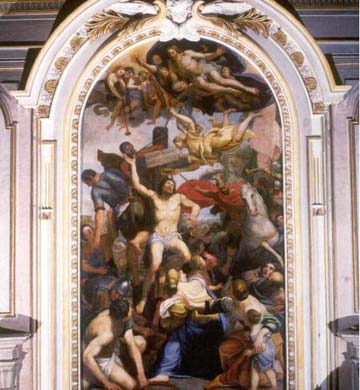
"Fall of Simon Magus" copy by Pierre Charles Tremollière (1703/39) from the original on blackboard by Francesco Vanni (about 1563/1610), formerly located in St. Peter's Basilica in front of the tomb of Alexander VII
On the Left Wall
"St. Peter raises Tabitha from the dead" by Francesco Mancini (1679/1758)
"Preaching of St. Jerome" end of sixteenth century by Girolamo Muziano (1532/92), his last work with landscape painted by Paul Brill (1554/1626)


"I must say that the harmony of these holy men with the serious and solemn landscape has a really touching effect, that no other artist has been able to achieve with means as simple and convincing. Muziano gives up completely the compositional tricks of the time, as well as chromatic effects and daring fore-shortenings of the figures. Only the dignified and quiet profile of the monk listening devoutly and the appearance of St. Jerome, so grandly complete in itself and for itself, must speak, must agree with the elegiac atmosphere of the background generously articulated, in which the figures fit beautifully with a soft rounding of the composition" (Hermann Voss)
MONUMENTAL TOMBS of the three main generals for the Italian victory in World War I:
"Marshal Armando Diaz" 1928 by Antonio Muñoz (1884/1960)
In the Chapel of the Blessed Niccolò Albergati, on the right "Vittorio Emanuele Orlando" 1953 and on the left "Admiral Paolo Thaon di Revel" 1953 both by Pietro Canonica (1869/1959)
Right end of the transverse hall CHAPEL OF THE BLESSED Niccolò Albergati
1746 Clemente Orlandi (1694/1775) a pupil of Luigi Vanvitelli
Vault with "Holy Spirit and Doctors of the Church, Jerome, Augustine, Ambrose and Gregory" by Antonio Bicchierai (1688/1766) and Giovanni Mezzetti
On the altar "A miracle of Blessed Niccolò Albergati" first half of eighteenth century by Ettore Graziani
On the sides large paintings "Baptism of water" and "Baptism of desire" Francesco Trevisani
Two statues in plaster of "Angels of Peace and Justice" 1835 Federico Pettrich
LEFT SIDE OF TRANSVERSE HALL
On the Right Wall
"Virgin Mary and Saints" (formerly in the Choir Chapel in St. Peter's replaced by a copy in mosaic) 1730/35 by Pietro Bianchi aka il Creatura (1694/1740), a Roman pupil of Benedetto Luti and Baciccio
"Resurrection of Tabitha" by Placido Costanzi (1702/59), previously in the right passageway to the apse of St. Peter's Basilica now replaced by a mosaic copy
On the Left Wall
"Fall of Simon Magus" 1755 by Pompeo Batoni (1708/87), which originally was to replace the ruined painting on blackboard of the same subject by Francesco Vanni in St Peter's Basilica: it never ended up in St. Peter's and it was eventually replaced with a copy of Vanni's painting by Pierre Charles Tremollière which was also replaced in 1925 with the mosaic dedicated to St. Margherita Alacoque
"Batoni from Lucca was the undisputed arbiter and leader of the Roman scene. He related to instances of Marco Benefial and further deepened the secession in the classic sense of the local figurative culture, which will find new support around mid-century in the new passionate rediscovery of antiquities and in the subsequent theoretical formulations and practices of Mengs and Winckelmann. In Batoni however, there is still a fully eighteenth-century taste for the beautiful painting nobly composed and balanced in the rational organization of means of expression, yet vibrant for the fluid brushwork, rich and precious" (Carlo Bertelli, Giuliano Briganti, Antonio Giuliano)
"Mass of St. Basil" 1743/47 by Pierre Subleyras (1699/1749) formerly in the passage between the right transept and the Gregorian Chapel in St. Peter's Basilica replaced by a copy in mosaic
"He spent the last years of his life in Rome, introducing in his work a noble simplicity and precision of design and expression, together with a limited but well-considered light range of tonal values" (Rudolf Wittkower)
"Pierre Subleyras was the favorite artist of Benedict XIV Lambertini (1740/58). His star became increasingly bright for its style refined and classical but still suffused with an intense sentimental impulse. (...) The Mass of St. Basil is a great composition but imbued with intimate recollection, all played on the clear light of the central nucleus of the pearl white robes. It displays classical rigor expressing the same humanity authoritatively professed by the pope" (Anna Lo Bianco)
Left end of the transverse hall CHAPEL OF St. BRUNO
Carlo Maratta (1625/1713) on the altar "Virgin with Sts. Peter and Bruno" about 1700 by Giovanni Odazzi (1663/1731)
In the vault "Evangelists" about 1700 by Andrea Procaccini (1671/1734)
On the right large painting "Baptism of Blood" by Francesco Trevisani: his other canvas originally on the left has been moved to the Chapel of St. Teresa since the organ was installed
On the left monumental Organ by Barthélémy Formentelli donated to John Paul II (1978/2005) from the city of Rome for the Jubilee of the year 2000
PASSAGE ROOM TO THE PRESBYTERY
On the right CHAPEL OF St. HYACINTHUS
"Virgin and Child, Angels and Sts. Hyacinthus and Raymond", on the wall to the right "Sts. Cecilia and Valerian", on the wall to the left "St. Francis receiving the Stigmata", in the vault "God the Father and Angels" all works by Giovanni Baglione (1566/1643)
On the left CHAPEL OF THE SAVIOUR
On the altar "Incarnation of Jesus and worship of the Seven Angels" by Domenico da Modena
On the side walls "Souls in Purgatory" and "Praying Pope" 1574 by Giulio Mazzoni (about 1525/after 1589) with several contemporary portraits
Frescoes in the vault 1574 by the Flemish artist Hendrick van der Broek (1519/97)
RIGHT WALL
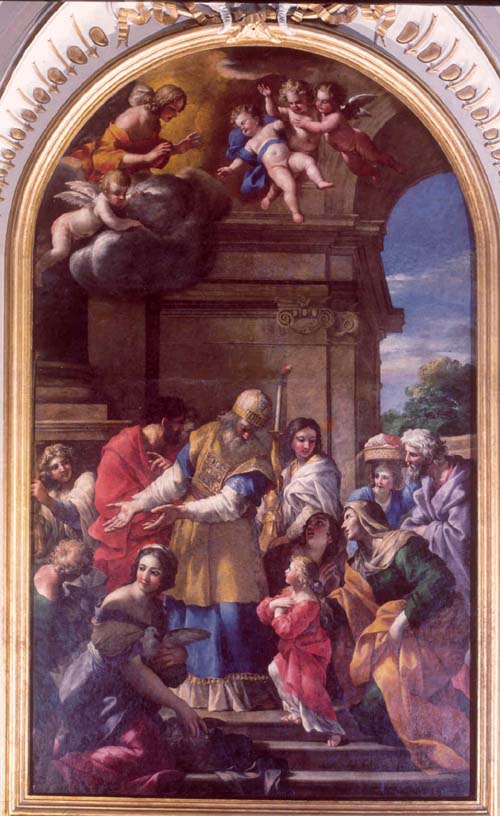
"Presentation of Mary in the temple" about 1640 by Giovanni Francesco Romanelli (1610/62) from Viterbo, a pupil of Pietro da Cortona. It was formerly in the church S. Maria Regina Coeli destroyed for the construction of the prison with the same name by the River Tiber
"Educated by Domenichino, he became assistant to Cortona in the Barberini ceiling, was permanently protected by the Barberini and he was given considerably large jobs that he executed with great decorative ability. It was he who introduced a watered down version of Cortona and classical style in Paris, where his paintings of mythological, allegorical and historical subjects in the gallery of the Hotel Mazarin and several rooms of the Louvre reveal an easy craft that also appears in his mid-century Roman works" (Rudolf Wittkower)
"Martyrdom of St. Sebastian" 1629 Domenico Zampieri aka Domenichino (1581/1641), painted with oil on stucco, formerly in the Chapel of St. Sebastian in St. Peter's Basilica replaced by a copy in mosaic
LEFT WALL
"Punishment of Ananias and Sapphira" about 1605 Cristoforo Roncalli aka Pomarancio (1552/1626) on blackboard, formerly in the passage between the transept and the Chapel of St. Clement in St. Peter's Basilica replaced by a copy in mosaic
Ananias and Sapphira, after selling a farm, had delivered to the apostles only a portion of the proceeds, mendaciously claiming to have delivered the entire sum: for this lie they were killed by God
"The way the dramatic story was represented here through a few figures relatively quiet but powerful, without the multitude of people used by the Zuccaris' imitators, also seemed to indicate a new road for the altarpieces with historical subjects that had come to a standstill at that time both among the followers of the Zuccaris and among the imitators of Barocci. It is significant that Roman painting, just before the phenomenon of the Carraccis would be known in Rome, would generate similar phenomena alone" (Hermann Voss)
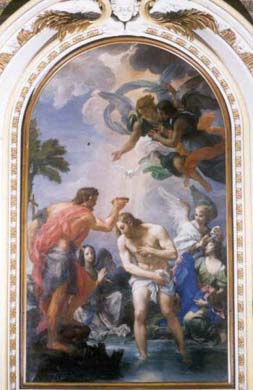
"Baptism of Jesus" about 1697 Carlo Maratta, formerly in the Chapel of the Baptistery in St. Peter's Basilica replaced by a copy in mosaic
"Carlo Maratta was the prince of the Roman Academy, in whose eclectic classicism also the last stimuli of seventeenth century Baroque style are composed in a correct and formal style, especially as we see it unfolding in the great altarpieces" (Carlo Bertelli, Giuliano Briganti, Antonio Giuliano)
APSE
Vault "Assumption of the Virgin and Virtues" by the Viennese Daniele Seiter (1649/1705)
On the left "Tomb of Pope Pius IV" Medici (1559/65)
On the right "Tomb of Cardinal Giovanni Antonio Serbelloni"
Wooden altar with "Altar frontal in bronze with Deposition" 1928 by Umberto Mastroianni (1910/98)
ON THE BACK WALL
"Madonna Enthroned between the Seven Angels" 1543 Venetian painting maybe by Lorenzo Lotto (about 1480/1556)
On the left CHAPEL OF THE RELICS or CYBO CHAPEL
1742 for Cardinal Camillo Cybo titular of the church. It was built to preserve the relics of the martyrs related to construction of the baths (Sts. Ciriaco, Largo, Smaragdus, Massimo and many others) to whom Cardinal Cybo joined the relics of the four Doctors of the Church (Sts. Jerome, Ambrose, Augustine and Gregory) which he formerly kept in his palace
The paintings in the chapel are by Nicolò Ricciolini (1687/1772)
On the left of the presbytery EPIPHANY CHAPEL
"Stories of St. Bruno" and in the vault "Triumph of St. Bruno" maybe by Luigi Garzi (1638/1721)