Showing posts with label Guide of Rome Romapedia. Show all posts

Monday, December 12, 2016

PALACE OF THE STOCK EXCHANGE

PALAZZO DELLA BORSA
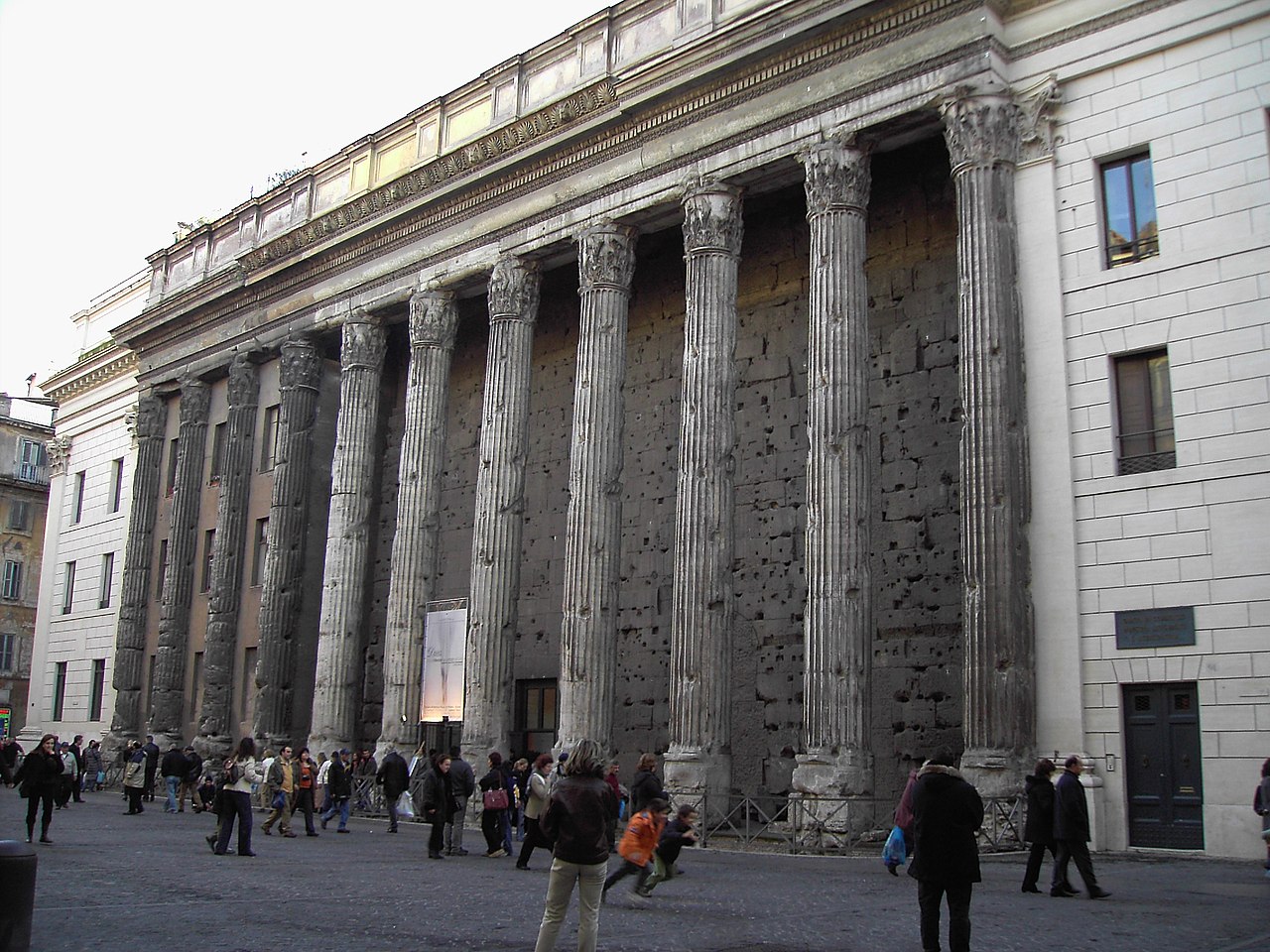
Temple of Hadrian transformed in 1695 by Carlo Fontana (1634/1714) and his son Francesco Fontana (1668/1708) in the headquarters of the Dogana di Terra (Land Customs Office) for Innocent XII Pignatelli (1691/1700)
Modified in 1879 by Virginio Vespignani (1808/82) to become the headquarters of the Camera di Commercio e della Borsa Valori (Chamber of Commerce and Stock Exchange)
Renovated in 1928 by Tullio Passarelli (1869/1941) who made the columns more visible
Tempio di Adriano
Temple of Hadrian
Embedded in the Palazzo della Borsa
Dedicated in 145 AD by Antoninus Pius (138/161) to his predecessor Hadrian (117/138)
Temple peripteral octastyle (surrounded by columns of which eight on the front) with thirteen columns on the long sides of which there are eleven left in white marble Proconnesian (Marmara Sea, Turkey) 15 m (49 feet) high on a podium of about 4 m (13 feet)
It was preceded by a staircase at the entrance on the east side that was facing towards the Via Lata, the present Via del Corso
Inside the building there are the remains of the coffered vault of the cella, the internal room
Embedded in the base inside the cella “Marble reliefs of provinces subject to Rome” were found, now in the courtyard of the Palace of the Conservatives, in Palazzo Massimo, and in the National Museum of Naples
“The formal and iconographic precedents date back to the ‘nationes’ of Pompey and even before, but conceptually the difference is substantial, because these are not peoples subjected by the victorious emperor, but the reality of the empire that surrounds the prince, and that at his death is symbolically present together with the Roman people, to assist him being accepted among the gods: no longer the Italy of Augustus, but an ecumenical conception of Rome and a first step towards the not so distant granting of the citizenship to anybody living in the provinces” (Francesca de Caprariis and Fausto Zevi)
Around the temple there was maybe a large ARCADED SQUARE of about 100 x 90 m (328 x 295 feet) with columns of yellow marble from Tunisia and on the side facing the Via Lata there was a MONUMENTAL ARCH which contained two reliefs, one now in Palace of the Conservatives and one in Palazzo Torlonia

Wednesday, August 10, 2016

CORSINI PALACE - CORSINI GALLERY (eight part)

Room VII - Green Room
“Cardinal Andrea Corsini used the room as a new Audience Hall and for this purpose he placed here a series of paintings of great quality and indicative of his aesthetic taste. The current exhibit, unable to reproduce the original layout, includes a selection of works that entered the collection after the death of Neri Maria (1770). The date in mosaic under the window (1858) recalls the reconstruction of the floors in Venetian style” (Official Website of the Galleria Corsini - galleriacorsini.beniculturali.it)
Marble sculpture “Psyche carried by the Zephyrs” by the Welsh pupil of Canova John Gibson (1790/1866)
Marble sculpture “Dancer with Finger on her Chin” by Luigi Bienaimè (1795/1878)
Precious “Corsini Cup” in silver dating back to the first century BC
“St. John the Baptist” 1606 by Michelangelo Merisi aka Caravaggio (1571/1610)
“The figure of three quarters of this precursor dark and handsome dandy turns his head out of the field, observing something, while the intensity of his gaze, felt just below the thick mass of hair, is perhaps the poetically higher moment of the composition” (Vincenzo Pacelli)
“Madonna and Child” by Bartolomè Esteban Murillo (1618/82)
“Undisputed protagonist of the second half of the seventeenth century, he ushers in a new pictorial language. He opposes to the local tradition a conventional narrative representation made with delicate chiaroscuro, far away from the strong contrasts of light of Zurbaran. His appearance on the scene of Seville was in opposition to the current style, showing novelties from his knowledge of contemporary Neapolitan and Genoese production. An anti-rhetorical vein characterizes the production of religious subjects, where the sacred episodes are similar to scenes from everyday life” (Carlo Bertelli, Giuliano Briganti, Antonio Giuliano)
“Venus and dead Adonis” 1637 by Jusepe de Ribera aka Spagnoletto (1591/1652)
“The original myth told in Ovid's Metamorphoses is enriched from the fourteenth century of new metaphorical meanings, which compare the figure of Adonis that of Jesus. As G.B. Marino, who in his famous poem Adonis (1623) explicitly alludes to the sacrifice of Christ, Ribera representing Adonis with an obvious wound on the side takes up the theme of the Passion” (Official Website of the Galleria Corsini - galleriacorsini.beniculturali.it)
“Entry of Christ in Jerusalem” by Luca Giordano (1634/1705)
“Herodias with the Head of St. John the Baptit” about 1625 by Simon Vouet (1590/1649)
“Particular attention is paid to the material quality of fabric and to the expression of the face of the protagonist, who shows his macabre trophy. Declined in the painting are the many different stimuli and influences in the formation of the French painter: the realism of Caravaggio's matrix on one hand, and the colors, the drapery and the preciousness of the Venetian school on the other “(Official website of the Corsini Gallery - galleriacorsini.beniculturali.it)
“Judith with the Head of Holofernes” by the Flemish painter Gerard Seghers (1591/1651)
“Annunciation” by Marcello Venusti (about 1512/79). It is a copy of a lost original by Michelangelo Buonarroti for the Cesi Chapel in S. Maria della Pace
“Tribute of money” by Mattia Preti (1613/99)
“St. George and the Dragon” by Francesco Raibolini aka Francia (1450/1517)
“Sinite Parvulos” the Frenchman Nicolas Tournier (1590/post 1657)
“Homer” by Pier Francesco Mola (1612/66)
“Mary Magdalene” by Francesco Trevisani (1656/1746)
“In Rome since 1678 he got closer to the circle of Carlo Maratta and of the Arcadia, developing a rococo style composed and refined, with tones graceful and pathetic” (Enciclopedia Treccani)
“Nativity” about 1748 by Pompeo Batoni (1708/87) with a spectacular frame
“Resurrection of Lazarus” by Giuseppe Cesari aka Cavalier d'Arpino (1568/1640)
“Madonna of the Rose” by Massimo Stanzione (1585/1656)
“In Rome, the knowledge of the works by Caravaggio and the Carraccis, as well as Domenichino and Guido Reni (present in those years in Naples) led him to an attempt to mediate between the two modes. Following the sharp naturalism of the early works (...), looking at Simon Vouet and Guido Reni, he developed a style characterized by elegant and refined shapes of color, light and bright tones. Leading personality in Naples, he had a profound influence also in the opening to the baroque, clear in his later works” (Enciclopedia Treccani)
“St. Peter freed by the Angel” by Johann Heinrich Schoenfeld (1609/83)
“The crowning with thorns” copy from Antoon Van Dyck (1599/1641)
Panel “Madonna with Child, Saints and scenes from the life of Christ” an early work by Giovanni di Jacopo di Guido aka Giovanni da Milano (active 1346/69)
Panel with “Coronation of the Virgin Mary” by Andrea di Cione aka Orcagna (active 1343/68)
Two panels long and narrow with “Apostles” by the Venetian Niccolò di Pietro (active 1394/1430)
Triptych “Madonna and Child, Saints and Crucifixion” by the Master of S. Verdiana (active 1370/1400)
“Madonna and Child” and “Madonna and Child with Sts. Jerome and Francis” by an unknown artist of the Florentine school
“Triptych” by an unknown artist of the Florentine school
“Madonna and Child” by an unknown artist of the Viterbo-Umbrian school of the fifteenth century
“Still life with fish and shellfish” by the mysterious Neapolitan Marco de Caro (Eighteenth century)
“Still Life with Peaches” and “Still life with peaches and grapes” by Jan Decker (Eighteenth century)
Above the doors “Flowers and fruit (Autumn and Winter)” and “Flowers and fruit (Spring and Summer)” by the Flemish Abraham Brueghel (1631/97)
Seven beautiful still lives by the German Christian Berentz (1658/1722): “The elegant snack”, “Clock”, “The Fly”, “Roman Vegetables”, “Still life with Mascherone (Big Mask)”, “Fruit”, “Preparations for Dinner” and “Casino dell’Aurora (Aurora Lodge)” where it is possible to recognize the Aurora Casino of the Ludovisi family

Tuesday, May 12, 2015

HISTORICAL MUSEUM OF THE LIBERATION OF ROME

MUSEO STORICO DELLA LIBERAZIONE


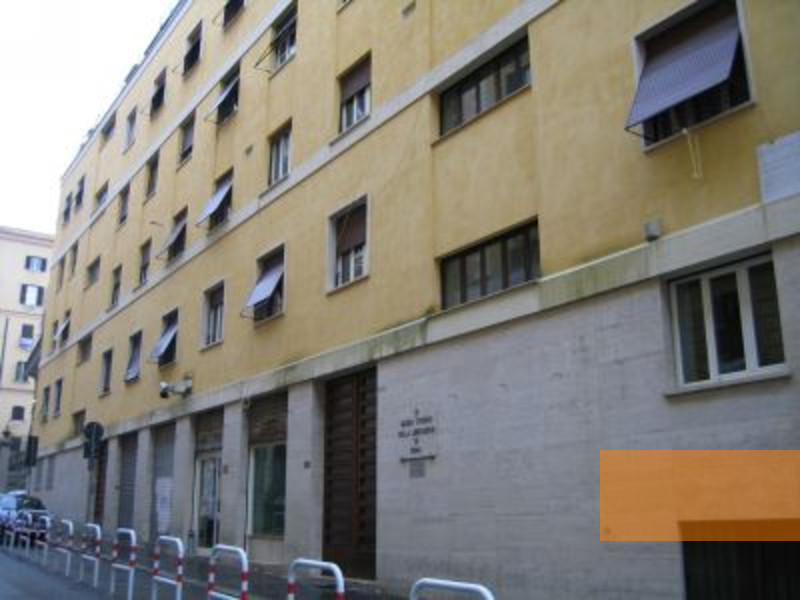
It was set up in 1954 into four apartments of the building which, in the 268 days of the Nazi occupation of Rome (11 September 1943 - 4 June 1944), was used as a prison by the command of the security police

The detention cells are still as they were left by the fleeing Germans and originally occupied the entire building and are now visible in two of the four apartments that the museum comprises

The building was built in the late thirties of the twentieth century for Prince Francesco Ruspoli who wanted to make apartments for rent

Eventually he rent it all to the German Embassy for its cultural offices and, during the fateful 268 days, it became a site of terror and death

The SS closed the windows with grates and brick and, under the command of the infamous Herbert Kappler, about 2,000 human beings in total were locked in tiny cells stacked like animals and tortured brutally

The prison at Via Tasso in Rome was regarded as “the antechamber of death”

After the Liberation of Rome the apartments were occupied by homeless people and in 1950 the Princess Josepha Ruspoli donated four of them to the Italian State with the obligation to turn them into a Liberation Museum to house objects and documents belonging or relating to victims

In the night between 22 and 23 November 1999 the Museum was the subject of a bomb attack of anti-Semitic nature. It did not cause disastrous consequences and it only caused damage to the windows of the apartments


First Floor


Conference room, Library and Archives
During the war this floor was used as the office of the Nazis


Second Floor


Prison itself: the rooms have remained, even in detail, exactly as the Germans, fleeing from Rome, left them. Same wallpaper, same windows bricked up, same grating on the doors of the various cells, same electrical system

CELL 1

Memories of the 335 Italians killed at the Fosse Ardeatine on March 24, 1944

CELL 2

Isolation cell with walls covered in graffiti made by prisoners

“Together with the upper floor, it is perhaps one of the most significant and poignant rooms in this museum. These rooms were the only two of the whole prison without wallpaper, and had plastered surfaces. More importantly, within them the prisoners were segregated individually. These, back from being questioned, alone with their anxieties and their tortured pain, carved on the wall, laboriously, with nails or fingernails, prayers, literary memories, trying to keep the sense of passing time, words of comfort for those who remained, important information for those who would continue to fight, the last wills waiting for death to which many were condemned” (Web site of the Historical Museum of Liberation - www.viatasso.eu)

CELL 3

It honors the seventy-seven Italians shot at Fort Bravetta

CELL 4

It is dedicated to the massacre of La Storta on June 4, 1944, the day of the Liberation of Rome, when fleeing Germans shot fourteen prisoners they had brought with them including the Italian MP Bruno Buozzi

Cell 5
Here was held prisoner the heroic Colonel of the Corps of Engineers Giuseppe Cordero Lanza di Montezemolo, head of the Clandestine Military Front

“For the duration of World War II he served in the operations office of the supreme command, of which he later became the head; on July 27, 1943, as a colonel, he was called to lead the secretariat of Badoglio, from which it split in not agreeing on his methods of leading the negotiations for the armistice. After September 8 he was at the side of the general Calvi di Bergolo as chief of the civil affairs bureau of the open city of Rome. Wanted by the Germans, he escaped capture and dedicated to the organization of the first clandestine military center in Rome” (Enciclopedia Treccani)


“He was tortured for days. The executioners tore his teeth one by one and then, just to make him talk, they continued with his nails. They broke his bones and he was whipped and beaten with chains. He resisted heroically, and even the Germans were impressed by his courage: 'Frankly, we were moved' Kappler said later” (Anthony Majanlahti and Amedeo Osti Guerrazzi)

The colonel, an authentic hero, one of the most courageous in the long history of Italy, while being aware of names and important facts, he never gave them out and he was brutally murdered at the Fosse Ardeatine

His name would deserve to be present in all the books of Italian history for school children


Third Floor


CELL 11

It was one of the torture chambers. On display there are prints and posters of the time

CELL 12

Isolation cell, like the one on the second floor. It holds the messages of those who were imprisoned

CELL 13

Collection of newspapers printed clandestinely

In a showcase there are the three-pointed nails used by partisans against German columns of trucks

There is also a touching and precious heirloom: a loaf of bread on which a prisoner before execution, recorded the words “coraggio mamma” (courage mother)

CELL 14

Flyers printed clandestinely

The first flag that waved on the tower of the Town Hall on Capitoline Hill at the liberation of Rome, on June 4, 1944

ROOM 1

Dedicated to the Jewish community of Rome, the oldest in Europe, dating back at least to the second century BC

1,022 Jews, including 221 children were deported to Auschwitz. Only seventeen returned alive, including a woman, and no children