Showing posts with label Virginio Vespignani. Show all posts

Monday, January 27, 2020

ROSSINI THEATER

TEATRO ROSSINI
Via S. Chiara 14

1874 Virginio Vespignani (1808/82)

Here were represented mainly shows in Roman dialect
It was closed in 1886 and reopened in 1950 by the will of Checco Durante, poet and actor who used to express himself in Roman dialect, and who directed the theater

Since 1990 the direction passed to Alfiero Alfieri, another talented actor specialized in Roman dialect
The theater originally had 600 seats, now reduced to 200 and it was renamed TEATRO ROSSINI - RENATO RASCEL in 2005

Friday, January 12, 2018

St.PANCRAS GATE

PORTA S. PANCRAZIO
1644 Marcantonio de Rossi (about 1607/61) military architect, father of the architect, Bernini's assistant, Mattia De Rossi, on the site of the ancient Porta Aurelia inserted in the circle of the Aurelian Walls
It is part of the Gianicolensi Walls built in the years 1642/44 for Urban VIII Barberini (1623/44) and Innocent X (1644/55)
It was destroyed by the French bombardment of 1849 and rebuilt in 1854/57 by Virginio Vespignani (1808/82) for Pius IX-Mastai Ferretti (1646/78)
It encloses a water tank in the upper part
Inside there is the small 
Museum of the Roman Republic and of Garibaldi's Legacy
It is an educational museum concerning the events of 1849 when it was proclaimed the Roman Republic that overthrew Pope Pius IX and was ruled by a triumvirate with Giuseppe Mazzini, Carlo Armellini and Aurelio Saffi
The Roman Republic fell following the siege of Rome by the French troops of General Oudinot, which began on June 3 and ended on July 2. Here was its main front culminated in the bloody battle of June 30
The museum was renovated in 2011 to mark the 150th anniversary of the Unification of Italy with busts, paintings, engravings, models, memorabilia of Garibaldi and educational material divided into six sections distributed over four floors of the building:
1) Riots in 1948. The years 1848/49
2) The reform policy of Pius IX
3) Rome; Republic; come! The birth of the Republic
4) Twenty-year old heroes. The young defenders of the Republic
5) The days of the siege
6) The Constitution of the Roman Republic

Tuesday, January 9, 2018

PIUS GATE

PORTA PIA
1561/65 by Michelangelo Buonarroti (1475/1564) for Pius IV Medici (1559/65), after the ancient NOMENTANA GATE of the Aurelian Walls at 75 m (246 feet) away, under which passed the ancient VIA NOMENTANA, had been walled up
Completed after Michelangelo's death by his followers Matteo Bartolani da Città di Castello (about 1527/about 1598) and Jacopo Del Duca (about 1520/1604)
“Coat of arms of Pius IV Medici” by Jacopo Del Duca with “Angels” by Nardo De Rossi, restored by Virginio Vespignani (1808/82)
The tools for barbers stylized in the decoration probably recall the profession of the Milanese family of Pius IV, namesake of the Florentine bankers
The marble was taken from the revetment of the Torre dei Conti, which in turn was taken from the Imperial Fora 
“Compared to the shrine of the Medici Chapel dating back some 40 years earlier, Michelangelo's forms have become even more complex, such as, for example, inserting a curved broken pediment in a triangular uninterrupted pediment. At the same time he shows great interest for the contrasts of texture in the composition, expressed in the smooth wall surfaces of the central part and the rough masonry of the side spans. The inventiveness he shows with the blind windows would be taken up and further developed by the seventeenth-century architects, such as Bernini and Borromini, who will owe a lot to the Roman works of Michelangelo” (Peter Murray)
1853/69 Virginio Vespignani (1808/82) who apparently was inspired by an engraving of 1568 that had to be close enough to the original plan by Michelangelo
In the niches “Statues of Sts. Agnes and Alexander” by Francesco Amadori (active in Rome 1836/67), placed by Vespignani at the will of Pius IX Mastai-Ferretti (1846/78) who wanted to remember the danger caused by the collapse of the roof's courtroom in the complex of St. Agnes, when he had visited it in 1855
The statues were damaged by shelling in 1870 and relocated here in 1929
During the skirmish on September 20, 1870 49 Italian Bersaglieri and 19 Papal soldiers were killed
In the rooms formerly used as Customs House there is the small
Historical Museum of the Bersaglieri
The Bersaglieri are a specialty corps of the Italian Army Infantry, famous for the plumed hat and to be the only military force in the world that in parades performs running and playing the trumpet
The corps was established in 1836 by Carlo Alberto of Savoy on the proposal of captain Alessandro La Marmora
The museum is currently closed for restoration
COURTYARD
Busts of the most distinguished representatives of the Bersaglieri Corps including the “Bust of Enrico Toti (1882/1916)”, a young Roman invalid (he had a leg amputated at the pelvis) who, despite his disability, volunteered for the First World War and was killed after he hurled his crutch against the enemy
LA MARMORA ROOM
“Bust of Alessandro La Marmora” founder of the Bersaglieri Corps and two rifles that he himself had invented
HALL OF HONOR
Various relics including the “Original Proposition” written by La Marmora himself to get from King Carlo Alberto the establishment of the corps
MEMORIAL
Dedicated to the more than 100,000 dead of the Bersaglieri
Saber of Alessandro La Marmora and his portrait
FIRST FLOOR
Memorabilia, documents and memories of the campaigns of the Risorgimento from 1848 to 1866
THREE ROOMS IN THE UPPER FLOOR OF THE SOUTH SIDE
Memorabilia relating to the colonial campaigns
FIRST FLOOR OF THE SOUTH SIDE
Memorabilia relating to the First World War, including the gun that killed at 16 hours on November 4, 1918 at Quadrivio di Paradiso (Crossroads of Heaven), the nineteen year old lieutenant Alberto Riva di Villasanta and his riflemen, the last men to die in the war
GROUND FLOOR OF THE SOUTH SIDE
Memorabilia relating to World War II
The museum also houses a HISTORICAL archive and a LIBRARY with material regarding, of course, the Bersaglieri Corps

Monday, December 12, 2016

PALACE OF THE STOCK EXCHANGE

PALAZZO DELLA BORSA
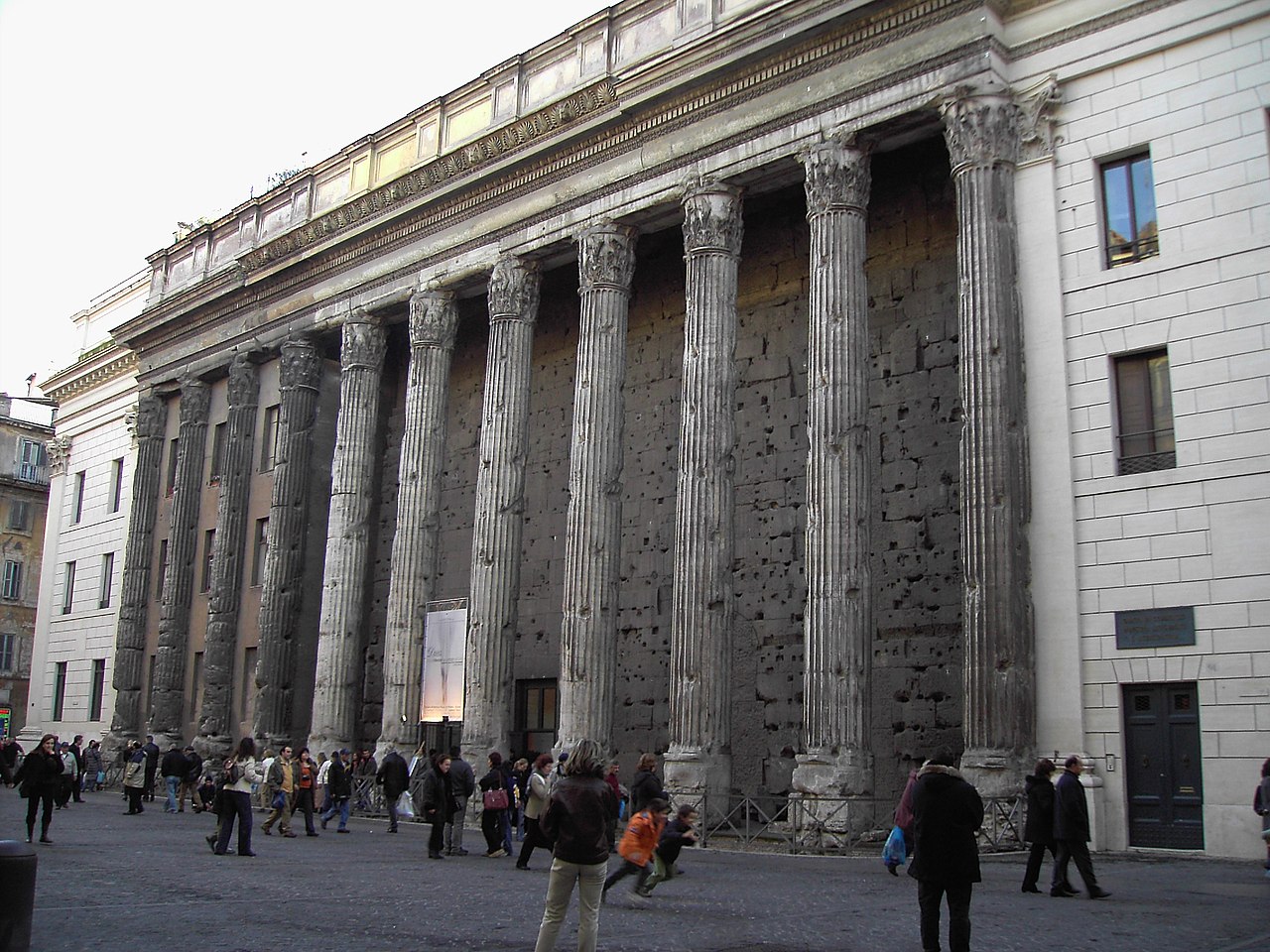
Temple of Hadrian transformed in 1695 by Carlo Fontana (1634/1714) and his son Francesco Fontana (1668/1708) in the headquarters of the Dogana di Terra (Land Customs Office) for Innocent XII Pignatelli (1691/1700)
Modified in 1879 by Virginio Vespignani (1808/82) to become the headquarters of the Camera di Commercio e della Borsa Valori (Chamber of Commerce and Stock Exchange)
Renovated in 1928 by Tullio Passarelli (1869/1941) who made the columns more visible
Tempio di Adriano
Temple of Hadrian
Embedded in the Palazzo della Borsa
Dedicated in 145 AD by Antoninus Pius (138/161) to his predecessor Hadrian (117/138)
Temple peripteral octastyle (surrounded by columns of which eight on the front) with thirteen columns on the long sides of which there are eleven left in white marble Proconnesian (Marmara Sea, Turkey) 15 m (49 feet) high on a podium of about 4 m (13 feet)
It was preceded by a staircase at the entrance on the east side that was facing towards the Via Lata, the present Via del Corso
Inside the building there are the remains of the coffered vault of the cella, the internal room
Embedded in the base inside the cella “Marble reliefs of provinces subject to Rome” were found, now in the courtyard of the Palace of the Conservatives, in Palazzo Massimo, and in the National Museum of Naples
“The formal and iconographic precedents date back to the ‘nationes’ of Pompey and even before, but conceptually the difference is substantial, because these are not peoples subjected by the victorious emperor, but the reality of the empire that surrounds the prince, and that at his death is symbolically present together with the Roman people, to assist him being accepted among the gods: no longer the Italy of Augustus, but an ecumenical conception of Rome and a first step towards the not so distant granting of the citizenship to anybody living in the provinces” (Francesca de Caprariis and Fausto Zevi)
Around the temple there was maybe a large ARCADED SQUARE of about 100 x 90 m (328 x 295 feet) with columns of yellow marble from Tunisia and on the side facing the Via Lata there was a MONUMENTAL ARCH which contained two reliefs, one now in Palace of the Conservatives and one in Palazzo Torlonia

Thursday, November 3, 2016

QUIRINAL PALACE (ninth part)

COFFEE HOUSE
1741 Ferdinando Fuga (1699/1782)
Two paintings in the room on the mezzanine:
“S. Maria Maggiore” and “Piazza del Quirinale with Palazzo della Consulta” 1742 by Giovanni Paolo Pannini (1691/1765), a brilliant landscape artist
“It differs from the objective views of Van Wittel for a taste for the theatrical and decorative and for his seemingly casual handling of figurative materials, often arbitrarily combined; but his views nevertheless are widely lucky with foreign travelers: in fact, although they are often invented, they can anyway manage to make alive again the memory of the impact with the grandeur of that historic fabric, the tingle of life, the space and the light of the city” (Carlo Bertelli, Giuliano Briganti, Antonio Giuliano)
Five paintings by Pompeo Batoni (1708/87) in the vault of the green room
Five works by Agostino Masucci (1691/1758) in the turquoise room
SCUDERIE DEL QUIRINALE
Quirinal Stables
Begun 1722 by Alessandro Specchi (1668/1729) for Innocent XIII Conti (1721/24) and finished in 1730 by Ferdinando Fuga (1699/1782) for Clement XII Corsini (1730/40)
Mutilation with removal of the semi-elliptical staircases by Fuga in 1866 by Virginio Vespignani (1808/82) for Pius IX Mastai-Ferretti (1846/78) to open Via della Dataria
The building was built on the spot where was the glorious Temple of Serapis used to stand. Some of the ancient structures are still visible
In 2000 it was redesigned by Gae Aulenti (1927/2012) as a museum for prestigious temporary exhibitions

Wednesday, May 4, 2016

CAPPONI ANTONELLI PALACE

PALAZZO CAPPONI ANTONELLI
Built in the sixteenth century for the Capponi, an important Florentine family
The exact date of construction and the architect are unknown
In the second half of the sixteenth century the property passed to the Casali family from Bologna
It was expanded in the seventeenth century
At the beginning of the nineteenth century it was bought by the Dall'Olio family for whom Virginio Vespignani (1808/82) did partial reconstruction in 1840 and designed the FAÇADE
Since the beginning of the twentieth century it belongs to the Antonelli family
The two buildings of the sixteenth and seventeenth century are joined by a transverse porch
In the GARDEN there are remains of ancient Roman structures and a beautiful fountain

Friday, November 22, 2013

CAMPO VERANO CEMETERY

CIMITERO MONUMENTALE DEL VERANO
1807/12 begun by Giuseppe Valadier (1762/1839)
Continued by Virginio Vespignani (1808/82) who also designed the great SQUARE PORTICO in 1880
It was enlarged until 1960
The name derives from the Verani family, an ancient Roman patrician family who used to own this area in the Republican period
Statues 1874/78 "Meditation" and "Charity" by Francesco Fabj-Altini (1830/1906), "Hope" by Stefano Galletti (1832/1905) pupil of Pietro Tenerani and "Silence" by Giuseppe Blasetti (1826/1908)
Among the monuments:
"Painter Tommaso Minardi" 1876 by Luigi Fontana (1827/1908)
"General Giacomo Medici" 1884 by Giulio Monteverde (1837/1917)
"Erminia Fuà Fusinato" 1876 by Stefano Galletti
On the small hill known as PINCETTO
"Monument to the pontifical soldiers fallen during the Mentana battle against the Italian army" by Vincenzo Luccardi (1808/76)
"Monument to the navy soldiers of the Sebastiano Veniero submarine" 1930 by Publio Morbiducci (1889/1963)
"Monument to the Roman soldier fallen during the First World War in the years 1915/18" 1922/31 by Raffaele De Vico (1881/1969)
CHAPEL OF St. MARY OF MERCY
Built in 1859
"Purgatory's souls" by Tommaso Minardi (1787/1871)

Thursday, November 14, 2013

CHURCH OF THE GOOD SHEPHERD

CHIESA DEL BUON PASTORE
1619 with the adjoining monastery for Cardinal Antonio Barberini, brother of Pope Urban VIII (1623/44)
It was entrusted to the Sisters of the Good Shepherd of Angers. They used to help women of "ill repute" who wanted to redeem themselves: raped minors whose parental rights had been entrusted to the guardianship court, young orphans forced into prostitution or former prisoners from the nearby Mantellate Prison
The monastery was enlarged by Virginio Vespignani (1808/82)
The original name was S. CROCE DELLE SCALETTE (St. Cross of the Ladders) or S. CROCE ALLA LUNGARA (St. Cross in Lungara Street)
It stopped being used as a church in 1979 and it is now owned by the municipality that established here the International Women's House
Interior modified in the nineteenth century
Right altar "Annunciation" and MAIN Altar "Crucifix" both by Francesco Troppa
Left altar "Magdalene" by Ciccio da Napoli (active 1680/1700)

Wednesday, November 13, 2013

CHURCH OF THE INFANT JESUS

CHIESA DEL BAMBINO GESÙ
1731/36 begun by Carlo Buratti (active from 1694/died after 1734) and completed after his death (1732) by Ferdinando Fuga (1699/1782) for Clement XII Corsini (1730/40) and for the Congregation of the Oblates Nurses of the Holy Child Jesus founded in 1671
Magnificent example of eighteenth-century artistic taste
"Fuga's intervention is recognizable in the attic, crowned with a broken pediment and the cross between two torches. (...) the dome divided into eight segments is by Fuga (...). To Fuga are also attributed the presbytery and perhaps even the design of the elegant balustrade. These addictions introduce a refined contrast between the rational rigor of the architectural form and the looseness decorative of details" (Sandra Suatoni)
Restoration and interior decorations 1882 by Andrea Busiri Vici (1818/1911)
There had been a previous project in the years 1708/10 by the great Alessandro Specchi who had begun working on the convent in 1913 designing the church central in the façade and not to the right as it is now
In the vestibule to the right
CHAPEL OF THE PASSION OF CHRIST
1856 juvenile work by Virginio Vespignani (1808/82) who later would contribute to decorations and refurbishing of many and important Roman churches
"Wooden statue of Jesus of Nazareth" early 1700s
In the niches "Statues of the four Evangelists" Stefano Galletti (1832/1905) pupil of Pietro Tenerani
In the spandrels "Prophets"
In the dome and vaults "Little angels bearing instruments of the Passion"
On the right "The Kiss of Judas" in 1855 and on the left "Flagellation" 1856 all painted by Francesco Grandi (1831/91) a pupil of Tommaso Minardi
"Grandi uses in the Kiss of Judas strong contrasts of light and shadow denoting a breach of the purists modules of his first training towards neo-Baroque" (Sandra Suatoni)
ON THE RIGHT - ALTAR OF St. AUGUSTINE
"St. Augustine triumphs over heresy" 1736 by Domenico Maria Muratori (1661/1742)
"The Emilian Muratori, along with other fellow painters from the same area (Giacomo Zoboli, Aureliano Milani), represented in the eighteenth century Rome a tradition of Bolognese culture, less successful than the prevailing style of the Maratta followers or 'barocchetto' (late baroque) style. This work belongs to the last period of his activity in large part guided by the recovery of the seventeenth-century representative models of Reni and especially Domenichino" (Sandra Suatoni)
MAIN ALTAR
"Adoration of the Shepherds" by an anonymous nineteenth-century artist (maybe G.B. Gagliardi nephew of Pietro Gagliardi) replacing the canvas of the same subject by Marco Benefial, considered one of his masterpieces, removed in 1883 and now kept in a room of the annexed kindergarten
In the vault "Baby Jesus" and in the spandrels of the dome "Four angels with scrolls" G.B. Gagliardi
ON THE LEFT - ALTAR OF S. ANDREA CORSINI
"Apparition of the Virgin to S. Andrea Corsini" 1783 by Giacomo Zoboli (1681/1767) from Modena for Cardinal Neri Corsini
CONVENT
Begun 1713 by Alessandro Specchi (1668/1729), In 1717 Carlo Buratti took over
Completed 1856/58 by Andrea Busiri Vici (1818/1911). The Via Cavour wing was completed in the years 1885/93
The priest PIETRO PAPPAGALLO was the spiritual father of the Oblate Sisters of the Holy Child Jesus here during the Second World War. He gave help and protection to soldiers, partisans and Jews sought by the Nazis and was killed at the Fosse Ardeatine March 24, 1944
His story was revived in the 1945 movie "Roma città aperta" (Rome, open city) by Roberto Rossellini who gave Don Pietro Pappagallo's role to Aldo Fabrizi. Only the scene of his death differs from his history having been inspired by that of Don Giuseppe Morosini shot at Fort Boccea
In 1998 the President of the Republic Ciampi awarded him the gold medal for civil valor. In 2000 John Paul II included him among the martyrs of the church of the twentieth century
A plaque commemorates him to the right of the façade of the church

Saturday, October 19, 2013

BASILICA OF St. MARY OF THE LITTLE ARCH

CAPPELLA DELLA MADONNA DELL'ARCHETTO
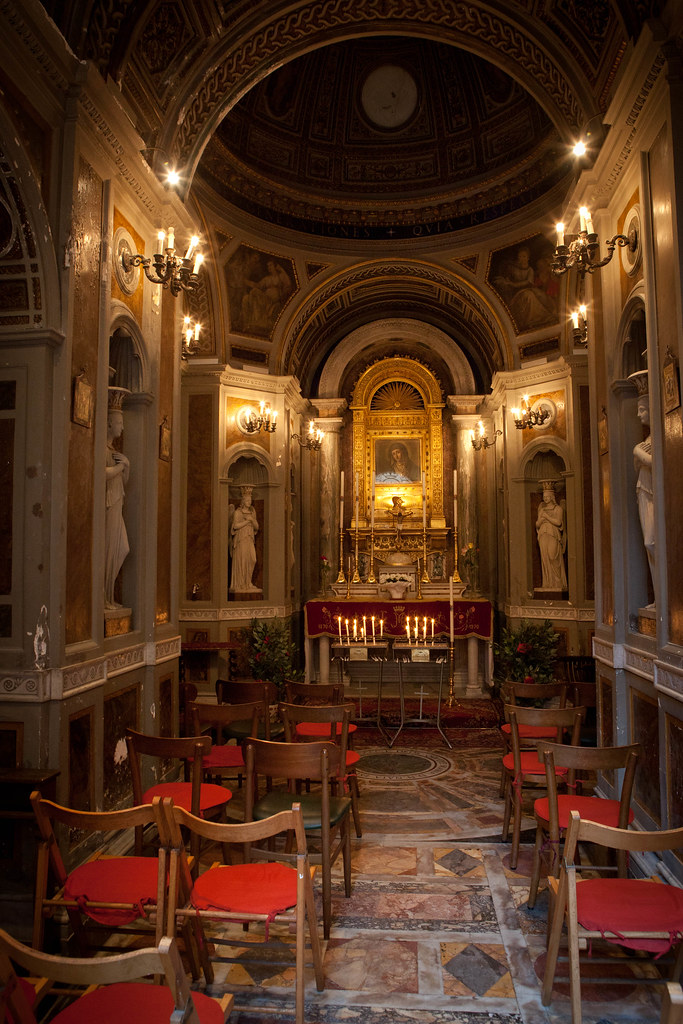
1851 Virginio Vespignani (1808/82) for Alessandro and Caterina Papazzurri to preserve an ancient image of the Virgin Mary formerly venerated under an arch nearby the palace of the marquis and marquess
The official name of the chapel is S. MARIA CAUSA NOSTRAE LAETITIAE
It is probably the smallest church in Rome
ALTAR
"Madonna causa nostrae letitiae" 1690 by Domenico Maria Muratori (1661/1742) on tiled stone. On July 9, 1796, many witnesses saw this picture of the Madonna rolling her eyes
DOME
Frescoes in the middle "Immaculate Conception", in the spandrels "Innocence, Wisdom, Prudence and Fortitude" 1851 by Costantino Brumidi. He later went to Washington and painted for 25 years on Capitol Hill
Costantini Brumidi was generously described by Nancy Pelosi, Speaker of U.S. House of Representatives, as "Our Michelangelo"

Saturday, September 28, 2013

BASILICA OF St. MARY IN TRASTEVERE

BASILICA S. MARIA IN TRASTEVERE
Maybe it was the first church in Rome officially opened for worship being active since the Severian period (193/235)
According to tradition it was founded in about AD 220 by Pope St. Callistus (217/222) as TITULUS CALLISTI on the area of a so-called taberna meritoria, a meeting place for milites emeriti, retired soldiers and veterans
In this place an eruption of mineral oil from underground occured in 38 BC: this event is mentioned by Dio Cassius and St. Jerome and it was interpreted by Jewish people as the announcement of the Messiah
It was rebuilt by Julius I (337/352) with the name TITULUS CALLISTI ET JULII
 St. Damasus (366/384) was the first one to describe it as basilica. His supporters had killed 137 supporters of the titular bishop of the church Ursino
It was modified in the late eighth century when it is mentioned as Sancta Maria Transtiberis
Renovated in early and mid-ninth century by Benedict III (855/858) after the earthquake of 847
It was completely rebuilt 1138/48 by Innocent II Papareschi (1130/43) with material from the Baths of Caracalla, including granite columns and capitals, although the Isis images and references had some scholars believe that they would have come from the Iseo Campense, the temple dedicated to the Egyptian goddess Isis in the Campus Martius, where the church of S. Stefano del Cacco now stands
EXTERNAL APSE with blind arches and windows with original architectural solution
SIDE CHAPELS 1580/85 by Martino Longhi il Vecchio (1534/91)
FRONT PORCH 1702 rebuilt and modified in late Baroque style by Carlo Fontana (1634/1714) for Clement XI Albani (1700/21)
The basilica was restored in 1866/77 by Virginio Vespignani (1808/82) for Pius IX Mastai-Ferretti (1846/78). During that restoration the upper façade was brought back to its original medieval look
Mosaic on the façade "Madonna enthroned with two donors and two lines of women" maybe representing the Parable of the wise and foolish virgins or Saints with the holy flame symbol of faith: seven central figures first half of thirteenth century, three figures on the right late thirteenth century, three figures on the left beginning of fourtheenth century
The almost disappeared frescoes were painted in the second half of 1800 by Silverio Capparoni (1831/1907)
Statues of popes from left to right of "Sts. Callistus, Cornelius, Julius and Calepodius" 1702 by Jean-Baptiste Théodon (1646/1713), Michel Maille aka Michele Maglia (active in Rome in the second half of the seventeenth century), Lorenzo Ottoni (1648/1736) and Vincenzo Felici (noto 1667/1702)
On the BELL TOWER of the first half of thirteenth century small late Medieval mosaic "Madonna and Child"
Exterior columns in Egyptian granite
Fragments of marble sarcophagi from the catacombs, including:
"Figure of a child praying called Maximinus" who died at 9 years and 7 months
"Tombstone of Cocceius" imperial freed slave who claims to have never quarreled with his wife in a happily married life during 45 years and 11 days: obviously he was either a liar or a world record holder!
The door was used from 1625 as a replacement door for the Holy Door of the Basilica of St. Paul at times when the latter was unusable for floods of the nearby River Tiber
FLOOR
Cosmatesque but almost entirely rebuilt by Virginio Vespignani
COFFERED WOODEN CEILING
1617 by Domenico Zampieri aka Domenichino (1581/1641) for Cardinal Pietro Aldobrandini. Domenichino also painted the "Assunta" in the octagon at the center of the ceiling
Twenty-two extraordinary ancient Roman columns divided into two files. On some capitals attributes and objects belonging to the Isis cult as well as figures of Isis, Serapis and Arpocrate
"In a kind of neoclassical purism, the lintel on Ionic columns reappears, an experiment already made in small size buildings such as S. Crisogono and that will be taken up in S. Lawrence outside the Walls. In all buildings mentioned just now the porch entrance reappeared and above all, the mosaics in the apse and the façade, and, on the ground, the magnificent marble floors. Nothing recalls the architecture of the North, all the masses, walls, vaults, carved ornaments: here the traditional polychrome stones are used and fresco and stained glass windows that animate shrines elsewhere are unknown" (André Chastel)
COUNTER-FAÇADE
Windows with "St. Julius", "St. Callistus" and "St. Cornelius" painted using fire in the second half of ninteenth by Antonio Moroni (1825/86) and designed by Francesco Grandi (1831/91)
ON THE WALLS AT THE TOP BETWEEN THE WINDOWS
"Sixteen Saints" by several nineteenth-century painters including:
On the right "S. Francesca Romana" Cesare Fracassini (1838/68), "St. Apollonia" Francesco Grandi (1831/91), "S. Biagio" Silverio Capparoni (1831/1907), "St. Gregory" Enrico Chiari
On the left "S. Dalmazio" Giuseppe Sereni (1823/after 1888), "S. Rufina" Luigi Fontana (1827/1908) and "St. Bridget" Cesare Mariani (1826/1901)
TRIUMPHAL ARCH
Fresco "Virgin and Child, four angels, Noah and Moses" by Francesco Coghetti (1801/75)
At the beginning of the nave marble "Tabernacle" fifteenth century by Mino del Reame
1st RIGHT - S. FRANCESCA ROMANA CHAPEL
Her real name was Francesca Bussa de' Leoni (1384/1440) born from a noble family in Rome near Piazza Navona. She came to live in Trastevere when she was 12 years old after her marriage to a member of the noble Ponziani family who became rich working as butchers
The chapel was designed and executed in the years 1721/27 by Giacomo Onorato Recalcati and completed by Francesco Ferrari (active in Rome 1721/44)
On the altar "S. Francesca Romana" by Giacomo Zoboli (1681/1767)
On the side walls "Monument for the Bussi family" by Francesco Ferrari (active in Rome 1721/44) and "Bust of the archeologist G.B. De Rossi"
2nd RIGHT - NATIVITY CHAPEL
1739 by Filippo Raguzzini (1680/1771)
On the altar "Nativity" 1739 by Etienne Parrocel (1696/1774)
3nd RIGHT - CHAPEL OF THE LADY OF SORROWS
1652 for Cardinal Francesco Cornaro with "Wooden Cross" of the fifteenth century
Polychrome wooden "Head of Our Lady of Sorrows" maybe by the school of Bernini
4th RIGHT - St. PETER'S CHAPEL
Maybe end of sixteenth century by Martino Longhi il Vecchio
On the right "Cenotaph of Francesco Longhi" who died in 1838 by Rinaldo Rinaldi (1793/1873)
BETWEEN THE 4th CHAPEL AND THE EXIT
"Cenotaph of Cardinal Pietro Marcellino Corradini" 1745 by Francesco Ceroti; oval with bust by Filippo Della Valle (1698/1768)
Niche with weights and chains, traditionally referred to the torture of the martyrs; a weight is believed to be the one that was tied to the neck of S. Callistus to drown him in the well still existing in the garden of the nearby convent bearing the same name of the saint
RIGHT END OF THE TRANSEPT
"Cenotaph Cardinal Francesco Armellini Medici" 1524 maybe by Andrea Contucci aka Andrea Sansovino (1460/1529 or Michelangelo Senese a follower of Baldassare Peruzzi: he died of a broken heart after the sack of Rome in 1527 and this tomb had been prepared remained empty, having been hastily buried in S. Maria Traspontina
CHAPEL OF THE WINTER CHOIR
1625 by Domenico Zampieri aka Domenichino (1581/1641) who also painted the putto spreading flowers
"Madonna di Strada Cupa" maybe by Pietro Bonaccorsi aka Perin del Vaga (1501/47) found in a vineyard on the Gianicolo in a street called Cupa
On the left "Flight into Egypt" by Carlo Maratta (1625/1713)
On the right "St. John the Baptist" maybe Antonio Carracci (about 1589/1618) son of Annibale
Frescoes on the pediment "Dove of the Holy Spirit" by Paris Nogari (about 1536/1601)
"Ciborium" Virginio Vespignani
"Paschal Candlestick" thirteenth century by members of the Vassallettos' workshop
In the apse mosaics about 1144 for Innocent II Papareschi (1130/43) with "Christ Enthroned with the Virgin whom he embraces; on the right Sts. Peter, Cornelius, Julius and Calepodius; on the left Sts. Callistus, Lawrence and Pope Innocent II"
On the arch "Prophets Jeremiah (he predicted that Jesus would have died for the sins of humankind) and Isaiah (he prophesied that a Virgin would bear a son), symbols of the Evangelists and seven candlesticks of the Apocalypse"
These mosaics celebrate the end of the schism in 1138: it had lasted eight years and resulted in the Second Lateran Council of 1139
"The characters around the throne of Christ have in common the struggle they have incurred during their lives against schisms and heresies. This analogy demonstrates, along with all the images in the apse illustrating fateful moments of the divine plan for man's salvation of which the church is custodian, that the ecclesiastical unity, although troubled by the mistakes of men, has always been reconstructed thanks to the divine will and through the intercession of the Virgin" (Cristina Marchei)
Between the windows mosaics "Six stories of the Virgin": from left "Nativity of Mary", "Annunciation", "Birth of Jesus" (with a small representation of the taberna meritoria with the oil eruption), "Adoration of the Magi", "Presentation of Jesus at the Temple", "Death of Mary"
At the center "Madonna and Child with Sts. Peter and Paul with the little Cardinal Bertoldo Stefaneschi" 1291 by the great Pietro de 'Cerroni aka Pietro Cavallini (about 1240/1325) commissioned by the Cardinal Bertoldo Stefaneschi brother of the Cardinal Jacopo Stefaneschi who commissioned Giotto to paint the Triptych for St. Peter's altar, now in the Vatican Museum
"Compared to Jacopo Torriti's figures in S. Maria in Trastevere, the ones by Cavallini, although just as dense and full, are covered with softer and heavy draperies and they move dramatically into a realistic space if limited, suggested by the fact that the action takes place diagonally, in depth, and that the landscape and architectural scenes seem to penetrate the gold background. While Torriti merely suggests reality, Cavallini makes it credible; however his scenes too, such as those of Torriti, find parallels and maybe even models in the refined art that for some time had emerged in some of the major Byzantine centers" (Richard Krautheimer)
"The classic Roman style reached a new summit of courtly composure; it is interpreted through the exaltation of the striking color tones and the chromatic vibration. New evidence is the soft emergence of plastic figures and the attention to the sense of depth resulting" (Carlo Bertelli, Giuliano Briganti, Antonio Giuliano)
Above the choir stalls frescoes "Angels with symbols of the mysteries of Mary" 1600 Agostino Ciampelli (1565/1630) for Cardinal Alessandro de' Medici
"Cathedra" of the twelfth century
ALTEMPS CHAPEL
1584/85 by Martino Longhi il Vecchio for Cardinal Marco Sittico Altemps, nephew of Pius IV Medici (1559/65) and titular of the Basilica from 1580 to 1595 during the general renovation
Beautiful stuccoes by Pompeo Dell'Abate gilded by Giovanni Capitio and Giovanni Antonio da Varese
Frescoes on the ceiling and walls on the left "Session of the Council of Trent 1545/1563", on the right "Approval of the acts of the Council" Pasquale Cati (1537/1612)
"The representations in fresco by Pasquale Cati were made according to the scheme of the ceremonial paintings by Zuccari and are pleasant in their coloring. The ceiling, very harmonious in the overall decorative effect, has a layout similar to that of the Mattei Chapel by Taddeo Zuccari, and also the individual scenes from the life of Mary point to the same model with regard to the composition. The double portrait of Pius IV and of Cardinal Altemps above the altar is quite original" (Hermann Voss)
Over the altar famous "Madonna of Mercy" sixth or seventh century icon painted with encaustic tecnique on linen mounted on cypress wood. It is considered to be acherotipa, which means "not done by human hands". It is believed that it saved Rome from famine caused by drought in 1659
EFT END OF THE TRANSEPT
To the right "Tomb of Cardinal Pietro Stefaneschi" who died in 1417 Magister Paulus
At the center "Tomb of Robert Altemps" who died in 1586 with statues in the pediment by Giovanni Antonio Parracca aka Valsoldo (?/1642-46)
On the left "Tomb of Cardinal Philippe d'Alencon" who died in 1397 maybe by Giovanni d'Ambrogio (active 1366/1418)
vestibule of the sacristy
Two fragments of ancient Roman mosaics: "Riverbirds" and "Fishing Scene" of the beginning of first century AD from Palestrina
SACRISTY
Rebuilt in 1483
Renewed by Francesco Carlo Bizzaccheri (1655/1721)
"Madonna with St. Roch and St. Sebastian" by the Umbrian school of the sixteenth century
5th LEFT - AVILA CHAPEL
1680 masterpiece of the great but underrated Antonio Gherardi (1638/1702) for Pietro Paolo Avila, influenced by Borromini and with illusionistic dome supported by four angels in plaster
It has been described as "one of the most complex and unique Roman monuments"
Over the altar "St. Jerome" 1686 also by Antonio Gherardi
"Antonio Gherardi was among the first to seek a synthesis between the spatial vision of Borromini and Bernini's taste for the total show. The lantern supported by angels, which develops a Bernini's theme, is coupled with a search of spatial units placed one inside the other using indirect light" (Antonio Portoghesi)
4th LEFT - CHAPEL OF THE SACRED HEART OF JESUS
"Sacred Heart" by Francesco Gagliardi
BETWEEN 4th AND 3rd CHAPEL
"Tomb of Innocent II Papareschi (1130/43)" 1869 by Virginio Vespignani in classicist style
3rd LEFT - St. FRANCIS CHAPEL
Restored by Pietro Camporese who also designed the pavonazzetto marble balustrade
Paintings in the vault and altarpiece "St. Francis receives the Stigmata" by Ferraù Fenzone (1562/1645)
2nd LEFT - CHAPEL OF DIVINE LOVE
Copy of the 1956 image of Our Lady of Divine Love (Madonna del Divino Amore) in Castel di Leva
1st LEFT - BAPTISTERY
1741 by the great Filippo Raguzzini (1680/1771)
Under the floor of the chapel, during a restoration in 1920, archeologists found the remains of a Roman house with traces of wall paintings