S. MARCELLO AL CORSO
Dating back
to the late fourth century and mentioned in the sources since the year 418 as TITULUS
MARCELLI
The Pope
Marcellus (308/309) was forced by Maxentius (306/312) to serve in the CATABULUM
(headquarters of the organization of public transport) that used to be located
in this area and his body was later moved in this church at the end of the
eight century or at the beginning of the ninth
Rebuilt in
the twelfth century
From 1368
it was assigned to the Servants of Mary or Servites who still
officiate it today
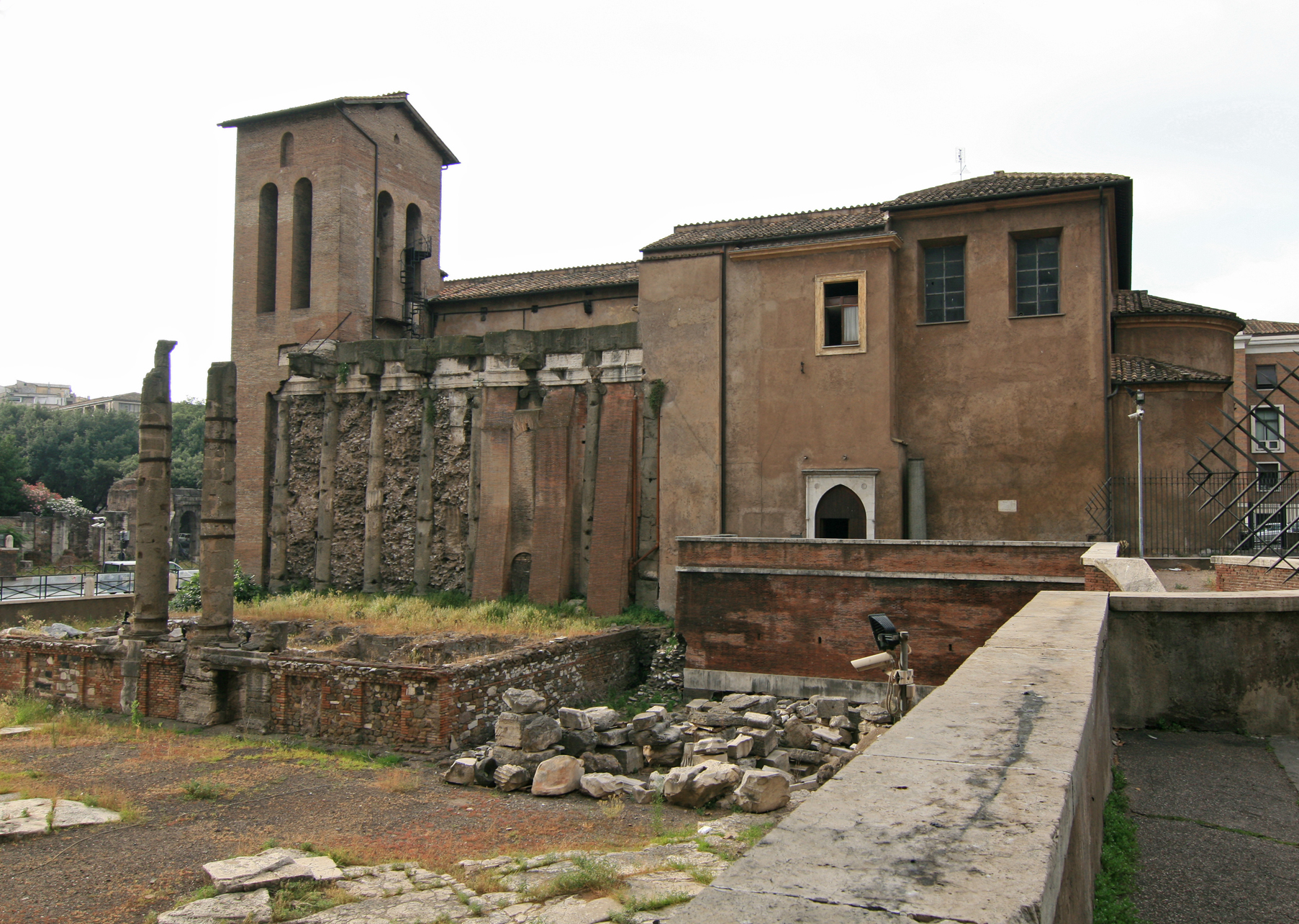
It was
destroyed in 1519 by a fire that spared only the outer walls and a wooden
crucifix which was therefore revered as miraculous
Reconstruction
began in 1519 with a project by Jacopo Tatti aka Jacopo
Sansovino (1486/1570), who was replaced in 1527 by Antonio Cordini aka Antonio da Sangallo the Younger (1483/1546) and Annibale Lippi (active in Rome the second half of the
sixteenth century)
With this
reconstruction the orientation of the church was reversed and the entrance was
moved from Piazza Ss. Apostoli to Via del Corso
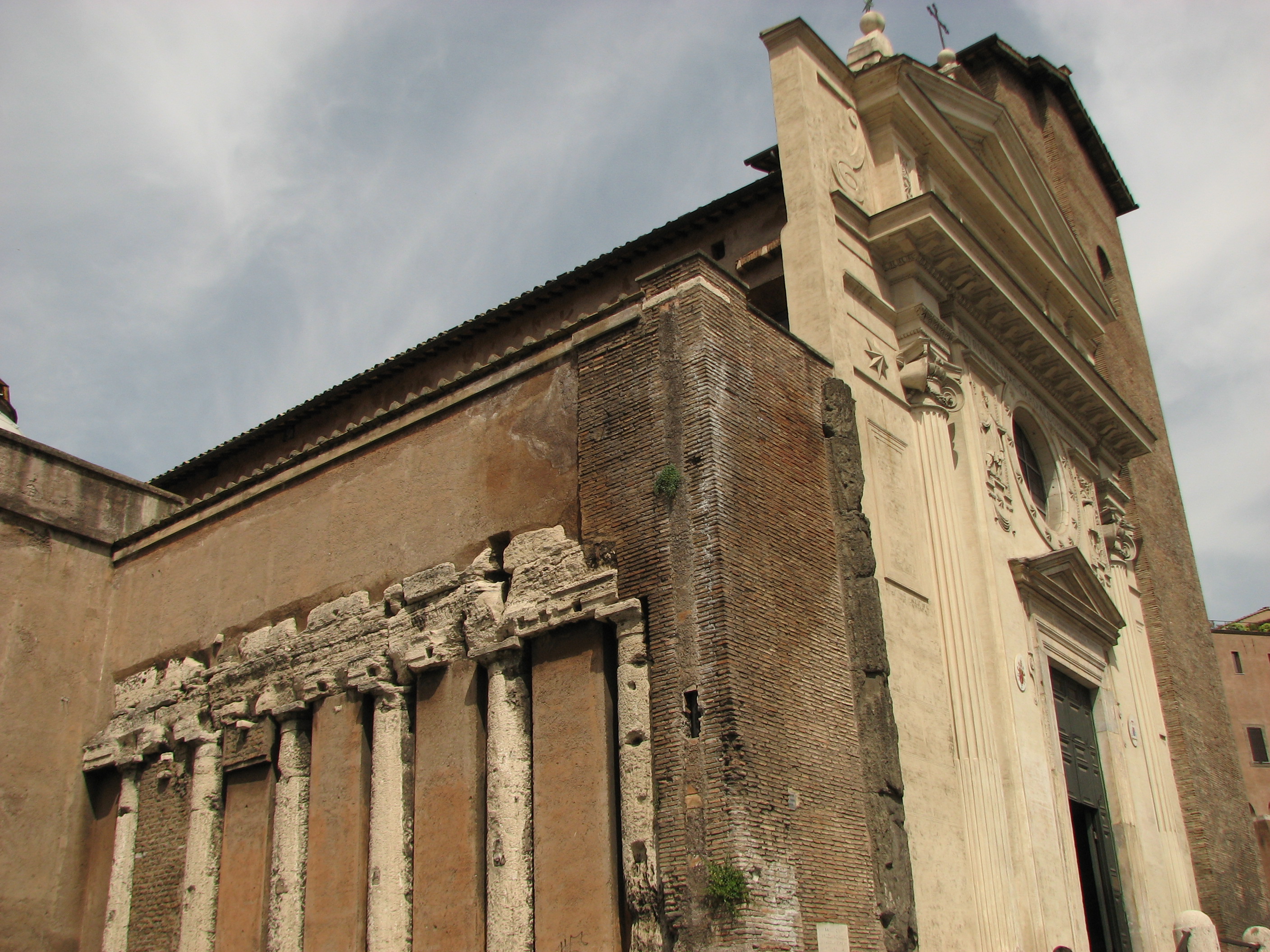
Finished in 1592
1682/86 masterpiece by Carlo Fontana (1634/1714)
“The façade
is a free interpretation of the examples of his teachers Gian Lorenzo Bernini
and Carlo Rainaldi. Slightly concave, the front has a lively articulation: the
two side wings give the structure elasticity, underlined by the imaginative
portico with free columns and pediment with spirals. The pictorial qualities of
the architecture derive instead from the plastic elements of nature, such as
palm leaves, connecting the two side wings and the median body, and the fan at
the center of the aedicula of the second order” (Carlo Bertelli, Giuliano
Briganti, Antonio Giuliano)
“The design
of the aedicula gives the impression of being removable and gives to its
superstructure - the broken pediment with the empty picture frame - its scenic
quality. The principle used here corresponds to that of theatrical wings not
connected, a principle that is foreign to the structures of the Roman Baroque,
but inherent to the classicism of the late Baroque” (Rudolf Wittkower)
Sculptures
in the lower part “St. Marcellus” and “St. Philip Benizi” 1686 by Francesco Cavallini (active 1672/1703)
Sculptures
in the upper part “Blessed Gioacchino Piccolomini”, “Blessed Francesco Patrizi”
and, on the pediment, “Faith” and “Hope” 1701/03 by Andrea
Fucigna (about 1660/1711)
Decoration
continued until the eighteenth century
Restoration
1861/67 by Virginio Vespignani (1808/82) and
1923
1592/97 Carlo Lambardi (1545/1619)
Decorated
by G.B. Ricci (about 1550/1624) and repainted by
Virginio Vespignani
Cardinal
Giovanni Michiel was killed with poison in 1503 by members of the Borgia
family. The volumes
represented in the work allude to the 370 codes that the Cardinal gave the
library of the convent
On the
altar “Annunciation” by Lazzaro Baldi (about
1624/1703)
In the
upper part “Madonna and Child” of the fifteenth century possibly from the old
church
In the
vault “Colonnade foreshortened with putti” about 1605 by Tarquinio Ligustri (about 1563/1621)
Wooden
group “Pieta”
of the end of the seventeenth century, derived from a painting by Annibale
Carracci
“It's
interesting because it was conceived to be part of a processional apparatus for
the transport, in particular festive occasions, of the miraculous Crucifix. The
processional wagon was rebuilt to a design by Francesco Carlo Bizzaccheri, on
the occasion of the Holy Year 1700. Filippo Leti was responsible for the
lighting apparatus, consisting of four large lights, and several smaller ones.
A riot of leaves and garlands, angels, lilies, candles, the Caetani family coat
of arms, who had paid for rebuilding the machine, on top of the imperial crown
with many jewels, as well as fragrances that wafted in its path, gave rise to a
real touring show” (Francesca Aloisi)
On the side
pillars “Sts. Peter, Paul, Ursula and Giacinta Marescotti” by Silverio Capparoni (1831/1907)
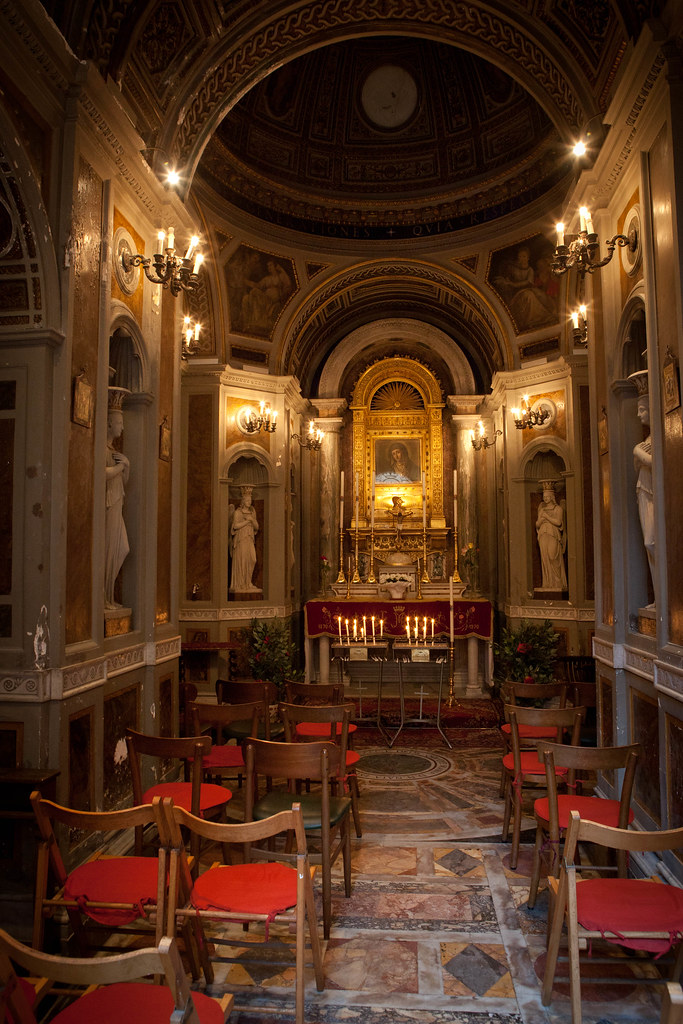
About 1725
by Francesco Ferrari (active in Rome 1721/44)
On the
altar “The Martyrdom of Sts. Degna and Merita” 1727 by Pietro Barbieri (1684/1730), pupil of Carlo Maratta
Vault “Glory
of the Sts. Degna and Merita” by Ignazio Stern
(1679/1748)
On the
walls “Monuments of Maria Colomba Vincentini and Giovanni Muti” 1725 by Bernardino Cametti (1669/1736)
“The entire
chapel forms a unity of color and light of airy architectural character and the
new spirit of the eighteenth century is perfectly expressed by the graceful
elegance of the faithful behind the pews just as the spirit of the seventeenth
century was expressed by devotees in deep mystical contemplation” (Rudolf
Wittkower)
PILLAR
BETWEEN THE 2nd AND 3rd CHAPEL ON THE RIGHT
“Pulpit”
maybe by Mattia De Rossi (1637/95), pupil of
Bernini, or by the sculptor Giovanni Mattia De Rossi
Under the
pulpit “Angel” by Pietro Paolo Naldini (1619/91)
Altarpiece “Madonna
with Child” of the beginning the fourteenth century by an anonymous Roman painter
“Very
interesting fresco of the very early fourteenth century, by a Roman painter
updated on models of Assisi and Giotto” (Francesca Aloisi)
There is
also the story of the Purification, rarely represented
In the
vault frescoes with “Life of the Virgin Mary” by G.B.
Ricci (about 1550/1624)
“Funeral
Monument of Bishop Matteo Grifoni” by Stoldo Lorenzi
(about 1533-34/1583)
Bishop Matteo
Grifoni had commissioned the decoration of the chapel in 1519 to the young
Pietro Bonaccorsi aka Perin del Vaga (1501/47).
Of his work the only trace left are perhaps the two angels holding the crown of
the Virgin Mary
The tomb of
the bishop was placed here only in 1651
UNDER THE
GRIFONI CHAPEL
CRYPT OF
LORD HUGH CHARLES CLIFFORD 1837/38 by Agostino
Giorgioli with “Four marble reliefs” in the lunettes, two statues of “Angels”
and “Crucifix” in alabaster by Costantino Brumidi
(1805/80), among of the few works of sculpture of the Roman artist
Costantino
Brumidi was primarily a painter and, after his involvement in the events of the
Roman Republic of 1848, he went to America and painted for 25 years the U.S.
Capitol in Washington
“Wooden
crucifix” of the fifteenth century
It was
believed to be miraculous in 1519 when it remained intact after a fire that
destroyed the church and after the plague of 1522 was believed to have ceased
as a result of its presence in a procession
This event
led to the founding of the Brotherhood of the Holy Cross and the construction
of the nearby Oratory of the Most Holy Crucifix
The
crucifix is kept in a tabernacle with paintings on the door “Angels supporting
the Cross” by Luigi Garzi (1638/1721)
“Ciborium” in semi-precious stones 1689/91 by Francesco Carlo Bizzaccheri (1655/1721)
Under the
table “Memorial stone” of the third century AD, reworked in the twelfth
century, flanked by Roman military insignia (eagles). It was found in 1909. The
opus
sectile (inlaid marble) in the frontal dates back to the
twelfth century
To the
right “Monument of Cardinal Carlo Grano” d. 1977 by Tommaso
Gismondi (1906/2003)
In the
vault frescoes “Creation
of Eve”, Evangelists “Mark” and “John” by Pietro Bonaccorsi
aka Perin del Vaga (1501/47) who also began “Matthew”
and “Luke” finished by Daniele da Volterra
(1509/66)
The
frescoes were begun in the years 1525/27, interrupted for the sack of Rome in
1527 and then completed only between the years 1540/43
“For the
design and the compositional layout of this difficult work Perin del Vaga was
inspired both by the fresco on the ceiling of the Sistine Chapel and by the
little scenes of the Vatican Loggia. From Michelangelo the figure of Eve, who
turns to the creator with a gesture of adoration, from Raphael the figure of
the Father, whose profile shows some vigorous drawing. Quite peculiar and
extremely convincing the young and slim figure of Adam, lying on the ground in
a deep state of unconsciousness. The figures of the Evangelists have a purely
decorative purpose. They blend in with each other in the amplitude of the
relief pattern typical of Perin del Vaga; the rhythms of the robes rustle
solemnly around their well-proportioned bodies” (Hermann Voss)
5th
RIGHT - CHAPEL OF S. PELLEGRINO LAZIOSI
1725 Ludovico Rusconi Sassi (1678/1736)
On the
right “Monument of Cardinal Fabrizio Paolucci” by Pietro
Bracci (1700/73)
On the left
oval marble with “Portrait of Cardinal Camillo Merlini Paolucci”, supported by
putti, 1776 by Tommaso Righi (1727/1802)
1569 Annibale Lippi (active in Rome the second half of the
sixteenth century), modified by Virginio Vespignani
(1808/82)
In the
altar there are the bodies of St.
Marcellus and S. Foca martyrs
Apsidal
basin “Stories
of the Life of the Virgin Mary” and “Prophets”, under-arch and “Saints”
between the windows by G.B. Ricci (about
1550/1624), retouched by G.B. Polenzani who
painted the four saints in the lower part
Wooden
choir 1642
5th
LEFT - CHAPEL OF S. PHILIP BENIZI
On the
right “Funeral of St. Philip Benizi”, on the left “Miracle of bread” and on the
pillars “Saints” 1642 by Bernardino Gagliardi
(1609/1660)
On the
right “Funeral Monument of Francesco Dandini de Sylva” 1918 by Ercole Tadolini
Vault and
sides with “Stories of St. Paul” by Taddeo Zuccari
(1529/66) begun in 1558 and completed after his death by his younger brother Federico:
On the left
“Blinding of Elymas”
On the
right “Healing of a cripple”
In the
vault “Shipwreck in Malta”, “Martyrdom of St. Paul” and “Resurrection of
Eutichio”
Under-arch “Doctors
of the Church”
Three round
panels with “St. Peter”, “St. Paul” and “St. John”
On the
pillars “Two prophets” and “Two Saints”
“The
retrospective classicism of Taddeo Zuccari, who in addition to Raphael also
looks to the art of Michelangelo and Sebastiano del Piombo, is supported by
genuinely manneristic pulses towards a complex structure and a refined
calligraphy, just like in the Stories of St. Paul (...). His formal
elaboration, however, tends to a clear and refined narrative style”
(Enciclopedia Treccani)
“Algardi was
respected and admired in his time as a major rival of Gian Lorenzo Bernini, and
was also later considered the most representative and almost the symbol, for
sculpture, of the so-called classicist and traditionalist current of the
seventeenth century, which was a current of a taste very representative of that
century, full of vital energy, of sincere and genuine interests and motives. So
his work is to be considered valid by itself, for the intrinsic dignity and
quality, even considering the predominant genius of Bernini. Through the
important activities of his vast following, his influence was exercised for a
long time and throughout the eighteenth century” (Antonia Nava Cellini -
Dizionario Biografico degli Italiani Treccani)
The three
busts on the left “Antonino and his sons Curzio and Mario” are by an anonymous sixteenth-century sculptor
1762
designed by Zenobio del Rosso
On the
sides “Sacrifice of Isaac” and “Finding of Moses” 1762 by Domenico Corvi (1721/1803) from Viterbo
Vault “Presentation
in the Temple” by Antonio Bicchierai (1688/1766)
2nd
LEFT - CHAPEL OF St. MARY MAGDALENE
On the
altar “St. Mary Magdalene” by Giacomo Triga
(1674/1746), pupil of Benedetto Luti
On the
right “Blessed Gioacchino Piccolomini” by Giuseppe
Tommasi (1610/72) from Pesaro
Vault
painted about 1550 by Francesco di Michelangelo del
Colle, who completed the work begun by the Flemish Lorenzo da Rotterdam
On the
altar “Madonna and the Seven Holy Founders of the Servites” by Agostino Masucci (1691/1758)
On the
right “Jesus fallen on Golgotha”, on the left “Transportation
to the tomb” and lunette with “Crucifix, Our Lady and St.
John” by Pietro Paolo Naldini (1619/91)
CHAPEL
BEFORE THE COUNTER FAÇADE
1954
designed by Arnaldo Brandizzi
SACRISTY
1661 walnut
wood furniture of the late seventeenth century
Vault “Glory
of S. Marcellus” and on the sides “Medallions with Cardinal Virtues” 1690 by
the Florentine G.B. Ciocchi
On the back
wall “Crucifix” maybe by Antoon Van Dyck
(1599/1641)
In a niche “Christian
Sarcophagus with Adoration of the Magi and Original Sin” of the fourth century
AD
BAPTISTERY
Discovered
in 1912. It is among the few remaining in Rome for the ritual with full
immersion
The
tank is perhaps of the eighth century AD with some remains of the fifth century
AD