Showing posts with label Giacomo Della Porta. Show all posts

Thursday, August 6, 2020

ALDOBRANDINI VILLA

VILLA ALDOBRANDINI

Via Mazzarino 11

End of 1500s by Carlo Lambardi (1545/1619) for the Vitelli family who had bought the preexisting building with land in 1566 from the Genoese family Grimaldi

It was bought in 1601 by Clement VIII Aldobrandini (1592/1605) who gave it to his nephew Cardinal Pietro Aldobrandini and had it restored in the years 1601/02 by Giacomo Della Porta (1533/1602)

Here used to be kept a huge collection of paintings and ancient statues including the “Aldobrandini Wedding” now in the Vatican Museums

“The area where the villa was built has played a leading role since the second half of the sixteenth century, in relation to the arrangement of the Roman road ‘Alta Semita’ (High Semite) promoted by Pius IV (1559/65), completed in 1561, symbol of the 'salus publica' (public health) given back to the city by the pope. The renewal of the street gave impetus to the construction of new gardens, usually arranged by clients who delighted in antiquarian research, and in this way would recover the Renaissance scholarly tradition of this hill linked to the activities of Pomponio Leto (1425/98)” (Carla Benocci - Verdi Delizie, le ville, i giardini, i parchi storici del Comune di Roma)

In the third decade of the 1700s Gabriele Valvassori (1683/1761) was in charge of the maintenance of the garden, and designed the appearance appropriate to the French taste of the time

In 1811 the property passed to Count Alexandre François Sextius Miollis, General of Napoleon

“The Count Miollis introduced a new neoclassical idea of collecting works in a museum inspired by Antonio Canova. The sculpture collection was enriched (...); the interiors were furnished with a large collection of paintings both French and Italian, following the general taste, who had made the villa a veritable living room, where it was possible to study Latin literature, especially the works of Virgil” (Carla Benocci - Verdi Delizie, le ville, i giardini, i parchi storici del Comune di Roma)

In 1814 it was re-acquired by Giuseppe Aldobrandini who in 1846 had a NYMPHAEUM built by G.B. Benedetti

In 1876 the area of the villa was halved for earthworks due to the opening of Via Nazionale

In 1929 it was bought by the Italian state

Since 1992 it is a public park

“It is one of the oldest and most prestigious Renaissance complex, where there were exposed famous collections of paintings and sculptures, inherited by Pietro Aldobrandini and later transferred to the Galleria Doria Pamphili, the Borghese Gallery and other collections” (Carla Benocci - Verdi Delizie, le ville, i giardini, i parchi storici del Comune di Roma)

ENTRANCE ON VIA MAZZARINO

1938 Cesare Valle (1902/2000)

BUILDINGS ON VIA NAZIONALE AND BETWEEN VIA NAZIONALE AND VIA MAZZARINO

Built between late 1800s and early 1900s after the opening of Via Nazionale

BUILDING ON THE CORNER BETWEEN VIA MAZZARINO AND VIA PANISPERNA

It is the seat of the Istituto internazionale per l'Unificazione del Diritto Privato (International Institute for the Unification of Private Law)

The rest of the villa is managed by the City of Rome

On Via Mazzarino large ancient brick building, probably WAREHOUSES OF LUCIUS NEVIO CLEMENT of the end of the first century AD with restorations carried out at the time of Trajan (98/117) and the Severian emperors (193/235), covered later by the embankment of the BATHS OF CONSTANTINE

Sunday, July 14, 2019

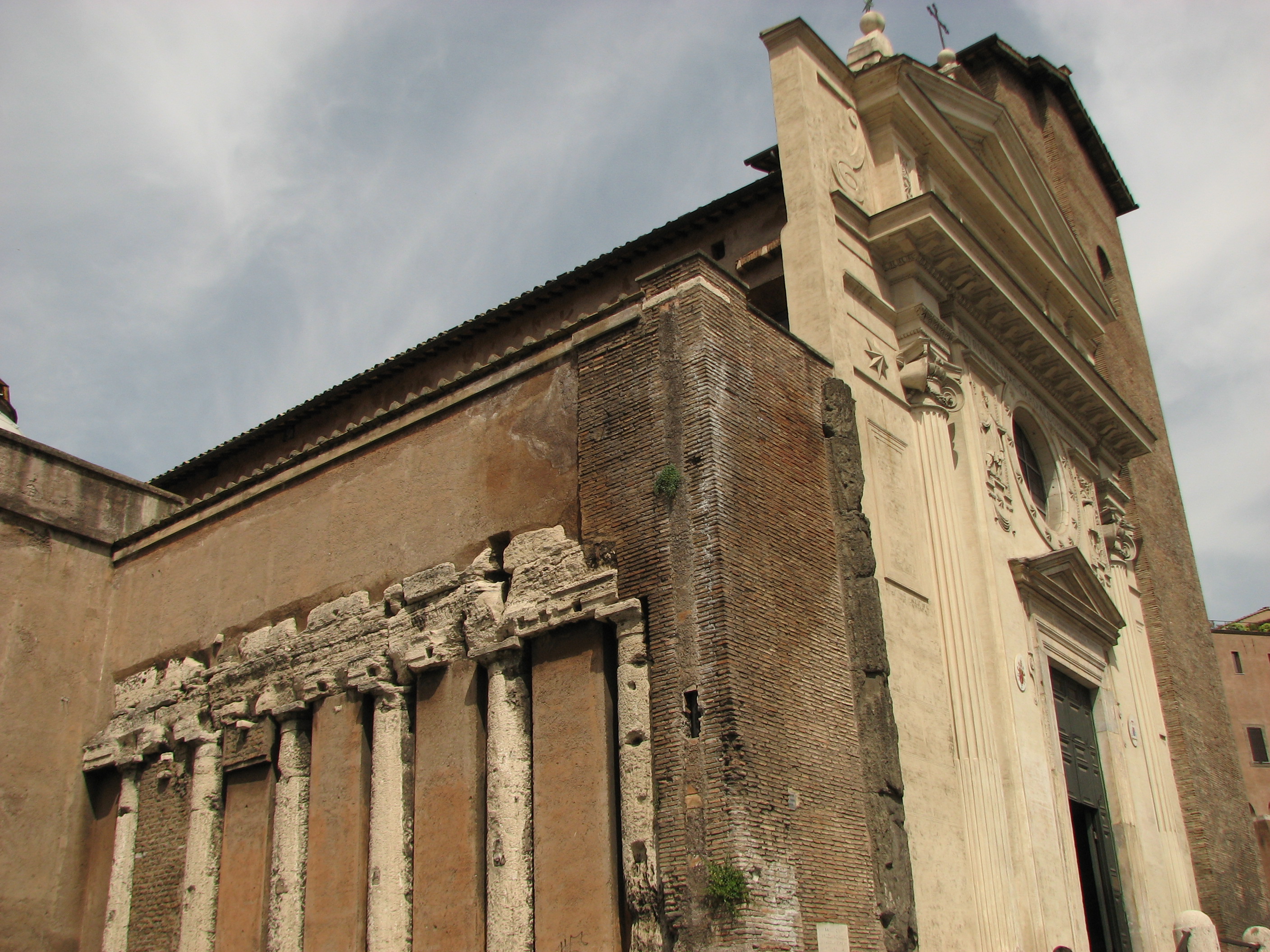
St. NICHOLAS IN PRISON

S. NICOLA IN CARCERE
Maybe built in the seventh century. Mentioned in the sources for the first time in the ninth century
Renovated in 1128 at the time of Honorius II (1124/30) as evidenced by the plaque at the top of the right nave. Dating back to the same period are the frescoes with “Baptism of Christ”, “Prophets” and “Decorative motifs with plants and animals” detached in 1853 and now in the Vatican Museums
Restored in 1733 with the remake of roof and floor and with the construction of the sacristy
Restored in the years 1846/65 with a new restoration of the roof and the opening of four windows on each side of the nave and two in the transept
It was isolated from adjacent buildings in 1932
The church's name probably derives from an early medieval prison not existing anymore that had to be nearby
On every 6th of December, on the occasion of the feast of St. Nicholas, here the loaves of bread of St. Nicholas were donated to the faithful
Regional Church of Puglia and Lucania regions

FAÇADE
1599 Giacomo Della Porta (1533/1602) for Cardinal Pietro Aldobrandini, restored in 1733, and finally in 1808 by Giuseppe Valadier (1762/1839)
In the reliefs “Eight-pointed stars” symbol of the Aldobrandini family. On the right “Martyrs Mark and Marcellianus”, on the left “St. Nicholas”

BELL TOWER
Probable rest of the fortifications of the Pierleoni family, with bells cast in 1286 by Guidotto Pisano

MAIN NAVE
Ten panels with “Stories of St. Nicholas” 1865/66 by Guido Guidi (1867/1911)
“This was Guido Guidi's first public commission. He was a minor exponent of the Eclectic Roman group of artists lead by Francesco Podesti and Pietro Gagliardi, after the teachings of Purism by Tommaso Minardi” (Angela Catalano)

BEGINNING OF THE RIGHT NAVE
Copy of the “Holy Trinity” by Guercino (in S. Maria della Vittoria) by Constantino Brumidi (1805/80) who maybe also executed the copy of the “Assumption of the Virgin Mary” by Annibale Carracci from the original (in S. Maria del Popolo) in the chapel of the left nave
Constantino Brumidi eventually ended up in Washington where he painted the Capitol for twenty five years

ON THE WALL OF THE RIGHT NAVE
Painting “Madonna and Child” about 1470 by Antonio Aquili aka Antoniazzo Romano (about 1435-40/1508). Some date it to 1486, when an altar was consecrated in the left nave, where perhaps it was originally placed

RIGHT TRANSEPT
“Tomb of Cardinal G.B. Rezzonico” nephew of Clement XIII Rezzonico (1758/69) by the Irish Christopher Hewetson (about 1739/1797)

AT THE END OF THE RIGHT TRANSEPT - CHAPEL OF THE ROSARY
Frescoes inspired by the Eucharist by Giovanni Baglione (1566/1643), the only remnant of the paintings that were in the church at the end of the sixteenth century

APSE
On the basin “Glorification of Christ between the Virgin Mary and St. Nicholas with Triumphant Church in heaven and with Militant Church on earth”, on the hemicycle in the bottom part “St. Nicholas at the Council of Nicaea in 325 hurls anathemas against Arius” by Vincenzo Pasqualoni (1819/80) a pupil of Tommaso Minardi, like Guido Guidi
Painting “St. Nicholas between angels and the three children he resurrected” by an anonymous eighteenth-century artist

MAIN ALTAR
“Urn in green porphyry” about IV/V d.C. from the crypt
“Four angels in bronze holding the altar” by Antonio Della Bitta (1807/about 1879) who also sculpted the famous statue of Neptune in the homonymous fountain that decorates the north of Piazza Navona

TRIUMPHANT ARCH
On the sides “Angels with the symbols of the episcopate and of St. Nicholas” by Guido Guidi

LEFT TRANSEPT
Above the altar “Ascension of Jesus” 1505/06 by Lorenzo Costa (1460/1535)
Lorenzo Costa was one of the most important artists of the schools of Ferrara and Mantua in the sixteenth century. The work was painted for the church of S. Maria Mascarella in Bologna and it was badly cut to fit this altar

CHAPEL IN THE LEFT TRANSEPT - CHAPEL OF THE CROSS
On the altar “Wooden crucifix painted” of the sixteenth century
On the left wall painting “St. Nicholas between Christ and the Virgin Mary” by an unknown nineteenth-century artist

LEFT NAVE - CHAPEL OF OUR LADY OF GUADALUPE
On the altar “Our Lady of Guadalupe” by an anonymous artist, brought from Mexico in 1773 by Jesuit missionaries
Frescoes with “Angels”, “Prophets”, “Annunciation” and “Coronation of the Virgin Mary” 1862 by Luigi Martinori (1828/95)
On the left copy of the “Assumption of the Virgin Mary” maybe by Constantino Brumidi from the original by Annibale Carracci in S. Maria del Popolo
On the right “Annunciation” by an unknown seventeenth-century artist of Tuscan culture

SACRISTY
In the entrance canvas “Immaculate Conception” maybe by Guido Guidi (1867/1911)
“Eighteenth-century wooden crucifix”
Copy painted in 1850 of the “Ecstasy of St. Francis” by Domenichino from the original in the church of St. Mary of the Immaculate Conception

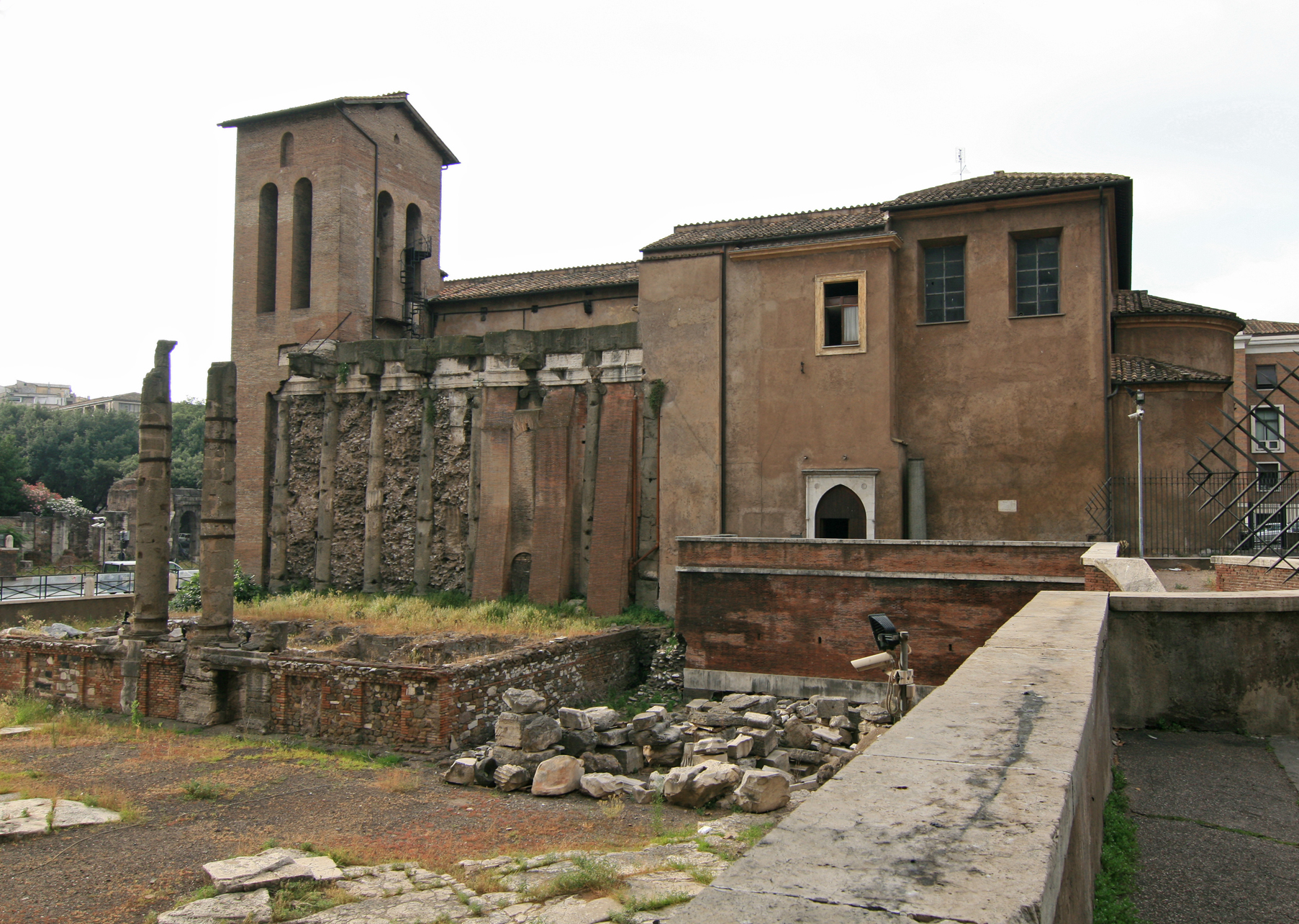
Three Temples under St. Nicholas in Prison

To the right of the church
TEMPLE OF JANUS (maybe) 
264/241 BC Caius Duilius during the First Punic War 
Restored in the year 17 AD by Tiberius (14/37) 
Peripterus hexastyle sine postico (columns all around, six columns in the front, non in the back) with eight columns remaining on the right side and two in front

Under the church
197 BC, the current structure dates back to 90 BC built for one Cecilia Metella 
Peripterus hexastyle in Ionic style

To the left of the church
TEMPLE OF HOPE (maybe) 
260 BC Atilius Calatinus
Peripterus hexastyle with six Doric columns on the left side. Originally on each side there were eleven columns

Monday, November 26, 2018

St. CAESAR OF THE APPIAN WAY

S. CESAREO DE APPIA
Via di Porta S. Sebastiano
Built in the eight century AD over an ancient building of the second century AD, maybe part of the BATHS OF COMMODUS
Rebuilt at the end of the sixteenth century maybe by Giacomo Della Porta (1533/1602)
Karol Wojtyla was the titular cardinal of this church for 11 years until 1978, when he was elected pope
Also known as S. Cesareo in Turrim or, erroneously, from the sixteenth century, as S. Cesareo in Palatio
It was confused with the homonymous church no longer existing identified in 1907 by Alfonso Bartoli in a cubiculum (bedroom) of the Domus Augustana on Palatine Hill, in which a small apse had been obtained in the back wall. At the time of the excavations some painted figures were still fairly well identifiable in the cubiculum

PRESBYTERY
Enclosure of the presbytery, pulpit, altar frontal and chair reassembled at the end of the sixteenth century using also “Cosmatesque elements” from St. John Lateran

Canopy of the end of the sixteenth century

Above the chair
Fresco of the fifteenth century “Madonna and Child”

Mosaics with “Eternal Father in glory” in the apse and “Annunciation” on the outside of the triumphal arch 1603 from cartoons by Giuseppe Cesari aka Cavalier d'Arpino (1568/1640) who maybe also painted the panels in the attic with “Stories of Sts. Ippolitus and Cesareus”

ARCHAEOLOGICAL EXPLORATIONS
Mosaic floor in black and white with “Marine scenes” of the second century AD that covers the entire area of the church
A little further along the Appian Way is the CASINA DEL CARDINAL BESSARIONE (Small Villa of Cardinal Bessarion) of the mid-fifteenth century with inside part of the original frescoes

Thursday, May 17, 2018

St. ATHANASIUS OF THE GREEKS


S. ATANASIO DEI GRECI
1580/81 Giacomo Della Porta (1533/1602) for Gregory XIII Boncompagni (1572/85) who established the Congregation of the Greeks for the communities that followed the Greek-Albanian rite in Southern Italy
It was consecrated only in 1583 and the decoration was completed only in 1591
The trichora plant (rectangular room with apses on three sides) follows the byzantine schemes
Greek Catholic Church officiated with the Byzantine rite in Greek
FAÇADE
Maybe completed by Martino Longhi the Elder (1534/91)
With its two towers echoes the nearby and almost contemporary church SS. Trinità dei Monti
CHAPEL ON THE RIGHT
Altarpiece “Annunciation” about 1583 by Francesco Traballesi (active second half of the sixteenth century)
On the left “Tomb of the priest Demetrius Falereo” d. 1664 with the painting “Head of Christ between two executioners” of the sixteenth century by an unknown artist of the German school, improbably attributed to Albrecht Dürer (1471/1528)
APSE ON THE RIGHT
Altarpiece “Assumption and Coronation of the Virgin Mary” began in 1585 and ended only in 1591, maybe early work by Giuseppe Cesari aka Cavalier d'Arpino (1568/1640)
In a glass case there is the mechanism of the clock tower dating back to 1710. The clock is externally facing the Greek College
MAIN ALTAR
Great “Iconostasis in wood” 1876 by Andrea Busiri Vici (1818/1911)
It replaced the original iconostasis painted by Traballesi whose fragments are now kept in the refectory of the Collegio Greco
APSE ON THE LEFT
“Crucifixion with Mary and St. John” by Giuseppe Cesari aka Cavalier d'Arpino
CHAPEL ON THE LEFT
Altarpiece “Jesus among the doctors” by Francesco Traballesi (active second half of the sixteenth century)
COLLEGIO GRECO (Greek College)
To the left of the church
1796 Carlo Puri De Marchis

Monday, April 9, 2018

St. ANDREW OF THE VALLEY

Built in the area of​ a square called “Siena” from a building that had been built here for Enea Silvio Piccolomini, later Pope Pius II (1458/64)
In 1582 the Countess Piccolomini d'Aragona Duchess of Amalfi bequeathed the family mansion to the Regular Clerks also known as Theatins founded in 1524 by Gian Pietro Carafa, later Paul IV (1555/59), and St. Cajetan of Thiene, provided a church would be built dedicated to St. Andrew patron saint of Amalfi
FOUNDATIONS
1591/93 Fra' Francesco Grimaldi supervised by Giacomo Della Porta (1533/1602) for the Theatins and for Cardinal Alfonso Gesualdo on the area of the destroyed church S. Sebastiano de Via Papae
Works continued in the years 1594/96 with Pietro Paolo Olivieri (1551/99)
New continuation of the works from 1608 with Carlo Maderno (1556/1629) for Cardinal Alessandro Peretti Montalto nephew of Pope Sixtus V
NAVE 1612/13
TRANSEPT and CHOIR 1620/21
In 1621 Francesco Borromini (1599/1667) worked on the capitals of the lantern
1622, the fifth (16.10 m - 52.8 feet) larger in diameter in Rome after the Pantheon (43.3 m - 142.06 feet), S. Peter's (42.56 m - 139.6 feet), S. Giovanni Bosco al Quadraro (31 m - 101.7 feet) and Sts. Peter and Paul in the EUR district (28 m - 91.8 feet)
Consecrated in 1650 by Cardinal Francesco Peretti nephew of Cardinal Alessandro Peretti Montalto
The church is also known for having been chosen by the composer Giacomo Puccini as the setting of the first act of his opera Tosca, based on the stage play of the same name by the French Victorien Sardou
In the plot a mysterious Attavanti Chapel is mentioned, but a chapel with that name never existed in the church. The only Attavanti Chapel of Rome is in the church of S. Bernardino da Siena
1656/65 Carlo Rainaldi (1611/91) with the help of his assistant Carlo Fontana (1634/1714), who developed an existing project by Maderno
According to Cesare Brandi, when Corso Vittorio Emanuele II was enlarged it produced a distortion of visual perception of the façade. It was designed to have the viewer closes to it, while distance vision produces a visual compression of the columns
“The current baroque façade is a baroque alteration of Carlo Rainaldi of a design by Maderno. The design, in turn, was purified and freed from any ambiguity by Carlo Fontana” (Rudolf Wittkower)
Statues on the façade:
On the left “St. Cajetan of Thiene” by Domenico Guidi (1625/1701) and “St. Andrew” by Ercole Ferrata (1610/86)
On the right “St. Sebastian” by Domenico Guidi and “St. Andrew Avellino” by Ercole Ferrata
On the arched pediment of the portal “Hope and Fortitude” by Giacomo Antonio Fancelli (1619/71) who had sculpted the Nile in the nearby Fountain of the Four Rivers in Piazza Navona
On the left side “Angel” by Ercole Ferrata not replicated on the right side and tied to an anecdote: when the statue was erected, it was much criticized and Ercole Ferrata, having learned that Alexander VII Chigi (1655/67) had joined the critics, said: “If he wants another angel, he can do it himself!”
“For St. Andrew the Apostle and St. Andrew Avellino, Ferrata used perhaps sketches of Melchiorre Caffà, which allowed him to achieve greater dynamism and chiaroscuro effects. Ferrata was also responsible for sculpting the imposing angel on the top left depicting Fame” (Gerardo Casale - Dizionario Biografico degli Italiani Treccani)
The façade was cleaned in 1991, but it is, unfortunately, already dirty
Painted in 1905 in panels imitating those by Domenichino in the choir
Stuccos by Michele Tripisciano (1860/1913)
Paintings:
“Apparition of the Immaculate to Sister Orsola Benincasa” and “Expulsion from Paradise” by Salvatore Nobili (1865/1919)
“Proclamation of the dogma of the Immaculate Conception” and “Visitation” by Virginio Monti (1852/1942)
“Holy Family” and “Annunciation” by Cesare Caroselli (1847/1927)
“Apostles” in the lunettes of the windows by Silvio Galimberti (1869/1956)
1667/84 Carlo Fontana (1634/1714)
Relief “Angel announces the Flight into Egypt” 1675 by Ercole Antonio Raggi (1624/86) who also sculpted the “Statue of Cardinal Marzio Ginetti” on the left
Copies made in the seventeenth century of statues by Michelangelo
On the left “Tomb of the Marquise Prassede Tomati Robilant” 1828 by Giuseppe De Fabris (1790/1860)
ABOVE THE CIRCULAR CHAPEL ON THE RIGHT
“Tomb of Pius III” Piccolomini (1503) maybe by Sebastiano Ferrucci or Francesco di Giovanni
It was moved here in 1614, with the tomb of Pius II, from the ruined chapel of St. Andrew of the old Basilica of St. Peter
Renovated in 1858
“Illness of St. Andrew Avellino during Mass in St. Paul in Naples” 1625 by Giovanni Lanfranco (1582/1647). The painting was carried out, according to tradition, in just eight days
On the right “Tomb of Gioacchino Ventura” 1870 by Stefano Galletti (1832/1905), a pupil of Pietro Tenerani
To the right of the presbytery CHAPEL OF THE CRUCIFIX with the body of S. Giuseppe Maria Tomasi, canonized in 1986
“It was in Parma that the artist found the stimuli to abandon his initial classicism assimilated through contacts with Reni and Domenichino: the vision of the dome of the cathedral with frescoes by Correggio of the years 1526/30 was an ideal model, so much that Lanfranco took on and developed in his Assumption that proposal before its time, breaking out with the fundamental principles of balance and harmony. The relationship with the viewer is now played on the direct emotional involvement. Again Correggio-like is the use of light: placed over the figures, it moves in a descending way and at the same time, as a physical component coming from the holes, causes an illusionistic dilation towards the infinite space of the heavens. Shapes, whose contours disappear in motion, regain their relief in the unity of light. The dome caused astonishment in Rome and it started a new phase of decoration of domes and vaults: the Baroque illusionism” (Carlo Bertelli, Giuliano Briganti, Antonio Giuliano)
PENDENTIVES
APSE
Thirteen sections with “Stories of St. Andrew, Virtues and two nudes” 1622/28 by Domenico Zampieri aka Domenichino (1581/1641)
“This arch-classicist seemed tempted by the new Baroque trend. This is clearly visible in the Evangelists, where a strong Correggio note is added to the reminiscences of Raphael and Michelangelo. One could assume that Domenichino wanted to outshine his rival Lanfranco. In the apse scenes, while individual episodes are still strictly separated by decorated ribs, the scenario is expanded and figures move more deeply in it than they used to do before, some in perfect coordination with the lush landscapes surrounding them. Domenichino appears to be inspired also by Ludovico Carracci, another sign of his departure from his orthodox classicism of ten years before” (Rudolf Wittkower)
The two great artists and rivals, Giovanni Lanfranco and Domenichino, found themselves working at the same time, despite their will, only a few meters away. It is documented the purchase of a tent which served to hide from each other their respective work
“Rome, in the alternative between Classicism and Baroque - that opposed Domenichino and Lanfranco and that was carried out, because of the extraordinary coincidences that sometimes the randomness of history gives us, on the surfaces of the same church - had already chosen Baroque: its freedom of design and invention that was in stark contrast with the principles of Domenichino. Its transcending the likelihood in imagination. Its considering immediacy, the transience of the real true as a testing ground of art which therefore can be fixed only with the speed of execution and not with the slow methodical planning. The pope who ushered Baroque in painting, with the dome of Lanfranco in May 1627, was Urban VIII Barberini who, doing so, unsettled the known idea of painting, but also unsettled the image of Rome. It was the pope who called Bernini and Pietro da Cortona to create this new image. For Domenichino there was no room in this vision, as there was no room for Francesco Albani, Guercino and Guido Reni. They all left Rome” (Anna Coliva)
Divisions in golden stucco by Alessandro Algardi (1598/1654)
CURVE OF THE APSE
“Crucifixion”, “Martyrdom” and “Burial of St. Andrew” 1650/51 by Mattia Preti (1613/99)
“His appointment in the congregation of the Virtuosi of the Pantheon (1650) coincided with the execution of the monumental frescoes of the choir and tribune of S. Andrea della Valle in Rome, which seem to have been completed in 1651. Alongside the works of Domenichino and Lanfranco the three large paintings (...), are binding for their all new strength and breadth of style. The diagonal composition, emphasized by the bodies, the choice of simple perspective axes, the beautiful paint, the airiness of the scenes are elements that put the artist well up in the art scene of his time” (Enciclopedia Treccani)
At the sides on the right “Arrival in Ancona of Cardinal Basilios Bessarion with the head of St. Andrew” and on the left “Condemnation of St. Andrew” 1662 by Carlo Cignani (1628/1719), a pupil of Francesco Albani
To the left of the presbytery CHAPEL OF PURITY with decorations of the early 1900s
1912 by Cesare Bazzani (1873/1939)
Above the altar “Apparition of the Virgin Mary to St. Cajetan of Thiene” 1770 by the Sicilian Mattia de Mare
Statues of “Abundance” and “Wisdom” by Giulio Tadolini (1849/1918)
Statues on the pediment by Michele Tripisciano (1860/1913)
Paintings in the vault by Silvio Galimberti (1869/1956)
ABOVE THE CIRCULAR CHAPEL ON THE LEFT
“Tomb of Pius II” (1458/64) maybe begun by Paolo Taccone aka Paolo Romano (about 1415/77) and finished by a follower of Andrea Bregno known as the Master of Pius II for Cardinal Francesco Todeschini
In the relief there is the presentation of the head of St. Andrew to Pius II. The tomb was originally in the old Basilica of St. Peter
IN THE LEFT VESTIBULE
“Tomb of Count Gaspare Thiene” 1676 by Domenico Guidi (1625/1701)
Above the altar “St. Sebastian” about 1613 by Giovanni De Vecchi (about 1537/1615)
On the sides “Stories of the Sts. Rocco and Martha” about 1869 by Guido Guidi (1867/1911)
2nd LEFT - CHAPEL RUCELLAI
1603/04 by Matteo Castelli (1560/1632), probably designed by Carlo Maderno
Matteo Castelli came from Melide in Switzerland
He was a relative of Borromini and later became the chief architect of the king of Poland, for whom he designed castles, palaces and churches, taking to the largest Polish cities the Roman style of Carlo Maderno
Above the altar “Blessed Theatins Marinoni, Burali and Tomasi” first half of 1700s by Francesco Manno (1752/1831)
Monsignor Giovanni Della Casa (1503/56) was a writer and archbishop, famous for being the author of the manual of good manners and etiquette Galateo overo de' costumi (Etiquette or about costumes)
Damaged frescoes and dome painted by Cristoforo Roncalli aka Pomarancio (1552/1626)
1st LEFT - BARBERINI CHAPEL or OF THE ASSUMPTION
1604/16 Matteo Castelli, with marble taken from buildings of the Forum, for Carlo Barberini and his brother Maffeo Barberini, the future Pope Urban VIII (1623/44)
“Maffeo had chosen some of the best sources of inspiration: the superb Caetani chapel of S. Pudenziana, the one dedicated to St. Lawrence in the church of S. Susanna, the precious marbles of S. Cecilia, the Aldobrandini family chapel by Della Porta in S. Maria sopra Minerva and the Rucellai chapel that the architect Castelli was about to carry out with a successful project” (Cesare D'Onofrio)
Altarpiece “Assumption”, paintings on the walls “Stories of Mary,” in the small dome “Eternal Father”, in the DOME, in the niche on the left “Lucina collects St. Sebastian” 1604 by Domenico Crespi aka Passignano (1559/1638)
In the niches there are important statues:
On the right:
“S. Marta” 1609/17 masterpiece by Francesco Mochi (1580/1654)
Mochi had almost completed in 1611 when he had to go to Parma to sculpt the equestrian statues for the Farnese family. It was placed in the chapel on the floor in front of its niche only in 1617, probably in order to be retouched, and it was finally placed in a niche in 1621
Martha was the sister of Mary Magdalene and, according to a Provencal legend, she had killed a dragon with holy water. Mochi depicted here the very determined saint who is about to use the sprinkler while holding the dragon still with her left hand
“It's not a fight scene between Martha and the dragon, it seems rather a scene of victory, so much is the self-confidence in the expression of the beautiful face and in the peaceful and intent attitude of the entire body, draped in a robe with large and discrete folds. I could not really say how many statues, in the chapels of Rome, can compete with this Martha of Bethany” (Cesare D'Onofrio)
“St. John the Evangelist” 1610/12 masterpiece by Ambrogio Buonvicino (about 1552/1622)
On the left:
“St. John the Baptist” 1615 by Pietro Bernini (1562/1629), who replaced Nicolas Cordier (1567/1612) who had been given originally the job, but died in 1612
“The comparison between Buonvicino's St. John the Evangelist and the St. John the Baptist made by Pietro Bernini shows again the cultural differences already present in the Pauline Chapel. The thin figure with minute features of the Baptist carved by Pietro, with his gentle twisting of the body and the dense drilling of marble at the level of the hair and the lamb is still heir to the tradition of Mannerism from Tuscany and Rome. The strong and vigorous statue by Buonvicino seems to oppose that sharp and rarefied elegance that, marked by a sweet naturalness and a calm expression completely Lombard” (Alessandro Angelini)
“St. Mary Magdalene” 1609/12 by Cristoforo Stati (1556/1619)
“Pair of putti” to the left by Francesco Mochi. They replaced in the third decade of the seventeenth century the original ones by Gian Lorenzo Bernini
“Pair of putti” on the right 1618 early work by Gian Lorenzo Bernini (1598/1680)
The other statues are by Cristoforo Stati
IN THE PASSAGE ON THE RIGHT
“Tombs of the parents of Urban VIII, Antonio Barberini and Camilla Barbadori” 1627 by Tommaso Fedeli. They replaced the original busts of the years 1619/20 by Gian Lorenzo Bernini
SACRISTY
1629 Paolo Marucelli (1594/1649)
“Crucifixion” about 1614 by Giovanni De Vecchi (about 1537/1615)
CONVENT OF THE THEATINS
1602 Girolamo Rainaldi (1570/1655) and Paolo Marucelli (1594/1649)