Showing posts with label Pompeo Batoni. Show all posts

Thursday, March 28, 2019

St. MARY IN MONTERONE

S. MARIA IN MONTERONE
Mentioned in the sources for the first time in 1186
Rebuilt in 1682
It was entrusted in 1728 to the Mercedari monks of the Congregation of Holy Mary of Mercy for the ransom of slaves
Restored with the raising of the floor in 1754 maybe by Domenico Gregorini (1692/1777)
Restored again in 1848
The church is located at the center of the area where there was once the STAGNUM AGRIPPAE, an the ancient artificial lake of the Baths of Agrippa

TO THE RIGHT OF THE ENTRANCE
“Tombstone of Giovanni Bazzano” d. 1406 originally embedded in the floor
EIGHT ANCIENT COLUMNS
RIGHT NAVE - ALTAR OF THE SOULS IN PURGATORY
Painting “Assumption” 1830 by Giovanni Gagliardi
AT THE END OF THE RIGHT NAVE - CHAPEL OF St. JOSEPH
Above the altar “Madonna with Child, St. John the Baptist and an Angel” of the end of the seventeenth century
On the right wall “Tomb of Anna Moroni” 1647
TO THE RIGHT OF THE ALTAR
“Memory funeral of John Rinuccini” 1730

MAIN ALTAR
“Sts. Peter Nolasco, Peter Paschasius and two slaves in chains venerating the Virgin Mary and Child” maybe by Pompeo Batoni (1708/87) or of his pupil Gaspare Serenari (1707/59)

TO THE LEFT OF THE ALTAR
“Tomb of Cardinal Stefano Durazzo” 1667, with winged skeleton
AT THE END OF THE LEFT NAVE - CHAPEL OF St. ALPHONSUS MARIA DE' LIGUORI
1848 Pietro Camporese il Giovane (1792/1873)
Above the altar “Stories of St. Alphonsus” 1848, on the right “St. Alphonsus in ecstasy in front of the Virgin Mary” and on the left “St. Alphonsus gives the rule to the Redemptorists” by Donato De Vivo
On the left “Tomb of Vincenzo Campanari” 1858

BUILDING OF THE CONVENT OF S. MARIA IN MONTERONE
To the right of the church
1735 Francesco Bianchi for the brothers Mercedari, with bizarre and interesting decoration on the façade

Monday, January 14, 2019

St. EUSEBIUS

S. EUSEBIO
The original church dates back to the fifth century, one of the oldest churches in Rome
It was built, according to tradition, on the Titulus Eusebii, the house of S. Eusebius (about 319/about 357), one of the 43 saints with this name recognized by the Catholic Church
Rebuilt in 1238 for Gregory IX dei Conti di Segni (1227/41)
It was rebuilt again in 1600 by Onorio Longhi (1568/1619)
Restored in the years 1750/59 by Nicolò Picconi

FAÇADE
1711 Carlo Stefano Fontana (active 1700/about 1719) son of Carlo Fontana (1634/1714) and brother of Francesco Fontana

BELL TOWER of the time of Honorius III Savelli (1216/27)
Every 17 January for the feast of St. Anthony of Egypt the blessing of the animals takes place in the churchyard, moved here in the twentieth century from the churchyard of the neighboring church of St. Anthony of Egypt for reasons of public order

VAULT
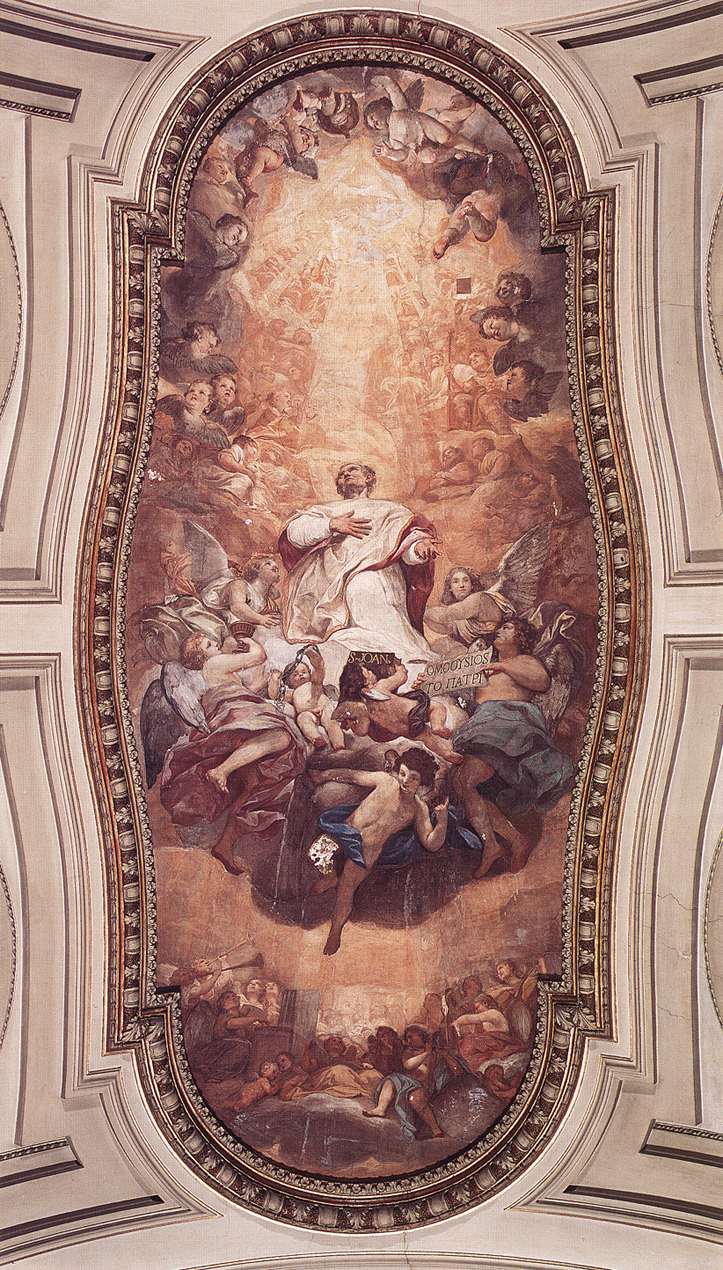
“Glory of St Eusebius” 1757 by Anton Raphael Mengs (1728/79)
It is one of the first examples of a painting in neoclassical style
The face of one of the angels represented by Mengs is the portrait of the woman he loved

NAVE
Paintings between the windows by Giuseppe Passeri (1654/1714) pupil of Carlo Maratta

SIDE NAVES
End of 1800s/beginning of 1900s

MAIN ALTAR
Designed by Onorio Longhi
On the altar “Madonna and Child” maybe by Pompeo Batoni (1708/87)

CHANCEL
Stalls and music stand of walnut carved with grotesque figures in the seventeenth century
To the right “Madonna and Saints” by Baldassare Croce (about 1553/1628)

CLOISTER
1588 Domenico Fontana (1543/1607)
It is built with bricks and it features a central fountain
The MONASTERY, to which the cloister belongs, is the seat of the Central Directorate of Health of the State Police
It was the place where one of the first printers in Rome ever operated: it was run in the years 1470/71 by the German Georg Lauer

Thursday, November 3, 2016

QUIRINAL PALACE (ninth part)

COFFEE HOUSE
1741 Ferdinando Fuga (1699/1782)
Two paintings in the room on the mezzanine:
“S. Maria Maggiore” and “Piazza del Quirinale with Palazzo della Consulta” 1742 by Giovanni Paolo Pannini (1691/1765), a brilliant landscape artist
“It differs from the objective views of Van Wittel for a taste for the theatrical and decorative and for his seemingly casual handling of figurative materials, often arbitrarily combined; but his views nevertheless are widely lucky with foreign travelers: in fact, although they are often invented, they can anyway manage to make alive again the memory of the impact with the grandeur of that historic fabric, the tingle of life, the space and the light of the city” (Carlo Bertelli, Giuliano Briganti, Antonio Giuliano)
Five paintings by Pompeo Batoni (1708/87) in the vault of the green room
Five works by Agostino Masucci (1691/1758) in the turquoise room
SCUDERIE DEL QUIRINALE
Quirinal Stables
Begun 1722 by Alessandro Specchi (1668/1729) for Innocent XIII Conti (1721/24) and finished in 1730 by Ferdinando Fuga (1699/1782) for Clement XII Corsini (1730/40)
Mutilation with removal of the semi-elliptical staircases by Fuga in 1866 by Virginio Vespignani (1808/82) for Pius IX Mastai-Ferretti (1846/78) to open Via della Dataria
The building was built on the spot where was the glorious Temple of Serapis used to stand. Some of the ancient structures are still visible
In 2000 it was redesigned by Gae Aulenti (1927/2012) as a museum for prestigious temporary exhibitions

Wednesday, November 2, 2016

QUIRINAL PALACE (eighth part)

TEN ROOMS NOT OPEN TO THE PUBLIC
BRONZINO'S ROOM
Ten tapestries displayed in rotation with “History of Joseph Jew” 1546 three of which designed by Jacopo Carrucci aka Pontormo (1494/1556) and the others by Agnolo di Cosimo Tori aka Bronzino (1503/72) commissioned by Cosimo I de' Medici for the Room of the Two-Hundreds in Palazzo Vecchio in Florence, where are the other ten of the series are
“In these tapestries the tormented artificiality of Pontormo reaches its peak. The simplicity of the subject does not raise virtually any concern in the artist, who has become more and more convoluted and self-effacing. (...) The tapestries have a figurative pattern compressed in the vertical direction, with no clear structure or content. It is not surprising that Cosimo and the heads of the Tapestries' factory would no longer employ Pontormo” (Hermann Voss)
ROOM OF DRUSUS
SMALL PASSAGE OF URBAN VIII
OFFICE OF THE PRESIDENT
ROOM OF THE TAPESTRIES OF LILLE
Five tapestries 1715/20 by Guillaume Werniers from models by David Teniers the Younger (1610/90)
SMALL NAPOLEONIC LIVING ROOM
PIFFETTI LIBRARY
MUSIC ROOM
ROOM OF PEACE
ROOM OF VICTORY
ROOM OF THE DAMES
Beautiful frieze “Triumph of Alexander the Great” 1812 by Bertel Thorvaldsen (1770/1844)
“Admirable work for the lightness of ornament and for the variety of attitudes in the long procession inspired by the reliefs of the Parthenon” (Carlo Bertelli, Giuliano Briganti, Antonio Giuliano)
Chapel of Pius IX
In the MANICA LUNGA (Long Wing) with five major paintings:
On the right “Madonna with Saints” 1603 maybe by Innocenzo Tacconi (active in Rome 1607/25) and “The Birth of the Virgin” 1643 by Pietro Berrettini aka Pietro da Cortona (1597/1669)
On the altar “Mystic Marriage of St. Catherine of Alexandria with Sts. Jerome and Lucy” 1779 by Pompeo Batoni (1708/87)
On the left “Annunciation” by Carlo Maratta 1673 (1625/1713) and “Apparition of the Virgin to St. Lawrence” 1617 by Giovanni Lanfranco (1582/1647)
Garden
“Fountain of the organ” 1596 with hydraulic parts by Giovanni Fontana (1540/1614), brother of Domenico Fontana and expert in hydraulic, with decorations by Giovanni da Neri for Clement VIII Aldobrandini (1592/1605)

Wednesday, June 22, 2016

COLONNA PALACE - COLONNA GALLERY (sixth part)

Room of Landscapes

Vault “Allegory of the Battle” by Sebastiano Ricci (1659/1734)
“Ricci is the typical extrovert virtuoso of the eighteenth century and as such his splendor could look a bit superficial. Roberto Longhi spoke of his paintings that have the flavor of a skilled reportage of all the Europeans themes. But it took the easy and versatile talent of Ricci to bring Venetian art back to a new understanding of the great past and towards the synthesis accomplished by the heroic style of Tiepolo” (Rudolf Wittkower)
Two magnificent chests of sandalwood and precious stones: one in ebony and ivory with the image of the Last Judgement by Michelangelo, another maybe by Carlo Fontana (1634/1714)
“Landscapes” by Gaspard Dughet (1615/75), Crescenzio Onofri (1632/1712) and Jacob de Heusch (1657/1701)
“Antigone near the bodies of Eteocles and Polynices” maybe by Paul Brill (1554/1626)
“The deer hunting” and “Battlefield” by Jacques Courtois aka Borgognone (1628/79)
“Preaching of St. John the Baptist” by Michelangelo Cerquozzi (1602/60)

Room of the Apotheosis of Martin V

In the center of the ceiling painting “Apotheosis of Martin V Colonna (1417/31)” 1720 by Benedetto Luti (1666/1724)
“Among the students of Maratta only the distinguished Benedetto Luti from Florence, character of international renown, also known as a collector and teacher, completed the transformation of Maratta's style in an eighteenth-century style elegant and sweet” (Rudolf Wittkower)
In the ceiling near the walls: “Merit crowned by Virtue” by Pietro Bianchi aka il Creatura (1694/1740) Roman student of Luti and Baciccio
In the ceiling near the walls: splendid “Time discovers the truth” and in the corners “Allegories” by Pompeo Batoni (1708/87) among which there is an incredibly explicit and passionate sapphic kiss between Peace and War
“In the work of Batoni, in his thematic ideas, he reconstructed his love for the operatic melodrama of which he had to be an assiduous listener (...), and as a painter of mythological themes he had a preference for scenes that would lend themselves more to express a pathetic aspect (...). As in opera, where they often are not overly moved if not in words, so in Batoni’s painting, the characters express themselves psychologically in a gesture, in a tear, but the painting remains serene and full of life because of its colors: it becomes a show, a wise and skillful game content in the oblivion of all evil or simply of all the unpleasant” (Isa Belli Barsali – Dizionario Biografico degli Italiani Treccani)
“Madonna and Child asleep, St. John and St. Elizabeth” by Agnolo di Cosimo Tori aka Bronzino (1503/72)
“Under the influence of Michelangelo, Bronzino also carried out a total change of style, which manifested itself most clearly in the extraordinarily exalted corporeality of the naked figures, in the strong emphasis on the muscles modeled as if they were sculpture. To this he added a chromatic style, cold and hard, which increased even more the plastic impression” (Hermann Voss)
“Portrait of Onofrio Panvinio” by Jacopo Robusti aka Tintoretto (1518/94)
“Mangiafagioli (Beans Eater)” about 1584/85 by Annibale Carracci (1560/1609)
“Being able to work simultaneously on two levels, Agostino and Annibale Carracci reveal a dichotomy that from then on became more and more marked in the work of great artists and culminated in the dual activities or double aspirations of Hogarth or Goya. It is not surprising that this mentality would define the Carraccis as the ancestors of the modern caricature” (Rudolf Wittkower)
“St. Charles Borromeo” by Giovanni Lanfranco (1582/1647)
“Rape of Europa” by Francesco Albani (1578/1660)
The color combinations are intoxicating and bring out the irresistible sensuality of the icy and curvy legs in Europe, constituting, with her breasts exposed, the element in the painting that glows more than any other with bright light
Two “Portraits of men” by Domenico Robusti aka Tintoretto (1560/1635)
“Portrait of a Gentleman” by Paolo Caliari aka Veronese (1528/88)
“Madonna with Child, Two Angels and St. John” maybe by Andrea d'Agnolo aka Andrea del Sarto (1486/1531)
“Guardian Angel”, “The Virgin of the Annunciation” and “The Archangel Gabriel” by Giovanni Francesco Barbieri aka Guercino (1591/1666)
“Ecce homo” by Francesco da Ponte aka Bassano the Younger (1549/92)
“Resurrection of Lazarus” and “Portrait of a Gentleman with cameo” Francesco de' Rossi aka Francesco Salviati (1510/63)
“St. Jerome Penitent” by Giovanni di Pietro aka Spagna (about 1450/1528) a pupil of Perugino to whom he owed a lot for his style
“Bust of Cardinal Girolamo I Colonna” 1651 by Orfeo Boselli (about 1600/67)
The Cardinal was the one who wanted to begin the art collection of the family
“Virgin Mary gives the scapular to St. Simon Stock” by Ippolito Scarsella aka Scarsellino (1551/1620)

Sunday, June 12, 2016

COLONNA PALACE - COLONNA GALLERY (third part)

GALLERIA COLONNA

The collection was put together from 1650 by Cardinal Girolamo I Colonna (his grandfather was Marcantonio II Colonna the victor of Lepanto)
It was continued from 1666 by his nephew Grand Constable Lorenzo Onofrio Colonna and by his son Filippo II Colonna, who inaugurated the gallery in 1703
The building of the gallery was begun in 1654 by Antonio Del Grande (about 1625/79)
A document written by Antonio Del Grande mentions a collaboration with Gian Lorenzo Bernini (1598/1680) but the active presence here of the great genius of Baroque art is not otherwise documented
Continued in the years 1693/1703 by Girolamo Fontana (1668/1701)

“It is the most spectacular work designed by Antonio Del Grande in the palace, which was gradually assuming the form of a huge complex with several courtyards, for which only in the eighteenth century, with the intervention first of Nicola Michetti, and then of Paolo Posi, there will be attempts to impose uniformity. The gallery (...) will be finished by Girolamo Fontana, but the wide body, divided into three spaces by two pairs of free Corinthian columns, demonstrates the ability of Del Grande to interpret courtly themes avoiding any rhetorical excess” (Manfredo Tafuri - Dizionario Biografico degli Italiani Treccani)
The 210 paintings dating from the fifteenth to the eighteenth century and the about 150 sculptures mostly ancient are shown to the public for one morning a week since the seventeenth century
STAIRS
“Isabella Colonna Salviati” by Pompeo Batoni (1708/87)
Antechamber
“St. Julian Hospitaller” maybe by Pietro Bonaccorsi aka Perin del Vaga (1501/47)
“Christ Crowned with Thorns” by Francesco Trevisani (1656/1746)
“Vision of St. Jerome” by Pier Francesco Mola (1612/66)
“Time steals away beauty” by Giuseppe Cesari aka Cavalier d'Arpino (1568/1640)
“He stands out thanks to a sensibility, become rare, for noble tranquility and grandeur. In contrast to the broken lines of the Zuccaris' school, he loves long lines that runs uninterrupted, with a distinctly melancholy ductus. In line with this approach, in him the modeling of bodies and of drapery does not show, as in his predecessors, the absolute tension toward a strong plastic fullness, but instead something consciously superficial. (...) Even in chiaroscuro, however treated with great care, he does not seek, as it happened for example in the school of Barocci, a surprising effect in patches, but he puts larger areas of well shaded tones alongside each other. Thanks to these qualities, Cavalier d'Arpino's works have an aristocratic touch” (Hermann Voss)

Monday, April 18, 2016

BRASCHI PALACE - MUSEUM OF ROME (fifth part)

Artists in Rome
ROOM 10
“Self-portrait with family” about 1709 by Giuseppe Chiari (1654/1727)
“The clear and measured forms, defined on the basis of the proportions of classical statuary, and the subtle interpretation of faces and feelings placed the portrait in the more mature production of Roman neoclassicism, derived from the portraits of Anton Raphael Mengs and Pompeo Batoni. (...) Even the choice of clothing (...) seems to allude to the refusal of contemporary social codes, in an atmosphere of brotherhood intellectual precursor of instances of the nineteenth century” (Rossella Leone)
Plaster sculpure “Self-Portrait” about 1799 and painting “Portrait of the Vitali Family” about 1790/98 by Antonio Canova (1757/1822)
“The plaster bust is the original model of the great self-portrait of Antonio Canova (1812), placed in the sarcophagus of the Temple of Possagno dedicated to him. The work, which comes from the study of his favorite pupil, Adamo Tadolini, lets see the 'spots' for the translation in marble and provides an idealizing image of the artist, destined to be handed down to posterity. From the bust, characterized by the look to the sky and the half-open mouth, almost in an otherworldly dimension, were taken several copies that the sculptor gave to friends and admirers” (Official website of the Museo di Roma - www.museodiroma.it)
“Bust of Luigi Gonzaga of Castiglione” 1776 and “Bust of the poet Maria Maddalena Morelli Fernandez” 1776 by the Irishman Christopher Hewetson (about 1739/1797)
“Portrait of the doge Michelangelo Cambiaso” about 1792 by the Viennese Anton Von Maron (173/1808)
“Self-Portrait” about 1766 by Charles-Joseph Natoire (1700/77)
“Portrait of Catherine Bishopp” 1757 by Joshua Reynolds (1723/92)
“He also distinguished himself as a portraitist, required by the most distinguished foreign guests, especially English. He inaugurated the kind of portrait of the Enlightenment, by portraying the character in an elegant pose, random only in appearance, in the background of landscapes and fragments of the ancient world. He was admired by the English artists, especially Joshua Reynolds, who was in Batoni's studio in Rome between 1750 and 1752” (Carlo Bertelli, Giuliano Briganti, Antonio Giuliano)
“Self-Portrait of Pompeo Batoni” about 1774/87 copy by an unknown artist of the studio of Pompeo Batoni from the original self portrait of the great master of the eighteenth century
“Portrait of Giacinta Orsini” (arcade poet who died in childbirth only nineteen years old) 1757/58 copy of Teresa Tibaldi from original by Pompeo Batoni
“Portrait of G.B. Piranesi” by Pietro Labruzzi 1779 (1738/1805)
“In line with the circle of artists who worked for Pius VI (...) during the eighties, his painting style became increasingly dramatized, opening up to a palette of tones bright and earthy - it was the same chromatic path of Domenico Corvi - and to restless faces with emphatic accents of expressionism” (Francesco Leone - Dizionario Biografico degli Italiani Treccani)
“Roman and Flemish Artists in a tavern” by the so-called Bamboccio Pieter Van Laer (about 1595/1642)
Extraordinary painting “St. Camillus de Lellis rescues the sick at the S. Spirito Hospital during the flood of the Tiber in 1598” 1746 by the French Pierre Subleyras (1699/1749). It was painted on the occasion of the ceremony of canonization of St. Camillus de Lellis
 “Painted at the time of full artistic maturity of the artist, the image is one of the highest synthesis between the ideal of classical forms and proportions and the representation of events and real emotions. Nobility of the faces, simplified according to formulas Raphael, gestures composed and without emphasis, accompany the drama of the episode that culminates in the left half-naked body of the patient to the right, alluding to a sacred deposition. (...) The obvious derivation from the group of Aeneas and Anchises by Federico Barocci resolves in a classic and heroic key the uplifting intent this picture of canonization was intended for” (Rossella Leone)

Monday, April 11, 2016

BRASCHI PALACE - MUSEUM OF ROME (third part)

FIRST FLOOR
The Popes

ROOM 1
Pius VI: The ancient city and the major works
“Portrait of Pope Pius VI” by the great painter from Lucca 1775 Pompeo Batoni (1708/87)
“Batoni, going back to the Roman tradition of the early eighteenth century, but not forgetting the new impulses from French and English schools, creates a new way to portray: the perfect physiognomic rendering combines psychological analysis of the character, often depicted in a setting that, in objects and in the landscape, reminds of his intellectual interests” (Anna Maria De Strobel)
Large “Portrait of Pius VI” about 1776 by Giovanni Domenico Porta (1722/80)
Marble bust “Pius VI” after 1788 by Giuseppe Ceracchi (1751/1801)
Paintings “The abduction of Helen” 1784 and “The Death of Achilles” 1785 by the Scottish Gavin Hamilton (1723/98)
ROOM 2
Pius VI: The ancient city and the major works
“Allegory of the Museum Pius Clementine in the Vatican” about 1788 by Bernardino Nocchi (1741/1812)
Tempera on canvas model for the decoration of the ceiling of the Sala del Cantone in the Palazzo della Consulta. Painting, Architecture and Sculpture are invited by the Genius of the Arts to visit the Museum Pius Clementine
“Pius VI visiting the Pontine Marshes” 1786 by Abraham Louis Rodolphe Ducros
ROOM 3
The papal court
“Terracotta bust of Cardinal Maurizio of Savoy” 1635 by François Duquesnoy (1597/1643)
“Profile portraits of Innocent XIII Conti (1721/24) and of Cardinal Ludovico Sergardi” after 1724 by Pietro Bracci (1700/73) or Filippo Della Valle (1698/1768)
“Terracotta bust of Innocent XII Pignatelli (1691/1700)” 1694/96 maybe by Domenico Guidi (1625/1701)
“Busto in marmo di Clemente XII Corsini (1730/40)” di Filippo Della Valle (1698/1768)
“The bust, which reveals the sculptor's ability to capture the facial features within the limits of an idealizing style, was placed in 1818 on the Marforio Fountain in Piazza del Campidoglio, under the inscription for the inauguration of the Museum of Sculpture in the Palazzo Nuovo, opened in 1734 by Clement XII” (Sign posted in the museum by the work)
“Marble bust of Cardinal Pietro Ottoboni” 1670/80 maybe by Domenico Guidi (1625/1701)
He was pope for a year and a half with the name of Alexander VIII (1689/91)
“Terracotta Bust of Cardinal Paluzzo Paluzzi degli Albertoni” about 1698 by the Florentine Lorenzo Merlini (1666/1745)
“A stylistic language rich in refined eclecticism, borrowed mainly from the Tuscan and Roman schools. If typical of G.B. Foggini (his Florentine teacher) are, in fact, the shape and the anatomical definition of the figure, typical of Lorenzo Ottoni, leading figure of the Roman sculptural portraiture in the late Baroque age, appear to be the strong expressive characterization of the face, deferential, markedly, to the style common in Rome between Bernini’s death (1680) and the eighteenth century” (Sandro Bellesi - Dizionario Biografico degli Italiani Treccani)
ROOM 4
The papal court
“Corpus Christi procession in St. Peter's Square” about 1646 by an anonymous artist of the seventeenth-century before the construction of the colonnade of Bernini with the bell tower still on the façade

ROOM 5
The papal court
“The portrait of Clement XI is considered one of the most significant examples of the portraits of the artist, based on intensive physiognomic characterization, almost caricatured traits, and a search for immediacy of gestures and expressions, accentuated by the rapid treatment of the subject and by the fringed painting” (Brief Guide to the Museum of Rome)
“Portrait of Cardinal Giacomo Rospigliosi” about 1669 maybe by Carlo Maratta (1625/1713)
“Portrait of Cardinal Giovan Francesco Ginetti” about 1681 maybe by G.B. Gaulli aka Baciccio (1639/1709)