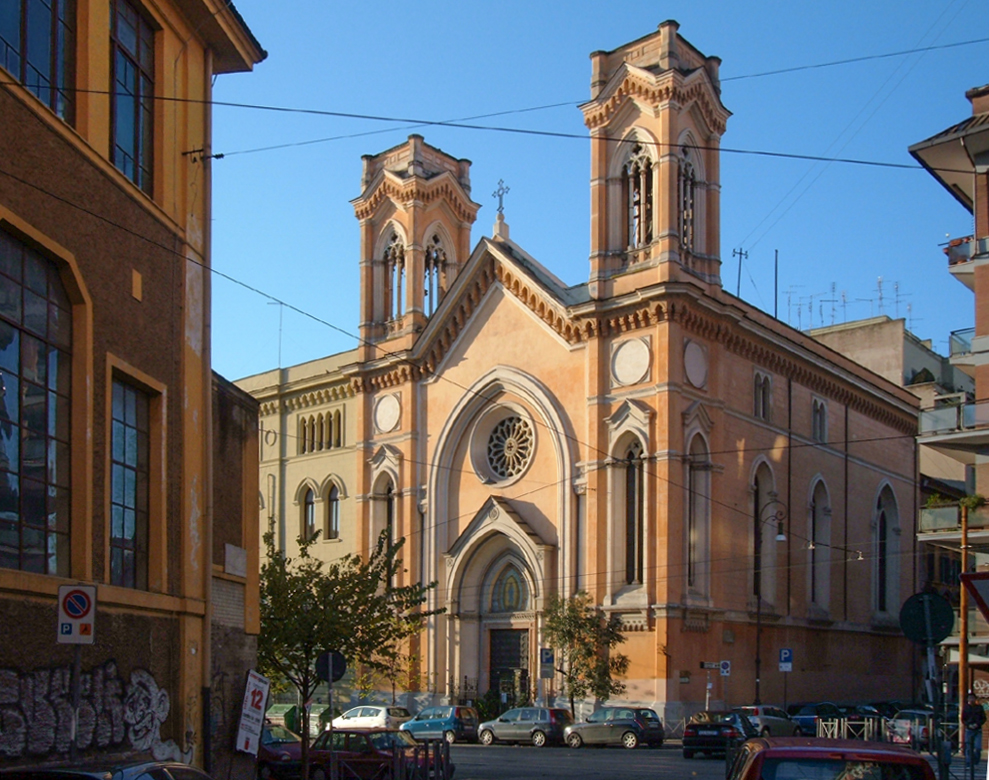
Showing posts with label Churches in Rome. Show all posts

Sunday, January 5, 2020

HOLY TRINITY OF THE PILGRIMS

SS. TRINITÀ DEI PELLEGRINI
Via Trinità dei Pellegrini/angolo Via dei Pettinari

Eleventh or twelfth century, formerly known as S. Benedetto de Arenula (St. Benedict of Arenula) connected to the hospice for pilgrims and convalescents founded in 1540 by S. Filippo Neri

Rebuilt in the years 1603/16 by Paolo Maggi (?/1613) from a design by Martino Longhi the Elder (1534/91)

In 1690 G.B. Contini (1641/1723) inserted eight columns in the pillars of the dome

FAÇADE
1722/23 by Francesco De Sanctis (1693/1740) with “Statues of the four evangelists” by Bernardino Ludovisi (about 1713/49)
Francesco De Sanctis after completing this façade designed and executed in the following three years the famous Spanish Steps in Piazza di Spagna

INTERIOR remodeled in 1858 by Antonio Sarti (1797/1880)

1st RIGHT - CHAPEL OF THE HOLY CROSS
“Wooden crucifix” of the seventeenth century
Frescoes with scenes of the “Passion” of the beginning of 1600s by an anonymous artist influenced by Giovanni Alberti

2nd RIGHT - CHAPEL OF St. FILIPPO NERI
1852 designed by Antonio Sarti
Above the altar “Ecstasy of S. Filippo Neri” by Filippo Bigioli (1798/1898)

3rd RIGHT - CHAPEL OF S. G.B. DE ROSSI
Above the altar “Christ with the Virgin Mary and Sts. John the Baptist and Filippo Neri” 1882 by Antonio Bianchini (1803/84)
Frescoes “Stories of St. Julius” about 1615 by G.B. Ricci (about 1550/1624)

RIGHT TRANSEPT
Marble group “St. Matthew “1587/1602 by Jacob Cornelisz Cobaert aka Cobe the Dutch (about 1535/1615), who had sculpted it for the Contarelli Chapel in S. Luigi dei Francesi. However, it was rejected by the client Matteo Contarelli

It was purchased by the Crescenzi family and it was made complete in 1615 with the “Angel” by Pompeo Ferrucci (about 1566/1637)

“The marked Mannerism of the apostle contrasts here with the Baroque figure of the angel, echoing the style of Francesco Mochi and elements of classical sculpture which Ferrucci liked very much” (Roberto Luciani)

MAIN ALTAR
“Holy Trinity” by Guido Reni 1625/26 (1575/1642) for Cardinal Ludovisi

PENDENTIVES
“Four Evangelists” about 1612 by G.B. Ricci

DOME
In the lantern “Eternal Father” 1612 by Guido Reni

LEFT TRANSEPT
“Sts. Joseph and Benedict” by G.B. Ricci, containing a fragment of a fresco with “Madonna and Child” originally on the outside wall of Palazzo Capranica and considered miraculous

3rd LEFT - CHAPEL OF St. GREGORY THE GREAT
Above the altar “Mass of St. Gregory” by Baldassare Croce (about 1553/1628), who also painted the frescoes on the walls

2nd LEFT - CHAPEL OF Sts. FRANCIS AND AUGUSTINE
Above the altar “Madonna and Child with Sts. Augustine and Francis” by Giuseppe Cesari aka Cavaliere d'Arpino (1568/1640)
Frescoes “Four Doctors of the Church and the four Evangelists” by Baldassare Croce

1st LEFT – CHAPEL OF St. CHARLES BORROMEO
“Madonna and Child with Sts. Dominic, Anthony, Charles Borromeo and Filippo Neri” 1677 by Guillaume Courtois aka il Borgognone (1628/79), other paintings by G.B. Ferretti

SACRISTY
1644 designed by Giacomo Mola (?/1650)
“Annunciation” by G.B. Ricci and “Mass of St. Gregory” about 1572 by Jacopo Zucchi (about 1542/96) with the face of the client right in the center of the painting, Cardinal Ferdinando de' Medici, who inspired Caravaggio for one of the faces of his Deposition in the Chiesa Nuova, now in the Vatican Museums

HOSPITAL-HOSPICE FOR PILGRIMS AND CONVALESCENTS
1622/25 by Giacomo Mola (?/1650)
In 1849 here died the Italian patriot Goffredo Mameli, author of the lyrics of the Italian national anthem

Saturday, January 4, 2020

HOLY TRINITY OF THE SPANISH PEOPLE

SS. TRINITÀ DEGLI SPAGNOLI
Via Condotti 41

1741/46 Emanuel Rodriguez Dos Santos (about 1702/74) for the Bishop Diego Morcillo of the Order of the Shod Trinitarians who sent 200,000 pesos from Peru

The Portuguese architect was joined in the years 1741/44 by Giuseppe Sardi (1680/1753)

There was a dispute between the Trinitarians and Dos Santos, who was considered too experimental

“If the extreme attention to detail has led to describe, as a recurring feature of the works of Dos Santos, a certain 'over-emphasis of detail with respect to the structural frame' (A. Marino), also evident in the façade of the church in question, however, Dos Santos was not lacking quality as an urban planner, evident in the brilliant solution of the inclusion of the church itself in the urban context: the qualification of the surrounding space is achieved through the 'creation of a plastic-spatial structure able to blend seamlessly with the urban surroundings' (Tafuri)” (Daria Colonna)

The church was consecrated in 1750
It passed in 1895 to the Spanish Dominicans

FAÇADE
ABOVE THE PORTAL there is the sculptural group “Angel freeing two chained slaves” by Pietro Pacilli (1716/after 1769)
In the NICHES statues of the founding saints of the order: on the left “St. Felix of Valois” and on the right “St. John of Matha” by Pascasio La Tour

“On entering the church one is struck by the tone of polite composure and consistency of style that characterizes the decoration as a whole, conceived and developed within a few years, both in terms of general fittings and for the individual works of art. About the latter, the Longhi even coined the formula of 'culture of Via Condotti' to indicate that interesting episode of Roman artistic life represented by paintings of the Trinity of the Spaniards” (Daria Colonna)

VAULT

“St. John de Matha in glory” 1748 by Gregorio Guglielmi (1714/73) who also painted “Virgin Mary among the Trinitarians” in the CEILING OF THE CHOIR BALCONY

“He was perhaps the greatest exponent of Roman Rococo. He gave his figures, although hoisted between daring perspectives and unbelievable foreshortenings, a full-bodied and clear corposity, with a new attention derived from the Enlightenment focused on the new spectacle of the world, on familiar and exotic habits. After 1750 he also, like Giaquinto, left the city, to carry out his brilliant career as a fresco painter at the major courts of northern Europe” (Carlo Bertelli, Giuliano Briganti, Antonio Giuliano)

CHAPEL TO THE RIGHT OF THE VESTIBULE
Above the altar “Good Shepherd” by Antonio Gonzalez Velazquez (1723/93), a pupil of Corrado Giaquinto

“The theme of derivation from Murillo with a strong devotional message is treated with a pictorial refinement, sensitive to the teachings of his master” (Daria Colonna)

On the left “S. Miguel de Los Santos” 1779 by Andrea Casali (1705/84), a pupil of Sebastiano Conca and Francesco Trevisani. He painted sixteen canvas in this church

1st RIGHT - CHAPEL OF St. CATHERINE OF ALEXANDRIA
Above the altar “Martyrdom of St. Catherine of Alexandria” 1764 maybe by Giuseppe Paladini (1721/94) but, more likely, by Andrea Casali
On the left “Miracle of the wheel” and on the right “St. Catherine of Alexandria ascends to heaven” 1771 by Andrea Casali

2nd RIGHT - CHAPEL OF St. FELIX OF VALOIS
Above the altar “Sts. John de Matha and Felix of Valois” 1775
On the right “Vision of St Felix of Valois” and on the left “Miracle of St. Felix of Valois with the blind child” 1776 all works by Andrea Casali

3rd RIGHT - CHAPEL OF THE PIETÀ
Above the altar “Deposition of Christ between Mary Magdalene, Mary and St. John the Evangelist” 1777
On the right “Fall under the Cross” and on the left “Flagellation” 1777 all works by Andrea Casali

MAIN CHAPEL
Above the altar “The Holy Trinity assists in the liberation of a slave carried out by an angel” about 1749 by Corrado Giaquinto (1703/66)
It is a splendid work of solemn monumentality and exceptional richness of color, typical features of his maturity
Paintings on the walls “Innocent III dei Conti di Segni (1198/1216) recognizes the Trinitarians” and “Two Founders of the Order”
Frescoes in the dome “Abraham and the Three Angels” and pendentives “Evangelists” 1750 by Antonio Gonzàlez Velàzquez (1723/93) of such excellent workmanship technique that they have led to the belief (rebutted) that they had been retouched by Francisco Goya in 1770

3rd LEFT - CHAPEL OF THE IMMACULATE CONCEPTION
Above the altar “Immaculate Conception” 1750 by Francisco Preciado (1713/89), a pupil of Sebastiano Conca
On the right “Annunciation” and on the left “Assumption of the Virgin Mary” 1781 maybe by Michele Espinosa de la Torre or Andrea Casali

2nd LEFT - CHAPEL OF St. JOHN DE MATHA
Above the altar “St. John De Matha” by Gaetano Lapis (1706/76) who also studied with Sebastiano Conca
On the right “St. John De Matha receives money from the Virgin Mary to free slaves” 1779 and on the left “Miracle of St. John De Matha” 1776 by Andrea Casali

1st LEFT - CHAPEL OF St. AGNES
Above the altar “Martyrdom of St. Agnes” 1750 by Marco Benefial (1684/1764)
This painting is among the most unorthodox and dramatically effective of all the ecclesiastical paintings of the eighteenth century in Rome
On the right “St. Agnes goes to martyrdom” and on the left “Apparition of St. Agnes to her parents” 1773 by Andrea Casali

SACRISTY
1758 Marco David (active in Rome 1754/65)
Vault “St. Ambrose and the two founder saints among angels, slaves and heretics” about 1747 by Gregorio Guglielmi (1714/73)
“Bust in a round frame of Bishop Diego Morcillo” who commissioned the church, by Gaspare Sibilla (about 1723/82)

CONVENT
Paintings by Francisco Preciado (1713/89), Giuliano Presutti (active 1490/1554) and Antonio Gonzàlez Velàzquez (1723/93)

Sunday, September 22, 2019

St. POLYCARP

S. POLICARPO
Piazza Arulio Celio Sabino 50 - Tuscolano
1964/67 masterpiece by Giuseppe Nicolosi (1901/81)
St. Polycarp lived between the first and second century AD in Turkey. He was a disciple of St. John the Evangelist and was bishop of Smyrna in the period of Emperor Trajan (98/117)
This church is one of the most successful among the religious buildings built in Rome in the Sixties
The hexagonal plan determines a giant Star of David also explicitly quoted by the interior beams of the ceiling

“The internal bricks arranged in parallel and crossing rows intend to refer to the situation of human reality, in which lives and destiny of men and women intersect with one another, and in which each person, as each brick, is useful and necessary to support each other” (Official website of S. Policarpo Church - www.sanpolicarpo.it)

Internal height of about 40 m (131 feet)

The architect has cleverly managed to quote, with the color and the treatment of the materials used, the nearby and remarkable ancient Roman ruins of the adjacent Park of the Aqueducts

At the end of the sixties this was the first church ever to be directly involved in the political turmoil of that period. It was even occupied by slum dwellers who lived nearby

“Extraordinary synthesis between figurative tension and geometric rigor. The research for a form figurative and timeless at the same time finds here its expressive peak. The building features an architectural design based on the shape of the hexagon, which ends up invading all areas, from the plan of the floor, to the volume of the building, to its structural pattern” (Giorgio Muratore)

“The whole play of volumes that some authors have described as animated by a 'telescopic dynamism' is indeed very innovative and it is a work of great maturity, especially in a period in which architectural experiments followed each other without apparently leading to unequivocal results. The complex system of layers of the roof highlights, from a first glance, a design quality of high profile, both structurally and in terms of form. (...) In short, we face a church where are happily married advanced architectural solutions and liturgical requirements, formal aspects and social commitment, demonstrating that a sacred building to be 'alive' must be a creature of its time participating in what is the social life of the community, so as to penetrate into it with the power of the Christian message” (Massimo Alemanno)

Thursday, July 25, 2019

St. PAUL FIRST HERMIT

S. PAOLO PRIMO EREMITA
1767/75 Clemente Orlandi (1694/1775) Luigi Vanvitelli's pupil. It was built over a previous church of mysterious origins
“The church stands on the site of an older one, for which the only source is a manuscript of Giovanni Antonio Bruzio. According to this manuscript some Hungarian and Polish monks, following the rule of St. Paul the First Hermit, previously settled in S. Salvatore in Onda and later in S. Stefano Rotondo, in 1669 bought this site on Viminal Hill from the Cistercians of St. Pudentiana and erected here a small church and a monastery” (Antonio Michelazzi - www.sanfrumenzio.it/archivio/paolo_di_tebe.pdf)
“It was the most important job, albeit late in his life, that Orlandi was ever given. His career, although celebrated with important academic awards, had consisted mainly in technical consulting, renovations and restorations. So he poured it into what was to be his masterpiece, all of his architectural culture, deeply rooted in the great tradition of the Roman Baroque” (Antonio Federico Caiola)
It is the last example of a Baroque style building in Rome
It became the new Hungarian church of the Order of the Pauline Monks after the destruction in 1777 of the ancient church of the Hungarians near the Basilica of St. Peter, for the construction of the new sacristy
It was also dedicated to the St. Stephen I (about 970/1038), the first king of Hungary who had promoted the conversion of the Hungarians to Christianity
Since 1801 it belonged to the Conservatory of the Most Holy Trinity
Deconsecrated in 1870 when the Savoy crest on the FAÇADE replaced a palm tree. The coat of arms is still however supported by two lions and a raven, symbol of the saint as the palm
It is now owned by the Ministry of Interior and it is the seat of the officers' club of the Italian Police

INTERIOR
A Greek cross with a dome with skylight windows. The original decorations is gone
St. PAUL OF THEBES lived in the third century AD and, according to tradition, when he was sixteen, during the persecution of Decius (249/251), fled into the wilderness where he lived for almost ninety years sheltered in a cave with a palm tree and a source of water, eating the bread that was brought to him by a raven
He would have died at 113 years in the year 341 AD
At his death, St. Anthony Abbot buried him in a pit dug, according to legend, by two lions
In the emblem of the Order of the Pauline Monks there are the symbols of St. Paul of Thebes that relate to his life: a palm tree, two lions and a raven with a piece of bread in its beak

Tuesday, April 2, 2019

St. MARY ON VIA LATA

S. MARIA IN VIA LATA
Founded, according to tradition, in the seventh century as a diaconia in the six quadrilateral rooms built, at the time of emperor Hadrian (117/138 AD) and at the beginning of the third century AD
The six rooms included the large PORTICO of the first century AD, with vaulted ceilings 10 m (33 feet) high, which continues at the side of Via del Corso under Palazzo Doria Pamphilj
A diaconia was an establishment for the care of the poor and distribution of the church's charity in the Middle Ages
Mentioned in the sources for the first time in the year 806
An upper church was built in 1049
Demolished and rebuilt in the years 1491/1506 for Pope Innocent VIII Cybo (1484/92) and, later, for Julius II Della Rovere (1503/13)

BELL TOWER
1580 Martino Longhi the Elder (1534/91)

FAÇADE
1658/62 masterpiece by Pietro Berrettini aka Pietro da Cortona (1597/1669) for Alexander VII Chigi (1655/67)
“The classicizing tendencies already apparent in the simple Doric style of S. Maria della Pace, grow stronger here, while the complexity of Sts. Luke and Martina seems to have been reduced to the crystal clarity of some recurrent themes” (Rudolf Wittkower)
“The building offers multiple views: from the front, with the leading the rhythm of the columns inserted in the predominantly flat façade, laterally, with the depth in foreshortening view of portico and loggia. In both cases you have vigorous contrasts of light and shadow; his interest for Venetian art prompts Pietro da Cortona to conceive the façade not only as a plastic entity, but as a coloristic one” (Giulio Carlo Argan)
“For the façade of the church of S. Maria in Via Lata (...), Pietro da Cortona had to give up a scenic architectural style as well as a bend of the façade. It gives the impression of a severe and monumental classicism, with two floors of Corinthian colonnades divided by a heavy entablature and framed by a wall with pilasters. In the motif of the arch in the upper floor, which interrupts the entablature and fits into a triangular pediment, Cortona was obviously inspired by the examples of Hellenistic and late Roman architecture (Baalbek, Split, etc.)” (Giuliano Briganti - Dizionario Biografico degli Italiani Treccani)
In the ENTRANCE relief “Virgin Mary” by Cosimo Fancelli (1620/88)
INTERIOR completely renovated for the Holy Year of 1650 by Cosimo Fanzago (1591/1678)
Restoration 1863 Salvatore Bianchi (1821/84)
“Twelve ancient columns of cipolin marble” coated with Sicilian jasper

CEILING
Made out of wood with coffers painted, renovated in 1863 for Pius IX Mastai-Ferretti (1846/78) with “Coronation of the Virgin Mary” by Giacinto Brandi (1621/91) and illusionistic perspective painted by Viviano Codazzi (1604/70)

COUNTER FAÇADE
Oval “Baptism of Jesus” by Agostino Masucci (1691/1758)
In the church there are ten more ovals with “Stories of the Virgin Mary and Christ” 1720/40 by Agostino Masucci, Pietro de Pietri (1663/1716), Giovanni Domenico Piastrini (1678/1740)
The organ dates back to 1652

1st RIGHT - ALTAR OF St. ANDREW
Maybe by Bernardo Borromini, Francesco Borromini's nephew
Above the altar “Martyrdom of St. Andrew” about 1685 by Giacinto Brandi

2nd RIGHT - ALTAR OF St. JOSEPH
Above the altar “St. Joseph and Sts. Nicholas and Blaise” about 1686 by Giuseppe Ghezzi (1634/1721)

CHAPEL TO THE RIGHT OF THE APSE (Sacrament and Crucifix)
1716 by Domenico Paradisi (active in the first half of the eighteenth century) for G.B. Pamphilj
“Ciborium of alabaster and lapis lazuli” by Domenico Paradisi
On the right “Funerary monument of the painter Drouais” 1789 by Claude Michaillon (1751/99)
“The monument is important evidence of the severe artistic taste that was forming among the youth of the Académie de France, and that had already conducted, a few years before, to the early masterpieces by David. The typology of the ancient stele, tested here is the premise of some of the most important novelties by Canova, who much admired this work” (Francesca Aloisi)
On the left “Monument to Pope Pius IX” 1871 by Ignazio Jacometti (1819/83)

MAIN ALTAR
1636/43 by Gian Lorenzo Bernini (1598/1680) who used about twenty different types of marble and gilded bronze for Francesco D'Aste who wanted to have here the graves of his father G.B. D'Aste on the left by Giuliano Finelli (1602/53) and of his mother Clarice Margana on the right by Andrea Bolgi (1606/56)
Above the altar “Madonna Advocata” painted on board in about 1175, formerly believed to have been painted by St. Luke himself
In the apsidal basin “Assumption” by Andrea Camassei (1602/49) repainted in the nineteenth century
“Wooden Choir” 1628

CHAPEL TO THE LEFT OF THE APSE (Sts. Catherine and Cyriacus of Ancona)
Designed by Domenico Paradisi
Above the altar “Madonna and Child with Sts. Catherine and Cyriacus of Ancona” by Giovanni Odazzi (1663/1731)
Traces of cosmatesque floor
“Tomb of Joseph Napoleon Bonaparte”, Napoleon's brother, by G. Tombini and “Tomb of Zenaide Bonaparte”, nephew of Napoleon, with bust by Pietro Tenerani (1789/1869)
“Monument of the poet Antonio Tebaldeo, d. 1537” 1776

2nd LEFT - ALTAR OF St. PAUL
Above the altar “St. Paul baptizes St. Sabina and her children” about 1726 by Pier Leone Ghezzi (1674/1755)

1st LEFT - ALTAR OF St. LAWRENCE
Altarpiece “Madonna and Sts. Anthony of Padua, Lawrence, Praxedes and Venancio” by Pietro de Pietri (1663/1716)

ROOM CLOSE TO THE SACRISTY
Terracotta relief “Holy Family” by Cosimo Fancelli (1620/88)
“Crucifixion” maybe by Ciro Ferri (1634/89) copy from the original by Pietro da Cortona in S. Thomas of Villanova in the city of Castel Gandolfo

SACRISTY
Vault “Assumption” 1733 by Michelangelo Cerruti (1663/1748)

UNDERGROUND ROOMS
Six quadrangular rooms of the time of emperor Hadrian (117/138), five of which were rearranged by Pietro Berrettini aka Pietro da Cortona in the years 1658/61:
Two frescoes of his school in the stairwells
“Monument to Atanasio Ridolfi” in the vestibule of his own design
High relief “Sts. Peter, Paul, Martial, and Luke” by Cosimo Fancelli
Cosmatesque ornamentation of the thirteenth century on a railing
The paintings of the beginning of the seventh century that were found here are now in the Balbi Crypt
According to an ancient tradition, these rooms were one of the Roman houses where St. Paul stayed and St. Luke would have also lived here

Thursday, March 28, 2019

St. MARY IN MONTERONE

S. MARIA IN MONTERONE
Mentioned in the sources for the first time in 1186
Rebuilt in 1682
It was entrusted in 1728 to the Mercedari monks of the Congregation of Holy Mary of Mercy for the ransom of slaves
Restored with the raising of the floor in 1754 maybe by Domenico Gregorini (1692/1777)
Restored again in 1848
The church is located at the center of the area where there was once the STAGNUM AGRIPPAE, an the ancient artificial lake of the Baths of Agrippa

TO THE RIGHT OF THE ENTRANCE
“Tombstone of Giovanni Bazzano” d. 1406 originally embedded in the floor
EIGHT ANCIENT COLUMNS
RIGHT NAVE - ALTAR OF THE SOULS IN PURGATORY
Painting “Assumption” 1830 by Giovanni Gagliardi
AT THE END OF THE RIGHT NAVE - CHAPEL OF St. JOSEPH
Above the altar “Madonna with Child, St. John the Baptist and an Angel” of the end of the seventeenth century
On the right wall “Tomb of Anna Moroni” 1647
TO THE RIGHT OF THE ALTAR
“Memory funeral of John Rinuccini” 1730

MAIN ALTAR
“Sts. Peter Nolasco, Peter Paschasius and two slaves in chains venerating the Virgin Mary and Child” maybe by Pompeo Batoni (1708/87) or of his pupil Gaspare Serenari (1707/59)

TO THE LEFT OF THE ALTAR
“Tomb of Cardinal Stefano Durazzo” 1667, with winged skeleton
AT THE END OF THE LEFT NAVE - CHAPEL OF St. ALPHONSUS MARIA DE' LIGUORI
1848 Pietro Camporese il Giovane (1792/1873)
Above the altar “Stories of St. Alphonsus” 1848, on the right “St. Alphonsus in ecstasy in front of the Virgin Mary” and on the left “St. Alphonsus gives the rule to the Redemptorists” by Donato De Vivo
On the left “Tomb of Vincenzo Campanari” 1858

BUILDING OF THE CONVENT OF S. MARIA IN MONTERONE
To the right of the church
1735 Francesco Bianchi for the brothers Mercedari, with bizarre and interesting decoration on the façade

Saturday, March 9, 2019

St. MARY OF THE LIGHT

S. MARIA DELLA LUCE
Third or fourth century as S. Salvatore della Corte (St. Savior of the Court) alluding to the name of the nearby ancient EXCUBITORIUM DELLA VII COORTE DEI VIGILI (Headquarters of the VII Firefighters Brigade) 
Renovated in the twelfth century
Renovated again in 1730 by Gabriele Valvassori (1683/1761), who worked for free as a vow to the Virgin Mary for having been healed from a serious illness
The DOME was demolished in 1891 due to the damage caused by the explosion of a gunpowder depot nearby

1821 in simple stucco. Funds were never raised to properly complete Valvassori's work
The name of the church is such for a series of miracles that occurred in 1730 related to an image painted on the outside wall of a house nearby, which was seen to glow, after having returned sight to a blind man
The image was then transferred in the church, which changed its name from St. Savior of the Court to St. Mary of Light
It is the church of the Latin-American community in Rome and it is entrusted to the Minims of St. Francis of Paola
It is the seat since 2003 of the CAPPELLANIA LATINOAMERICANA (Latin-American Chaiplaincy), founded by the Scalabrini Fathers in 2000
The mission is made up of eighteen communities from different countries of Latin America and here Mass is celebrated in both Spanish and Portuguese languages

INTERIOR
Restored in 1730 by Gabriele Valvassori
Stucco decoration 1768

3rd CHAPEL ON THE RIGHT
Above the altar “Death of St. Joseph” 1754 by Giovanni Conca (about 1690/1771) cousin of the more famous Sebastiano Conca and often believed his brother, so tight their bonds of friendship and work were. He was the father of distinguished painter Tommaso Conca

4th CHAPEL ON THE RIGHT
Above the altar “Virgin Mary with Sts. Anne and Joachim” 1753 by the Roman Pietro Labruzzi (1738/1805) who was the court painter of King Stanislaus Augustus of Poland
“His first documented work dates to 1753 with the Virgin Mary and Sts. Anne and Joachim painted for the Roman church of S. Maria della Luce, as part of the decoration works promoted by the Minims and assigned to a group of artists of Neapolitan background, including Sebastiano and Giovanni Conca and Onofrio Avellino. This would suggest, considering also the stylistic affinity with the adjacent works by Sebastiano Conca and Avellino in the same church, a youth pictorial training of Labruzzi among the Neapolitan community of artists operating in the papal capital. Moreover, still together with artists from the southern area (again Sebastiano Conca, but also Gaetano Sortini), Labruzzi was active in the subsequent works in St. Stephen in Piscinula (destroyed in about 1862) for the altar with The Stoning of St. Stephen” (Francesco Leone - Dizionario Biografico degli Italiani Treccani)
Frescoes in the APSE “Eternal Father blessing”, “Savior” on the tabernacle and restoration of the “Lady of Light” (originally dating back to the sixteenth century) by Sebastiano Conca (1680/1764)

LEFT TRANSEPT
Above the altar “St. Francis of Paola crossing the Strait of Messina” by Onofrio Avellino (about 1674/1741), a pupil of Francesco Solimena

3rd CHAPEL ON THE LEFT
Above the altar “Sts. Francis of Paola, Francis de Sales and Jeanne de Valois” 1752 by Giovanni Conca (about 1690/1771)

Wednesday, March 6, 2019

St. MARY IMMACULATE ON THE ESQUILINE HILL

S. MARIA DELL'IMMACOLATA ALL'ESQUILINO
1886/1914 by the architects Cursi and Cortese for the order of the Frati Bigi (Grey Friars) which was abolished in 1973
Neo-Gothic style
The church was consecrated only in 1942
Since 1973 it has become a subsidiary place of worship for the parish of Sts. Peter and Marcellinus

St. MARY OF THE SOUL

S. MARIA DELL'ANIMA
Built in the fourteenth century as a chapel for the Hospice for German, Dutch and Flemish Pilgrims at behest of the gunsmith Dordrecht and his wife
Rebuilt in the years 1500/23 maybe by Giuliano Giamberti aka Giuliano da Sangallo (1445/1516)
Mid-1700s CHOIR renovated by Paolo Posi (1708/76)
Fully restored in 1843
Further restoration 1874/75 by Emilio Stramucci with interior decoration by Ludovico Seitz (1844/1908) representing German personalities and Saints

Three portals and a copy of the sculptural group “Virgin Mary between two souls in purgatory” (original in the Chapel of the Fallen) maybe by Andrea Contucci aka Andrea Sansovino (1460/1529) or by Bartolomeo Lante

BELL TOWER built in 1502
It is the German national church whose model were the German Hallenkirchen
“Saints” in the nave and stained glass window above the entrance “Virgin Mary with Child enthroned with saints” 1875/82 by Ludovico Seitz

TO THE LEFT OF THE ENTRANCE
“Tomb of Cardinal Andrea d'Asburgo” 1600 by Gillis de la Rivière (?/1602)

TO THE RIGHT OF THE ENTRANCE
“Tomb of Cardinal Willem van Enkevoirt” 1536/38 by Giovanni Mangone

1st RIGHT - CHAPEL OF S. BENNO
“The Bishop Benno, who lived in the eleventh century, was declared a saint in 1523 by Pope Adrian VI (buried in this church) in opposition to the rampant Lutheran movement, which soon after would destroy Benno's reliquary throwing it in the Elba River; the saved relics were brought to the Duke of Bavaria (to whom Saraceni was about to send some of his works) in the 'Bavaria Sancta' where the Catholic cult of relics was a bulwark against the Protestant Reformation and of which Benno was declared guardian saint. (...) The fish is a clear reference to Christology, and the host-fisherman is almost certainly a portrait of an influential member of the community, the merchant and patron George Piscatorius” (Maria Giulia Aurigemma)
Altarpiece “Holy Family” by Giacinto Gimignani (1606/81)
On the left “Tomb of Cardinal Johann Walter Sluse” 1687 with bust by Ercole Ferrata (1610/86)
On the right “Tombs of Johannes Savenier and his nephew Gualtero Gualteri de Castro” with a bust by Alessandro Algardi (1598/1654)

ON THE 3rd PILLAR ON THE RIGHT
“Tomb of Adrian Vryburg with cherubs” 1629 by François Duquesnoy (1597/1643)
“From 1618 he was active in Rome, where he remained until a short time before his death. He was successful in the Roman scene, becoming one of the most prominent figures of the Classicist style. (...) The tombs (...) in S. Maria dell'Anima (...), enriched with figures of little angels, indicate not only his mastery in dealing with marble but also the anti-Baroque classical composure that was his artistic ideal” (Enciclopedia Treccani)
“Crucifix” by G.B. Montano (1543/1621)
“Life of the Virgin Mary” by Girolamo Siciolante da Sermoneta (1521/80)

4th CHAPEL ON THE RIGHT
Copy of the “Pieta” by Michelangelo begun in 1532 by Lorenzo Lotti aka Lorenzetto (1490/1541) and completed by Giovanni Lippi aka Nanni di Baccio Bigio (about 1513/68)

1937 Karl Holey (1879/1955) who rebuilt the Cathedral of Vienna and the Salzburg Cathedral after the Second World War

MAIN ALTAR
“Fugger altarpiece: the Holy Family with saints” 1522 by Giulio Pippi aka Giulio Romano (1499/1546) for the banker Jacob Fugger of Augsburg, his last work before going to Mantua
It was repainted in 1619 by Carlo Saraceni in 1682 by Carlo Maratta, in 1819 by Pietro Palmaroli and in 1880 by Ludovico Seitz, although the work is considered by Giulio Romano for about 85%
“It is particularly significant because it seems to anticipate some of the grounds that the artist will develop after a few years. Thus the luminous effect that envelops the characters isolated in a dark space, recalls the night of the Sala di Psyche at Tea Palace in Mantua, in the same way as the ' architecture in the background with octagonal coffered vault and Doric pilasters that frame the niches , prefigures certain architectural solutions of the palace of Mantua” (Carlo Bertelli, Giuliano Briganti, Antonio Giuliano)
On the right “Nativity of the Virgin” and on the left “Death of the Virgin” mid-1700s by Ludovico Stern (1709/77), son of Ignazio Stern
Central window “Trinity” by Ludovico Seitz (1844/1908)
On the right “Monument of Adrian VI (1522/23)” with the four cardinal virtues: “Fortitude, Temperance, Justice and Prudence” by Baldassare Peruzzi (1481/1536)
Adrian VI was born in Utrecht in the Netherlands and he was the last non-Italian pope before John Paul II (1978/2005)
On the left “Tomb of the Duke of Cleves” 1576 by Gillis de la Rivière (?/1602) and Nicolò Pippi (?/1601-1604 )

TO THE LEFT OF THE ENTRANCE TO THE SACRISTY
“Tomb of Lukas Holstenius” by Antonio Giorgetti (active since 1660/d. 1669)

ON THE 3rd PILLAR ON THE LEFT
“Tomb of Ferdinand van der Eyden” 1631 by François Duquesnoy (1597/1643)

4th CHAPEL ON THE LEFT
On the altar “Deposition”, in the vault “Descent of the Holy Spirit” and on the walls “Sacred Stories” 1540 masterpiece by Francesco de' Rossi aka Francesco Salviati (1510/63)
“Today, unfortunately, the frescoes are so faded that even critical judgment on them would be diminished. Anyway it is admirable the beautiful decorative texture of the side walls, whose narrowness does not appear to have represented a major obstacle for Salviati. On each of them the mighty figure of a saint stands in a pose with imposing balanced gestures and rhythmic articulation, surrounded by a rich ornamental frame. (...) The altarpiece accentuates almost too violently the nakedness of the body taken down from the cross. What in Rome appears as a novelty is the extraordinary exuberance of the decorative system of illusionary type” (Hermann Voss)
“Stories of St. Barbara” about 1538 by the Flemish artist Michiel Coxie (1499/1592), known as the Flemish Raphael. He died 92 years old, falling from the stairs


There are the relics of St. Lambert
Altarpiece “Martyrdom of St. Lambert” 1618/19 by Carlo Saraceni (1579/1620)
“The patron Lambertus de Ursinus Vivariis placed the painting with his namesake saint in his family chapel. He chose a subject connected with his name and with the criminal profanation in a sacred place (the Cathedral of Liege), alluding to the desecration of the memory of the martyrs and of the role itself of holiness that the Protestants carried out during the wars of religion that had shocked the Netherlands” (Maria Giulia Aurigemma)
Frescoes “Stories of St. Lambert” 1650/53 by the painter from Antwerp Jan Miel (1599/1663)

SACRISTY
1636 Orazio Torriani (about 1601/about 1657) and later Paolo Marucelli (1594/1649)
In the vault “Assumption” 1636/39 by Giovanni Francesco Romanelli (1610/62) from Viterbo, a pupil of Pietro da Cortona
Paintings on the walls with the theme of “Life of the Virgin Mary” by Gilles Hallet (1620/94), Giovanni Maria Morandi (1622/1717), Theodor van Loon (1581-82/1649) and Anton von Maron (1733/1808)