Showing posts with label Anton Raphael Mengs. Show all posts

Monday, January 14, 2019

St. EUSEBIUS

S. EUSEBIO
The original church dates back to the fifth century, one of the oldest churches in Rome
It was built, according to tradition, on the Titulus Eusebii, the house of S. Eusebius (about 319/about 357), one of the 43 saints with this name recognized by the Catholic Church
Rebuilt in 1238 for Gregory IX dei Conti di Segni (1227/41)
It was rebuilt again in 1600 by Onorio Longhi (1568/1619)
Restored in the years 1750/59 by Nicolò Picconi

FAÇADE
1711 Carlo Stefano Fontana (active 1700/about 1719) son of Carlo Fontana (1634/1714) and brother of Francesco Fontana

BELL TOWER of the time of Honorius III Savelli (1216/27)
Every 17 January for the feast of St. Anthony of Egypt the blessing of the animals takes place in the churchyard, moved here in the twentieth century from the churchyard of the neighboring church of St. Anthony of Egypt for reasons of public order

VAULT
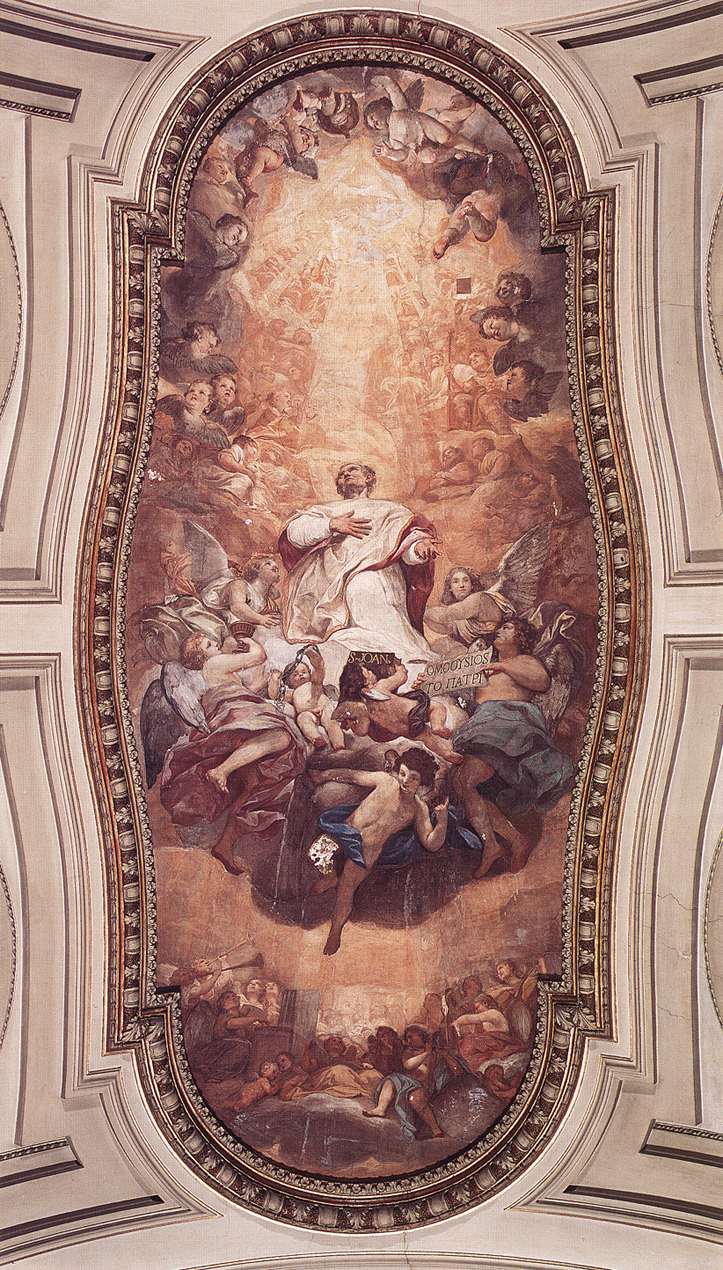
“Glory of St Eusebius” 1757 by Anton Raphael Mengs (1728/79)
It is one of the first examples of a painting in neoclassical style
The face of one of the angels represented by Mengs is the portrait of the woman he loved

NAVE
Paintings between the windows by Giuseppe Passeri (1654/1714) pupil of Carlo Maratta

SIDE NAVES
End of 1800s/beginning of 1900s

MAIN ALTAR
Designed by Onorio Longhi
On the altar “Madonna and Child” maybe by Pompeo Batoni (1708/87)

CHANCEL
Stalls and music stand of walnut carved with grotesque figures in the seventeenth century
To the right “Madonna and Saints” by Baldassare Croce (about 1553/1628)

CLOISTER
1588 Domenico Fontana (1543/1607)
It is built with bricks and it features a central fountain
The MONASTERY, to which the cloister belongs, is the seat of the Central Directorate of Health of the State Police
It was the place where one of the first printers in Rome ever operated: it was run in the years 1470/71 by the German Georg Lauer

Friday, December 15, 2017

VIDONI PALACE

PALAZZO VIDONI
Built in1515 as Palazzo Caffarelli for Bernardino Caffarelli
Giorgio Vasari attributed to Lorenzo Lotti aka Lorenzetto (1490/1541) who is said to have followed the advice of Raffaello Sanzio (Raphael) (1483/1520)
Expanded in 1550 and in 1770 by Nicola Giansimoni (active from 1766/d. 1800) for the Stoppani family
At the end of the eighteenth century it was bought by Cardinal Pietro Vidoni. Later it belonged to the Giustiniani Bandini family
The original FAÇADE is on Via del Sudario
It was raised with an EXTRA FLOOR and given a NEW FAÇADE ON CORSO VITTORIO EMANUELE II in the years 1886/87 by Francesco Settimj (active 1876/88), who opened a new main entrance in what was once the back of the building
Here took place the historic meeting between Pope Paul III (1534/49) and the German Emperor Charles V key to future relations between empire and papacy
It was the German Embassy and the administrative headquarters of the National Fascist Party. At that time it was renamed PALAZZO DEL LITTORIO
At the end of the Second World War it was the headquarters of the French Army
Now it houses the Ministry for Reforms and Innovation in Public Administration
In the foundations of the palace the “talking” statue Abate Luigi was found. It originally decorated the Curia of Pompey over which the palace was built
ROOM CHARLES V
In the frieze paintings “Stories of Charles V” by the school of Pietro Bonaccorsi aka Perin del Vaga (1501/47)
ROOM OF MIRRORS
Also called the Lady's Cabinet, the lady being the Duchess Giustiniani Bandini. A delightful delirium of Rococo style
Ceiling “Cupid with Doves” by Prospero Piatti (1842/1902)
ROOM OF AUDIENCES
Ceiling “Allegory of painting, sculpture and architecture” maybe by Anton Raphael Mengs (1728/79), more likely by Tommaso Maria Conca (1734/1822) who was a pupil of his uncle, the great Sebastiano Conca

Wednesday, February 24, 2016

BARBERINI PALACE - NATIONAL ART GALLERY (twenty-fourth part)

Room XXIX - The Second Half of the 1700s in Rome: Towards Neoclassicism

“Young Girl as a Bacchante” by the Swiss-Austrian Angelica Kauffmann (1741/1807)
“Angelica begins her career very young, showing a child prodigy talent. Her father, a painter, although of poor fortune, was her first teacher and also the architect of her success. He accompanied her in Florence, (...) in Rome and also spent brief periods in Naples and Bologna. She got assignments in London at the court of George III and had a great success. (...) The girl depicted with the attributes that one would commonly refer to Bacchae seems to express the 'natural grace', that for Winckelmann is the 'nice according to reason' (...), far away from the gallant grace, sensual and frivolous of rococo painting, while still making an image of studied sensuality, in which the attribute of the cuff on the upper arm takes us back to the classical iconography of Venus” (Lorenza Mochi Onori)
“Portrait of sir Henry Peirse” 1775, “Madonna with child and S. Filippo Neri” and the incredibly beautiful “Hagar and the Angel” 1776 by Pompeo Batoni (1708/87)
“This painting depicts the apparition to Hagar, banished to the desert with her son Ishmael, of an angel, who indicates a source of water (Genesis, xxi, 8-21). It is one of the most refined and elegant productions of Batoni's late activity, during which his work differs from the prevailing neoclassical structure in the landscape, which builds on models of the previous century” (Lorenza Mochi Onori)
“In the Madonna and Child with S. Filippo Neri Batoni had as a model the work of Guido Reni the Virgin Mary with St. Philip at the Vallicella, and for the features of the saint, the study of the death mask (...). In this work the relationship between Batoni's painting and the great Roman classical school of the seventeenth century is perfected, filtered through a new accuracy and clarity of form already neoclassical” (Lorenza Mochi Onori)
Extraordinary “Back of naked woman” about 1740 by the Frenchman Pierre Subleyras (1699/1749)
“He painted one of the first female nudes from life ever, perhaps his wife, the miniaturist Maria Felice Tibaldi. The representation is intimate and spontaneous, the smooth curves of the body are made ​​from soft brushed with various shades, with a technique very forerunner and modern” (Official website of the Barberini Gallery - www.galleriabarberini.beniculturali.it)
“Portrait of Mrs. Carducci” and “Jupiter Kisses Ganymede” about 1759 by Anton Raphael Mengs (1728/79)
Jupiter kisses Ganymede is the famous ancient false which made Winckelmann so excited that he described it as “the most beautiful painting so far extant from antiquity”
Anton Raphael Mengs himself, only at the point of death, begged her sister to make the false public
“The portrait of Mrs. Carducci was executed by Mengs in a virtuoso and quick manner, managing anyway to render the expressiveness of the face of the portrayed, a certain air of melancholy and the depth of her look” (Lorenza Mochi Onori)
“The Portrait of Lady was attributed to Anton Raphael Mengs, teacher and brother-in-law of Von Maron (Von Maron had married Mengs' sister) and painter who was contending to Pompeo Batoni the first place as a painter of portraits immediately after the mid-century. This kind of portraiture, particularly in the way of making the expression of intent on the face of the lady in her official character, belongs to the ways of Mengs. Nevertheless, even if the two painters worked together for a long time, because of their close relationship, and Von Maron followed the pattern of Mengs in portraiture, inheriting also his customers, the two fundamental elements that would attribute the painting to the hand of Von Maron are the color of the skin, looking pale and porcelain-like, and the dating of the lady's hairdressing “(Steffi Röttgen)
“Portrait of Cardinal Francesco Landi” by Ludovico Stern (1709/77) son of Ignazio Stern (1679/1748)
“Ludovico was a versatile artist, a beautiful hand, extensive and updated artistic culture and full academic training. Oddly, compared to the customs of the Roman painting of the eighteenth century, he refused any specialism, competing with equal commitment and results just as brilliant in all types and genres of painting: from altarpieces to frescos, from history paintings to portraits, from still life to paintings of animals. His career, it seems, took place entirely in Rome and in fact his painting reveals a detailed knowledge of the Roman paintings of the seventeenth and eighteenth centuries. His constant reference points were, on one hand, the works of Guido Reni, of whom was often a copyist, on the other hand the so-called masters of the Baroque period, as Baciccio, Ludovico Gimignani, Borgognone, Carlo Maratta, Benedetto Luti” (Francesco Petrucci - www.news-art.it)
“Portrait of the painter Filippo Agricola” by Émile Jean Horace Vernet (1789/1863) one of the greatest French painters of the nineteenth century
“Filippo Agricola (1795/1857) was a well-known artist in Rome in the first half of the nineteenth century, a pupil of Gaspare Landi and Vincenzo Camuccini, he painted, among other things, the cartoons for the mosaics on the façade of the Basilica of St. Paul outside the Walls. Agricola (...) was a painter essentially tied to traditional models and neoclassical forms. (...) Vernet, the artist who would describe in passionate tones the Napoleonic epic period and the exoticism of the Orient, shows in this painting, painted 'dal vero' (from life), as stated in the autograph, all characters of the romantic portrait” (Lorenza Mochi Onori)
“Birth of Venus” by Gaetano Lapis (1706/76)
“Pupil in Rome of Sebastiano Conca, Lapis was distinguished for an attitude toward a moderate classicism inspired by the painters from Bologna, which earned him the nickname of 'Carraccetto' (little Carracci). This painting is a sketch for a fresco located on the ground floor of the city palace of Princes Borghese in Campo Marzio, a work that Lanzi considers the masterpiece of this artist from Cagli, near Urbino. (...) The mythological theme is unusual: instead of Venus rising from the water, she is presented as a child on a shell to her father Jupiter flanked by Juno and Minerva. This is one of the very few secular subjects in the production of Lapis, which is underlined in the accentuation of a taste closer to neoclassicism, based on the recovery of antiquity, even if interpreted with balanced moderation by the old painter” (Lorenza Mochi Onori)
“Apollo and Daphne” by Pietro Angeletti (about 1737/98) sketch for the ceiling of the Room of Apollo and Daphne in the Borghese Gallery which houses the eponymous sculpture by Gian Lorenzo Bernini
Sketch “Test of the True Cross” by Giuseppe Cades (1750/99)

Monday, April 20, 2015

VATICAN MUSEUMS - MUSEUMS OF THE APOSTOLIC VATICAN LIBRARY (second part)

Room of the Papyri
 
Built for Clement XIV Ganganelli (1769/74) in order to accommodate the “Papyri of Ravenna” dating from the sixth to the ninth century AD from various sources, of which however copies are exhibited

On the ceiling “Allegory of History” 1774 Anton Raphael Mengs (1728/79) ornamental decorations and frames Cristoforo Unterberger (1732/98)

Models of the “Truth Unveiled by Time” and “Two Charities” by Gian Lorenzo Bernini (1598/1680) for the Monument of Pope Urban VIII in the Basilica of St. Peter

The model of Charity with four putti was executed for the first version of the monument in about 1627/28, the one with two putti for the second version of the years 1634/39

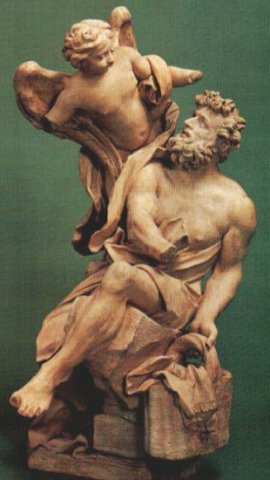
Models of the “Prophet Habakkuk” and “Daniel in the lions' den” also by Gian Lorenzo Bernini for the Chigi Chapel in S. Maria del Popolo

Model of “St. John the Baptist baptizing Jesus” by Alessandro Algardi (1598/1654) for a group of silver made in 1644 on the occasion of the election of Innocent X Pamphilj (1644/55)

The terracotta models kept in this room belonged to Cardinal Flavio Chigi, nephew of Alexander VII
They passed in 1918 to the Italian state and in 1923 they were donated by Benito Mussolini to Pius XI Ratti (1922/39) as an act of reconciliation between Italy and the Holy See


Sacred Museum


Designed by Paolo Posi (1708/76) for Benedict XIV Lambertini (1740/58) in order to accommodate early Christian relics

At the sides of the entrance statues: on the right “Lysias” and on the left “Aelius Aristides”

On the ceiling “Triumph of the Church” and “Triumph of Faith” 1757 by the Roman Stefano Pozzi (1699/1768)

Above the precious cabinets in walnut finished with gilded bronze are placed “Twenty-four bronze busts of cardinals librarians” made in 1783 by Luigi Valadier (1726/85)

Precious Christian and non-Christian ancient pieces:

Glass objects from the fourth century AD some from Ostia, amulets, Roman rings, oil lamps in terracotta, Byzantine seals and weights

“Silver plate” with hunting scenes of the fifth century AD

“Reliquary of Algeria” of the sixth century AD

Early Christian and Coptic textiles including “Sheets of the seven Greek martyrs” eighth or ninth century

“Mosaic with St. Theodore” about 1200 icon for traveling similar to those of the monasteries of Mount Athos

“Chest for the Head of St. Sebastian” ninth century, formerly in the church Ss. Quattro Coronati
“Acquamanile” in oriental style used, according to legend, by St. Lawrence to give baptism