Showing posts with label Giuseppe Cades. Show all posts

Wednesday, February 24, 2016

BARBERINI PALACE - NATIONAL ART GALLERY (twenty-fourth part)

Room XXIX - The Second Half of the 1700s in Rome: Towards Neoclassicism

“Young Girl as a Bacchante” by the Swiss-Austrian Angelica Kauffmann (1741/1807)
“Angelica begins her career very young, showing a child prodigy talent. Her father, a painter, although of poor fortune, was her first teacher and also the architect of her success. He accompanied her in Florence, (...) in Rome and also spent brief periods in Naples and Bologna. She got assignments in London at the court of George III and had a great success. (...) The girl depicted with the attributes that one would commonly refer to Bacchae seems to express the 'natural grace', that for Winckelmann is the 'nice according to reason' (...), far away from the gallant grace, sensual and frivolous of rococo painting, while still making an image of studied sensuality, in which the attribute of the cuff on the upper arm takes us back to the classical iconography of Venus” (Lorenza Mochi Onori)
“Portrait of sir Henry Peirse” 1775, “Madonna with child and S. Filippo Neri” and the incredibly beautiful “Hagar and the Angel” 1776 by Pompeo Batoni (1708/87)
“This painting depicts the apparition to Hagar, banished to the desert with her son Ishmael, of an angel, who indicates a source of water (Genesis, xxi, 8-21). It is one of the most refined and elegant productions of Batoni's late activity, during which his work differs from the prevailing neoclassical structure in the landscape, which builds on models of the previous century” (Lorenza Mochi Onori)
“In the Madonna and Child with S. Filippo Neri Batoni had as a model the work of Guido Reni the Virgin Mary with St. Philip at the Vallicella, and for the features of the saint, the study of the death mask (...). In this work the relationship between Batoni's painting and the great Roman classical school of the seventeenth century is perfected, filtered through a new accuracy and clarity of form already neoclassical” (Lorenza Mochi Onori)
Extraordinary “Back of naked woman” about 1740 by the Frenchman Pierre Subleyras (1699/1749)
“He painted one of the first female nudes from life ever, perhaps his wife, the miniaturist Maria Felice Tibaldi. The representation is intimate and spontaneous, the smooth curves of the body are made ​​from soft brushed with various shades, with a technique very forerunner and modern” (Official website of the Barberini Gallery - www.galleriabarberini.beniculturali.it)
“Portrait of Mrs. Carducci” and “Jupiter Kisses Ganymede” about 1759 by Anton Raphael Mengs (1728/79)
Jupiter kisses Ganymede is the famous ancient false which made Winckelmann so excited that he described it as “the most beautiful painting so far extant from antiquity”
Anton Raphael Mengs himself, only at the point of death, begged her sister to make the false public
“The portrait of Mrs. Carducci was executed by Mengs in a virtuoso and quick manner, managing anyway to render the expressiveness of the face of the portrayed, a certain air of melancholy and the depth of her look” (Lorenza Mochi Onori)
“The Portrait of Lady was attributed to Anton Raphael Mengs, teacher and brother-in-law of Von Maron (Von Maron had married Mengs' sister) and painter who was contending to Pompeo Batoni the first place as a painter of portraits immediately after the mid-century. This kind of portraiture, particularly in the way of making the expression of intent on the face of the lady in her official character, belongs to the ways of Mengs. Nevertheless, even if the two painters worked together for a long time, because of their close relationship, and Von Maron followed the pattern of Mengs in portraiture, inheriting also his customers, the two fundamental elements that would attribute the painting to the hand of Von Maron are the color of the skin, looking pale and porcelain-like, and the dating of the lady's hairdressing “(Steffi Röttgen)
“Portrait of Cardinal Francesco Landi” by Ludovico Stern (1709/77) son of Ignazio Stern (1679/1748)
“Ludovico was a versatile artist, a beautiful hand, extensive and updated artistic culture and full academic training. Oddly, compared to the customs of the Roman painting of the eighteenth century, he refused any specialism, competing with equal commitment and results just as brilliant in all types and genres of painting: from altarpieces to frescos, from history paintings to portraits, from still life to paintings of animals. His career, it seems, took place entirely in Rome and in fact his painting reveals a detailed knowledge of the Roman paintings of the seventeenth and eighteenth centuries. His constant reference points were, on one hand, the works of Guido Reni, of whom was often a copyist, on the other hand the so-called masters of the Baroque period, as Baciccio, Ludovico Gimignani, Borgognone, Carlo Maratta, Benedetto Luti” (Francesco Petrucci - www.news-art.it)
“Portrait of the painter Filippo Agricola” by Émile Jean Horace Vernet (1789/1863) one of the greatest French painters of the nineteenth century
“Filippo Agricola (1795/1857) was a well-known artist in Rome in the first half of the nineteenth century, a pupil of Gaspare Landi and Vincenzo Camuccini, he painted, among other things, the cartoons for the mosaics on the façade of the Basilica of St. Paul outside the Walls. Agricola (...) was a painter essentially tied to traditional models and neoclassical forms. (...) Vernet, the artist who would describe in passionate tones the Napoleonic epic period and the exoticism of the Orient, shows in this painting, painted 'dal vero' (from life), as stated in the autograph, all characters of the romantic portrait” (Lorenza Mochi Onori)
“Birth of Venus” by Gaetano Lapis (1706/76)
“Pupil in Rome of Sebastiano Conca, Lapis was distinguished for an attitude toward a moderate classicism inspired by the painters from Bologna, which earned him the nickname of 'Carraccetto' (little Carracci). This painting is a sketch for a fresco located on the ground floor of the city palace of Princes Borghese in Campo Marzio, a work that Lanzi considers the masterpiece of this artist from Cagli, near Urbino. (...) The mythological theme is unusual: instead of Venus rising from the water, she is presented as a child on a shell to her father Jupiter flanked by Juno and Minerva. This is one of the very few secular subjects in the production of Lapis, which is underlined in the accentuation of a taste closer to neoclassicism, based on the recovery of antiquity, even if interpreted with balanced moderation by the old painter” (Lorenza Mochi Onori)
“Apollo and Daphne” by Pietro Angeletti (about 1737/98) sketch for the ceiling of the Room of Apollo and Daphne in the Borghese Gallery which houses the eponymous sculpture by Gian Lorenzo Bernini
Sketch “Test of the True Cross” by Giuseppe Cades (1750/99)

Saturday, October 12, 2013

BASILICA OF THE HOLY APOSTLES

BASILICA SS. APOSTOLI
Begun at the behest of Pelagius I (556/561) to celebrate the Byzantine victory over the Goths in the Greek-Gothic war (535/553) and to house the relics of St. Philip and S. James the Less, Apostles of Jesus, still housed in the Basilica
Its original name was Basilica of Sts. James and Philip
It was completed in 570 under John III (561/574)
Martin V Colonna (1417/31) restored it
Sixtus IV della Rovere (1471/84) renewed it and had the porch added maybe by Baccio Pontelli (about 1450/92)
The porch was modified and closed in 1675 by Carlo Rainaldi (1611/91) who also did some work in the interior of the church
Francesco Fontana (1668/1708) transformed it in the years 1702/1708 for Clement XI Albani (1700/21) with his father Carlo Fontana (1634/1714) who worked there until his death in 1714, six years after his son's death
It was most likely built using mainly building materials from the nearby Temple of Serapis and the Baths of Constantine
Sts. Philip and James the Less are being celebrated on the same day (May 3) as their relics were placed together in the Basilica
St. PHILIP was a native of the city of Bethsaida, the same of the apostles Peter and Andrew. A disciple of John the Baptist, he was among the first to follow Jesus and, according to tradition, he evangelised the Scythians and the Parthians
St. JAMES THE LESS was the cousin of Jesus and had an important role in the council of Jerusalem (about 50), becoming head of the church in the city after the death of James the Greater. He wrote the first of the Letters of the Catholic New Testament. According to Josephus he was stoned to death between 62 and 66. However the reliability of the story is dubious
In 1439 it was appointed by Cardinal Basilios Bessarion to the Conventual Friars Minor and they still officiate it to this day
Here on February 18th, 1564 the funeral of Michelangelo Buonarroti (1475/1564) was held. Eighteen days after the funeral, his nephew Leonardo stole the body, put it into a wagon covered with cloth and took it to Florence, where it is still buried in the church of Santa Croce
1827 Giuseppe Valadier (1762/1839) for the Torlonia family
On the pedestals of the statues on the external balustrade the letters F. L. D. L. C. S. O. T. C. E. C. V. B. are carved, standing for Frater Laurentius De Laureolo Consultor Sancti Officii Theologus Cardinalis Episcopus Custos Vaticanae Bibliothecae
It is a tribute to the patron of the statues sculpted at the end of the seventeenth century, Cardinal Lorenzo Brancati di Lauria eminent theologian and Vatican librarian who is buried in the Basilica. So he was discreetly mentioned without diminishing, and then irritate, the pope
PORTICO
On the right splendid and iconic relief "Imperial Eagle" from the time of Trajan (98/117)
"Funerary stela of Giovanni Volpato" 1807 di Antonio Canova (1757/1822)
"Canova developed intensively in these years the theme of memory and celebratory funeral, highlighting, such as Foscolo, both the affective meaning, when it is privately adorned by the tears of family and friends, and its the value of civil institution, when it hands down legacy of noble examples. With specific reference to the ancient Attic stelae, the bas-relief shows a figure of a weeping woman, bent at the herm of the deceased" (Carlo Bertelli, Giuliano Briganti, Antonio Giuliano)
"Tombstone with a portrait of Giovanni Colonna" maybe by Luigi Capponi (active end of 1400s/beginning of 1500s)
VAULT
"Triumph of the Franciscan Order" 1707 G.B. Gaulli aka Baciccio (1639/1709)
 "Gaulli is protagonist of the natural evolution of Bernini's Baroque towards the Rococo style (as Shor was for the decorative arts and Caffà for sculpture), and those new trends in the great illusionistic tradition that will be followed more abroad than in Rome and disclosed in all Europe by artists such as Luca Giordano, Corrado Giaquinto, Sebastiano Ricci (think of the Ascension in the sacristy of the SS. Apostles and other Roman works) and G.B. Tiepolo (...) It is the response in terms of theology and of high artistic prestige, to the ornate Baroque decorations of the previous century by Lanfranco, Pietro da Cortona, Andrea Pozzo and Baciccio himself in the churches of the Theatines, the Congregation of the Oratory and the Jesuits (S. Andrea della Valle, Chiesa Nuova, Church of the Gesu, St. Ignatius), inaugurating the first Roman religious decorative cycle of the eighteenth century, in a supreme synthesis of the figurative culture of the time" (Francesco Petrucci)
"Evangelists" and "Apostles" 1869/75 di Luigi Fontana (1827/1908)
COUNTER FAÇADE
"Religion" by Pierre Legros (1666/1719)
"Prayer" by Pierre-Étienne Monnot (1657/1733)
"Charity" by Giuseppe Napolino
"Faith" by Pietro Papaleo
1st RIGHT - MENDOSI CHAPEL
Below "Madonna of Cardinal Bessarion" about 1480 formerly attributed to Jacopo Ripanda but more likely by Antonio Aquili aka Antoniazzo Romano (1452/1508)
Statues "Divine Wisdom" on the left and "Faith" on the right by Bartolomeo Cavaceppi famous "restorer" of ancient marbles
2nd RIGHT - CHAPEL OF THE IMMACULATE
"Virgin Mary and angels" Corrado Giaquinto (1703/66)
2nd PILLAR
"Tomb of Clementina Sobieski" 1737 by Filippo Della Valle (1698/1768)
Clementina Sobieski was the nephew of the King of Poland Jan III Sobieski and wife of James Stuart heir to the throne of England in exile in Rome. It contains only the heart. The rest of the body is in the Basilica of St. Peter 
3rd RIGHT - ODESCALCHI CHAPEL or St. ANTHONY's
1703 Ludovico Rusconi Sassi (1678/1736) pupil of Carlo Fontana
On the floor mosaic "Coat of arms of Innocent XI Odescalchi (1676/89)" 1716 in memory of the liberation of Vienna in 1683
On the altar "St. Anthony of Padua" 1723 by Benedetto Luti (1666/1724)
Frescoes on the ceiling "Glory of St. Anthony" and pendentives by Giuseppe Nasini (1657/1736)
Under the altar in a wonderful ancient "Red porphyry sarcophagus" there are the relics of St. Eugenia, of her mother St. Claudia and of twelve other martyrs brought here from the Aproniano cemetery on Via Latina
BEHIND THE ALTAR OF THE ODESCALCHI CHAPEL:
WALL OF THE APSE OF THE FUNERARY CHAPEL OF CARDINAL BASILIOS BESSARION (1403/72)
Dedicated to Our Lady, and to the Saints Michael, John the Baptist and Eugenia
It is one of the most important places for the history of fifteenth century painting in Rome
Frescoes 1464/68 by Antonio Aquili aka Antoniazzo Romano (about 1435-40/1508) and artists of his workshop, maybe with the collaboration of Melozzo Ambrosi aka Melozzo from Forlì (1438/94) for the distinguished humanist Cardinal Basilios Bessarion titular of the church from 1439 to 1449
Lower part
"Madonna and Child" between "S. Eugenia" and "S. Claudia". The two saints replaced, at the beginning of the seventeenth century, the original frescoes with stories of St. John the Baptist, destroyed by the rise of the floor of the chapel
Upper part
On the right "Dream of St. Aubert of Avranches in Mont Saint Michel on the Gulf of Saint Malo in Brittany" where there is another important shrine dedicated to St. Michael the Archangel
Perhaps the image alludes to the attempt by Cardinal Bessarion to involve the king of France, Louis XI in a crusade against the Ottomans. Bishop St. Aubert in the painting would have the appearance of Louis XI, while behind him would be represented in red clothes, Francesco Maria Della Rovere, the future Pope Sixtus IV (1471/84), and, in purple clothes, his nephew Giuliano della Rovere, future Pope Julius II (1503/13)
"If the decoration of the apse with angels is painted by his workshop working on master's cartons still in the wake of Benozzo Gozzoli's style, in the 'Procession of Bishops' one can see the hand of Aquili during his period inspired by Piero della Francesca, the same period which produced the triptych of Subiaco in 1467. The solemn image of the bishop (...) leading the procession evokes the best figures painted by the Roman master in those years (...) for the physiognomy itself in the Piero della Francesca's style, joined by a research for realism typical of the Flemish master, while memories of his first training influenced by Benozzo Gozzoli are noticeable in the sumptuous cope in blue and gold damask covering his imposing figure" (Anna Cavallaro)
The frescoes were covered by a coat of lime as early as 1545, for the serious damage caused by continuous flooding of the Tiber and the sack of Rome in 1527
They were partly obliterated in 1650 by the monumental altar of St. Anthony, which Carlo Rainaldi built against the apse of the chapel and finally completely hidden with the construction of the present Odescalchi chapel
Still known through some descriptions of the seventeenth century, the remnant frescos were discovered only in 1959 by the architect Clemente Busiri Vici (1887/1965) during some maintenance work on Palazzo Colonna behind the wall of the Basilica
"He contributed to the diffusion in Italy of the study of the Greek language and especially of the Platonic philosophy, and in defense of Plato (...) he wrote (...) against Thomistic Aristotelianism. (...) He translated into Latin the Metaphysics by Aristotle. He left letters, prayers, theological essays, rich in doctrine, supported by great balance of thought. He strove with great fervor, with writings and words, with extensive and skillful diplomacy, for a crusade to win back Constantinople, fallen into the hands of the Turks in 1453. In 1463 the alliance of Venice with Pope Pius II, obtained by Bessarion, seemed to make the crusade possible, but the death of the pope (1464) brought Bessarion to move away from the Curia and to continue alone diplomatic relations in Europe. His rich library of Greek manuscripts, donated to Venice (1468), was the first and most important collection of the Biblioteca Marciana" (Enciclopedia Treccani)
Level of the first basilica of the sixth century with remains of opus sectile about 1.40 m (4.6 feet) below the present level of the church 
Level of the Bessarion Chapel about 0.80 m (2.6 feet) below the present level of the church
AT THE END OF THE RIGHT NAVE - CHAPEL OF THE CRUCIFIX
1858 Luca Carimini (1830/90) with "Eight spiral columns" of the fourth century found under the apse
Paintings "St. Francis", "St. Anthony" and "Stories of St. Francis 1875 by Domenico Bruschi (1840/1910)
"One of his best works: (...) the style of Domenico Bruschi, still mindful of the stylizations of purists and related to fifteenth century models, here is redeemed by the precision of his drawings and the refined taste of his chromatic chords. The paintings in the sacristy are of inferior quality" (Anna Maria Damigella - Dizionario Biografico degli Italiani Treccani)
CONFESSION 1873/79 Luca Carimini
On the right "Tomb of Raffaele Della Rovere" maybe by Andrea Bregno (1418/1503) for the son of Raffaele Giuliano Della Rovere later Pope Julius II
On the left Roman strigillated sarcophagus with the "Tomb of Alessandro Riario" who died in 1524
At the two ends of the stairs statues: on the left "S. Eugenia" by Giuseppe Peroni (about 1626/63) and on the right "S. Claudia" by Domenico Guidi
The vault was formerly decorated with a fresco by Melozzo Ambrosi aka Melozzo da Forlì (1438/94), fragments of which are in the Vatican Picture Gallery (angels musicians) and in the Palazzo del Quirinale (Jesus)
"Fall of the Rebel Angels" incredible illusionistic effect by Giovanni Odazzi (1663/1731), G.B. Gaulli aka Baciccio's favorite pupil. He painted it after the death of his teacher
ON THE RIGHT TWO TOMBS:
Below "Tomb of Count Giraud d'Ansedum" brother in law of Julius II maybe by Mino del Reame (active about 1463/77)
Above "Tomb of Cardinal Raffaele Riario" who died in 1521. He was patron of Michelangelo and built the Palace of the Chancellery
ALTARPIECE
"Martyrdom of Sts. Philip and James" 1704 by Domenico Maria Muratori (1661/1742), the largest altarpiece in Rome (20 x 10 m - 15.3 x 7.6 feet)
ON THE LEFT
"Tomb of Cardinal Pietro Riario" who died in 1474 by Andrea Bregno (1418/1503), Mino da Fiesole (1429/84) and Giovanni Duknovich aka Giovanni Dalmata (about 1440/1510) who did the bas-relief "Madonna and Child with Saints"
TO THE LEFT OF THE APSE
"Monument of Clement XIV" Ganganelli (1769/74) with statues of "Meekness" and "Modesty" 1783/87 first Roman work of Antonio Canova, who got the job thanks to the engraver Giovanni Volpato, for whom, 20 years later, he made the funeral stele in the porch
"He takes up the pattern laid down by Bernini, but there are decisive differences: continue animation of the seventeenth century monument is replaced by a precise scan of the elements (Francesco Milizia stresses "the great divisions and a few" that recall the setting of the contemporary Orazi Oath by David), the rich ornamentation, the multi-colored marble, the tumultuous drapery are banned. Humility and temperance lament in silence and profound sorrow the death of the pope; a noble simplicity and a quiet greatness enfold the mausoleum" (Carlo Bertelli, Giuliano Briganti, Antonio Giuliano)
3rd LEFT - COLONNA CHAPEL or St. FRANCIS's
"St. Francis supported by angels" 1726 by Giuseppe Chiari (1654/1727), Carlo Maratta's favorite Roman pupil
On the right "Monument of Maria Salviati Lucrezia Rospigliosi" 1749 by Bernardino Ludovisi (about 1713/49)
In the little dome "Allegorical Figures" 1865 by Luigi Fontana (1827/1908)
ON THE PILLAR
"Pulpit" 1736 by Sebastiano Cipriani (about 1660/1740)
BETWEEN THE 3rd AND THE 2nd CHAPEL
"Monument of Prince Filippo Colonna" 1822 by Francesco Pozzi (1779/1844)
2nd LEFT - St. JOSEPH OF CUPERTINO CHAPEL
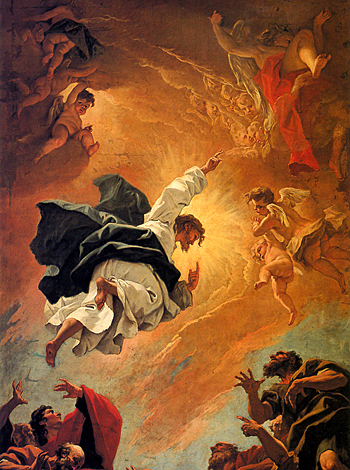
"St. Joseph of Cupertino" 1777 by Giuseppe Cades (1750/99)
He is the saint who protects the examinees. He was famous because he used to levitate when he was immersed in the ecstasy of prayer, as seen in this splendid painting 
Late-nineteenth-century frescoes in the vault by Luigi Fontana (1827/1908)
1st LEFT - PIETÀ CHAPEL
"Pietà" by Francesco Manno (1752/1831)
"Two statues of angels" on the left and on the right by Andrea Bergondi (active in Rome XVIII century)
SACRISTY
In the vault "Ascension" 1701 Sebastiano Ricci (1659/1734)
"The legacy of the Baroque style and the lesson of Baciccio, the Genoese master, was far from being over, if Sebastiano Ricci in the same sacristy of the Holy Apostles had developed in 1701, as Barroero says, a form of neocorreggism and bold flavors with a blend of the best Gaulli" (Francesco Petrucci)
"Constantine received by Sylvester I", "Proclamation of St. Bonaventure as Seraphic Doctor of the Church" and "Allegorical figures" 1882 by Domenico Bruschi (1840/1910)
Cabinets 1669/97 carried out on a design by Francesco Fontana