Showing posts with label Antoniazzo Romano. Show all posts

Monday, January 6, 2020

Sts. VITUS AND MODESTUS

SS. VITO E MODESTO
Via S. Vito/Via Carlo Alberto 47

Mentioned in the sources at the end of the eighth century also as San Vito in Macello Martyrum (St. Vitus in the Slaughterhouse of the Martyrs) because it stood close to the MACELLUM LIVIAE (Livia’s Slaughterhouse)
According to tradition, St. Vitus came from Sicily and was martyred under Diocletian (284/305) in 303 with his teacher St. Modestus

The church was rebuilt for Pope Sixtus IV della Rovere (1471/84)

In the twentieth century its orientation was reversed with entrance on Via Carlo Alberto

The restoration of the years 1973/77 returned the orientation of the fifteenth century

“Marble portal of Sixtus IV” 1477

ALTAR ON THE RIGHT
“Virgin Mary and Child with Saints” 1483 maybe by Antonio Aquili aka Antoniazzo Romano (about 1435-40/1508)
Near the altar, behind a lattice, there is the so called pietra scellerata, an ancient Roman stone with a funerary inscription, believed to be the stone on which Christians were martyred over the centuries and scraped to obtain powder with alleged therapeutic powers

Sunday, September 1, 2019

St. PATRICK

S. PATRIZIO
Via Boncompagni 31

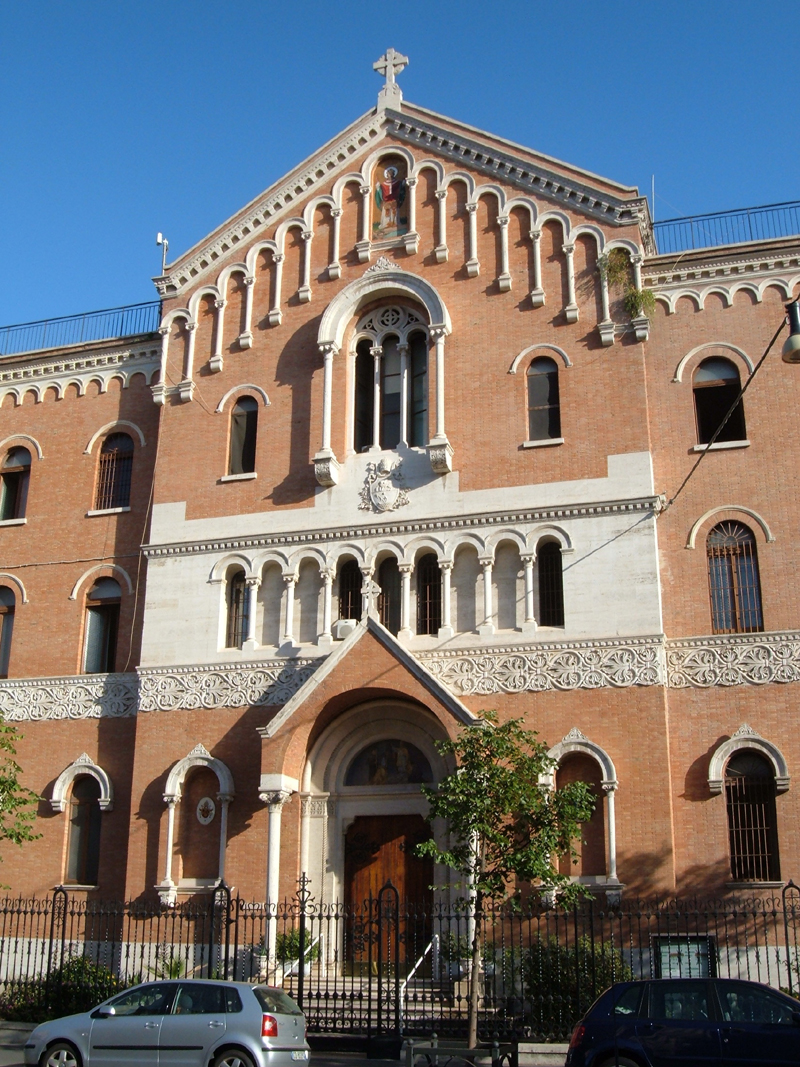
1908/11 Aristide Leonori (1856/1928) for the College of the Irish Augustinians who still officiate it
FAÇADE Northern-European Romanesque
National Church of Ireland

AT THE END OF THE RIGHT NAVE
Detached fresco of the end of the thirteenth century “Our Lady of the Graces” formerly S. Maria in Posterula, previous church of the Irish, destroyed in order to build Ponte Umberto I (Humbert I Bridge)

APSE
Mosaic “St. Patrick explains the mystery of the Trinity to King Laoghaire” 1936 by Rodolfo Villani (1881/1941)

ON THE LEFT - ALTAR OF THE SACRED HEART
Mosaic “Last Supper” 1942 by Silvio Galimberti (1869/1956)

COLLEGE OF THE IRISH AUGUSTINIAN
In a CHAPEL on the second floor “Madonna and Child or Virgin Mary of S. Maria in Campo” about 1484 by Antonio Aquili aka Antoniazzo Romano (about 1435-40/1508) and artists from his workshop

“The setting of the image, clearly derived from the Florentine tradition, associates this Madonna (...) to models sculpted by Verrocchio, exemplified by the Madonna and Child of the Bargello Museum. Its simple frame is an integral element of the board, and maybe it is the original one. (...) The fact that the execution can be likely dated to 1484 and its quality level lead to put it in a context of strict observance of Antoniazzo Romano's style, which does not exclude the intervention of the painter himself” (Adriana Capriotti)

Sunday, March 3, 2019

St. MARY OF THE ANNUNCIATION IN THE BORGO NEIGHBORHOOD

S. MARIA ANNUNZIATA IN BORGO
It was moved in 1950 from Borgo S. Spirito where it was originally built in 1744 by Pietro Passalacqua (1690/1748)
It is popularly known as ANNUNZIATINA
There are works of art formerly in the church S. Angelo dei Corridori (S. Angel of the Runners) destroyed in 1937
INTERIOR completed at the end of the eighteenth century

ON THE RIGHT
Bronze group “St. Michael the Archangel fighting with Lucifer” maybe by Albert Gefèvre

ON THE LEFT
Lunette “Apparition of St. Michael to St. Gregory the Great (590/604)” end of the sixteenth century by G.B. Montano (1543/1621)
In a niche “Madonna of the Milk with the Child” artist of the school of Antonio Aquili aka Antoniozzo Romano (about 1435-40/1508)

Thursday, March 22, 2018

St. AMBROSE DELLA MASSIMA

S. AMBROGIO DELLA MASSIMA
Erected, according to tradition, over the house of the father of St. Ambrose (about 334/397) who would have lived here before being transferred as consul in Milan where he later became bishop, in the area once occupied by the TEMPLE OF HERCULES MUSAGETE
According to tradition, at the time of St. Leo III (795/816) it became the property of a certain Maxima, hence perhaps the name, who built a Latin cross church with monastery
The specification De Maxima in the name of the church appears in the sources only in the thirteenth century and, in fact, it is most likely derived from the nearby Cloaca Maxima, the oldest sewer of Rome, or from a commercial building known as Porticus Maxima
It was called S. Stefano de Maxima and S. Maria in Formosa but in the fifteenth century it returned to its original name
Rebuilt in the years 1606/26 maybe by Carlo Maderno (1556/1629) for the De Torres family
Complete with dome and side altars in 1633 by Orazio Torriani (about 1601/about 1657)
The FAÇADE was rebuilt in 1863 on the model of the previous one and on the same year the church was restored and the interior embellished with inlaid marble altar frontages taken from Ligurian churches
Since 1861 the monks of Subiaco live in the premises
1st CHAPEL ON THE RIGHT
Nineteenth-century painting “Sts. Marcellina, Ambrose and Satyr” which replaced the painting by Pietro da Cortona “Martyrdom of St. Stephen” stolen in 1810
2nd CHAPEL ON THE RIGHT
Statue “St. Benedict” of the Roman Orfeo Boselli (about 1600/67), who was inspired by the style of François Duquesnoy
RIGHT TRANSEPT
“Crucifixion” copy with variations from the original by Francesco Trevisani (1656/1746) in S. Sylvester in Capite
MAIN ALTAR
Canvas of 1974 painted on the occasion of the visit of Pope Paul VI to the Church
PENDENTIVES OF THE DOME
“Cardinal Virtues”: “Justice defeats Envy”, “Fortress defeats Fear”, “Temperance defeats Lust” and “Prudence defeats Luck” about 1633 by Francesco Cozza (1605/82), pupil of Domenichino
“This is actually the triumphs of the cardinal virtues on the personifications of the vices opposing them, as they are described by Cesare Ripa in his Iconology. (...) Inspired by similar depictions of Domenichino in S. Carlo ai Catinari, Francesco Cozza is shown here firmly rooted in his training with the first generation of Bolognese classicists” (Francesca Cappelletti)
LEFT TRANSEPT
“S. Mauro heals a paralytic” by Ciro Ferri (1634/89)
2nd CHAPEL ON THE LEFT
Frescoes “Life of the Virgin Mary” maybe by Giuseppe Cesari aka Cavalier d'Arpino (1568/1640) and his school
Altar “Medieval Icon” discovered in S. Benedict in Piscinula in 1846, heavily restored. Only the face of the Virgin Mary is original
1st CHAPEL ON THE LEFT
Canvas “Ss. Joseph, Ambrose and Marcellina” of the second half of 1800s
REFECTORY
Fresco transferred to canvas in 1963 originally in the portico of the church from which it was detached in 1862 “Deposition with the patrons Benedictine Sisters” about 1497 by Antonio Aquili aka Antoniazzo Romano (about 1435-40/1508)
“The scene follows the iconography of the Nordic Vesperbild (image of the vesper), a subject of popular piety derived from Northern Europe and common in the Umbria region, but very unusual in Rome. Towards the end of the fifteenth century Michelangelo will be the one (...) to give fame and nobility to this Nordic popular subject. In the Roman painting the theme of the Pietà is inserted in a more complex figurative system with the presence in the background of the symbols of the 'Arma Christi' (Arms of Christ), according to an association quite common starting from the second half of the fourteenth century to encourage the faithful to meditate, prompting emotional involvement” (Anna Cavallaro)
“Death of St. Benedict” about 1609 by Baccio Ciarpi (1574/1654)
“In Rome he had Pietro da Cortona as one of his pupils. His works show a conventional narrative language in a reformed key, enriched with a luminosity influenced by Caravaggio” (Enciclopedia Treccani)

Friday, March 17, 2017

DORIA PAMPHILJ PALACE - DORIA PAMPHILJ GALLERY (fourth part)

Room of the 1600s
“Still life with oysters, flowers, fruits and animals” and “Still life with flowers, fruits and animals” by Jan van Kessel the Elder (1626/79)
“Sleeping Endymion” by Giovanni Francesco Barbieri aka Guercino (1591/1666)
“Daedalus and Icarus” maybe by Andrea Sacchi (1599/1661)
“Penitent Magdalene” 1594/95 by Michelangelo Merisi aka Caravaggio (1571/1610)
“It didn't even look like a religious painting: simply the study of a common modern girl sitting on a low wooden chair intent on drying her hair. Where was the meaning? Where the prostitute repentance, her suffering, the promise of salvation? That single barely visible tear that ran down her nose seemed insufficient. (...) The broken string of pearls and other ornaments looked like having been ripped, not forsaken by herself, and more than the regret and renunciation of the holy prostitute, they reminded the punishment given to courtesans in Rome, the lashes that a girl was threatened to get from the police” (Peter Robb)
“Rest on the Flight into Egypt” about 1596/98 another great masterpiece by Caravaggio
The music of the lullaby that the angel holds in his hands is Quam pulchra es with words from the Song of Songs and music of the Flemish Bauldewyn, symbolizing the mystical marriage between Christ and the Virgin, and therefore between Christ and the Church
“In this work, the feeling of the divine and the feeling of reality live together in perfect harmony. Structure, still that of the juvenile phase, has the space developed in parallel levels within which the shapes are clearly outlined almost flat. Light here is not creator of forms, but as an element to give extreme clarity to the scene: it is falling on the Angel and it enhances the whiteness of the veil and it is spread instead on the faces of the characters. This canvas can be considered one of the first statements anti-mannerist style against the religious bombast of Roman painting official” (Carlo Bertelli, Giuliano Briganti, Antonio Giuliano)
“Seven Mother and Child by Caravaggio remain, and, for how the face, the body, the movements of the newborn, and the way in which the mother is holding him, were seen by the painter, none of the other hundreds of thousands of images of this kind produced in Italian painting would have ever surpassed them” (Peter Robb)
“Sibyl” by Massimo Stanzione (1585/1656)
“St. Sebastian” by Ludovico Carracci (1555/1619)
“Portrait of a Franciscan friar” maybe by Pieter Paul Rubens (1577/1640)
“Marina rock arch” by Salvator Rosa (1615/73)
Room of the 1500s
“Salome with the Head of John the Baptist” by Tiziano Vecellio (Titian) (about 1490/1576)
“The field where the penetration and psychological confidence of Raphael are more happily combined with his sense of subtle values, subdued ranges, is the portrait. (...) In these portraits of writers Raphael seems to have expressed himself representing more an ideal than a character: the vocation of poetry and love. The authority of the artist has so created a sort of portrait-type” (André Chastel)
“Portrait of a couple” by Sofonisba Anguissola (about 1531/1626)
“Portrait of a Young Gentleman” by Jacopo Robusti aka Tintoretto (1518/94)
“Return of the Prodigal Son” by Francesco da Ponte aka Bassano the Younger (1549/92) and Jacopo da Ponte aka Jacopo Bassano (about 1510/92)
“Portrait of Niccolò Machiavelli” by Cristofano dell'Altissimo (?/1605)
“Portrait of Girolamo Beltramoto” circle of Giovanni Luteri aka Dosso Dossi (about 1486/1542)
Room of the 1400s
“Pietà (Mercy)” and “Massacre of the Innocents with Rest on the Flight into Egypt” by Ludovico Mazzoli aka Ludovico Mazzolino (about 1479/about 1529)
“Madonna and Child” by an artist of the school of Antonio Aquili aka Antoniazzo Romano (about 1435-40/1508)
“Holy Family” and “Visitation” by Benvenuto Tisi aka Garofalo (about 1481/1559)
“Nativity with Sts. Francis, John the Baptist and Mary Magdalene” by Giovanni Battista Benvenuti aka Ortolano (1487/after 1524)
“Sts. Anthony Abbot and James the Apostle” and “Sts. Christopher and John the Baptist” by Bicci di Lorenzo (1373/1452)
Two “Stories of St. Anthony Abbot” and “Temptation of St. Anthony” by Bernardo Parentino (1434 or 1437/1531)
“The triptych is dated in the mature phase of the master, in the ninth decade of the fifteenth century, when he was at the court of Mantua. The panels, perfectly preserved, have a strong relationship with Andrea Mantegna and the relief with putti reminds of a sarcophagus painted by an artist in the circle of Squarcione. Moreover Bernardo himself executed drawings inspired from ancient artworks very similar to the works of Mantegna and of the circle of Squarcione, while some torment in the contours also recalls the works of Cosmè Tura and Ercole de' Roberti from Ferrara” (Official Website of the Galleria Doria Pamphilj - www.dopart.it)
“Two old men in prayer (the hypocrites)” by the Belgian Quinten Massys (1466/1530)
“Marriage” and “Birth of the Virgin Mary” by Giovanni di Paolo (about 1400/82)

Thursday, March 10, 2016

BARBERINI PALACE - NATIONAL ART GALLERY (twenty-eighth part)

Other Works in the Museum Storage

“St. Sebastian between Onorato II and Pietro Bernardino Caetani d'Aragona” about 1481 by Antonio Aquili aka Antoniozzo Romano (about 1435-40/1508)
“This painting on board is revealing of the versatility of Antoniazzo in different areas of his artistic production (...): a versatility that is expressed in the production of frescoes as well as in the paintings for private devotion or in the sceneries for religious events, always accommodating the needs of his clients, using an entrepreneurship approach which is probably the main reason for the difficulty of rebuilding the catalog of the artist. (...) The painting in Palazzo Barberini synthesizes, for example, his familiarity with the tradition of icons and his knowledge of classical art, evident in the vivid representation of St. Sebastian, and at the same time suggests the skills of the painter for portraits and landscape compositions. (...) The setting is similar to the plain of Fondi and the mountain in the background was recently recognized as being Monte Sant'Angelo near Terracina” (Daniele Ferrara)
“Juno and Argus” by the so-called Maestro della Betulla (Master of the Birch) (active 1630/40)
“Allegory of Peace” maybe by Simon Vouet (1590/1649)
“Sacrifice of Isaac” about 1625 by Orazio Riminaldi (1593/1630)
“Rest on the Flight into Egypt” about 1640 by Angelo Caroselli (1585/1652)
“The Flight into Egypt” about 1625 by Andrea Ansaldo (1584/1638)
“Judith and Holofernes” about 1636 by the Florentine Francesco Furini (1603/46)
“Influenced by Guido Reni, he produced paintings of soft sensuality. The tones of flesh made with ultramarine blue and shaded to give his pictures a sweet taste, soft, but no one can deny that he had a special gift to play the melodic line of the body women, thus revealing its attachment to the Mannerist tradition” (Rudolf Wittkower)
“Still Life with Tuberous Root” maybe by Luca Forte (about 1600/70)
“Cain and Abel” by Pietro Novelli aka Monrealese (1603/47)
“Samson and Delilah” by the Dutchman Matthias Stom (about 1600/50)
“The doughnut maker” 1630 by the so-called Bamboccio (Puppet) Pieter Van Laer (about 1595/1642)
“Country scene” and “Figures in a tree lined road” about 1640/50 landscapes by Angeluccio (fl. 1640/50) and figures by Michelangelo Cerquozzi (1602/60)
Four gouache on paper for Cardinal Francesco Barberini's tapestries now at the Philadelphia Museum of Art:
“Constantine destroying idols”, “Naval Battle of Crispus against Abate”, “Constantine kills the lion” and “Constantine burns the Decretals” about 1631 by Pietro Berrettini aka Pietro da Cortona (1597/1669)

“The massacre of Niobe” 1638/39 and “The Hunt of Diana” 1638/39 by Andrea Camassei (1602/49)

Four anamorphosis: “Portrait of Louis XIII”, “St. Francis of Paola”, “Scene of Marriage” and “Louis XIII before the crucifix” about 1635 by Jean François Niceron (1613/46)

Thursday, January 7, 2016

BARBERINI PALACE - NATIONAL ART GALLERY (fifth part)

Room V - Antoniazzo and Lorenzo. The Thousand Faces of the Roman School

Vault: “Ship of the Argonauts with Jason showing the Golden Fleece from Colchis” by Giuseppe Passeri (1654/1714)
“In this painting, which comes from the church of S. Maria Maggiore in Cerveteri, Federico Zeri, noting the hand of a coworker in the figure of St. Michael, of lesser quality, believed that the cross above the inscription 'Laurentius Jacobi da Viterbo 1472' would indicate that the painter's death had occurred. This remains a key work to reconstruct the figure of the painter who looks to Piero della Francesca and Melozzo as well as Ferrara paintings and Mantegna, showing the variety of influences present in Lazio painting of the fifteenth century” (Lorenza Mochi Onori)
“Antoniazzo, still tied to tradition, was at the forefront - along with Tuscans, Umbrians, Venetians and Flemish - in combining sacred images, landscapes and portraits. He was the head of a busy workshop active in every field of artistic production: icons, images for private devotion, ceremonial apparatuses; narrative fresco cycles and altarpieces” (Official website of the Barberini Gallery - www.galleriabarberini.beniculturali.it)

“Madonna and Child with Sts. Paul and Francis of Assisi” about 1487 by Antonio Aquili aka Antoniazzo Romano (about 1435-40/1508)
“The conventionality of the iconography is, however, animated by the elegant architectural solution of the pink throne defined by pilasters over which there is a rich antiquarian decoration. (...) These decorative ornamentations recall the works by Andrea Bregno and his workshop in the Roman funerary monuments of the seventh and eighth decade of the fifteenth century. (...). The cartoon of the Virgin and Child would be copied in the panel with the Madonna and Sts. Francis and Anthony of Padua today at S. Antonio dei Portoghesi” (Anna Cavallaro)

Monday, September 21, 2015

SIXTUS V SMALL PALACE

PALAZZETTO DI SISTO V


Built at the end of 1500s for the wedding of the nephew of Sixtus V Peretti (1585/90) Flavia Peretti with Virginio Orsini

Now is the seat of the Pio Sodalizio dei Piceni (Pius Sodality of the Piceni) derived by the Association of Residents in Rome from Marche Region

The association was founded in early 1600s and, in 1633, it became the Brotherhood of the Holy House of Loreto

The LIBRARY contains about 14,000 books

Courtyard and roof terrace with frescoes by Paul Brill (1554/1626)

INSIDE LOGGIA
“Stories of Hercules and nudes” Giuseppe Cesari aka Cavalier d'Arpino (1568/1640) and Federico Zuccari (about 1542/1609)

ROOMS
Oil paintings on canvas such as:

“Our Lady of Mercy” by Federico Fiori aka Barocci (1535/1612)

“Virgin Mary with Child blessing aka S. Maria delle Grazie” 1494 by Antonio Aquili aka Antoniazzo Romano (about 1435-40/1508)
It was originally a processional standard and it was the only painting not to have been destroyed by the fire of 1591 in the church of S. Salvatore in Lauro

“The stylistic and compositional features, including the structure of the throne in a niche or the iconography of the sacred group, correspond to the subjects of Marian paintings of the nineties definitely attributed to Antoniazzo (...) here solved in a version with a more pronounced Umbrian character, derived from Pinturicchio. His original function as a standard makes it a typical product of the mature phase of the painter, when the demands intensified in his workshop for equipment and items to be carried in processions on the occasion of the annual festivals of the brotherhoods” (Anna Cavallaro)

“Cardinal Domenico Consolini” by Francesco Podesti (1800/95

“Christ Redeemer” attributed to Melozzo of Ambrosi aka Melozzo da Forlì (1438/94)

Monday, June 29, 2015

ORATORY OF St. MARY OF GOOD HELP

ORATORIO DI S. MARIA E DEL BUON AIUTO


1476 for Pope Sixtus IV Della Rovere (1471/84)

According to tradition, Sixtus IV found refuge from a raging storm in a shrine with an image of the Virgin Mary

Once the danger was over he ordered that a church would be dedicated to that image with the title of Buon Aiuto (Good Help)

Fresco detached from the original shrine “Madonna with Child” maybe by Antonio Aquili aka Antoniazzo Romano (about 1435-40/1508)

Tuesday, June 23, 2015

ORATORY OF St. CATHERINE OF SIENA

ORATORIO DI S. CATERINA DA SIENA


Also known as CHAPEL OF THE TRANSIT S. CATHERINE OF SIENA

It is the house where St. Catherine of Siena died on April 29, 1380, only 33 years old

The companions of St. Catherine, after her death, founded in the house the first community of the Sisters of Penance of St. Dominic

In 1480, for the centenary of her death, Antonio Aquili aka Antoniazzo Romano (about 1435-40/1508) and the assistants in his workshop frescoed the chapel with “St. Catherine of Siena with Saints”

The frescoes were removed in 1637 and divided between the Chamber of St. Catherine at the Minerva and the Convent of St. Catherine of Siena at Magnanapoli

“Today we can only imagine what the room would have looked like in the fifteenth century (...): scenes and isolated figures of saints arranged with bright blue skies in the background within frames that gave the illusion of opening to the outside, according to the criteria of the painting fashion of the late fifteenth century. (...) The choice of holy men and women of the cycle is explained in the biography itself of Catherine. The saint from Siena in fact lived a life both for charity and for militant political action shared with other saints in the cycle such as Bridget of Sweden and Catherine of Alexandria, kept today at Magnanapoli. In the choice for the other saints the dominant theme is the aspiration to a pattern of life of penance and eremitic asceticism and it is clear therefore the thin thread that ties the cycle: not only celebratory - Catherine saint among saints - but also an allusion to an active commitment in the Church and to a life of poverty” (Anna Cavallaro)

In 1573 the nuns moved into their new convent in S. Catherine at Magnanapoli

St. Catherine of Siena is the patron saint of Italy and Europe and is the only saint with St. Francis of Assisi and St. Pio of Pietrelcina to whom the Catholic Church has officially recognized the authenticity of the stigmata

She was buried in the nearby church of S. Maria sopra Minerva, but her head was severed in 1381 at the behest of Pope Urban VI (1378/89) and taken to the Basilica of St. Dominic in Siena where it is also kept a hand thumb with which the saint's blessing to Italy and Europe is given each year on her feast day

A foot of St. Catherine is preserved in the Church of Sts. John and Paul in Venice while a rib and a scapula are in the Shrine of St. Catherine in Astenet in Belgium

In 1579 the ORATORY was enlarged by Francesco Capriani aka Francesco da Volterra (1535/94) for the College of the Neophytes

It was renovated in the years 1638/39 for the Confraternity of the Annunciation, whose activity was to adopt poor girls

The wooden CEILING is the original one of the fourteenth century

On the WALLS seventeenth-century paintings with “Stories from the life of St. Catherine”

First painting on the left “Return to Rome of Gregory XI” 1980 Arcangelo Longo

ALTAR

“St. Catherine” a late work by Giuseppe Cesari aka Cavalier d'Arpino (1568/1640)

Beneath the altar relics of St. John the Martyr

In the two side arches sarcophagi made out of jasper with the relics of Sts. Euraclio and Esuperanzia

The building is part of the 1874 TEATRO ROSSINI (Rossini Theatre) by Virginio Vespignani (1808/82)

Saturday, February 1, 2014

DOMINICAN MUSEUM OF St. SABINA AT THE AVENTINE

MUSEO DOMENICANO DI S. SABINA ALL'AVENTINO
Piazza Pietro d'Illiria
Opened to the public in 2010 in the premises of the dormitory of the medieval CONVENT OF St. SABINA
34 works dating from various historical periods, from the thirteenth to the nineteenth century
AMONG THE MASTERPIECES:
Sculpture on capital of a column "St. Dominic or young friar" maybe by Arnolfo di Cambio (about 1245/1302)
"The piece has been damaged due to prolonged outdoor exposure, as evidenced by the partially leached surface, especially of the nose. Indeed, it was found, presumably in the nineteenth century, among the remains of other artifacts accumulated in the thirteenth century convent garden. It was moved in the early twentieth century in the sacristy of the church, (...) it was transferred after the Second World War in the area above the atrium; badly fixed on a capital it was later moved tothe cloister and later in the Dominican Museum where it is now. Stylistic features link the artifact to the art Arnolfo; for its quality, the fragment was considered in 1977 by Valentino Martinelli a work by the master himself. The Arnolfo connection is also in the special relationship established between sculpture and architecture" (website Sheets and Words of Art - www.foglidarte.it/index.php/luoghi-mostre-eventi/266-il-museo-di-santa-sabina-a-roma)
Tempera on wood "St. Vincent Ferrer and the client" about 1488/89 by Antonio Aquili aka Antoniozzo Romano (about 1435-40/1508)
"The style of the painting anchor it to Antoniazzo's period of greater adherence to Melozzo, before the influence of Umbrian painting: the influence of Melozzo is evident in the monumentality of the figure of the saint and in his face, described in great realistic detail with incipient wrinkles and thin white threads in his hair (...), evoking the superb portraiture components in the fresco of Sixtus IV and Platina in the Vatican Library. The hand too, gripping the book with thin highlighted veins, is a piece of acute realistic investigation, inspired by the Flemish influence transmitted to the Roman artist by the painter from Forlì. The austere client (...) is 'an authentic piece of painting of reality' (Paolucci) and one of the most vital and genuine evidence of Roman portraiture the fifteenth century. (...) It is one of the highest pinnacle achieved by Antoniozzo's art" (Anna Cavallaro)
Painting on board "Miracle of the Crucifix of St. Catherine de' Ricci" maybe by Salvatore Monosilio (active from 1744/d. 1776)
Superb "Madonna of the Rosary with St. Dominic and St. Catherine of Siena" by G.B. Salvi aka Sassoferrato (1609/85)
Sculptural group in cornel wood painted "Madonna and Child" by an anonymous Nordic artist
Near the church there is an opening known as the small window of S. Domenico from which, according to tradition, the brothers used to watch the saint while praying in church

Saturday, October 12, 2013

BASILICA OF THE HOLY APOSTLES

BASILICA SS. APOSTOLI
Begun at the behest of Pelagius I (556/561) to celebrate the Byzantine victory over the Goths in the Greek-Gothic war (535/553) and to house the relics of St. Philip and S. James the Less, Apostles of Jesus, still housed in the Basilica
Its original name was Basilica of Sts. James and Philip
It was completed in 570 under John III (561/574)
Martin V Colonna (1417/31) restored it
Sixtus IV della Rovere (1471/84) renewed it and had the porch added maybe by Baccio Pontelli (about 1450/92)
The porch was modified and closed in 1675 by Carlo Rainaldi (1611/91) who also did some work in the interior of the church
Francesco Fontana (1668/1708) transformed it in the years 1702/1708 for Clement XI Albani (1700/21) with his father Carlo Fontana (1634/1714) who worked there until his death in 1714, six years after his son's death
It was most likely built using mainly building materials from the nearby Temple of Serapis and the Baths of Constantine
Sts. Philip and James the Less are being celebrated on the same day (May 3) as their relics were placed together in the Basilica
St. PHILIP was a native of the city of Bethsaida, the same of the apostles Peter and Andrew. A disciple of John the Baptist, he was among the first to follow Jesus and, according to tradition, he evangelised the Scythians and the Parthians
St. JAMES THE LESS was the cousin of Jesus and had an important role in the council of Jerusalem (about 50), becoming head of the church in the city after the death of James the Greater. He wrote the first of the Letters of the Catholic New Testament. According to Josephus he was stoned to death between 62 and 66. However the reliability of the story is dubious
In 1439 it was appointed by Cardinal Basilios Bessarion to the Conventual Friars Minor and they still officiate it to this day
Here on February 18th, 1564 the funeral of Michelangelo Buonarroti (1475/1564) was held. Eighteen days after the funeral, his nephew Leonardo stole the body, put it into a wagon covered with cloth and took it to Florence, where it is still buried in the church of Santa Croce
1827 Giuseppe Valadier (1762/1839) for the Torlonia family
On the pedestals of the statues on the external balustrade the letters F. L. D. L. C. S. O. T. C. E. C. V. B. are carved, standing for Frater Laurentius De Laureolo Consultor Sancti Officii Theologus Cardinalis Episcopus Custos Vaticanae Bibliothecae
It is a tribute to the patron of the statues sculpted at the end of the seventeenth century, Cardinal Lorenzo Brancati di Lauria eminent theologian and Vatican librarian who is buried in the Basilica. So he was discreetly mentioned without diminishing, and then irritate, the pope
PORTICO
On the right splendid and iconic relief "Imperial Eagle" from the time of Trajan (98/117)
"Funerary stela of Giovanni Volpato" 1807 di Antonio Canova (1757/1822)
"Canova developed intensively in these years the theme of memory and celebratory funeral, highlighting, such as Foscolo, both the affective meaning, when it is privately adorned by the tears of family and friends, and its the value of civil institution, when it hands down legacy of noble examples. With specific reference to the ancient Attic stelae, the bas-relief shows a figure of a weeping woman, bent at the herm of the deceased" (Carlo Bertelli, Giuliano Briganti, Antonio Giuliano)
"Tombstone with a portrait of Giovanni Colonna" maybe by Luigi Capponi (active end of 1400s/beginning of 1500s)
VAULT
"Triumph of the Franciscan Order" 1707 G.B. Gaulli aka Baciccio (1639/1709)
 "Gaulli is protagonist of the natural evolution of Bernini's Baroque towards the Rococo style (as Shor was for the decorative arts and Caffà for sculpture), and those new trends in the great illusionistic tradition that will be followed more abroad than in Rome and disclosed in all Europe by artists such as Luca Giordano, Corrado Giaquinto, Sebastiano Ricci (think of the Ascension in the sacristy of the SS. Apostles and other Roman works) and G.B. Tiepolo (...) It is the response in terms of theology and of high artistic prestige, to the ornate Baroque decorations of the previous century by Lanfranco, Pietro da Cortona, Andrea Pozzo and Baciccio himself in the churches of the Theatines, the Congregation of the Oratory and the Jesuits (S. Andrea della Valle, Chiesa Nuova, Church of the Gesu, St. Ignatius), inaugurating the first Roman religious decorative cycle of the eighteenth century, in a supreme synthesis of the figurative culture of the time" (Francesco Petrucci)
"Evangelists" and "Apostles" 1869/75 di Luigi Fontana (1827/1908)
COUNTER FAÇADE
"Religion" by Pierre Legros (1666/1719)
"Prayer" by Pierre-Étienne Monnot (1657/1733)
"Charity" by Giuseppe Napolino
"Faith" by Pietro Papaleo
1st RIGHT - MENDOSI CHAPEL
Below "Madonna of Cardinal Bessarion" about 1480 formerly attributed to Jacopo Ripanda but more likely by Antonio Aquili aka Antoniazzo Romano (1452/1508)
Statues "Divine Wisdom" on the left and "Faith" on the right by Bartolomeo Cavaceppi famous "restorer" of ancient marbles
2nd RIGHT - CHAPEL OF THE IMMACULATE
"Virgin Mary and angels" Corrado Giaquinto (1703/66)
2nd PILLAR
"Tomb of Clementina Sobieski" 1737 by Filippo Della Valle (1698/1768)
Clementina Sobieski was the nephew of the King of Poland Jan III Sobieski and wife of James Stuart heir to the throne of England in exile in Rome. It contains only the heart. The rest of the body is in the Basilica of St. Peter 
3rd RIGHT - ODESCALCHI CHAPEL or St. ANTHONY's
1703 Ludovico Rusconi Sassi (1678/1736) pupil of Carlo Fontana
On the floor mosaic "Coat of arms of Innocent XI Odescalchi (1676/89)" 1716 in memory of the liberation of Vienna in 1683
On the altar "St. Anthony of Padua" 1723 by Benedetto Luti (1666/1724)
Frescoes on the ceiling "Glory of St. Anthony" and pendentives by Giuseppe Nasini (1657/1736)
Under the altar in a wonderful ancient "Red porphyry sarcophagus" there are the relics of St. Eugenia, of her mother St. Claudia and of twelve other martyrs brought here from the Aproniano cemetery on Via Latina
BEHIND THE ALTAR OF THE ODESCALCHI CHAPEL:
WALL OF THE APSE OF THE FUNERARY CHAPEL OF CARDINAL BASILIOS BESSARION (1403/72)
Dedicated to Our Lady, and to the Saints Michael, John the Baptist and Eugenia
It is one of the most important places for the history of fifteenth century painting in Rome
Frescoes 1464/68 by Antonio Aquili aka Antoniazzo Romano (about 1435-40/1508) and artists of his workshop, maybe with the collaboration of Melozzo Ambrosi aka Melozzo from Forlì (1438/94) for the distinguished humanist Cardinal Basilios Bessarion titular of the church from 1439 to 1449
Lower part
"Madonna and Child" between "S. Eugenia" and "S. Claudia". The two saints replaced, at the beginning of the seventeenth century, the original frescoes with stories of St. John the Baptist, destroyed by the rise of the floor of the chapel
Upper part
On the right "Dream of St. Aubert of Avranches in Mont Saint Michel on the Gulf of Saint Malo in Brittany" where there is another important shrine dedicated to St. Michael the Archangel
Perhaps the image alludes to the attempt by Cardinal Bessarion to involve the king of France, Louis XI in a crusade against the Ottomans. Bishop St. Aubert in the painting would have the appearance of Louis XI, while behind him would be represented in red clothes, Francesco Maria Della Rovere, the future Pope Sixtus IV (1471/84), and, in purple clothes, his nephew Giuliano della Rovere, future Pope Julius II (1503/13)
"If the decoration of the apse with angels is painted by his workshop working on master's cartons still in the wake of Benozzo Gozzoli's style, in the 'Procession of Bishops' one can see the hand of Aquili during his period inspired by Piero della Francesca, the same period which produced the triptych of Subiaco in 1467. The solemn image of the bishop (...) leading the procession evokes the best figures painted by the Roman master in those years (...) for the physiognomy itself in the Piero della Francesca's style, joined by a research for realism typical of the Flemish master, while memories of his first training influenced by Benozzo Gozzoli are noticeable in the sumptuous cope in blue and gold damask covering his imposing figure" (Anna Cavallaro)
The frescoes were covered by a coat of lime as early as 1545, for the serious damage caused by continuous flooding of the Tiber and the sack of Rome in 1527
They were partly obliterated in 1650 by the monumental altar of St. Anthony, which Carlo Rainaldi built against the apse of the chapel and finally completely hidden with the construction of the present Odescalchi chapel
Still known through some descriptions of the seventeenth century, the remnant frescos were discovered only in 1959 by the architect Clemente Busiri Vici (1887/1965) during some maintenance work on Palazzo Colonna behind the wall of the Basilica
"He contributed to the diffusion in Italy of the study of the Greek language and especially of the Platonic philosophy, and in defense of Plato (...) he wrote (...) against Thomistic Aristotelianism. (...) He translated into Latin the Metaphysics by Aristotle. He left letters, prayers, theological essays, rich in doctrine, supported by great balance of thought. He strove with great fervor, with writings and words, with extensive and skillful diplomacy, for a crusade to win back Constantinople, fallen into the hands of the Turks in 1453. In 1463 the alliance of Venice with Pope Pius II, obtained by Bessarion, seemed to make the crusade possible, but the death of the pope (1464) brought Bessarion to move away from the Curia and to continue alone diplomatic relations in Europe. His rich library of Greek manuscripts, donated to Venice (1468), was the first and most important collection of the Biblioteca Marciana" (Enciclopedia Treccani)
Level of the first basilica of the sixth century with remains of opus sectile about 1.40 m (4.6 feet) below the present level of the church 
Level of the Bessarion Chapel about 0.80 m (2.6 feet) below the present level of the church
AT THE END OF THE RIGHT NAVE - CHAPEL OF THE CRUCIFIX
1858 Luca Carimini (1830/90) with "Eight spiral columns" of the fourth century found under the apse
Paintings "St. Francis", "St. Anthony" and "Stories of St. Francis 1875 by Domenico Bruschi (1840/1910)
"One of his best works: (...) the style of Domenico Bruschi, still mindful of the stylizations of purists and related to fifteenth century models, here is redeemed by the precision of his drawings and the refined taste of his chromatic chords. The paintings in the sacristy are of inferior quality" (Anna Maria Damigella - Dizionario Biografico degli Italiani Treccani)
CONFESSION 1873/79 Luca Carimini
On the right "Tomb of Raffaele Della Rovere" maybe by Andrea Bregno (1418/1503) for the son of Raffaele Giuliano Della Rovere later Pope Julius II
On the left Roman strigillated sarcophagus with the "Tomb of Alessandro Riario" who died in 1524
At the two ends of the stairs statues: on the left "S. Eugenia" by Giuseppe Peroni (about 1626/63) and on the right "S. Claudia" by Domenico Guidi
The vault was formerly decorated with a fresco by Melozzo Ambrosi aka Melozzo da Forlì (1438/94), fragments of which are in the Vatican Picture Gallery (angels musicians) and in the Palazzo del Quirinale (Jesus)
"Fall of the Rebel Angels" incredible illusionistic effect by Giovanni Odazzi (1663/1731), G.B. Gaulli aka Baciccio's favorite pupil. He painted it after the death of his teacher
ON THE RIGHT TWO TOMBS:
Below "Tomb of Count Giraud d'Ansedum" brother in law of Julius II maybe by Mino del Reame (active about 1463/77)
Above "Tomb of Cardinal Raffaele Riario" who died in 1521. He was patron of Michelangelo and built the Palace of the Chancellery
ALTARPIECE
"Martyrdom of Sts. Philip and James" 1704 by Domenico Maria Muratori (1661/1742), the largest altarpiece in Rome (20 x 10 m - 15.3 x 7.6 feet)
ON THE LEFT
"Tomb of Cardinal Pietro Riario" who died in 1474 by Andrea Bregno (1418/1503), Mino da Fiesole (1429/84) and Giovanni Duknovich aka Giovanni Dalmata (about 1440/1510) who did the bas-relief "Madonna and Child with Saints"
TO THE LEFT OF THE APSE
"Monument of Clement XIV" Ganganelli (1769/74) with statues of "Meekness" and "Modesty" 1783/87 first Roman work of Antonio Canova, who got the job thanks to the engraver Giovanni Volpato, for whom, 20 years later, he made the funeral stele in the porch
"He takes up the pattern laid down by Bernini, but there are decisive differences: continue animation of the seventeenth century monument is replaced by a precise scan of the elements (Francesco Milizia stresses "the great divisions and a few" that recall the setting of the contemporary Orazi Oath by David), the rich ornamentation, the multi-colored marble, the tumultuous drapery are banned. Humility and temperance lament in silence and profound sorrow the death of the pope; a noble simplicity and a quiet greatness enfold the mausoleum" (Carlo Bertelli, Giuliano Briganti, Antonio Giuliano)
3rd LEFT - COLONNA CHAPEL or St. FRANCIS's
"St. Francis supported by angels" 1726 by Giuseppe Chiari (1654/1727), Carlo Maratta's favorite Roman pupil
On the right "Monument of Maria Salviati Lucrezia Rospigliosi" 1749 by Bernardino Ludovisi (about 1713/49)
In the little dome "Allegorical Figures" 1865 by Luigi Fontana (1827/1908)
ON THE PILLAR
"Pulpit" 1736 by Sebastiano Cipriani (about 1660/1740)
BETWEEN THE 3rd AND THE 2nd CHAPEL
"Monument of Prince Filippo Colonna" 1822 by Francesco Pozzi (1779/1844)
2nd LEFT - St. JOSEPH OF CUPERTINO CHAPEL
"St. Joseph of Cupertino" 1777 by Giuseppe Cades (1750/99)
He is the saint who protects the examinees. He was famous because he used to levitate when he was immersed in the ecstasy of prayer, as seen in this splendid painting 
Late-nineteenth-century frescoes in the vault by Luigi Fontana (1827/1908)
1st LEFT - PIETÀ CHAPEL
"Pietà" by Francesco Manno (1752/1831)
"Two statues of angels" on the left and on the right by Andrea Bergondi (active in Rome XVIII century)
SACRISTY
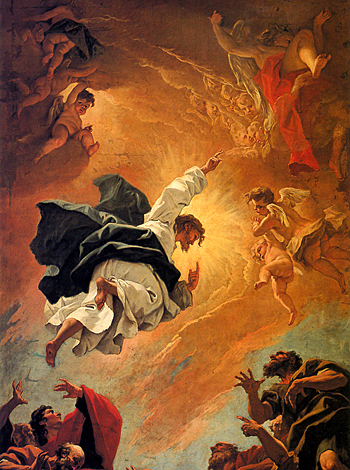
In the vault "Ascension" 1701 Sebastiano Ricci (1659/1734)
"The legacy of the Baroque style and the lesson of Baciccio, the Genoese master, was far from being over, if Sebastiano Ricci in the same sacristy of the Holy Apostles had developed in 1701, as Barroero says, a form of neocorreggism and bold flavors with a blend of the best Gaulli" (Francesco Petrucci)
"Constantine received by Sylvester I", "Proclamation of St. Bonaventure as Seraphic Doctor of the Church" and "Allegorical figures" 1882 by Domenico Bruschi (1840/1910)
Cabinets 1669/97 carried out on a design by Francesco Fontana