BASILICA S. PIETRO IN VINCOLI
Built in the fourth century. It was originally dedicated to the apostles and it was built over one house (domus) of the third century
Rebuilt in the early fifth century by the priest Philip with the help and patronage of Eudoxia Minor daughter of Theodosius II, wife of Valentinian III (425/455) emperor for 30 years, son of Galla Placidia
Consecrated by Pope Sixtus III (432/440) in 439 when the name changed in the current one
According to tradition Eudoxia received from her mother the chains that held St. Peter prisoner in Jerusalem and then gave them to pope Leo I the Great (440/461) who held them close to those used for the imprisonment of St. Peter in the Mamertine Prison
The chains miraculously merged into a single chain. The new cult of the chains supplanted the pagan rite celebrated on the Kalends of August to commemorate the victory of the emperor in Egypt
Restored by Hadrian I in 780 (772/795)
Modified in the years 1467/71 by Sixtus IV Della Rovere (1471/84), who added to the left of the façade the PALACE OF THE TITULAR CARDINAL
Restored in 1503 by Julius II Della Rovere (1503/13), nephew of Sixtus IV
Modified at the beginning of the eighteenth century and in the second half of the nineteenth century
Here in 533 Pope John II (533/535) was elected, the first pope who changed his name after being elected. His real name was Mercury and certainly he did not consider appropriate the name of a pagan god for a pope. An inscription of him, formerly on the floor is kept in the left aisle
Also here on April 21, 1073 the archdeacon Hildebrand of Soana was elected pope with the name of Gregory VII (1073/85) there
About 1475, completed in 1505
Attributed by Vasari to Baccio Pontelli (about 1450/92) but maybe designed by Meo del Caprino or Giovannino de' Dolci (d. about 1486)
The façade was elevated in the years 1570/78
The GATE is from the time of Clement XI Albani (1700/21)
COUNTER FAÇADE
Bricks original of the fifth century with novel structure of a rare type: arches on columns communicating with the narthex and five oculi above with the central one modified at the beginning of the eighteenth century
Above the monument fresco "Propitiatory procession for the plague of 1476" from the workshop of Aquili Antoniazzo aka Antonio Romano (1452/1508) formerly part of the dismantled 1576 altar for the mosaic icon of St.Sebastian depulsor pestilitatis (winner of the plague)
TWENTY ANCIENT IMEZIO MARBLE COLUMNS (or Proconnesus marble) maybe from the nearby Portico of Livia
On the right side, between the 5th and 6th intercolumniation there are openings to expose the original floor
WOODEN CEILING
1705/07 Francesco Fontana (1668/1708) son of Carlo Fontana and Carlo Stefano Fontana's brother
In a niche fragment of fresco "Head of the Redeemer"
1st RIGHT - ALTAR OF St. AUGUSTINE
"St. Augustine" believed to be a work of Giovanni Francesco Barbieri aka Guercino (1591/1666) but more likely of his pupil Benedetto Zalone
FURTHER AHEAD
2nd RIGHT - ALTAR OF St. PETER
"Liberation of St. Peter" copy of Pietro Santi from the original by Domenichino in the sacristy vestibule
FURTHER AHEAD
RIGHT TRANSEPT
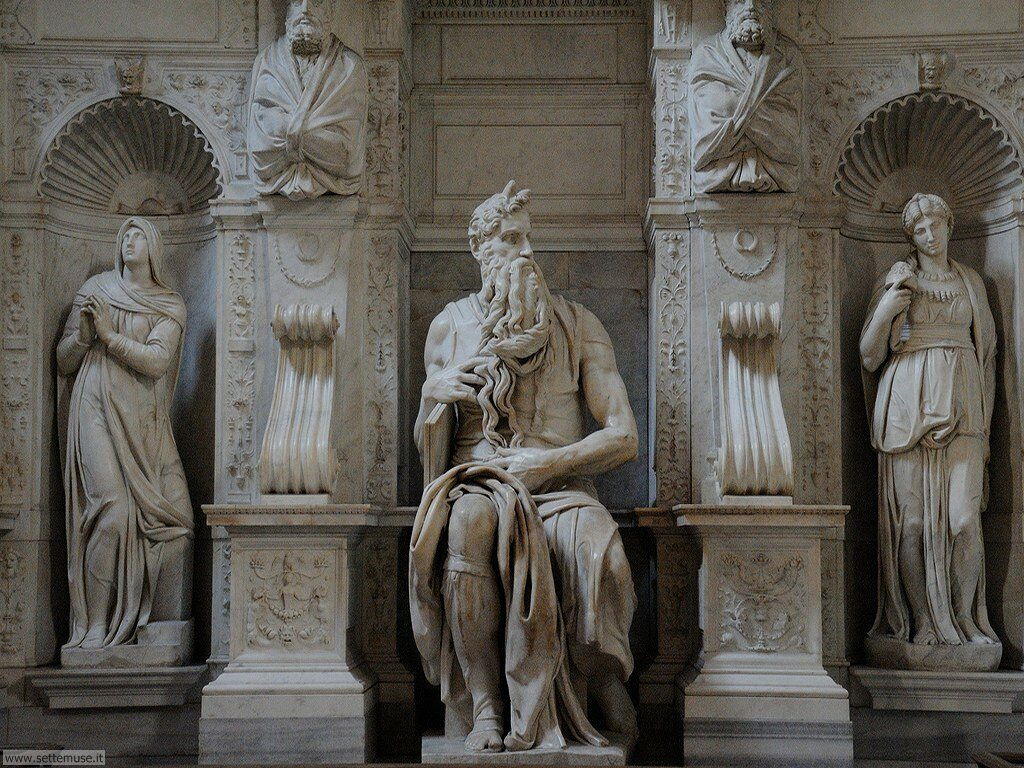
It was commissioned in 1505, begun in 1513 after the end of the vault in the Sistine Chapel, left unfinished after three years of work: it was Michelangelo's "torment" for 40 years
Julius II is actually buried with his uncle Sixtus IV in the Chapel of Sts. Michael and Petronilla in St. Peter's Basilica
"To adapt the pieces of marble already cut for the new site, he opened a large lunette in the wall over which the grave had to lean, so that the light coming from the back as well as left and right, was to create an effect of spatial ambiguity. The idea was that the tomb wouldn't seem to be leaning against the wall, but it would stand high and freely in the air. This device, which anticipated a century of research by Bernini and Borromini about light inside monuments, was the best way not to give up entirely the idea of three-dimensional monument for which he had worked so hard" (Antonio Forcellino)
"Moses" conceived 1513/16, drafted 1517, reworked 1542 (25 years later!) when Michelangelo drew back the left leg and turned the head which originally was looking straight ahead. The statue is in a more advanced position compared to the original project
"The reasons were certainly artistic, but perhaps the choice of turning the face of the prophet was also the presence of the Altar of the Chains on the opposite side of the transept to where Moses was placed. This altar was the symbol of Catholic superstition and the foundation of that temporal power which continued to claim a Church that Michelangelo didn't recognize anymore. If Moses had looked straight ahead, he would have just laid eyes on the altar, while with the amazing change he was looking toward the light coming down from an open window just to his left and unfortunately now closed. The ray of light that illuminated his face, left arm and his horns, would have completed in a refined way the spiritual suggestion to which the entire monument alluded" (Antonio Forcellino)
"The two figures seem to allude to the particular function that the theology of the Benefit of Christ, the guide book of the "Spirituals" of Viterbo, assigned respectively to faith and love in his attempt to mediate between conservative Catholicism and the Protestant Reformation. Faith saves and his fervor turns to the sky, where it seems to ascend like fire. Charity does not save, but it is equally appreciated for its ability to illuminate the truth of the feeling of faith, as flame reveals the heat of fire. The suggestion of Cardinal Reginald Pole to Vittoria Colonna effectively exemplifies this view: pray as if you would save for your faith, act as if you would save for your works. The sculptures of Michelangelo were crying this out to the whole world" (Antonio Forcellino)
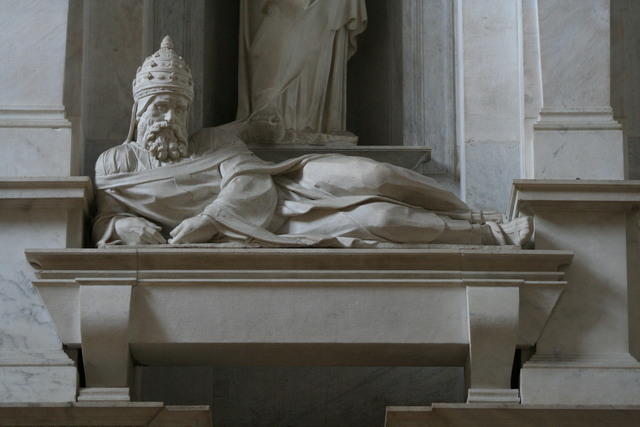
Giorgio Vasari mistakenly believed it to be the work of Tommaso Boscoli who maybe only made the sarcophagus, but it was correctly attributed to Michelangelo, according to recent findings of Antonio Forcellino, the restorer of the work
"The highest point of the sculpture are definitely the hands, reaching a summit never reached by anyone in the gestures of the body. The hands in statues of popes, central focus of the funeral ceremony along with the face, have two options: blessing or resting. But Michelangelo cannot be satisfied with something that was already said before and invents hands that speak with their peculiar posture. These are yielding hands, hands aware of the futility and vanity of life works, because eternal destiny will not be determined by life works. These are hands telling the misery of men, even popes, and the immensity of God's mercy" (Antonio Forcellino)
"Madonna and Child" by Michelangelo Buonarroti attributed by Vasari to Scherano da Settignano who had only roughhewn the marble. It was then finished by Raffaello da Montelupo
"Prophet" and "Sybil" Michelangelo Buonarroti finished by Raffaello da Montelupo
"Marble plinths with telamons" by Jacopo Del Duca (about 1520/1604)
To left of the monument "St. Margaret" 1644 Giovanni Francesco Barbieri aka Guercino (1591/1666) with a dragon painted maybe by his brother Paolo Antonio Barbieri. It was stolen along with two paintings by Carlo Maratta that were on the sides and were never found. It was recovered in 1976
"Funeral monument of Giulio Clovio" who died in 1578 protector of El Greco. He was described by Vasari as the Michelangelo of the miniature
Frescoes on the left "St. Peter released from prison"
In the center "The Patriarch of Jerusalem Juvenal gives the chains to Eudoxia"
The story of the crucifix of Beirut was a legend of the eighth century: an image of Christ on the Cross, crucified again with contempt, issued blood miraculously
"Marble chair" maybe from the nearby Baths of Trajan
CANOPY and CONFESSION 1876 by Virginio Vespignani (1808/82)
In the MAIN ALTAR two doors in gilded bronze with bas-reliefs "Scenes from the life of St. Peter" 1477 by Cristoforo di Geremia or Ambrogio Foppa aka Caradosso
Statues "St. Peter" and "Angel" by Ignazio Jacometti (1819/83)
In the CRYPT under the altar early Christian "Sarcophagus with scenes of the Gospel" from the period of Theodosius (379/395), found in 1876 with the alleged relics of the seven Maccabee brothers, Jewish martyrs of the second century BC, seen as precursors of the martyrs of Christ, whose cult was deeply felt in the fifth century
Frescoes "Stories of the Maccabean brothers" 1877 by Silverio Capparoni (1831/1907)
LEFT TRANSEPT - CHAPEL OF THE HOLY SACRAMENT
Painting "Virgin and Child with Angels" 1880 by Luigi Bravi
Organ 1884 on a wooden structure made in 1686
"Monument to Cardinal Antonio Andrea Galli who died in 1767
"Inscription of John II (533/535)" the oldest evidence of the cult of St. Peter's chains formerly in the floor
IN THE NAVE
2nd LEFT - ALTAR OF St. SEBASTIAN
Byzantine mosaic "St. Sebastian bearded" about 680 restored 1682, the only existing representation of the saint as a bearded old man. He is represented, according to the epigraph on the right, as a protector from the plague, maybe in connection with the plague that had broken out in Rome just in 680
FURTHER ON IN THE NAVE
"Monument of Cardinal Cinzio Passeri Aldobrandini" (nephew of Clement VIII Aldobrandini - 1592/1605 - and patron of artists including Torquato Tasso) 1704/07 di Francesco Carlo Bizzaccheri (1655/1721) with the help of Pierre Legros (1666/1719) for the Prince G.B. Pamphilj
"It reaches the top of the late baroque splendor for the preciousness of the materials, taken from the Villa del Bel Respiro, for its ultimate freedom from structural architectonical conditions but, above all, for the complexity of the allegorical theme evoked in terms of strong emotional impact. The grim gesture of Death with scythe and hourglass, wrapped in the shroud behind the precious alabaster urn of flowers, is hyperbolic as much as the presence of the two cherubs on the front" (Alfredo Marchionne Gunter)
1st LEFT - ALTAR OF THE PIETÀ
TO THE LEFT OF THE ALTAR OF THE PIETÀ
"Tomb of Cardinal Nicholas of Cusa" who died in 1464 with bas-relief of "St. Peter among Cardinal Nicholas of Cusa and the liberating angel" 1465 maybe by Andrea Bregno (1418/1503) formerly in the altar of the Holy Chains which was originally located in the left transept. Below coat of arms with a lobster derived from the name of the cardinal
His name was Nikolaus Krebs born in 1401 in Kues, latinized in Cusa, known now as Bernkastel-Kues near Trier in Germany. Philosopher, scientist and humanist, he argued, against Ptolemy and Aristotle, that the earth is not still, but rotates around the sun and it is not possible to determine the center of the universe, which coincides with God and not a star
He also argued that the stars are similar to the sun, that they can have planets rotating around them and that some planets may be inhabited
He therefore produced many theories similar to those that Giordano Bruno would later proclaim
He was the titular cardinal of St. Peter's in Chains and he had the church restored
FURTHER ON IN THE NAVE
"Tombstone of Cardinal Sisto Gara Della Rovere" nephew of Julius II
VESTIBULE
"Liberation of St. Peter" 1604 by Domenico Zampieri aka Domenichino (1581/1641)
"St. Augustine" by Pier Francesco Mola (1612/66). "Return of the Prodigal Son" maybe from the workshop of Pier Francesco Mola
SACRISTY
Marble altar of the fifteenth century with relief "Madonna and Child"
In the vault oval with "Liberation of St. Peter" surrounded by grotesque style decorations and four panels with "Miracles of St. Peter" 1580/81 maybe by Paris Nogari (about 1536/1601)
PALAZZO DELLA FACOLTÀ D'INGEGNERIA
Palace of the Faculty of Engineering
1885 Enrico Guj (1841/1905)
Completed 1916/25 G.B. Milani (1876/1940)
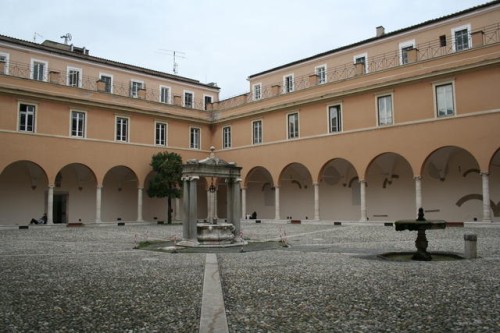
It was built on the right side of the church in the area of the former convent
It was the first modern university building in Rome after the Palazzo della Sapienza
Ancient cloister restored with the convent in 1651