Showing posts with label Ospedale S. Spirito in Sassia. Show all posts

Thursday, September 8, 2016

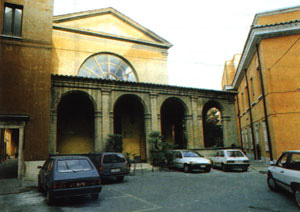
PALACE OF THE BANK OF THE HOLY SPIRIT

PALAZZO DEL BANCO DI S. SPIRITO

1521/25 Antonio Cordini aka Antonio da Sangallo the Younger (1483/1546)
Formerly known as Palazzo della Zecca (Palace of the Mint)
Statues on the façade “Charity” and “Abundance”
“Accentuated interests in spatial urban function with the assertion of a vigorous and non-inert 'classical' style inspired by Bramante and Raphael appear in the façade of the Mint, certainly conceived for viewers coming from Ponte S. Angelo. (...) Cordini exhibits a controlled search of novelty and monumental expression animated by the concavity of the front and showing proportional contrasts in the definition of linguistic elements and decorations. (...) Despite some uncertainties, a finally reached maturity, in the full domain of his personal language, characterizes this work generally considered by the scholars as one of the highest expressions of Cordini's activity” (Arnaldo Bruschi - Dizionario Biografico degli Italiani Treccani)
The mint remained here until 1541 and the building was thereafter known as Zecca vecchia (Old Mint)
In 1667 it became the headquarters of the BANCO DI SANTO SPIRITO (Bank of the Holy Spirit) changing name with internal adjustments by Giovanni Tommaso Ripoli for the new function
The Banco di Santo Spirito was founded in 1605 by Paul V Borghese (1605/21): it offered rudimentary banking services but it gained a huge success having as guarantee the funds of the nearby Ospedale S. Spirito (Hospital of the Holy Spirit)
It is still a bank today with a branch of Unicredit which incorporated the Banco di S. Spirito
Monday, August 10, 2015

HOSPITAL HOLY SPIRIT IN SAXIA - NATIONAL HISTORICAL MUSEUM OF SANITARY

Museo Storico Nazionale dell'Arte Sanitaria

Opened in 1933

It includes a library with more than 10,000 publications about the history of medicine

There are many fine editions from the sixteenth to the eighteenth century, including very important sixteenth century books printed by Aldus Manutius and his son

Faithful reconstruction of an old pharmacy of the seventeenth century and an alchemical laboratory
Among the pieces exhibited:

Collection of Roman and Etruscan votive vows

Horn of the Unicorn, mythical animal, but in fact a narwhal tooth, a very rare cetacean. It was believed to be an antidote against evil

Skull from the archaeological site of Boscoreale

Mauriceau syringe or rubber tube which was applied to a brass syringe to introduce holy water into the uterine cavity, in order to baptize before the birth the fetuses that were running the risk of succumbing during labor

The oldest coach of the Red Cross

Machine for grinding of china that was used here to treat malaria as early as 1632

Reconstruction of a chemistry lab of the sixteenth century

Arabic and Roman surgical instruments

Sunday, August 9, 2015

HOSPITAL HOLY SPIRIT IN SAXIA

OSPEDALE S. SPIRITO IN SASSIA


Schola Saxonum built for Ina king of the Saxons in 727 to assist his compatriots the English pilgrims of Wessex, the south-west of England

Though not yet then a hospital in the modern sense, it is considered the first hospital in Europe

In 1050 resided here as an illustrious pilgrim King Macbeth of Scotland, later immortalized by Shakespeare's play

After the Battle of Hastings in 1066 and the Norman occupation of England pilgrims dwindled drastically and the structure declined

Rebuilt in 1198 maybe, according to Vasari, by Marchionne Aretino at the behest of Innocent III of the Counts of Segni (1198/1216) and formalized in a Papal Bull in 1204

It was given to Guy of Montpellier, who had established the HOSPITALLER ORDER OF THE HOLY GHOST for the care of abandoned children, orphans and illegitimate

Rebuilt after being destroyed by fire and extended in the years 1473/78 for the Jubilee of 1475 maybe by Baccio Pontelli (about 1450/92) for Sixtus IV Della Rovere (1471/84) according to Giorgio Vasari
Vasari, however, seems to be contradicted by evidence documenting the presence of Baccio Pontelli in Rome shortly in 1477 and longer only after 1482

Expanded in the years 1665/67 with the SALA ALESSANDRINA (Alexandrine Hall) for Alexander VII Chigi (1655/67) parallel to the Sistine Ward and now used for conferences

The hospital enjoyed the proceeds of the Banco di S. Spirito (Bank of the Holy Spirit) founded in 1605 by Pope Paul V Borghese

ENTRANCE ARCH

1664 by Gian Lorenzo Bernini (1598/1680) that contains the portal of the end of 1400s maybe by Bregno Andrea (1418/1503)

To the left ARCH OF THE EXPOSED with spinning wheel where the unwanted children were left
From that moment they became children of the institute and were registered as matris ignotae. The contraction m. ignota generated the Italian word mignotta (bitch), certainly not a very nice way to describe a woman

It is believed that this custom began here in 1198 even if there is evidence only since the sixteenth century. In 1866 there were 1179 wheels all over Italy and they were abolished only after 1870

FAÇADE FACING THE RIVER rebuilt in the years 1926/28 by Luigi Lepri
To build the levees the 1744 extension of Ferdinando Fuga (1699/1782) was destroyed. Only the PORTAL maybe by Andrea Bregno and few items are original

BUILDING ON LUNGOTEVERE IN SASSIA 1927/33

VESTIBULE

On the altar of S. Job “Canopy” about 1546 maybe by Andrea Palladio (1508/80), altarpiece by Carlo Maratta (1625/1713)

SISTINE WARD

1473/78 maybe by Baccio Pontelli 120 m long (400 feet) and the two wings BAGLIVI HALL on the left and LANCISI HALL on the right

1,000 m² (10,800 square feet) of frescoes “Stories of Sixtus IV” of the fifteenth century by various artists of the Umbrian school