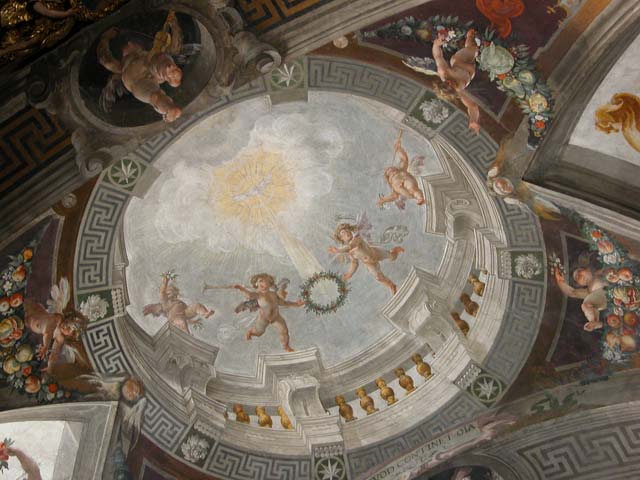
Showing posts with label Guida di Roma. Show all posts

Thursday, January 2, 2020

FOUR HOLY CROWNED ONES

SS. QUATTRO CORONATI
Via Ss. Quattro Coronati 20

Fourth century, reusing a hall with apse maybe belonging to the ancient Titulus Aemilianae perhaps from the name of the lady who used to own the house

The archaeological remains are very heterogeneous and there is a rich stratigraphy difficult to interpret
Maybe it was part of CAELIOLUS with the TEMPLE OF MINERVA CAPTA and the QUERQUETULANA GATE

Mentioned in the sources for the first time on the year 595

Enlarged in about 630 for Honorius I (625/638) who commissioned the Chapel of St. Barbara, the semicircular crypt, the portico and the bell tower

Converted into a basilica in about 850 by Leo IV (847/855)
For the foundations were used blocks of tufa stone taken from the Servian Walls

It was damaged by a destructive fire caused by the Normans in 1084

It was rebuilt smaller in the years 1111/16 for Pascal II (1099/1118), with a second internal courtyard

At the end of 1100s/beginning of 1200s monastery and cloister were added

Between 1244 and 1251 the building was used as a residence by the Cardinal Rainaldo Conti di Ienne, the future Pope Alexander IV (1254/61), who had here a wealthy PALATIUM (palace) definitely connected with the nearby Lateran Patriarchate

Only the TORRE MAGGIORE (Major Tower) and the adjoining TORRE DI S. SILVESTRO (tower of St. Silvester) are left of the Palace of Alexander VI
Soon after, the building was chosen as the home of some senators of Rome and it housed cardinals and politicians

Renewal of the sanctuary and crypt 1621/27

Restoration 1912/16 by Antonio Muñoz (1884/1960)

In the west side of the building live some nuns of the order of the Augustinians, in the east side live the so called Little Sisters of the Lamb

The church is dedicated to the four soldiers Severo, Severiano, Carpoforo and Vittorino martyred for not worshiping the statue of Aesculapius and whose bodies were buried in secret by their friend St. Sebastian
The church is dedicated also to four Dalmatians sculptors (to whom was later added a fifth martyr) of the Pannonia quarries, killed on the same day by the order of Diocletian (284/305) drowned in metal cases for having refused to carve the statue of Aesculapius
The cult of the two groups of martyrs was joined together by Pope Miltiades (311/314)

The TOWER WITH FOUR-LIGHT WINDOWS dates back to the ninth century
It was first used for defensive purposes, then as a bell tower
It is the oldest tower of Rome and it is a unique typology, inspired by models from across the Alps

In the PORTICO OF THE FIRST COURTYARD faded frescoes 1632 maybe of the school of Livio Agresti (about 1508/79) or of the school of G.B. Naldini (about 1537/91)

INTERIOR OF THE CHURCH

WOODEN CEILING
1580 for Cardinal Enrico from Portugal

COSMATESQUE FLOOR
One of the earliest examples of this technique in Rome

WALLS OF THE NAVE AND OF THE COUNTER FAÇADE
Frescoes with gaps representing “Stories of Saints” end of 1200s/beginning of 1300s

RIGHT NAVE - ALTAR OF THE HOLY SACRAMENT
“Adoration of the Shepherds” end of the 1500s, maybe by an anonymous artis of the school of Federico Zuccari

APSE
Closed by a gate and used by the cloistered Augustinian nuns to sing
On the right seventeenth-century organ with ivory keys and doors painted with “Musical Scenes”
Frescoes in the lower order “Seven scenes of the saints sculptors from Pannonian”, in the higher order “Four scenes of the saints soldiers”, in the apse “Paradise with the glory of all the saints” (known as “chorus of the women angels” for adolescent effeminate appearance of the angels) 1623 by Giovanni Mannozzi aka Giovanni da S. Giovanni (1592/1636) helped by the plasterer Francesco Solario from Chiaronno

“Not even the Roman experience freed him from the ways of expression and from the provincialism of the Florentines of his own period. Although his light touch, bright colors and the looseness and panache of his production make him one of the most attractive Florentine painters of the 1600s, the character of his art is dated” (Rudolf Wittkower)

CRYPT
Cell with “Four ancient tombs” (one in red porphyry, another in green porphyry) with the relics of the saints
Frescoes in the vault “God the Father” and “Sts. Four Crowned” by Giovanni Mannozzi aka Giovanni da S. Giovanni

AT THE END OF THE COLUMNS, ON THE LEFT
“Ciborium” of the end of the fifteenth century maybe by Andrea Bregno (1418/1503) or Luigi Capponi (active end 1400s/beginning of 1500s)

LEFT NAVE - ALTAR OF St. SEBASTIAN
Featuring a fenestella confessionis where the reliquary with the head of St. Sebastian used to be kept. Now it is in the Museo Sacro Vaticano
“St. Sebastian Tended by Irene and Lucina” by Giovanni Baglione (1566/1643)

FURTHER ON IN THE NAVE
“Annunciation” by Giovanni Mannozzi aka Giovanni da S. Giovanni

SACRISTY
“Aedicula in marble with winged griffins facing each other” about 1500

CLOISTER
About 1116 maybe by Pietro de Maria, one of the oldest in Rome, perhaps the first ever built
“Fountain made of two overlapping medieval pools” assembled by Antonio Muñoz in 1917
It probably dates to the late eleventh century and it could therefore be regarded as the oldest fountain in Rome

Adjacent to the cloister there is the CHAPEL OF St. BARBARA with traces of thirteenth-century paintings

In the second external courtyard RECEPTION OF THE NUNS with “Liturgical Calendar of the thirteenth ceentury”

FIRST FLOOR OF THE MONASTERY
Extraordinary GOTHIC CHAPEL with frescoes of the thirteenth century discovered in 1996 attributed to the Third Master of Anagni, the painter of the frescoes in the crypt of the Cathedral of Anagni, one of the most important and admired medieval pictorial cycles in Italy

“At the time of presentation of the frescoes to the scholars the Hall was called 'The Sistine Chapel of the thirteenth century'. Beyond the excellent quality of the frescoes, the historical importance of this series of paintings is such as to oblige scholars and historians to rewrite entire pages of art history. The press throughout Europe has spoken enthusiastically of this finding. (...) The Gothic Chamber, however, is in a monastery of cloistered nuns who can not have contact with any outside person. To open the hall to the public was thus necessary the construction of a secondary access door. In December 2006, the then Minister Francesco Rutelli announced the end of the restoration work, postponing the opening to the public in March 2009. To this day (May 2013) the works necessary for the construction of the door have not yet begun. From a research of the Rome daily Il Tempo has emerged that the responsibility of the work is of the APSA (Administration o the Apostolic Heritage), an organ of the Vatican from which the newspaper has received no answer. And so the Gothic Hallis likely to remain closed. All blocked. For a small door” (From the blog riprendiamociroma.blogspot.it)

Oratorio di S. Silvestro 

Oratory of St. Sylvester

Frescoed in 1247 by one or more masters of Byzantine influence, Venetian, perhaps, for Cardinal Rainaldo Conti di Ienne future Pope Alexander IV (1254/61), who consacrated it on that same year

In the counter façade
“Christ between the Virgin Mary, St. John the Baptist, the Apostles, and two angels”

On the side walls
“STORIES OF CONSTANTINE”
“Recognition of the true cross among the three crosses found by St. Helena on Golgotha”
“S. Silvestro resurrects a bull” who had been killed by a rabbi
With this miracle St. Sylvester (314/335) succeeded in converting both Helena and the rabbi and the bull became his iconographic attribute
“Defeat of a huge dragon settled in a cave of the Roman Forum” (almost completely gone) persistent symbol of paganism in Rome
“Constantine leper reassures mothers who ask mercy for their children” having had from the pagan doctors the advice to immerse himself in the blood of three hundred children
“Sts. Peter and Paul appear in a dream to Constantine”
“The imperial envoys go on the Soratte Mountain to look for St. Sylvester”
“St. Sylvester baptizes Constantine”
“Constantine cured of leprosy hands the tiara to St. Sylvester”
“Constantine receives St. Sylvester in Rome”

These paintings reflect the contrasts between Pope Innocent IV dei Conti di Lavagna (1243/54) and the Emperor Frederick II Hohenstaufen
Here the anti-imperial and theocratic ideology of the church is glorified with a flat but decoratively rich style. It is an original reprocessing of influences coming perhaps from the mosaics of Monreale or from the frescoes in the crypt of the Cathedral of Anagni

Rectangular apse:
Frescoes on the right “Deposition of the four saints sculptors in the coffers before being thrown into the river”
On the left “Flagellation of the four holy soldiers”
On the back wall “Crucifixion” and, in the upper part, “Annunciation”
In the pendentives “Four Saints”

In the vault “Four angels and four Evangelists” 1570 all works maybe by Raffaellino Motta aka Raffaellino da Reggio (1550/78)
On the frieze two marble funnels voice-carriers to allow to listen to the songs and ceremonies in the Gothic Hall on the floor above

Monday, December 16, 2019

St. SYLVESTER ON QUIRINAL HILL

S. SILVESTRO AL QUIRINALE
Via XXIV Maggio 10

Mentioned for the first time by the sources in 1030
Built over the TEMPLE OF SEMO SANCUS DIUS FIDIUS on the spur of the Quirinal Hill known as Mucialis Hill or Sanqualis Hill, from the name of the temple and of the nearby gate of the Servian Walls

Known also as S. Silvestro in Caballo (St. Sylvester at the Horse) and later as S. Silvestro in Arcioni from the Arcioni family who used to live in this area

Rebuilt in the years 1524/27 for Clement VII Medici (1523/34)

FAÇADE
1873/77 Andrea Busiri Vici (1818/1911) who destroyed the original façade and the first two chapels, following the lowering of 9 m (30 feet) of Via del Quirinale

CEILING
Coffered wooden ceiling of the second half of the sixteenth century

COUNTER FAÇADE
“Tomb of Cardinal Federico Cornaro” 1591 maybe by G.B Della Porta (1542/1602)

1st CHAPEL ON THE LEFT
Remarkable FLOOR in tiles 1525/27 by Luca Della Robbia (about 1400/82). They are just like the ones used by Raphael for the Vatican Loggia
Lower frieze painted with “Monochrome putti” and frescoes on the side walls “Stories of Mary Magdalene” and “Stories of St. Catherine of Siena” by Polidoro Caldara aka Polidoro da Caravaggio (about 1495/1543) and Maturino da Firenze (?/1528)
They are the first landscapes ever in Roman Renaissance painting

“Outwardly they are blunt as far as colors, monochrome, almost like the façade of Palazzo Milesi, and have, like the actual artist's drawings, soft traits with a pictorial effect. But their real importance is the fact that they successful bring together huge landscaped grounds and ancient style buildings. It is amazing to find in a period so remote a representation of heroic landscapes that anticipates the substance of the entire artistic development all the way until Gaspard Dughet and Claude Lorrain. Only a contemporary of Raphael, akin to him in spirit, could have succeeded in this great innovation to complement the style rediscovered by history” (Hermann Voss)

Vault “Stories of St. Stephen” by Giuseppe Cesari aka Cavalier d'Arpino (1568/1640)

2nd LEFT - GHISLIERI CHAPEL
Above the altar “Nativity” about 1575 by Marcello Venusti (about 1512/79)
On the right “Circumcision” and on the left “Adoration of the Magi” maybe by Jacopo Zucchi (about 1542/96)
On the vault, on the right “Dream of St. Joseph” and on the left “Massacre of the Innocents” about 1575 maybe by Raffaellino Motta aka Raffaellino da Reggio (1550/78)

1st CHAPEL ON THE RIGHT
Above the altar “Pope Silvester baptizes Constantine” about 1610 by Avanzino Nucci (1552/1629) from the destroyed chapel

2nd RIGHT - CHAPEL OF OUR LADY OF THE CHAIN
Painting on board “Our Lady of the Chain” of the thirteenth century by the Roman school inserted in “St. Pius V Ghislieri (1566/72) and the cardinal nephew Alessandrino in adoration of the Virgin Mary” about 1646 by Giacinto Gimignani (1606/81)
Frescoes on the walls, ceiling and under-arches by Cesare Nebbia (1536/1614)

PRESBYTERY
In the vault wonderful frescoes “Angels with palm trees and coats of arms” 1600/01 by the brothers Giovanni Alberti (1558/1601) and Cherubino Alberti (1553/1615) and continued in the second vault in 1602 by Matteo Zaccolini and Giuseppe Agellio

It is one of the first examples of perspective painting on the vaults of any church

“The interest in the architectural-decorative element is significantly strong in the Alberti family: the father Alberto and his three sons Giovanni, Cherubino and Alessandro, as well as their cousin Durante. All that had been done in illusionistic painting in central Italy (quadrature) at the level of isolated attempts, is summed up by their monumentality and elevated to the effect that prepares the way for the great perspective painters of the seventeenth century, from Pietro da Cortona to Andrea Pozzo. Already in Raphael and his school there had been some attempts to illusionistic effects, as the recurrent and beloved painted views in between columns. (...) That however was a very simple system based on a strictly architectural concept. A different story with the Albertis, where (...) each architectural idea push into each other, putti with garlands and coats of arms float in the entire space, richly articulated allegorical figures are placed on the balustrades - in short, the architectural scheme is enlivened in a larger than life way from a decorative point of view and it is dissolved in the pictorial element” (Hermann Voss)

On the left “St. Cajetan receives milk from the Virgin Mary” by Lazzaro Baldi (about 1624/1703)
On the right “Dispute of Jesus” by the Theatin father Biagio Betti

RIGHT TRANSEPT
Above the altar “St. Cajetan Thiene and St. Andrew Avellino” 1630 by Antonio Alberti detto il Barbalonga (1600/49), the best pupil of Domenichino

AT THE END OF THE LEFT TRANSEPT - BANDINI CHAPEL
Splendid and sumptuous chapel built in the years 1580/85 by the Bolognese Ottaviano Nonni aka Ottaviano Mascherino (1524/1606)

“Considered for a long time a minor artist (Golzio, 1929/30), more recent studies have highlighted his figure as emblematic in the history of Roman art at the end of the sixteenth century, his importance becoming apparent both from the analysis of his personal life and from his works - even if often of controversial attribution - well representing the moment of transition from late Mannerism to Baroque. (...) He owed much of his fame to the favor granted to him by the fellow Bolognese Gregory XIII Boncompagni (1572/85). He came to Rome probably in 1574 along with other artists and illustrious Bolognese called by the pope to work in the Vatican and to fill key posts in the administration and in the papal court. (...) In Rome he had brought his wife Domenica de Pinis, from Siena, (...) with whom it seems he lived in the Borgo neighborhood in a house on Via del 'Mascherino'“ (Isabella Salvagni - Dizionario Biografico degli Italiani Treccani)

Beautiful “Assumption” 1585 on slate by Scipione Pulzone (about 1550/98)

In the spandrels of the dome “Round panels with biblical scenes”:

“David dancing before the ark of the covenant”, “Judith with the Head of Holofernes”, “Esther before Ahasuerus”, “Solomon and Bathsheba” in 1628 by Domenico Zampieri aka Domenichino (1581/1641)
In the corner niches statues in stucco “Mary Magdalene” and “St. John” 1628 two of the first works in Rome by Alessandro Algardi (1598/1654) and “St. Joseph” and “St. Martha” maybe by Francesco Mochi (1580/1654)

On the left “Sepulchral monument of Cardinal Ottavio Bandini” by Giuliano Finelli (1602/53)

The left transept leads to a SMALL TERRACE, with a cemetery chapel, with pretty stuccos on the façade

Around the mid-sixteenth century here gathered some protagonists of the Roman cultural scene in a sort of religious Upper Room, where a possible internal reform of the church was usually discussed
The organizer was the brother Lancellotto Politi da Siena and among the participants were Michelangelo Buonarroti (1475/1564) and Vittoria Colonna

Thursday, September 26, 2019

St. ROCH

S. ROCCO
Largo S. Rocco/Piazza Augusto Imperatore 6

Eleventh century as S. Martino di Posterula
Rebuilt in the years 1499/1503 for Alexander VI Borgia (1492/1503) for the Confraternity of St. Roch, established precisely in 1499

It was dedicated to the French hermit St. Roch of Montpellier (about 1346-50/about 1376-79), protector of plague victims
In those same years a hospital and a chapel were also built adjacent to the church, eventually destroyed in 1938

It was transformed in the years 1644/80 by Giovanni Antonio De Rossi (1616/95)

FAÇADE
1834 neoclassical masterpiece by Giuseppe Valadier (1762/1839), a tribute to façade of S. Giorgio Maggiore in Venice by the great architect Andrea Palladio (1508/80)

“He was the best architect of his time, but he did not have ideological assumptions or social programs. He had too much taste and sense of proportion not to understand that Rome is, basically, a Baroque city. Everywhere, in numerous and timely interventions, he grasped with finesse the tone the Rome of his time, papal and bourgeoisie. His ideal was balance, a syntactically well-articulated discourse, without emphasis and without vulgarity. This is demonstrated by what is perhaps his masterpiece, the façade of St. Roch, where he combined to perfection, fitting the pieces into each other, the central section all developed in height and the two lowered wings all developed in width” (Giulio Carlo Argan)

The two “Angels holding candles” on the façade were placed here in 1984

On the right side of the church was placed in 1821 the Hydrometer of Ripetta, a bas-relief column that measures the height of the flooding of the Tiber
The worst flooding reported here is the one in 1598 with a record of 4 m (13 feet) above the current level of road

In the attached obstetrician hospital, now no longer extant, were accepted pregnant women who wanted to remain anonymous: they entered veiled, their beds were separated by curtains and were identified by numbers
They were therefore described as the celate di S. Rocco (concealed of St. Roch). Their children ended up in an orphanage

The hospital was abolished in the late nineteenth century but this activity continued in the Ospedale S. Giovanni (St. John's Hospital)

VAULT OF THE CENTRAL NAVE
“Christ, St. Peter and other saints” by Achille Scaccioni (active 1858/65)

DOME
Painted by Vincenzo Pasqualoni (1819/80), a pupil of Tommaso Minardi
Dome and vault were carried out in the artistic period defined purist
Above the entrance organ of 1721

COUNTER FAÇADE
“Tomb of the master builder Vitelli” (patron of the façade by Valadier) by Giuseppe De Fabris (1790/1860)

1st RIGHT - CHAPEL OF St. FRANCIS OF PAOLA
Above the altar “Ecstasy of St. Francis of Paola” 1719 by Antonio Amorosi (1660/1738)

2nd RIGHT - CHAPEL OF St. JOSEPH
Above the altar “St. Joseph” 1912 by Giovanni Gagliardi (1838/1924), grandson of Pietro Gagliardi

3rd CHAPEL ON THE RIGHT
Above the altar “St. Julian and St. Nicholas” by an unknown artist influenced by Carlo Maratta

TO THE RIGHT OF THE PRESBYTERY - CHAPEL OF OUR LADY OF GRACE
1655 masterpiece by Giovanni Antonio De Rossi for Urban VIII Barberini (1623/44) with influences Borromini

“The visitor can detect a likeness with the space of San Carlino by Borromini (the inspiration is evident even if this chapel is much smaller): the side walls constrict and dilate, the intricate design is repeated on the perimeter of the frame that has a strong overhang” (Rosanna Barbiellini Amidei)

In the dome “Assumption” by Giovanni Antonio Carosi (about 1600/about 1656)

ALTAR OF THE CRUCIFIX
Paintings by Ernesto Ballarini (1845/1922)

MAIN ALTAR
“St. Roch in glory with the Redeemer” 1674 by Giacinto Brandi (1621/91)
On the sides “St. Roch visit the plagued” and “St. Martin gives his cloak to the poor” 1885 by Cesare Mariani (1826/1901)

3rd LEFT - CHAPEL OF St. ANTHONY OF PADUA
Above the altar “St. Anthony of Padua” about 1650 by Gregorio Preti (active in the seventeenth century), brother of Mattia Preti
Frescoes “Stories of St. Anthony” by the Genoese Francesco Rosa (active since 1674/d. 1687)

2nd LEFT - CHAPEL OF THE NATIVITY
Above the altar “Nativity” second decade of the 1500s by Baldassare Peruzzi (1481/1536) badly damaged also by a restoration of the eighteenth century by Giovanni Odazzi

1st CHAPEL ON THE LEFT
Above the altar “St. Vincent Ferrer” 1721 by Antonio Gregolini (1675/1736)

SACRISTY
In the ceiling “Our Lady appears to St. Roch” maybe by Francesco Cozza (1605/82)
“Virgin Mary with Sts. Anthony Abbot and St. Roch and the Plague Victims” about 1660/65, first Roman masterpiece by G.B. Gaulli aka Baciccio (1639/1709)
“In the painting by Gaulli dominates the neo-venetian lesson of Nicolas Poussin. The vivid color range, the representation of 'feelings', even the poses of the characters, refer to prototypes common in the works by Poussin and Andrea Sacchi of the third decade of the century, as if the painter was trying independently to draw directly to the sources of Carlo Maratta” (Rosanna Barbiellini Amidei)

Thursday, March 28, 2019

St. MARY IN MONTICELLI

S. MARIA IN MONTICELLI
Maybe built in the seventh century AD over ruins which determined the mound where the church is and from which it took the name monticelli (mounds)
Maybe they were the ruins of a temple in the area of the Circus Flaminius such as the TEMPLE OF NEPTUNE. Filippo Coarelli reckons the Temple of Neptune was actually located in the area of the Manilis' House
In 1089 Pope Urban II (1088/99) transferred here the relics of five martyrs from Palermo
Restored in 1101 for Paschal II (1099/1118)
It was known as Sancta Maria in Monticellis Arenulae de Urbe
1715 transformed for Clement XI Albani (1700/21) by Matteo Sassi (1646/1723) who also designed the FAÇADE with the collaboration of Giuseppe Sardi (1680/1753)
1860 restoration by Francesco Azzurri (1831/1901) for Pius IX Mastai-Ferretti (1846/78) with polychrome marble taken from the columns of the previous church, as they were found embedded in the pillars of the eighteenth-century restoration
Since 1726 it is officiated by the Fathers of the Christian Doctrine

VAULT
“Six heroines of the Old Testament: Esther, Bathsheba, Deborah, Jael, Abighail and Judith” representatives of the main glories of Our Lady, 1860 by Cesare Mariani (1826/1901)
“Highly regarded by the popes, Cesare Mariani began his copious activities under Pius IX in the mid-1800s, and continued until the end of the century under Leo XIII, literally covering of paint vaults, pillars and domes of 13 Roman churches. Appreciated by the House of Savoy, he also contributed to the definition of the image of the emerging unitary Italian state, winning the competition for the first public commission of the new kingdom: the frescoes in the Hall of the Majority, at the current Treasury Palace, where the first ever Council of Ministers Italian met. (...) An artist who played an important role in that particular historical moment of transition between the papal city and the 'Third Rome' (...) His art is defined by critics as 'very flexible', as he knew to adapt it to any client with great ease” (Lauretta Colonnnelli - Corriere della Sera on 3/25/01)
COUNTER FAÇADE
Above the organ “Moses and the Burning Bush” and “Jacob's Dream” by Cesare Mariani
On the choir “St. Cecilia among the angels” by Tommaso Minardi (1787/1871)
To the left of the entrance there is a medieval fragment of a fresco representing perhaps “Paschal II”

FRESCOES ON THE PILLARS
“Evangelists” 1860 by the nineteenth-century painter Ercole Ruspi

1st CHAPEL ON THE RIGHT
Above the altar “Agony in the Garden” by Odoardo Vicinelli (1683/1755)
On the right wall “Assumption” maybe by Andrea Sacchi (1599/1661)

2nd CHAPEL ON THE RIGHT
Above the altar “Flagellation” by an anonymous seventeenth-century artist maybe Antonio Carracci (about 1589/1618), son of Annibale

3rd CHAPEL ON THE RIGHT
Above the altar “S. Ninfa refuses to sacrifice to idols” by G.B. Puccetti (1593/about 1670)
On the left wall “Madonna and Child with martyrs of Palermo” by Etienne Parrocel (1696/1774) formerly on the main altar

AT THE END OF THE RIGHT NAVE - CHAPEL OF JESUS ​​OF NAZARETH
Altarpiece “Jesus Christ” by an unknown seventeenth century artist
This image is famous for a miracle which took place in 1854: apparently the eyes of Jesus in this painting moved
Frescoes of the beginning of the twentieth century by Eugenio Cisterna (1862/1933)
“Tombstone of Gregoria de' Rusticelli” of the fifteenth century

APSE
Fragment of mosaic of the twelfth century with “Head of the Redeemer”

MAIN ALTAR
Relics of the martyrs of Palermo bishop Maximilian, Eustosius, Proculus, Golbodeus and the young girl Ninfa
Above the altar “Presentation of Mary in the Temple” by Alfredo Bea
Walls of the presbytery on the right “Mothers offer their children to Jesus”, on the left “Jesus teaches in the Temple” by Cesare Mancini

AT THE END OF THE LEFT NAVE - CHAPEL OF CESARE DE BUS
Founder of the Congregation of Priests of the Christian Doctrine, exhumed in 1975 when he was beatified

3rd CHAPEL ON THE LEFT
Above the altar “Preaching of St. John the Baptist” by G.B. Puccetti (1593/about 1670)
Under the altar body of S. Fortunato martyr of the second century

2nd CHAPEL ON THE LEFT
Above the altar “Wooden Crucifix” traditionally attributed to Pietro de' Cerroni aka Pietro Cavallini (about 1240/about 1325) in front of which it seems St. Bridget used to pray

1st CHAPEL ON THE LEFT
Above the altar “Flagellation” by the Frenchman Jean Baptiste Van Loo (1684/1745), who studied in Rome with Benedetto Luti

Wednesday, March 13, 2019

St. MARY OF THE STAIRS

S. MARIA DELLA SCALA
Built in the years 1593/1610. Francesco Capriani aka Francesco da Volterra (1535/94) began the works but he died after one year and the church was finished by Girolamo Rainaldi (1570/1655)

Finished in 1624 according to the design of Francesco da Volterra
In the niche of the façade “Madonna and Child” 1633 by Francesco di Cusart
In 1849, during the period of the Roman Republic, the church was used as a field hospital for Garibaldi's soldiers
Restored in 1851
The interior is a reformulation Church of the Gesù

Spectacular wooden choir stalls 1756 by Giuseppe Pannini (about 1720/about 1810), the architect of the Trevi Fountain and the son of the painter Giovanni Paolo Pannini

1st RIGHT - CHAPEL OF St. JOHN THE BAPTIST
Above the altar “Beheading of the Baptist” 1619 masterpiece by Gerrit Van Honthorst aka Gherardo Delle Notti (1590/1656)
“He brings back Caravaggio's forming light into a light source within the painting, taking advantage of the shade not as matrix of light, but as a screenplay” (Cesare Brandi)
2nd RIGHT - CHAPEL OF St. HYACINTH
On the altar “Virgin Mary, St. Hyacinth and St. Catherine of Siena” by Antiveduto Grammatica (about 1572/1626)

3rd RIGHT - CHAPEL OF St. JOSEPH
Above the altar “Holy Family” by Giuseppe Ghezzi (1634/1721)
Dome “Glory of St. Joseph” and on the right “Joseph's Dream” by Giovanni Odazzi (1663/1731)
On the left “Marriage of Mary and Joseph” by Antonio David (1684/after 1735)

RIGHT TRANSEPT - CHAPEL OF St. TERESA OF AVILA
Designed by Giovanni Paolo Pannini (1691/1765)
Here the right foot of St. Teresa of Avila was kept from 1617 until 1905. Now it is in the Chapel of the Relic
Above the altar “Ecstasy of St. Teresa” by Francesco Mancini (1679/1758)
Oval marble on the left “St. Teresa in Ecstasy” by Filippo Della Valle (1698/1768) and on the right “St. Teresa pierced by a cherub” by Michelangelo Slodtz (1705/64)
On the pediment “Two angels” in stucco by G.B. Maini (1690/1752)
In the big lunette two reliefs in stucco with “Visions of St. Teresa” by Giuseppe Lironi (1689/1749)

1647 Carlo Rainaldi (1611/91)
Statues at the sides on the left “St. Joseph” and on the right “St. Teresa” by Simone Giorgini (active in Rome 1677/1712)
On the back “Virgin Mary of Mount Carmel” 1737 by Giuseppe Peroni (about 1626/63)
Four paintings on the walls of the presbytery with “Stories of the Christ”:
From right “Baptism”, “Wedding at Cana”, “The Last Supper” and “Ascension” by the Flemish painter Lucas De La Haye aka Luca Fiammingo (second half of the eighteenth century) and “Madonna with Child” in 1612 by Giuseppe Cesari aka Cavalier d'Arpino (1568/1640)

IN THE APSE
“Redeemer Enthroned with Virgin Mary and saints” second half of the nineteenth century by Fra' Silvestro di S. Luigi

TO THE LEFT OF THE CHOIR - CHAPEL OF THE RELIC
The right foot of St. Teresa of Avila has been kept here since 1905
Six paintings with “Stories of St. Teresa of Avila” by Lucas De La Haye aka Luca Fiammingo

“Miraculous image of Our Lady”: according to tradition, in 1592 this icon, located on the outer stairs of a nearby house, miraculously healed a deformed child after the prayers of his mother
On the right “Cenotaph of Cardinal Prospero Santacroce” by Alessandro Algardi (1598/1654)
On the left “Tomb of Livia Prini Santacroce” by Domenico Guidi (1625/1701)
Cardinal Prospero Santacroce was the first ever to introduce tobacco in Rome. It was then known as Santacroce's grass
Paintings on the right “Coronation of the Virgin” and on the left “Immaculate Conception” by Lucas De La Haye aka Luca Fiammingo

3rd LEFT - CHAPEL OF THE CRUCIFIX
Marble group “St. John of the Cross at the foot of the Crucifix” by Pietro Papaleo (1640/1740)
Vault “Angels and symbols of the Passion”
On the right “Mocking of Christ” and on the left “Christ fallen under the Cross” by Filippo Zucchetti (active 1694/1712) from Rieti

2nd RIGHT - CHAPEL OF THE ASSUMPTION
Designed by Girolamo Rainaldi (1570/1655)
On the altar “Death of the Virgin Mary” about 1610 by the Venetian Carlo Saraceni (1579/1620) for the lawyer Laerzio Cherubini, instead of the rejected masterpiece by Caravaggio, now in the Louvre
“The first version is now in the Metropolitan Museum in New York. (...) For the Roman painting (...) a restoration carried out in 2013 on the occasion of the exhibition at Palazzo Venezia made ​​it possible to study in depth this work of great compositional maturity, albeit with sometimes hasty painting style in the lower half, with the figures of the apostles and the holy women intensely pathetic in pure Caravaggio's style, the Virgin Mary solemn and traditionally looking in the center. The masonry architecture with arches and vaults of the first version (...) is replaced by a rather conventional riot of angels rejoicing, of pictorial quality quite different than the lower part, with a small successful example of still life in the little wreath of flowers. (...) The modern character looking toward the viewers is perhaps a self-portrait and one can identify his collaborator in the man next to him” (Maria Giulia Aurigemma)
On the sides “Marriage of the Virgin Mary” and “Birth of the Virgin Mary” by Giovanni Conca (about 1690/1771) cousin of the more famous Sebastiano Conca and often believed his brother, so tight their bonds of friendship and work were. He was the father of distinguished painter Tommaso Conca

1st LEFT - CHAPEL OF THE BLESSED VIRGIN MARY OF MOUNT CARMEL
Above the altar “The Virgin Mary gives the scapular to St. Simon Stock” and in the pediment “Eternal Father” by Cristoforo Roncalli aka Pomarancio (1552/1626)

CONVENT OF THE DISCALCED CARMELITES
Maybe Matteo Bartolani da Città di Castello (about 1527/about 1598) and Ottaviano Nonni aka Ottaviano Mascherino (1524/1606) with OLD APOTHECARY on the second floor above the pharmacy, still operating
It was opened in the early eighteenth century and supplied the popes and their families, enjoying privileges and tax exemptions. The furniture and tools of the eighteenth century are still here today

Sunday, March 3, 2019

St. MARY OF MOUNT CARMEL AT THE THREE FOUNTAINS

S. MARIA DEL CARMINE ALLE TRE CANNELLE
1605/25 as the Oratorio della Confraternita del Carmine (Oratory of the Confraternity of Mount Carmel) for Cardinal Odoardo Farnese
1724/33 transformed and enlarged by Giacomo Cioli (?/1734)
Restored in 1775 after a fire in 1772 destroyed the interior of the church
The urban setting of the church was completely altered after the demolitions for the construction of Via IV Novembre began in 1875. Originally the church was on a larger square and the buildings surrounding it were lower

1750 Michelangelo Specchi (active in Rome about 1684/after 1750)
“At the center of the façade there is a window surmounted by a broken pediment with scrolls onto which there is a garland plant, according to a late Baroque taste, even if it is set in an already Neoclassical style, as it was typical of Specchi” (Olga Melasecchi)
In the lunette fresco with the “Virgin Mary of Mount Carmel” 1824

INTERIOR
Interior decoration 1817 by Camillo Marini
Decorative painting with “Fake stuccos and cornices” 1862 from drawings by Vincenzo Martinucci

COUNTER-FAÇADE
Organ of 1807

RIGHT ALTAR - ALTAR OF St. ELIJAH
Beautiful banner used as an altarpiece “Virgin Mary appears to Elijah on Mount Carmel” (front) and “Virgin Mary gives the scapular to St. Simon Stock” (back) 1727 maybe by Sebastiano Conca (1680/1764) or, more likely, by Corrado Giaquinto (1703/66)

MAIN ALTAR
Designed by Giacomo Cioli (?/1734) with eighteenth century statue “Virgin Mary of Mount Carmel and Child” in papier mâché

ALTAR TO THE LEFT OF MAIN ALTAR
Canvas “Our Lady gives the scapular to St. Simon Stock” 1776 by Giovanni Pirri, originally placed above the left altar

LEFT ALTAR - ALTAR OF St. TERESA
Canvas “St. Therese of the Child Jesus” 1927 by Tito Ridolfi (1886/1956)

SACRISTY
Canvas “S. Filippo Neri” by Corrado Giaquinto (1703/66)
“Flagellation” of the end of the sixteenth century by an anonymous artist of the Tuscan or Lombard schools

ORATORIO UPSTAIRS
“Virgin Mary of Mount Carmel” about 1605 by Gaspare Celio (1571/1640), originally placed on the main altar