Via XXIV Maggio 10
Mentioned for the first time by the sources in 1030
Built over the TEMPLE OF SEMO SANCUS DIUS FIDIUS on the spur of the Quirinal Hill known as Mucialis Hill or Sanqualis Hill, from the name of the temple and of the nearby gate of the Servian Walls
Known also as S. Silvestro in Caballo (St. Sylvester at the Horse) and later as S. Silvestro in Arcioni from the Arcioni family who used to live in this area
Rebuilt in the years 1524/27 for Clement VII Medici (1523/34)
FAÇADE
1873/77 Andrea Busiri Vici (1818/1911) who destroyed the original façade and the first two chapels, following the lowering of 9 m (30 feet) of Via del Quirinale
CEILING
Coffered wooden ceiling of the second half of the sixteenth century
COUNTER FAÇADE
“Tomb of Cardinal Federico Cornaro” 1591 maybe by G.B Della Porta (1542/1602)
1st CHAPEL ON THE LEFT
Remarkable FLOOR in tiles 1525/27 by Luca Della Robbia (about 1400/82). They are just like the ones used by Raphael for the Vatican Loggia
Lower frieze painted with “Monochrome putti” and frescoes on the side walls “Stories of Mary Magdalene” and “Stories of St. Catherine of Siena” by Polidoro Caldara aka Polidoro da Caravaggio (about 1495/1543) and Maturino da Firenze (?/1528)
They are the first landscapes ever in Roman Renaissance painting
“Outwardly they are blunt as far as colors, monochrome, almost like the façade of Palazzo Milesi, and have, like the actual artist's drawings, soft traits with a pictorial effect. But their real importance is the fact that they successful bring together huge landscaped grounds and ancient style buildings. It is amazing to find in a period so remote a representation of heroic landscapes that anticipates the substance of the entire artistic development all the way until Gaspard Dughet and Claude Lorrain. Only a contemporary of Raphael, akin to him in spirit, could have succeeded in this great innovation to complement the style rediscovered by history” (Hermann Voss)
Vault “Stories of St. Stephen” by Giuseppe Cesari aka Cavalier d'Arpino (1568/1640)
2nd LEFT - GHISLIERI CHAPEL
Above the altar “Nativity” about 1575 by Marcello Venusti (about 1512/79)
On the right “Circumcision” and on the left “Adoration of the Magi” maybe by Jacopo Zucchi (about 1542/96)
On the vault, on the right “Dream of St. Joseph” and on the left “Massacre of the Innocents” about 1575 maybe by Raffaellino Motta aka Raffaellino da Reggio (1550/78)
1st CHAPEL ON THE RIGHT
Above the altar “Pope Silvester baptizes Constantine” about 1610 by Avanzino Nucci (1552/1629) from the destroyed chapel
2nd RIGHT - CHAPEL OF OUR LADY OF THE CHAIN
Painting on board “Our Lady of the Chain” of the thirteenth century by the Roman school inserted in “St. Pius V Ghislieri (1566/72) and the cardinal nephew Alessandrino in adoration of the Virgin Mary” about 1646 by Giacinto Gimignani (1606/81)
Frescoes on the walls, ceiling and under-arches by Cesare Nebbia (1536/1614)
PRESBYTERY
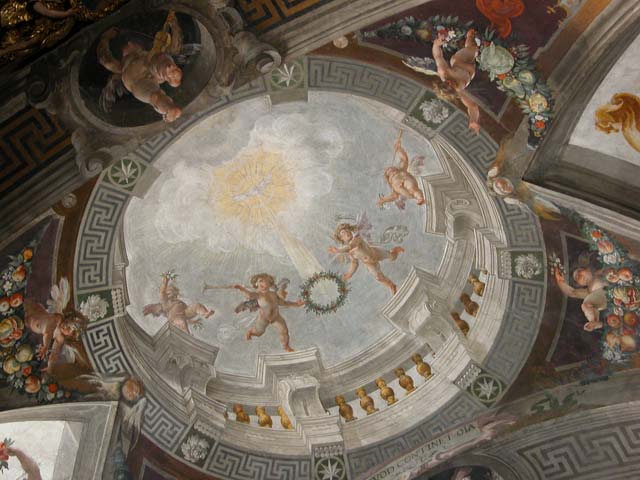
In the vault wonderful frescoes “Angels with palm trees and coats of arms” 1600/01 by the brothers Giovanni Alberti (1558/1601) and Cherubino Alberti (1553/1615) and continued in the second vault in 1602 by Matteo Zaccolini and Giuseppe Agellio
It is one of the first examples of perspective painting on the vaults of any church
“The interest in the architectural-decorative element is significantly strong in the Alberti family: the father Alberto and his three sons Giovanni, Cherubino and Alessandro, as well as their cousin Durante. All that had been done in illusionistic painting in central Italy (quadrature) at the level of isolated attempts, is summed up by their monumentality and elevated to the effect that prepares the way for the great perspective painters of the seventeenth century, from Pietro da Cortona to Andrea Pozzo. Already in Raphael and his school there had been some attempts to illusionistic effects, as the recurrent and beloved painted views in between columns. (...) That however was a very simple system based on a strictly architectural concept. A different story with the Albertis, where (...) each architectural idea push into each other, putti with garlands and coats of arms float in the entire space, richly articulated allegorical figures are placed on the balustrades - in short, the architectural scheme is enlivened in a larger than life way from a decorative point of view and it is dissolved in the pictorial element” (Hermann Voss)
On the left “St. Cajetan receives milk from the Virgin Mary” by Lazzaro Baldi (about 1624/1703)
On the right “Dispute of Jesus” by the Theatin father Biagio Betti
RIGHT TRANSEPT
Above the altar “St. Cajetan Thiene and St. Andrew Avellino” 1630 by Antonio Alberti detto il Barbalonga (1600/49), the best pupil of Domenichino
AT THE END OF THE LEFT TRANSEPT - BANDINI CHAPEL
Splendid and sumptuous chapel built in the years 1580/85 by the Bolognese Ottaviano Nonni aka Ottaviano Mascherino (1524/1606)
“Considered for a long time a minor artist (Golzio, 1929/30), more recent studies have highlighted his figure as emblematic in the history of Roman art at the end of the sixteenth century, his importance becoming apparent both from the analysis of his personal life and from his works - even if often of controversial attribution - well representing the moment of transition from late Mannerism to Baroque. (...) He owed much of his fame to the favor granted to him by the fellow Bolognese Gregory XIII Boncompagni (1572/85). He came to Rome probably in 1574 along with other artists and illustrious Bolognese called by the pope to work in the Vatican and to fill key posts in the administration and in the papal court. (...) In Rome he had brought his wife Domenica de Pinis, from Siena, (...) with whom it seems he lived in the Borgo neighborhood in a house on Via del 'Mascherino'“ (Isabella Salvagni - Dizionario Biografico degli Italiani Treccani)
Beautiful “Assumption” 1585 on slate by Scipione Pulzone (about 1550/98)
In the spandrels of the dome “Round panels with biblical scenes”:
“David dancing before the ark of the covenant”, “Judith with the Head of Holofernes”, “Esther before Ahasuerus”, “Solomon and Bathsheba” in 1628 by Domenico Zampieri aka Domenichino (1581/1641)
In the corner niches statues in stucco “Mary Magdalene” and “St. John” 1628 two of the first works in Rome by Alessandro Algardi (1598/1654) and “St. Joseph” and “St. Martha” maybe by Francesco Mochi (1580/1654)
On the left “Sepulchral monument of Cardinal Ottavio Bandini” by Giuliano Finelli (1602/53)
The left transept leads to a SMALL TERRACE, with a cemetery chapel, with pretty stuccos on the façade
Around the mid-sixteenth century here gathered some protagonists of the Roman cultural scene in a sort of religious Upper Room, where a possible internal reform of the church was usually discussed
The organizer was the brother Lancellotto Politi da Siena and among the participants were Michelangelo Buonarroti (1475/1564) and Vittoria Colonna