Showing posts with label Ottaviano Mascherino. Show all posts

Monday, December 16, 2019

St. SYLVESTER ON QUIRINAL HILL

S. SILVESTRO AL QUIRINALE
Via XXIV Maggio 10

Mentioned for the first time by the sources in 1030
Built over the TEMPLE OF SEMO SANCUS DIUS FIDIUS on the spur of the Quirinal Hill known as Mucialis Hill or Sanqualis Hill, from the name of the temple and of the nearby gate of the Servian Walls

Known also as S. Silvestro in Caballo (St. Sylvester at the Horse) and later as S. Silvestro in Arcioni from the Arcioni family who used to live in this area

Rebuilt in the years 1524/27 for Clement VII Medici (1523/34)

FAÇADE
1873/77 Andrea Busiri Vici (1818/1911) who destroyed the original façade and the first two chapels, following the lowering of 9 m (30 feet) of Via del Quirinale

CEILING
Coffered wooden ceiling of the second half of the sixteenth century

COUNTER FAÇADE
“Tomb of Cardinal Federico Cornaro” 1591 maybe by G.B Della Porta (1542/1602)

1st CHAPEL ON THE LEFT
Remarkable FLOOR in tiles 1525/27 by Luca Della Robbia (about 1400/82). They are just like the ones used by Raphael for the Vatican Loggia
Lower frieze painted with “Monochrome putti” and frescoes on the side walls “Stories of Mary Magdalene” and “Stories of St. Catherine of Siena” by Polidoro Caldara aka Polidoro da Caravaggio (about 1495/1543) and Maturino da Firenze (?/1528)
They are the first landscapes ever in Roman Renaissance painting

“Outwardly they are blunt as far as colors, monochrome, almost like the façade of Palazzo Milesi, and have, like the actual artist's drawings, soft traits with a pictorial effect. But their real importance is the fact that they successful bring together huge landscaped grounds and ancient style buildings. It is amazing to find in a period so remote a representation of heroic landscapes that anticipates the substance of the entire artistic development all the way until Gaspard Dughet and Claude Lorrain. Only a contemporary of Raphael, akin to him in spirit, could have succeeded in this great innovation to complement the style rediscovered by history” (Hermann Voss)

Vault “Stories of St. Stephen” by Giuseppe Cesari aka Cavalier d'Arpino (1568/1640)

2nd LEFT - GHISLIERI CHAPEL
Above the altar “Nativity” about 1575 by Marcello Venusti (about 1512/79)
On the right “Circumcision” and on the left “Adoration of the Magi” maybe by Jacopo Zucchi (about 1542/96)
On the vault, on the right “Dream of St. Joseph” and on the left “Massacre of the Innocents” about 1575 maybe by Raffaellino Motta aka Raffaellino da Reggio (1550/78)

1st CHAPEL ON THE RIGHT
Above the altar “Pope Silvester baptizes Constantine” about 1610 by Avanzino Nucci (1552/1629) from the destroyed chapel

2nd RIGHT - CHAPEL OF OUR LADY OF THE CHAIN
Painting on board “Our Lady of the Chain” of the thirteenth century by the Roman school inserted in “St. Pius V Ghislieri (1566/72) and the cardinal nephew Alessandrino in adoration of the Virgin Mary” about 1646 by Giacinto Gimignani (1606/81)
Frescoes on the walls, ceiling and under-arches by Cesare Nebbia (1536/1614)

PRESBYTERY
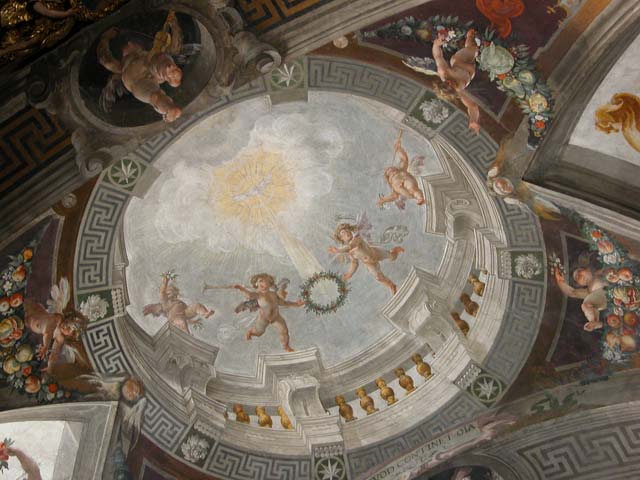
In the vault wonderful frescoes “Angels with palm trees and coats of arms” 1600/01 by the brothers Giovanni Alberti (1558/1601) and Cherubino Alberti (1553/1615) and continued in the second vault in 1602 by Matteo Zaccolini and Giuseppe Agellio

It is one of the first examples of perspective painting on the vaults of any church

“The interest in the architectural-decorative element is significantly strong in the Alberti family: the father Alberto and his three sons Giovanni, Cherubino and Alessandro, as well as their cousin Durante. All that had been done in illusionistic painting in central Italy (quadrature) at the level of isolated attempts, is summed up by their monumentality and elevated to the effect that prepares the way for the great perspective painters of the seventeenth century, from Pietro da Cortona to Andrea Pozzo. Already in Raphael and his school there had been some attempts to illusionistic effects, as the recurrent and beloved painted views in between columns. (...) That however was a very simple system based on a strictly architectural concept. A different story with the Albertis, where (...) each architectural idea push into each other, putti with garlands and coats of arms float in the entire space, richly articulated allegorical figures are placed on the balustrades - in short, the architectural scheme is enlivened in a larger than life way from a decorative point of view and it is dissolved in the pictorial element” (Hermann Voss)

On the left “St. Cajetan receives milk from the Virgin Mary” by Lazzaro Baldi (about 1624/1703)
On the right “Dispute of Jesus” by the Theatin father Biagio Betti

RIGHT TRANSEPT
Above the altar “St. Cajetan Thiene and St. Andrew Avellino” 1630 by Antonio Alberti detto il Barbalonga (1600/49), the best pupil of Domenichino

AT THE END OF THE LEFT TRANSEPT - BANDINI CHAPEL
Splendid and sumptuous chapel built in the years 1580/85 by the Bolognese Ottaviano Nonni aka Ottaviano Mascherino (1524/1606)

“Considered for a long time a minor artist (Golzio, 1929/30), more recent studies have highlighted his figure as emblematic in the history of Roman art at the end of the sixteenth century, his importance becoming apparent both from the analysis of his personal life and from his works - even if often of controversial attribution - well representing the moment of transition from late Mannerism to Baroque. (...) He owed much of his fame to the favor granted to him by the fellow Bolognese Gregory XIII Boncompagni (1572/85). He came to Rome probably in 1574 along with other artists and illustrious Bolognese called by the pope to work in the Vatican and to fill key posts in the administration and in the papal court. (...) In Rome he had brought his wife Domenica de Pinis, from Siena, (...) with whom it seems he lived in the Borgo neighborhood in a house on Via del 'Mascherino'“ (Isabella Salvagni - Dizionario Biografico degli Italiani Treccani)

Beautiful “Assumption” 1585 on slate by Scipione Pulzone (about 1550/98)

In the spandrels of the dome “Round panels with biblical scenes”:

“David dancing before the ark of the covenant”, “Judith with the Head of Holofernes”, “Esther before Ahasuerus”, “Solomon and Bathsheba” in 1628 by Domenico Zampieri aka Domenichino (1581/1641)
In the corner niches statues in stucco “Mary Magdalene” and “St. John” 1628 two of the first works in Rome by Alessandro Algardi (1598/1654) and “St. Joseph” and “St. Martha” maybe by Francesco Mochi (1580/1654)

On the left “Sepulchral monument of Cardinal Ottavio Bandini” by Giuliano Finelli (1602/53)

The left transept leads to a SMALL TERRACE, with a cemetery chapel, with pretty stuccos on the façade

Around the mid-sixteenth century here gathered some protagonists of the Roman cultural scene in a sort of religious Upper Room, where a possible internal reform of the church was usually discussed
The organizer was the brother Lancellotto Politi da Siena and among the participants were Michelangelo Buonarroti (1475/1564) and Vittoria Colonna

Sunday, December 15, 2019

St. SAVIOUR NEAR THE LAURELS

S. SALVATORE IN LAURO
Piazza S. Salvatore in Lauro 15

Mentioned for the first time by the sources in 1177
Rebuilt in 1449
It was rebuilt in 1594 by Ottaviano Nonni aka Ottaviano Mascherino (1524/1606) after a fire that had destroyed it in 1591
It is his architectural masterpiece

“The space of the single nave is dramatically shaped by a rhythm of paired columns detached from the wall, fastened at the top by protruding ribs, a solution of exceptional force (...). It is as if the drum with double columns of the dome of St. Peter's Basilica would be led in an interior space and would generate tension between the plastic frame and the space as well as a chiaroscuro vibration so intense to give a clear and authoritative alternative both to the interiors by Andrea Palladio in Venice, and to the Church of the Gesù. It was an alternative that would be echoed only in the Trinità dei Pellegrini church by Paolo Maggi, who introduced the motif of the free-standing columns in the pillars supporting the dome with a marked dramatic effect” (Paolo Portoghesi)

Completed only in the years 1727/34 by Ludovico Rusconi Sassi (1678/1736)

FAÇADE
1857/62 late purist architecture by Camillo Guglielmetti (pupil of Luigi Poletti) with bas-relief “Transport of the Holy House of Nazareth” by Rinaldo Rinaldi (1793/1873)

The square was enlarged in 1939 and the proportions of the façade in relation to the square itself were inevitably altered

The name probably derives from a forest of laurels in the Portico of Europe that maybe was once in this area

It is the National Church of the Piceni and of the Marche region

INTERIOR
Marble floor of the nineteenth century

COUNTER FAÇADE
On the right “Monument of Cardinal Gaspare Bernardo Pianetti” by Luigi Poletti (1792/1869) sculpted by Ignazio Jacometti (1819/83)
On the left “Monument of Cardinal Antonio Matteucci” d. 1868 by Luigi Fontana (1827/1908)

1st RIGHT - CHAPEL OF THE PIETÀ
Designed by Francesco Carlo Bizzaccheri (1655/1721)
Above the altar “Christ dead in the arms of the Virgin Mary” 1628/30 by Giuseppe Ghezzi (1634/1721) who also painted “St. Nicholas of Tolentino” and “St. Anthony of Padua” on the sides
Giuseppe Ghezzi was born in Ascoli Piceno and was buried in this church in which, from 1687 onwards, he was responsible for the exhibition of paintings held in the cloister every December 10, on the anniversary of the translation of the Holy House of Loreto
This art exhibition was the most important one of the whole seventeenth century in Rome

“The Pietà was entirely designed over diagonal lines, the grey background tone contrasting with the dazzling clarity of Christ's body in the foreground which seems almost to slip towards the viewer. The two saints on the sides are considered 'among the most beautiful and stirring works in Roman Baroque painting at the end of the century' (Martinelli)” (Rossella Faraglia - Dizionario Biografico degli Italiani Treccani)

In the upper part there are sculptures of “Angels” by Camillo Rusconi (1658/1728)

2nd RIGHT - CHAPEL OF St. CHARLES
Above the altar “Virgin Mary appears to St. Charles Borromeo” by Alessandro Turchi aka l'Orbetto (1578/1649)
On the RIGHT SIDE OF THE CHURCH there is a modern statue, considered very kitsch by many, with “Jesus and St. Padre Pio” of whom there are a few relics on the left side of the church

3rd RIGHT - CHAPEL OF THE NATIVITY
Above the altar “Nativity of Jesus” about 1625, early work and first public commission of Pietro Berrettini aka Pietro da Cortona (1597/1669)

“This first group of paintings already clearly states the beginning of a new expression, differing substantially, regardless of any qualitative consideration, from contemporary artistic manifestations. In this group of paintings one notices first of all the conscious intention to exclude from the scene and from the characters any realistic hint and any relationship with the sentimental individuality of the viewer. Without further indulging in the visual illusion of the details, Pietro da Cortona diffuses light, impartially, to the entire surface of the painting, creating that atmospheric likelihood that anticipates the Neo-Venetian style of paintings of the following decades” (Giuliano Briganti - Dizionario Biografico degli Italiani Treccani)

ALTAR OF St. EMYGDIUS
“St. Emygdius between St. Nicholas of Tolentino and St. James of the Marca” 1863 by Pietro Gagliardi (1809/90)
On the right “Tomb of Cardinal Nicola Grimaldi” about 1846 by Filippo Gnaccarini (1804/75)
On the left “Monument of Canon Gaspare Fatati” about 1852 and “Monument of Cardinal Raniero Simonetti” 1751 by Girolamo Theodoli (1677/1766) sculpted by Carlo Monaldi (about 1690/1760)

MAIN ALTAR
1792 Antonio Asprucci (1723/1808) who maybe replaced an altar by Andrea Palladio
On the altar “Glory of Angels” in stucco by Vincenzo Pacetti (1746/1820) surrounding a seventeenth-century copy of the Madonna of Loreto
“Angels” on the pediment 1721 by Pietro Paolo Campi (active 1702/40)

SPANDRELS OF THE DOME
“David, Moses, Ezekiel and Isaiah” 1862 by Luigi Fontana (1827/1908)

ALTAR OF THE CROSS OF SIROLO
Copy the wooden Crucifix venerated in Sirolo (Ancona) 1713 by Francesco Bellucci

ABOVE THE DOORWAY TO THE SACRISTY
“Tomb of Cardinal Prospero Marefoschi” 1751 by Girolamo Theodoli (1677/1766) sculpted by Carlo Monaldi (about 1690/1760)

4th LEFT - CHAPEL OF St. LUTGARD
Above the altar “S. Lutgard exchanges her heart with that of the Redeemer” and on the sides “Stories from the Life of St. Lutgard” 1679 by Antonio Mascherotti

2nd LEFT - CHAPEL OF St. JOSEPH
Decorated in 1773
Above the altar “Sts. Joseph, Joachim and Anna” 1731 by Pier Leone Ghezzi (1674/1755) who was buried in this church as his father Giuseppe Ghezzi

1st LEFT - CHAPEL OF St. PETER IN CHAINS
Above the altar “Liberation of St. Peter” 1624 by Antiveduto Grammatica (about 1572/1626)
On the sides “Liberation of St. Peter” and “St. Peter Baptizing the Centurion” 1731 by Domenico Corvi (1721/1803) from Viterbo

CONVENT or PALACE OF THE PICENI
Beautiful Renaissance cloister of the end of the fifteenth century; the second order was added in the sixteenth century

FOUNTAIN OF THE PICENI and TWO PORTALS of the late fifteenth-century

REFECTORY
On the wall “Wedding at Cana” 1550 by Francesco de' Rossi aka Francesco Salviati (1510/63)
On the left “Tomb of Pope Eugene IV Coldumer (1431/47)” 1450/55 by Isaia da Pisa (active 1447/64)
In the middle of the wall “Tomb of Maddalena Orsini” maybe by Giovanni Duknovich aka Giovanni Dalmata (about 1440/1510)
Canvas “St. Emygdius and other saints from the Marche region” by Pier Leone Ghezzi (1674/1755)

Friday, March 29, 2019

St. MARY IN TRASPONTINA

S. MARIA IN TRASPONTINA
FAÇADE (made with travertine taken, in part, from the Colosseum) and CHURCH UNTIL THE 4th CHAPEL built in 1566 by Giovanni Sallustio Peruzzi (?/1573), son of Baldassare Peruzzi 
It replaced an earlier church with the same name built closer to Castel Sant'Angelo 
1581/87 building up to the front pillars of the dome by Ottaviano Nonni aka Ottaviano Mascherino (1524/1606)
1635/68 building of the BELL TOWER, TRANSEPT and DOME by Francesco Peparelli (active since about 1626/d. 1641)
The construction of the church lasted therefore 102 years
It was the parish of the gunners of the nearby Castel Sant'Angelo who wanted a low dome, so as not to have their line of fire obstructed

“Glory of the Virgin Mary” 1894 by Cesare Caroselli (1847/1927)

Above the altar “St. Barbara” 1597 one of the masterpieces by Giuseppe Cesari aka Cavalier d'Arpino (1568/1640) for Pietro Aldobrandini
Frescoes “Stories of St. Barbara” 1610/20 by Cesare Rossetti (active 1593/1620) designed by Cavalier d'Arpino
Decorations with military guns, coats of arms and cannons
The breast in full view of the saint worried the patron Pietro Aldobrandini who didn't want his uncle, the Pope Clement VIII (1592/1605), to see the painting
The breast was covered only in the nineteenth century and revealed again in the twentieth century
“The fact that Caravaggio might have found ridiculous the St. Barbara painted by his former employer, can be guessed by the way he quoted her in the first version of St. Matthew and the Angel, destroyed in Berlin during the Second World War: in his cheeky androgynous angel Caravaggio mimicked the drapery and the curvy posture of the plump body of Barbara, a posture known among Mannerist as serpentine, and in particular he mimicked the way the flimsy fabric clung to the soft underbelly and to the just raised thigh, as well as her tousled hair” (Peter Robb)
2nd RIGHT - CHAPEL OF St. CANUTE
On the altar “Ecstasy of St. Canute” 1686 by the Viennese Daniel Seiter (1649/1705)
S. Canute (about 1042/1086) was a Danish king, who was canonized in 1101. He planned to invade England and tried to increase the power of monarchy and church at the expense of nobility and common people
He was murdered in the wooden church of St. Albany in the city of Odense during a popular rebellion

3rd RIGHT - CHAPEL OF OUR LADY OF CARMEL
In the nineteenth century the “Statue of Our Lady of Mount Carmel” was put here for veneration
The throne dates to 1922 and the statue, blessed by Pope Pius XI Ratti (1922/39), was crowned on the eve of the Feast of Mount Carmel (July 16) in 1928
On 12 September 2001, the day after the tragedy of the Twin Towers in the U.S., it was once again crowned by Pope John Paul II (1978 /2005), in St. Peter's Square, on the occasion of the 750th anniversary of the gift of the Scapular

4th RIGHT - CHAPEL OF THE CROSS
Above the altar “Wooden Crucifix” from the old church
Frescoes “Stories of the Christ” 1649 by Bernardino Gagliardi (1609/1660)

5th RIGHT - CHAPEL OF St. ALBERT OF TRAPANI
Canvas on the altar “St. Albert of Trapani” and frescoes in the vault “Stories of St. Albert of Trapani” 1614/20 by Antonio Circignani aka Pomarancio (about 1568/1629), son of Niccolò Circignani

RIGHT TRANSEPT or CHAPEL OF St. MARY MAGDALENE DE' PAZZI
Built in 1626 on the occasion of the beatification of the Florentine saint
Above the altar “Trinity, Virgin Mary, St. Mary Magdalene de' Pazzi and St. Joseph” by Giovanni Domenico Cerrini (1609/81) or G.B. Ricci (about 1550/1624)
Vault “Cross and angels with symbols of the Passion of Christ” by Cesare Caroselli (1847/1927)

1674 Carlo Fontana (1634/1714)
Altarpiece “Icon with the Virgin Mary and Child” 1216 brought from the Holy Land by the Carmelites
Superb ALTAR FRONTAL in opus sectile (inlaid marble)
“Angels” in stucco on the ciborium and in marble at the center by Leonardo Retti (active 1670/1709)
Statues on the doors of jasper at the sides of the ciborium:
On the right “Prophet Elijah” by Antonio Lavaggi (active in Rome in the second half of the seventeenth century) and “Prophet Elisha” by Vincenzo Felice (about 1657/1715)
On the left “St. Angelo martyr” by Alessandro Rondoni and “St. Albert of Trapani” by Michel Maille aka Michele Maglia (active in Rome in the second half of the seventeenth century)
“An absolute masterpiece is the altar for the Carmelites of S. Maria in Traspontina (...). having started from the very simple idea of a tabernacle, Fontana built a magnificent small temple with double columns in Sicilian jasper, a broken pediment on which there are two angels, by Leonardo Retti, flanking a monumental bronze dome shaped as a crown. The impression made on his contemporaries is evidenced by the initiative of the Confraternity of the Agonizing of S. Maria del Pianto that, in 1675, commissioned to Fontana 'a small temple with columns and a crown as dome' to celebrate the release of a person sentenced to death” (Helmut Hager - Dizionario Biografico degli Italiani Treccani)
CHOIR BEHIND THE ALTAR
“Stalls in walnut” 1651 by Filippo Gagliardi (about 1607/1659) also known as Filippo Bizzarro or Filippo delle Prospettive
On the walls to the left “Sacrifice of the Prophet Elijah on Mount Carmel” and “Birth of Jesus”, to the right “Liberation from the plague of the island of Cyprus thanks to S. Pier Tommaso” and “Birth of Mary” 1760/61 by Angelo Papi

LEFT TRANSEPT or CHAPEL OF St. ANDREW CORSINI
Above the altar “Virgin Mary appears to St. Andrew Corsini” by Giovanni Paolo Melchiorri (1664/1745)
Vault “Apparition of St. Andrew Corsini in the Battle of Anghiari” 1697 by Biagio Puccini (1673/1721)

5th LEFT - CHAPEL OF St. ANGELO OF SICILY
Above the altar “Preaching of St. Angelo martyr” and on the sides and vault “Stories of St. Angelo” 1612 by G.B. Ricci (about 1550/1624), who was buried in this chapel in a tomb now lost

4th LEFT - CHAPEL OF St. THERESA OF JESUS
Above the altar “Ecstasy of St. Theresa” 1698 masterpiece by Antonio Gherardi (1638/1702)
Ovals to the side of the beginning of the eighteenth century by Placido Celi

Columns to which St. Peter and St. Paul would have been tied
Above the altar “Flagellation of Sts. Peter and Paul” and frescoes “Stories of Sts. Peter and Paul” by G.B. Ricci

2nd LEFT - CHAPEL OF St. ELIJAH
Above the altar “Prophet Elijah between St. Antonio Abate and the blessed Carmelite Franco Lippi from Siena” by Giacinto Calandrucci (1646/1707) a pupil of Carlo Maratta

1st LEFT - CHAPEL OF THE PIETÀ
Above the altar “Pietà” in terracotta of the fifteenth century
“Angels in wood” painted in imitation of marble by artists of the school of Ercole Ferrata (1610/86)
Frescoes of the years 1700/16

ORATORIO OF THE CHRISTIAN DOCTRINE
To the right of the church
Frescoes by the brothers Luigi Garzi (1638/1721) and Sebastiano Garzi
“Glorification of St. Albert” by Carlo Maratta (1625/1713)

Monday, November 26, 2018

St. CATHERINE OF THE WHEEL

S. CATERINA DELLA ROTA
Piazza di S. Caterina della Rota
Mentioned in the Mirabilia Urbis Romae, a guide for pilgrims who visited Rome, in the twelfth century as S. MARIA IN CATERINO or IN CATERINE
Mentioned by a papal bull in 1186 as S. MARIAE IN CATHERINA

There are two hypotheses to explain the present name:

1) Maybe it comes from a certain Caterina, who must have founded the church, and whose name must have been kept in the name of the church, just as it happened for the churches of S. Lorenzo in Lucina or S. Lorenzo in Miranda

2) Maybe it comes from a misunderstanding: attached to the church there was a hospital for prisoners rescued from the hands of the Muslims of Tripoli and Tunis. They used to hang their chains at the altar of the Virgin Mary, in memory of the liberation, hence the name de catenariis

Over time, this expression was transformed into Caterina (Catherine), and then the cult of St. Catherine of Alexandria replaced that of the Virgin Mary
The rota refers to the instrument of torture of the saint who was killed in the early fourth century
Restored in the eighties of the sixteenth century by Ottaviano Nonni aka Ottaviano Mascherino (1524/1606) and about 1730, the period to which dates the façade designed by an unknown architect
Restored again in the years 1857 and 1879
It is since 1929 the church of the palafrenieri (grooms) or the papal sediari, people who supported the gestatorial chair of the pope and accompanied the papal carriage

WOODEN CEILING
1587/88 moved here from the destroyed Church of St. Francis near Ponte Sisto (Sixtus Bridge) destroyed in 1879 to build the Tiber Walls

1st NICHE ON THE RIGHT
Above the altar “Rest on the Flight into Egypt” and in the lunette “Two prophets and two putti” 1549 by Girolamo Muziano (1532/92)

“If in the lunette the influence of Michelangelo is evident, in the night scene of the panel, the artist resorts to Venetian models (Tintoretto, Sebastiano del Piombo) who had such a big part in his training” (Daniele Ferrara)

“Many elements of the style of Muziano remind us of Sebastiano del Piombo: the attitude full of quiet dignity of his figures, their restrained movements, the simple nobility of the clothes' motives, the wide technique, which still recalls Venice, the colors mostly gentle and harmonious” (Hermann Voss)

2nd NICHE ON THE RIGHT
“Wooden crucifix” maybe of the end of 1500s maybe by an anonymous Flemish artist

3rd NICHE ON THE RIGHT
“Altar of St. Anne” 1933. Sculptural group “St. Anne and the Virgin Mary” from the Monastery of the Most Holy Conception in the Campus Martius

MAIN ALTAR
“Glory of St. Catherine of Alexandria” painting of the nineteenth century by a certain Zucca
On the right fresco “God the Father in between angels and cherubs” maybe by Francesco Nappi (c. 1565/1630)
Nappi also painted the fresco in the apse to the left of the high altar beneath which there is the painting “Sts. Peter and Paul” by an anonymous artist of the end of the seventeenth century influenced by Carlo Maratta

“A sort of expressionistic epilogue of the parable of Francesco Nappi” (Claudio Strinati)

To the left of the main altar there is a “Case for the Holy Oil” of the beginning of the sixteenth century, in the form of a marble shrine

“The chorus joins the nave with three apses and, with its plan as a clover, it is the most interesting element of the structure of the church: Mascherino's drawing depicting the layout of the church kept in Rome at the National Academy of St. Luke is not still a sufficient element to understand whether the rare form with three apses would be his creation or if it would constitute a medieval legacy instead” (Daniele Ferrara)

3rd NICHE ON THE LEFT - DE MONTE ALTAR
Frescoes “Madonna and Child with Sts. Catherine of Alexandria and Apollonia” 1569 maybe by Domenico Zaga or Michele Grechi

2nd NICHE ON THE LEFT
“Miracle of St. Valeria” nineteenth century copy of Francesco Kech from the original painted for the Basilica of St. Peter by Giovanni Antonio Galli aka the Spadarino (1585/about 1653)

According to tradition, St. Valeria was beheaded for her faith and then she took her head in front of her bishop, S. Martial, who had made her convert

1st NICHE ON THE LEFT
“Funerary Memory of Giuseppe Vasi (1710/82)” engraver, architect and landscape painter born in Corleone in Sicily, famous for his detailed views of Rome

Sunday, September 3, 2017

POLI PALACE

PALAZZO POLI
1566 Martino Longhi the Elder (1534/91) who restored existing buildings for the Ceri family. At his death he was succeeded by Ottaviano Nonni aka Ottaviano Mascherino (1524/1606)
In 1678 the palace passed to the Poli family, and in 1812 to the Boncompagni who rented it out in part
Famous tenants of the building were the poet Gioacchino Belli and Princess Zenaide Wolkonski holding in her living room a gathering of aristocrats and scholars
The great DANTE HALL overlooking the Trevi Fountain was used as a ballroom, and now as a hall for exhibitions and cultural events
In 1978 it became property of the Italian state which turned it into the seat of the NATIONAL INSTITUTE OF GRAPHICS
On one of its sides the famous TREVI FOUNTAIN was completed in 1762

Saturday, October 29, 2016

QUIRINAL PALACE (sixth part)

Room of Hercules
Coffered ceiling and frieze with trophies 1940 by Cesare Maria Crestini
Paintings over the doors “Six stories of Aeneas” brought here in 1893 from the Savoy residences:
“Aeneas sacrifices to Apollo”, “ Venus appears to Aeneas as Diana”, “Aeneas and Dido caught by the storm”, “Mercury appears to Aeneas”, “Venus deliveries the weapons to Aeneas” and “Departure of Aeneas from Carthage” 1735/38 all sublime masterpieces by Corrado Giaquinto (1703/66)
“It is with the musical theater here that the painter seems to relate more explicitly than in his other works. (...) A new aesthetic marked by the desire to affirm the seriousness of art and to restore expressive decorum starting right from the reform of opera. His characters exemplify, in terms of behaviors, a way of feeling graceful and sensitive, according to the rules of society. The Arcadian world that reigns in these paintings is made of a mixture of subtle tones in which everything is blurred and in where the epic is transformed, rejecting the extremes of tragedy and comedy” (Sara Parca)
Three tapestries from the left “Stories of Apollo”, “Stories of Minerva” and “Stories of Hercules” beginning of the eighteenth century by the Gobelins Manufactory in Paris
Hall of the Chests
It takes its name from the five chests of the sixteenth and seventeenth century
In this room Pius VII Chiaramonti (1800/23) was arrested by the French on July 9, 1809
Busts “Hector” and “Paris” beginning of nineteenth century by Pietro Fontana
Four French tapestries 1743/47 by the Gobelins manufactory in Paris
Tapestry with “History of Don Quixote” 1773 by the royal manufactory of Naples
1583/85 by Ottaviano Nonni aka Ottaviano Mascherino (1524/1606)
Loggia of Honor
The center of the Gregorian Small Palace, the oldest part of the palace built by Ottaviano Nonni aka Ottaviano Mascherino for Gregory XIII Boncompagni (1572/85)
Ceiling “Allegory of the Arts” 1908 by Ernesto Ballarini (1845/1922)

Thursday, October 13, 2016

QUIRINAL PALACE (first part)

PALAZZO DEL QUIRINALE

1573/77 begun by Martino Longhi the Elder (1534/91) as the summer residence of the popes
It was built over the demolished fifteenth-century villa of Cardinal Oliviero Carafa which had later belonged to Orazio Farnese, nephew of Paul III (1534/49), and to Cardinal Ippolito d'Este
1578/85 continued by Ottaviano Nonni aka Ottaviano Mascherino (1524/1606), who designed the so-called PALAZZINA GREGORIANA (Gregorian Small Palace) for Gregory XIII Boncompagni (1572/85)
It would later be used as accommodation, first for the kings of Italy and later for the Presidents of the Republic
Under Alexander VII Chigi (1655/67) Pietro Berrettini aka Pietro da Cortona (1597/1669) directed the decorations in the Gallery of Alexander VII
It was the PAPAL RESIDENCE for 278 years, from 1592 with Clement VIII Aldobrandini (1592/1605) until 1870 when it became the residence of the Savoy family
In 1938 Adolf Hitler was a guest on the main floor of the small palace built by Mascherino under the clock tower and, for the occasion, restorations were carried out and new marble floors were made
Since 1947 it has been the RESIDENCE OF THE PRESIDENT OF THE ITALIAN REPUBLIC
It was built on the site of the ancient TEMPLE OF SALUS
EXTERIOR OF THE PALACE
WING FACING THE SQUARE AND FAÇADE
1589 Domenico Fontana (1543/1607) for Sixtus V Peretti (1585/90)
WING FACING THE GARDEN
1609/11 Flaminio Ponzio (1560/1613) for Paul V Borghese (1605/21)
WING FACING VIA DEL QUIRINALE
1615/17 Carlo Maderno (1556/1629) also for Paul V, in place of the deceased Flaminio Ponzio
TOWER
1626 Gian Lorenzo Bernini (1598/1680) for Urban VIII Barberini (1623/44)
1615 PORTAL by Carlo Maderno
1638 BENEDICTION LOGGIA by Gian Lorenzo Bernini
“Statue of St. Peter” by Stefano Maderno (1560/1636) and “Statue of St. Paul” by Guillaume Berthelot (about 1570/1648)
Manica Lunga (Long Wing)
Begun 1659 by Bernini, continued by Alessandro Specchi (1668/1729) and finished by Ferdinando Fuga (1699/1782) who was also responsible for the construction, at the short north end of the wing, of a BUILDING FOR OFFICES OF THE SEGRETARIO DELLE CIFRE (Accounting Secretary) who used to take care of the diplomatic correspondence of the Holy See

Sunday, October 9, 2016

PALACE OF THE MOUNTAIN OF MERCY

PALAZZO DEL MONTE DI PIETÀ

1588 designed by Ottaviano Nonni aka Ottaviano Mascherino (1524/1606) for Cardinal Prospero Santacroce as a modification of previous buildings belonging to the family Santacroce
Headquarters since 1603 of the ISTITUTO DEL MONTE DI PIETÀ (Institute of Pawnshop) at the behest of Clement VIII Aldobrandini (1592/1605)
It was founded in 1539 with headquarters originally in Via dei Banchi Vecchi to lend money to the poor at low interest against usury
Expanded in the years 1603/29 by Carlo Maderno (1556/1629) who had as collaborator the then young Francesco Borromini (1599/1667)
Works continued in the years 1629/37 by Bartolomeo Breccioli (?/1639) and Francesco Peparelli (active since 1626/d. 1641)
REAR FAÇADE on Via S. Paolo alla Regola 1735/40 by Nicola Salvi (1697/1751)
It is now a branch of the Unicredit Bank and they continue to make loans in exchange for pledges, an activity carried on here without interruption for almost 500 years
Chapel of the Mountain of Mercy
1618 Carlo Maderno (1556/1629), rebuilt 1639/41 by Francesco Peparelli (active since 1626/d. 1641) and continued in the years 1660/70 in the decorations by his pupil Giovanni Antonio De Rossi (1616/95): he transformed the plan from rectangular to elliptical
Decoration continued 1696/1725 with marble and stuccos by Francesco Carlo Bizzaccheri (1655/1721)
It was consecrated in 1730
VESTIBULE
Oval panel in the vault “Eternal God Surrounded by Angels” 1701 maybe by Michel Maille aka Michele Maglia (active in Rome the second half of the seventeenth century)
“Bust of St. Charles Borromeo” 1657 by Domenico Guidi (1625/1701). St. Charles Borromeo in 1564 was protector of the Monte and wrote its statutes
Four oval panels with “History of the Monte di Pietà” and central oval panel “Holy Spirit in glory” decoration began in 1696 by Francesco Carlo Bizzaccheri who coordinated Lorenzo Ottoni (1648/1736), Simone Giorgini (active in Rome 1677/1712), Michel Maille, Andrea Bertoni and Andrea Berrettoni
“While referring to the examples of Bernini's S. Andrea al Quirinale and St. Thomas of Villanova, the dome sunken-shaped, doesn't have similar monumentality, but it appears lighter as ornamental elements have no structural function” (Susanna Misiano)
STATUES IN THE NICHES ON EITHER SIDE OF THE ENTRANCE
On the right “Faith” 1724 by Francesco Moderati (about 1680/after 1724)
On the left “Hope” 1724 by Agostino Cornacchini (1683/1740)
“One of his best works in which the Baroque vehemence is contained in a subdued elegance, infusing lightness and painterly effects in the stone” (Susanna Misiano)
“His best work is the life-size figure of Hope in the chapel of the Monte di Pietà. The body moves with the slight wave of Rome 'Barocchetto' as it is crossed, in an almost musical counterpoint, by the folds of the wet drapery gathered brightly which also serves to reveal the soft underlying shapes” (Robet Engass - Dizionario Biografico degli Italiani Treccani)
RELIEFS ABOVE THE SIDE DOORS
On the right “Tobias lends money to Gabelo” 1704 by Pierre Legros (1666/1719)
On the left “Joseph lends the grain to the Egyptians” 1702 by Jean-Baptiste Théodon (1646/1713)
MAIN ALTAR
Relief “Pietà (Mercy)” 1661/76 by Domenico Guidi
“Guidi was largely responsible for the change from the Roman Baroque to the new Late Baroque idiom: this composition, which rises in a curve from the Magdalene at the bottom on the right to the Figure of God the Father at the top, is not without merit, but there isn't discrimination between the degrees of spiritual importance of the sacred characters, nor the individual figures are sufficiently articulated to put the viewer in a position to discern exactly the movements and even to decide whether the drapery belongs to a figure or another: the result is a lively jumble of plastic form” (Rudolf Wittkower)
STATUES IN THE NICHES ON EITHER SIDE OF THE MAIN ALTAR
On the right “Begging” 1724 by Bernardino Cametti (1669/1736)
On the left “Charity” 1721/24 by Giuseppe Mazzuoli (1644/1725) who maybe coordinated the other sculptors
“Very similar to the Bernini's group of the tomb of Alexander VII in St. Peter, the work, marked by a great dynamism, reveals the artist's effort to show, in a complex and redundant form, his virtuous ability even in his very old age” (Susanna Misiano)
Chapel of S. Mary of the Rescue
1759, in Via Arco del Monte with three paintings by an unknown artist of the eighteenth century:
ON THE RIGHT “Adoration of the Magi”
MAIN ALTAR “Virgin and Child bowing to St. John”
ON THE LEFT “Presentation in the Temple”