Showing posts with label Giuseppe Ghezzi. Show all posts

Sunday, December 22, 2019

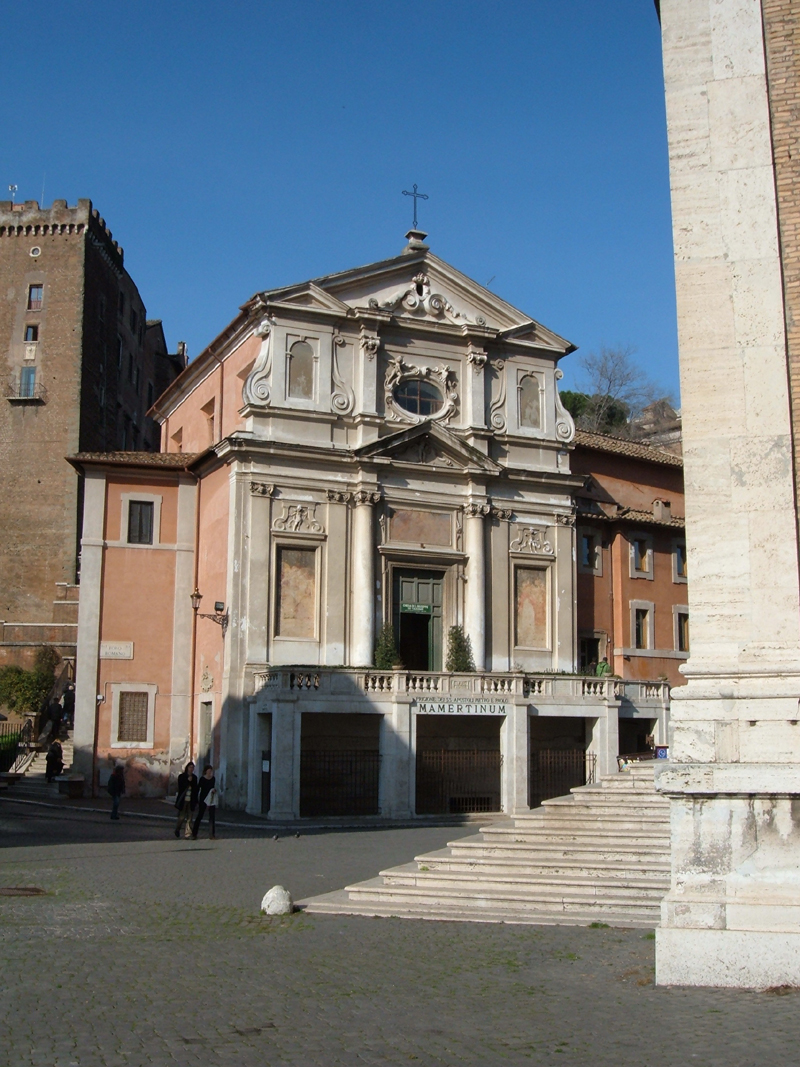
St. THEODORE

S. TEODORO
Via di S. Teodoro 7

Sixth century
Reconstructed 1454 maybe by Bernardo Rossellino (1409/64) for Nicholas V Parentucelli (1447/55)

SMALL SQUARE AND STAIRS
1703/05 Carlo Fontana (1634/1714)
It is dedicated to the martyr Theodore, a Roman Legionary, killed in Turkey being beaten with rods, tormented with steel combs and then burned alive, fully deserving the title of Megalomartyr
In the 1500s here was kept the Bronze She-Wolf of the Capitoline Hill
The Titulus S. Theodori was reestablished on December 2, 1959 by Giovanni XXIII Roncalli (1958/63)

Giovanni Paolo II (1978/2005) granted the use of the Church to the Ecumenical Patriarch of Constantinople and to the Greek Orthodox community in Rome, from July 1, 2004, to the presence of Patriarch Bartholomew I of Constantinople

RIGHT ALTAR
“S. Crescentino” by Giuseppe Ghezzi (1634/1721)

APSE
Mosaic “Redeemer among the Sts. Peter, Paul, Theodore and another Saint (S. Cleonico?)” VI century

Sunday, December 15, 2019

St. SAVIOUR NEAR THE LAURELS

S. SALVATORE IN LAURO
Piazza S. Salvatore in Lauro 15

Mentioned for the first time by the sources in 1177
Rebuilt in 1449
It was rebuilt in 1594 by Ottaviano Nonni aka Ottaviano Mascherino (1524/1606) after a fire that had destroyed it in 1591
It is his architectural masterpiece

“The space of the single nave is dramatically shaped by a rhythm of paired columns detached from the wall, fastened at the top by protruding ribs, a solution of exceptional force (...). It is as if the drum with double columns of the dome of St. Peter's Basilica would be led in an interior space and would generate tension between the plastic frame and the space as well as a chiaroscuro vibration so intense to give a clear and authoritative alternative both to the interiors by Andrea Palladio in Venice, and to the Church of the Gesù. It was an alternative that would be echoed only in the Trinità dei Pellegrini church by Paolo Maggi, who introduced the motif of the free-standing columns in the pillars supporting the dome with a marked dramatic effect” (Paolo Portoghesi)

Completed only in the years 1727/34 by Ludovico Rusconi Sassi (1678/1736)

FAÇADE
1857/62 late purist architecture by Camillo Guglielmetti (pupil of Luigi Poletti) with bas-relief “Transport of the Holy House of Nazareth” by Rinaldo Rinaldi (1793/1873)

The square was enlarged in 1939 and the proportions of the façade in relation to the square itself were inevitably altered

The name probably derives from a forest of laurels in the Portico of Europe that maybe was once in this area

It is the National Church of the Piceni and of the Marche region

INTERIOR
Marble floor of the nineteenth century

COUNTER FAÇADE
On the right “Monument of Cardinal Gaspare Bernardo Pianetti” by Luigi Poletti (1792/1869) sculpted by Ignazio Jacometti (1819/83)
On the left “Monument of Cardinal Antonio Matteucci” d. 1868 by Luigi Fontana (1827/1908)

1st RIGHT - CHAPEL OF THE PIETÀ
Designed by Francesco Carlo Bizzaccheri (1655/1721)
Above the altar “Christ dead in the arms of the Virgin Mary” 1628/30 by Giuseppe Ghezzi (1634/1721) who also painted “St. Nicholas of Tolentino” and “St. Anthony of Padua” on the sides
Giuseppe Ghezzi was born in Ascoli Piceno and was buried in this church in which, from 1687 onwards, he was responsible for the exhibition of paintings held in the cloister every December 10, on the anniversary of the translation of the Holy House of Loreto
This art exhibition was the most important one of the whole seventeenth century in Rome

“The Pietà was entirely designed over diagonal lines, the grey background tone contrasting with the dazzling clarity of Christ's body in the foreground which seems almost to slip towards the viewer. The two saints on the sides are considered 'among the most beautiful and stirring works in Roman Baroque painting at the end of the century' (Martinelli)” (Rossella Faraglia - Dizionario Biografico degli Italiani Treccani)

In the upper part there are sculptures of “Angels” by Camillo Rusconi (1658/1728)

2nd RIGHT - CHAPEL OF St. CHARLES
Above the altar “Virgin Mary appears to St. Charles Borromeo” by Alessandro Turchi aka l'Orbetto (1578/1649)
On the RIGHT SIDE OF THE CHURCH there is a modern statue, considered very kitsch by many, with “Jesus and St. Padre Pio” of whom there are a few relics on the left side of the church

3rd RIGHT - CHAPEL OF THE NATIVITY
Above the altar “Nativity of Jesus” about 1625, early work and first public commission of Pietro Berrettini aka Pietro da Cortona (1597/1669)

“This first group of paintings already clearly states the beginning of a new expression, differing substantially, regardless of any qualitative consideration, from contemporary artistic manifestations. In this group of paintings one notices first of all the conscious intention to exclude from the scene and from the characters any realistic hint and any relationship with the sentimental individuality of the viewer. Without further indulging in the visual illusion of the details, Pietro da Cortona diffuses light, impartially, to the entire surface of the painting, creating that atmospheric likelihood that anticipates the Neo-Venetian style of paintings of the following decades” (Giuliano Briganti - Dizionario Biografico degli Italiani Treccani)

ALTAR OF St. EMYGDIUS
“St. Emygdius between St. Nicholas of Tolentino and St. James of the Marca” 1863 by Pietro Gagliardi (1809/90)
On the right “Tomb of Cardinal Nicola Grimaldi” about 1846 by Filippo Gnaccarini (1804/75)
On the left “Monument of Canon Gaspare Fatati” about 1852 and “Monument of Cardinal Raniero Simonetti” 1751 by Girolamo Theodoli (1677/1766) sculpted by Carlo Monaldi (about 1690/1760)

MAIN ALTAR
1792 Antonio Asprucci (1723/1808) who maybe replaced an altar by Andrea Palladio
On the altar “Glory of Angels” in stucco by Vincenzo Pacetti (1746/1820) surrounding a seventeenth-century copy of the Madonna of Loreto
“Angels” on the pediment 1721 by Pietro Paolo Campi (active 1702/40)

SPANDRELS OF THE DOME
“David, Moses, Ezekiel and Isaiah” 1862 by Luigi Fontana (1827/1908)

ALTAR OF THE CROSS OF SIROLO
Copy the wooden Crucifix venerated in Sirolo (Ancona) 1713 by Francesco Bellucci

ABOVE THE DOORWAY TO THE SACRISTY
“Tomb of Cardinal Prospero Marefoschi” 1751 by Girolamo Theodoli (1677/1766) sculpted by Carlo Monaldi (about 1690/1760)

4th LEFT - CHAPEL OF St. LUTGARD
Above the altar “S. Lutgard exchanges her heart with that of the Redeemer” and on the sides “Stories from the Life of St. Lutgard” 1679 by Antonio Mascherotti

2nd LEFT - CHAPEL OF St. JOSEPH
Decorated in 1773
Above the altar “Sts. Joseph, Joachim and Anna” 1731 by Pier Leone Ghezzi (1674/1755) who was buried in this church as his father Giuseppe Ghezzi

1st LEFT - CHAPEL OF St. PETER IN CHAINS
Above the altar “Liberation of St. Peter” 1624 by Antiveduto Grammatica (about 1572/1626)
On the sides “Liberation of St. Peter” and “St. Peter Baptizing the Centurion” 1731 by Domenico Corvi (1721/1803) from Viterbo

CONVENT or PALACE OF THE PICENI
Beautiful Renaissance cloister of the end of the fifteenth century; the second order was added in the sixteenth century

FOUNTAIN OF THE PICENI and TWO PORTALS of the late fifteenth-century

REFECTORY
On the wall “Wedding at Cana” 1550 by Francesco de' Rossi aka Francesco Salviati (1510/63)
On the left “Tomb of Pope Eugene IV Coldumer (1431/47)” 1450/55 by Isaia da Pisa (active 1447/64)
In the middle of the wall “Tomb of Maddalena Orsini” maybe by Giovanni Duknovich aka Giovanni Dalmata (about 1440/1510)
Canvas “St. Emygdius and other saints from the Marche region” by Pier Leone Ghezzi (1674/1755)

Tuesday, March 5, 2019

St. MARY OF SUFFRAGE

S. MARIA DEL SUFFRAGIO
1662/80 Carlo Rainaldi (1611/91) for the Confraternity of Suffrage
“There is a plan dating back to 1662 that demonstrates the existence of an original design for the church with an elliptical layout, which was never executed. (...) The Roman architect experimented then some of the most innovative ideas of the Roman architectural culture of the mid-seventeenth century, but they were rejected by the confraternity in favor of a more traditional scheme. (...) The simplicity of the interior is also reflected on the outside, in one of the simplest façades of Rainaldi's repertoire” (Federica Maria Papi)
Restored in 1868 by Tito Armellini
VAULT
“Coronation of the Virgin”, “Coats of arms of the Archconfraternity of the Banner and of Pius IX” above the arches of the central nave “Heroines of the Old Testament prefiguring the Virgin Mary” 1868 by Cesare Mariani (1826/1901)
LUNETTE IN THE COUNTER FAÇADE
“Two Saints” 1868 by Cesare Mariani

1st RIGHT - CHAPEL OF THE NATIVITY
Above the altar “Adoration of the Magi”
On the right “Dream of St. Joseph” and on the left “Adoration of the Shepherds” by G.B. Natali (1630/96)
On the right “Funerary memory of the painter Pietro Neri” d. 1678 and on the left “Tomb of the engraver Gaspare Moroni” d. 1678 maybe by Pietro Paolo Naldini (1619/91)

2nd RIGHT - CHAPEL OF MARIA CONSOLATRIX AFFLICTORUM (Virgin Mary consoling the afflicted)
Designed by Carlo Rainaldi
“Holy image” of the eighteenth century brought from Mexico by the Jesuit Father Ximines
On the right “Jacob's Dream” by Giacinto Calandrucci (1646/1707) a pupil of Carlo Maratta
On the left “Sacrifice of Isaac” by Girolamo Troppa (1630/after 1710)

3rd RIGHT - MARCACCIONI CHAPEL
1674 G.B. Contini
Altarpiece “Madonna and Child” sixteenth century painting on board
On the right “Adoration of the Magi” and on the left “Birth of Mary” by Giuseppe Chiari (1654/1727), a pupil of Niccolò Berrettoni (a pupil of Carlo Maratta) who had begun the pictorial decoration

MAIN ALTAR
1674 Carlo Rainaldi
Above the altar “Our Lady of Suffrage with souls of the Purgatory” first public commission of Giuseppe Ghezzi (1634/1721)
Lunette frescoes and vault about 1675 “Assumption in Glory” and “The Lord among the angels” by G.B. Beinaschi (1638/88) follower of Lanfranco's Baroque opposed to Maratta's Classicism. Apparently Maratta visited this church and when he saw these paintings he went out without saying a word
“Beinaschi shows a distinct similarity to paintings by Lanfranco. Even if he could not have been for obvious chronological reasons (Lanfranco died, in fact, in the year 1647) a direct student, he was in fact among his most loyal follower. Lanfranco's influence persisted and was even enriched with new ideas during Beinaschi's stay in Naples. (...) He was able to recall the teachings of the art of Lanfranco without being restricted to being a slavish and late imitator, but rather with a certain expressive propriety, sometimes even intelligently expanding on the Correggio's components of Lanfranco's art” (Oreste Ferrari - Dizionario Biografico degli Italiani Treccani)
3rd LEFT - CHAPEL OF THE CRUCIFIX
“Wooden crucifix” first half of the eighteenth century
On the sides “Gravestones of the Mazzetti family”

2nd LEFT - CHAPEL OF St. JOSEPH CALASANZ
Altarpiece “St. Joseph Calasanz with the Child” first half of the eighteenth century by an artist of the Roman School
On the sides “Miracle of St. Joseph Calasanz” and “Death of St. Joseph Calasanz” by Sebastiano Ceccarini (1703/83)

1st LEFT - CHAPEL OF THE Sts. HYACINTH AND CATHERINE OF SIENA
1685 formerly of the Oliva and later of the Armellini family
Above the altar “Virgin Mary and Child with Sts. Catherine of Siena and Hyacinth” by Daniele Seiter (1649/1705)

ORATORY
“Our Lady of the Rosary among the angels and Sts. Joseph and Dominic” by Giuseppe Ghezzi (1634/1721)
Two paintings formerly in the presbytery and moved here in 1868: “Resurrection of Lazarus” and “Daniel in the lions' den” by G.B. Beinaschi

Tuesday, February 19, 2019

St. JOSEPH OF THE CARPENTERS

S. GIUSEPPE DEI FALEGNAMI
1546 for the Confraternity of Carpenters
1597/1602 G.B. Montano (1543/1621)
Sacristy 1621 and expansion of the oratorio 1627 by G.B. Soria (1581/1651), pupil of G.B. Montano, to whom he succeeded in the direction of the works
Completed in 1663 by Antonio Del Grande (about 1625/79) and consecrated in the same year
Restored in 1880 by Antonio Parisi

On the FAÇADE paintings on slate “Flight into Egypt” and “Sts. Peter and Paul”, now barely visible, maybe by Avanzino Nucci (1552/1629)

STAIRS IN FRONT OF THE FAÇADE
1625 G.B. Soria, modified and restored in 1884. The left ramp was eliminated in 1932

CEILING
Made of wood with central relief “Nativity” 1612 by G.B. Montano

WALLS OF THE NAVES
Frescoes on the right:
“Salathiel”, “Zerubbabel”, “Zadok”, “Ealzar”, “Nathan” and “Joachim”
Frescoes on the left:
“Abraham”, “Isaac”, “Judas”, “David”, “Solomon” and “Asa”
Frescoes on the sides of the presbytery:
“Joseph” and “Noah” painted in 1883 all by Cesare Mariani (1826/1901)

COUNTER FAÇADE
“Josiah” and “Hezekiah” 1883 by Angelo Maccaroni, a pupil of Mariani

1st RIGHT - CHAPEL OF St. JOSEPH
Above the altar “Death of St. Joseph” 1648 by Bartolomeo Colombo
Panels on the wooden choir “Stories of St. Joseph”, “David” and “Prophet” 1634 by G.B. Speranza (about 1600/40)

2nd RIGHT - CHAPEL OF St. ANNE
Above the altar “Holy Family with St. Anne” by Giuseppe Ghezzi (1634/1721)

PRESBYTERY
Transformed from a quadrangle apse in a semi-circular one in 1880 by Antonio Parisi
Above the MAIN ALTAR “Marriage of the Virgin Mary” 1605 by the French Horace Le Blanc (about 1580/1637)
On the right “Journey to Bethlehem”, on the left “Workshop of St. Joseph” 1883 by Cesare Maccari (1840/1919)
In the lunette “Eternal God and Holy Spirit” 1610 by Antonio Viviani aka il Sordo (1560/1620), a pupil of Federico Fiori aka Barocci

NICHES ON EITHER SIDE OF THE CHANCEL
Statue to the right “St. Paul” by Cesare Aureli (1843/1923) and to the left “St. Peter” by Pietro Jacometti

TO THE LEFT OF THE PRESBYTERY - CHAPEL OF OUR LADY OF SORROWS
“Our Lady of Sorrows” mid 1800s

2nd LEFT - CHAPEL OF THE NATIVITY
“Nativity” 1651 by Carlo Maratta (1625/1713)
It was his first public work and it contributed much to his personal success
“The Nativity was the brilliant prelude to an unbroken succession of commissions, which would have quickly established his primacy on the Rome scene and his role of arbiter of the artistic taste for over half a century. In the works carried out by the middle of the century one can already recognize the stylistic essential ingredients of Maratta's pictorial language, in which the classicism of Andrea Sacchi functioned as the basic component enriched by a plot of suggestions as articulated as wisely governed. In his style coexisted the universal and supreme model of Raphael, a special admiration for the soft luminosity of Correggio, the references to models of Annibale Carracci, Francesco Albani, Guido Reni and Domenichino, a most sumptuous coloring typical of Venice (especially Titian) and weighted openings to the baroque style, to be modulated between the dominant manner of Sacchi and the ones of Pietro da Cortona, Giovanni Lanfranco and the younger Giacinto Gimignani” (Luca Bortolotti - Dizionario Biografico degli Italiani Treccani)
Panels on the wooden choir “Rest on the Flight into Egypt”, “Two Prophets” and “Two Allegories” 1634 by Giuseppe Puglia aka Bastaro (about 1600/36)

1st LEFT - CHAPEL OF THE MAGI
On the altar “Flight into Egypt” by Niccolò Berrettoni (1637/82) copy from the original of Carlo Maratta for the Duomo of Siena, now housed in the Villa Chigi in Castelfusano
On the reverse of the canvas the painting “Marriage of the Virgin Mary” was rediscovered during a restoration in 1989
The altarpiece was originally used as a door for an organ, and it later replaced an altarpiece by Avanzino Nucci

ORATORIO
Renovated and enlarged in 1627 by G.B. Soria (1581/1651)
Wooden ceiling of the years 1628/29 and walnut wood stalls of the years 1639/43
Frescoes with “Stories of Joseph” 1631/37 by Marco Tullio Montagna (1594/1649) from Velletri, a pupil of Federico Zuccari
On the altar “Immaculate Conception with Sts. Joachim and Joseph” 1715/16 by Pier Leone Ghezzi (1674/1755)

SACRISTY
Built in 1621 by G.B. Soria
In the ceiling “St. Joseph in glory among four angel” by Marco Tullio Montagna

Carcere Mamertino

Mamertine Prison
Under the church. Also known as CARCERE TULLIANO (Tullian Prison)
Maybe it's just the most ancient and secret sector of the ancient prison (carcer) that was in this area

FAÇADE
Built in travertine limestone in the early imperial period (39/42 AD), with names of the consuls Caius Vibinus Rufinus and Marcus Cocceius Nerva
It covers an older façade in tufa from Grotta Oscura

INTERIOR
Trapezoidal room built in blocks of tufa from Monteverde and from the Aniene River in the second half of the second century BC
It was consecrated by Pope Sylvester I (314/335) as an oratory
It was considered to be the prison of Sts. Peter and Paul only from the fifteenth century without any documentary evidence
It was restored for Gregory XIII Boncompagni (1572/85) and in 1726 for Benedict XIII Orsini (1724/30)

TO THE LEFT OF THE STAIRS
Concavity in the stone where tradition has it that St. Peter hit his head
According to tradition, St. Peter converted his two jailers, Process and Martinianus, who later become saints, and forty-seven other prisoners. He baptized them with water from a source miraculously appeared at that very time, water that is still flowing and that was considered miraculous

ABOVE THE PRISON - CHAPEL OF THE CROSS
“Wooden Crucifix” maybe of the sixteenth century
A small door, now walled up, led to the other rooms of the prison along the foot of the Capitoline Hill, known as Lautumiae, carved in an ancient tufa quarry
There is a circular hole in the floor that was the only entrance to the room below: this was the Tullianum
Here the most important prisoners of state were thrown and strangled after the triumphs of the winners. Among the ones killed here: Jugurtha, Vercingetorix, the partisans of Caius Gracchus, the Catilinarians, Sejanus and his sons

TO THE LEFT OF THE PRISON
There were the SCALE GEMONIAE (the Gemoniae stairs) to the Capitoline Hill, perhaps coinciding with the Gradus Monetae
They came up from the Forum and had to be, as the current modern stairway, between the Temple of Concordia and the Mamertine Prison
On these stairs, close to the prison, were thrown the bodies of those condemned to death for crime of treason under Tiberius (14/37) and later also several victims of conflicts linked to the imperial power, as the Emperor Vitellius (69)