SS. SILVESTRO E MARTINO AI MONTI
Viale del
Monte Oppio 28
About 509
for Pope Symmachus (498/514) with the name of S. Martino (St. Martin)
It was
built at the same time of the adjacent church of S. Silvestro (St. Sylvester) for which the structures of the
ancient Titulus Equitii were used,
maybe house of Pope St. Sylvester I (314/335)
It was
renovated in the year 772 for Hadrian I (772/795)
Completely
rebuilt in the years 844/847 for Sergius II (844/847), who built the monastic
buildings over the old church of St. Sylvester. It was completed under the next
pope, Leo IV (847/855)
For the
foundations were used limestone blocks taken from the Servian Walls still visible on
the right side of the church
Restorations
1636/67 by the Roman architect and painter Filippo
Gagliardi (about 1607/1659) aka Filippo Bizzarro or Filippo delle
Prospettive
BELL TOWER
1714
It is
officiated since 1299 by the Carmelite Fathers
St. Martin
of Tours (about 316/397) was originally the patron saint of animals with horns,
and then also became the protector of cuckold husbands
“Twenty-four
ancient columns” in different kinds of marble: cipollino, pavonazzetto, biglio
and imezio, maybe recycled from the nearby Baths
of Trajan
When in
1653 the box with the relics was found, it was was decided the lowering of the
floor of the church of 50 cm (20 inches) in order to see the relics from the
entrance
CEILING
1560 for
Cardinal Charles Borromeo who was the cardinal in charge of the church with
frames embossed in gold
It was
rebuilt in 1650 and restored in the years 1741 and 1870
COUNTER FAÇADE
Statues in
the first order “St. Peter” and “St. Paul” by Pietro
Paolo Naldini (1619/91)
Statues in
the second order “St. John the Baptist” and “St. Antonio the Great aka St.
Anthony from Egypt” by Daniele Fiammingo
ON THE TRABEATION OF THE NAVES
“Frieze
with Christian-Jewish symbols” 1649/52
“Eight
statues of saints” and “Medallions in stucco” about1655 by Pietro Paolo Naldini
SIDE NAVES
Eighteen
frescoes on the walls “Stories of St. Elijah and of his
disciple Elisha inserted in the Roman countryside landscapes” of which sixteen were painted by Gaspard Dughet (1615/75) and two by Giovanni Francesco Grimaldi (1606/80) from Bologna
St. Elias
was the Prophet revered as an inspiration by the Carmelites
In
addition, two frescoes in the left nave with the interior of “St. John’s Lateran” (before the renovation by
Borromini) and “The old St. Peter's Basilica” by Filippo
Gagliardi (about 1607/1659)
“This
decoration is one of the most important and innovative cycle of paintings of
the mid-1600: it is unique in the panorama of seventeenth-century
ecclesiastical decoration in Rome. The novelty consists in the subordination of
religious scenes to the setting of broad landscape that accomplishes itself the
function of transmitting the religious message” (Simonetta Ceccarelli)
1st
RIGHT - ALTAR OF St. MARY MAGDALENE OF PAZZI
“St. Mary
Magdalene of Pazzi” 1647 by Giovanni Francesco Grimaldi
2nd
RIGHT - ALTAR OF St. TERESA OF JESUS
“Ecstasy of
St. Teresa of Jesus” 1646 by Giovanni Greppi
3rd
RIGHT - ALTAR OF St. MARTIN
“St. Martin”
1645 by Fabrizio Chiari (about 1615/95)
4th
RIGHT - ALTAR OF St. STEPHAN
“St.
Stephan” 1645 by Giovanni Angelo Canini (1609/66)
5th
RIGHT - ALTAR OF St. CHARLES BORROMEO
“St.
Charles Borromeo” 1693 by Filippo Gherardi (1643/1704)
MAIN ALTAR
End of the
eighteenth century by Francesco Belli
APSE
Eighteenth-century
frescoes “Eternal Father, saints and the Madonna and Child” by Antonio Cavallucci (1752/95) and Giovanni Micocchi
Spectacular
CRYPT about 1650 by Filippo Gagliardi with
stucco in the vaults by Pietro Paolo Naldini and
“Fake dome in perspective with the symbol of the church” also by Filippo Gagliardi
TO THE LEFT
OF PRESBYTERY - CHAPEL OF OUR LADY OF MOUNT CARMEL
Rebuilt in
1790 by Andrea de Dominicis
Above the
altar “Our Lady of Mount Carmel” 1595 by Girolamo
Massei (?/1614-19) surrounded by the altar piece “Souls in Purgatory and
cloud of St. Elijah” by Antonio Cavallucci who
also painted the fresco on the left wall “Vision of St Elijah” and in the vault
“Our Lady gives the scapular of Mount Carmel to St. Simon Stock” together with Tommaso Sciacca
3rd
LEFT - ALTAR OF THE HOLY TRINITY
“Holy
Trinity with Sts. Bartholomew and Nicholas of Bari” 1640/44 by Giovanni Angelo Canini (1609/66)
2nd
LEFT - ALTAR OF St. ALBERT
“St. Albert
Carmelite” 1575 by Girolamo Muziano (1532/92)
“A genuine
controversial response to the late Mannerist painters from Emilia and Tuscany
who still enjoyed great success in Rome during the seventies. The painting by
Muziano from Brescia is quiet and solemn, with that monumental saint who
dominates the canvas with his lofty quiet melancholy, solid like an oak and at
the same time available to a frank chat with the faithful. Muziano, just like
Marcello Venusti, moves away from any drama to focus on results of absorbed
severity and intense naturalism” (Vincenzo Farinella)
BETWEEN THE
TWO ALTARS
Large
fresco “Pseudo-council of St. Sylvester in the age of Constantine” according to
the apocryphal documents of Symmacus 1640 by Galeazzo
Leoncini a Milanese that after this work, perhaps aware of his
limitations, began the work as innkeeper
1st
LEFT - ALTAR OF St. ANGELUS OF JERUSALEM
“St.
Angelus of Jerusalem” 1646 by Pietro Testa (1612/50)
TOP OF THE NAVE
Large
fresco “S. Cyril baptizes a sultan” 1651 by the Antwerp painter Jan Miel (1599/1663)
ARCHAEOLOGICAL
EXPLORATIONS
From the
crypt it is possible to go down to a hall of 18 x 11 m (59 x 36 feet) of the
third century AD preceded by a vestibule part of the Titulus Equitii
Roman and
medieval architectural fragments
Remains of frescoes
from the ninth century, including “Jeweled cross” and a mosaic of the sixth
century “Madonna with St. Sylvester”
Showing posts with label Girolamo Muziano. Show all posts
Showing posts with label Girolamo Muziano. Show all posts
Thursday, January 2, 2020


Monday, November 26, 2018
St. CATHERINE OF THE WHEEL
S. CATERINA DELLA ROTA
Piazza di S. Caterina della Rota
Mentioned in the Mirabilia Urbis Romae, a guide for pilgrims who visited Rome, in the twelfth century as S. MARIA IN CATERINO or IN CATERINE
Mentioned by a papal bull in 1186 as S. MARIAE IN CATHERINA
Restored in the eighties of the sixteenth century by Ottaviano Nonni aka Ottaviano Mascherino (1524/1606) and about 1730, the period to which dates the façade designed by an unknown architect
Restored again in the years 1857 and 1879
It is since 1929 the church of the palafrenieri (grooms) or the papal sediari, people who supported the gestatorial chair of the pope and accompanied the papal carriage
On the right fresco “God the Father in between angels and cherubs” maybe by Francesco Nappi (c. 1565/1630)
Nappi also painted the fresco in the apse to the left of the high altar beneath which there is the painting “Sts. Peter and Paul” by an anonymous artist of the end of the seventeenth century influenced by Carlo Maratta

Piazza di S. Caterina della Rota
Mentioned in the Mirabilia Urbis Romae, a guide for pilgrims who visited Rome, in the twelfth century as S. MARIA IN CATERINO or IN CATERINE
Mentioned by a papal bull in 1186 as S. MARIAE IN CATHERINA
There are
two hypotheses to explain the present name:
1) Maybe it
comes from a certain Caterina, who must have founded the church, and whose name
must have been kept in the name of the church, just as it happened for the
churches of S. Lorenzo in Lucina or S. Lorenzo in Miranda
2) Maybe it
comes from a misunderstanding: attached to the church there was a hospital for
prisoners rescued from the hands of the Muslims of Tripoli and Tunis. They used
to hang their chains at the altar of the Virgin Mary, in memory of the
liberation, hence the name de catenariis
Over time,
this expression was transformed into Caterina (Catherine), and then the cult of
St. Catherine of Alexandria replaced that of the Virgin Mary
The rota
refers to the instrument of torture of the saint who was killed in the early
fourth centuryRestored in the eighties of the sixteenth century by Ottaviano Nonni aka Ottaviano Mascherino (1524/1606) and about 1730, the period to which dates the façade designed by an unknown architect
Restored again in the years 1857 and 1879
It is since 1929 the church of the palafrenieri (grooms) or the papal sediari, people who supported the gestatorial chair of the pope and accompanied the papal carriage
WOODEN
CEILING
1587/88
moved here from the destroyed Church of St. Francis near Ponte Sisto (Sixtus
Bridge) destroyed in 1879 to build the Tiber Walls
1st
NICHE ON THE RIGHT
Above the
altar “Rest on the Flight into Egypt” and in the lunette “Two prophets and two
putti” 1549 by Girolamo Muziano (1532/92)
“If in the
lunette the influence of Michelangelo is evident, in the night scene of the
panel, the artist resorts to Venetian models (Tintoretto, Sebastiano del
Piombo) who had such a big part in his training” (Daniele Ferrara)
“Many
elements of the style of Muziano remind us of Sebastiano del Piombo: the
attitude full of quiet dignity of his figures, their restrained movements, the
simple nobility of the clothes' motives, the wide technique, which still
recalls Venice, the colors mostly gentle and harmonious” (Hermann Voss)
2nd
NICHE ON THE RIGHT
“Wooden
crucifix” maybe of the end of 1500s maybe by an anonymous
Flemish artist
3rd
NICHE ON THE RIGHT
“Altar of
St. Anne” 1933. Sculptural group “St. Anne and the Virgin Mary” from the
Monastery of the Most Holy Conception in the Campus Martius
MAIN ALTAR
“Glory of
St. Catherine of Alexandria” painting of the nineteenth century by a certain ZuccaOn the right fresco “God the Father in between angels and cherubs” maybe by Francesco Nappi (c. 1565/1630)
Nappi also painted the fresco in the apse to the left of the high altar beneath which there is the painting “Sts. Peter and Paul” by an anonymous artist of the end of the seventeenth century influenced by Carlo Maratta
“A sort of
expressionistic epilogue of the parable of Francesco Nappi” (Claudio Strinati)
To the left
of the main altar there is a “Case for the Holy Oil” of the beginning of the
sixteenth century, in the form of a marble shrine
“The chorus
joins the nave with three apses and, with its plan as a clover, it is the most
interesting element of the structure of the church: Mascherino's drawing
depicting the layout of the church kept in Rome at the National Academy of St.
Luke is not still a sufficient element to understand whether the rare form with
three apses would be his creation or if it would constitute a medieval legacy
instead” (Daniele Ferrara)
3rd
NICHE ON THE LEFT - DE MONTE ALTAR
Frescoes “Madonna
and Child with Sts. Catherine of Alexandria and Apollonia” 1569 maybe by Domenico Zaga or Michele
Grechi
2nd
NICHE ON THE LEFT
“Miracle of
St. Valeria” nineteenth century copy of Francesco Kech from the original painted for the Basilica of St.
Peter by Giovanni Antonio Galli aka the Spadarino (1585/about 1653)
According
to tradition, St. Valeria was beheaded for her faith and then she took her head
in front of her bishop, S. Martial, who had made her convert
1st
NICHE ON THE LEFT
“Funerary Memory of Giuseppe Vasi (1710/82)” engraver, architect and landscape painter born in Corleone in Sicily, famous for his detailed views of Rome
“Funerary Memory of Giuseppe Vasi (1710/82)” engraver, architect and landscape painter born in Corleone in Sicily, famous for his detailed views of Rome
Monday, June 15, 2015
ORATORY OF THE MOST HOLY CRUCIFIX
ORATORIO DEL SS. CROCIFISSO
1562/69 Giacomo Della Porta (1533/1602) and Giovanni Lippi aka Nanni di Baccio Bigio (about 1513/68) under the patronage of Tommaso Cavalieri (the great love of Michelangelo) for the Confraternita del SS. Crocifisso (Confraternity of the Most Holy Crucifix)
1562/69 Giacomo Della Porta (1533/1602) and Giovanni Lippi aka Nanni di Baccio Bigio (about 1513/68) under the patronage of Tommaso Cavalieri (the great love of Michelangelo) for the Confraternita del SS. Crocifisso (Confraternity of the Most Holy Crucifix)
The
Confraternity was protected by Cardinal Ranuccio Farnese (after his death in
1565 his brother Cardinal Alessandro Farnese succeeded as protector) and had
duties of devotion for the fifteenth century wooden Crucifix kept in the church
of S.
Marcello al Corso
The
Crucifix was believed to be miraculous since it escaped in 1519 the fire that
destroyed the church of S. Marcello al Corso and after that the plague ceased
in 1522 due to its presence in a procession
Since then,
a procession used to move on the evening of every Holy Thursday from here to
St. Peter's Basilica
CEILING
1879 with painting in the center “Triumph of the Cross” by Giovanni
Gagliardi (1838/1924) grandson of Pietro Gagliardi

The
original ceiling of 1584 by Flaminio Boulanger was destroyed in 1798
Decorative
scheme on the walls made from 1578 to about 1584 and designed by Tommaso Cavalieri (1509/87) and Girolamo Muziano (1532/92) with a theme derived from
the medieval text of the thirteenth century by the Dominican friar Jacopo da
Voragine (or Varazze) “Legend of the True Cross”, a real tour de force of unlikely
fantasies
According
to the story, the wood of the Cross of Christ was already predestined by the
time that Adam's son Seth had put into his mouth, on his deathbed, three seeds
that would eventually spawn a large tree
After many
centuries, the tree was cut by Solomon to build the Temple in Jerusalem but the
wood did not seem compatible with the Temple and it was used for a footbridge
over a river. When the Queen of Sheba passed over the bridge had the
premonition that the Savior of mankind would have been crucified in the wood
and knelt in adoration
The story
continues with the battle of Milvian Bridge between Constantine and Maxentius,
and the journey of St. Helena, mother of Constantine, in search of the True
Cross
St. Helena
found a person who knew where it was buried, and to force him to talk, she had
him lowered into a pit without bread and water for seven days
She so
convinced the reluctant person to talk and she was able to find the three
different crosses used on the day of Christ's death. To identify the one on
which he died, St. Helena touched with the wood a dead man and he miraculously
resurrected
Another
chapter is the duel between Heraclius, Byzantine emperor, and Chosroes II, the
Persian king
After
Heraclius defeated the army of Chosroes in the battle of the Danube in 615 AD,
he invited him to be converted and baptized. Chosroes refused and Heraclius
drew his sword and cut off his head
Thus
Heraclius obtained the restitution of the Cross that was returned to Jerusalem
Compared to
the previously built Oratories of S. Giovanni Decollato
and of the Gonfalon,
the story loses its epic and dramatic dimension and gets a more serene and
discursive tone, of wider popular appeal, certainly more consonant with the
dictates of the recently completed Council of Trent (1545/63)
COUNTER
FAÇADE
Beautiful
1744 organ by the Tyrolean master Giovanni Corrado
Verlè
Frescoes
with “Stories of the brotherhood”:
On the right
“The Crucifix remains intact in the fire of S. Marcello” and “Foundation of the
convent of the Capuchin on Quirinal Hill” by Niccolò
Circignani aka Pomarancio (about 1520/98) who succeeded in 1582 to Giovanni De Vecchi (about 1537/1615)
On the left
“Procession
of the Black Plague of 1522” by Paris Nogari
(about 1536/1601)
“Approval
of the statutes of the brotherhood” by Baldassare Croce
(about 1553/1628)
WALLS
Story of
the Legend of the True Cross beginning from the right of the altar in clockwise
direction:
On the right
“St. Helena
tear down the idols” and “Invention of the Cross” about 1579 by Giovanni De Vecchi who also painted the “Sibyl”, the
two “Prophets” and the two higher “Stories with angels” and to whom it was
initially entrusted the job of completing the whole cycle

“Miracle of the True Cross” 1589 by Niccolò
Circignani aka Pomarancio who also did the two “Prophets” and the “Story”
above

On the left
“Duel
between Heraclius and Chosroes”, “Vision of Heraclius” and two “Prophets” by Niccolò Circignani aka Pomarancio
“Heraclius
carrying the Cross in Jerusalem”, two “Prophets” and “Sibyl” by Cesare Nebbia (1536/1614)
ALTAR
In the
niche on the right “Magdalena” and on the left “St. John the Evangelist” Cesare Nebbia
In the
lunette above the altar “Eternal Father” by Paris
Nogari
The wooden “Crucifix”
is a copy of the miraculous one preserved in S. Marcello al Corso
“Madonna of
the Sun” maybe dating back to the begin of fifteenth century from the chapel at
the Monastery
of Tor de' Specchi
Friday, June 6, 2014
VATICAN MUSEUMS - VATICAN PICTURES' GALLERY (fourth part)
ROOM XI
Aspects of Italian paintings in the second half of the sixteenth century
"St. Sebastian receiving the crown and the palm of martyrdom" by the school of Girolamo Siciolante da Sermoneta (1521/80)

"Miracle of St. Peter's shadow" by the Sicilian Tommaso Laureti (about 1530/1602). He was a pupil of Sebastiano del Piombo and designed, with Giambologna, the Fountain of Neptune in Bologna

"Sacrifice of Isaac" and "Holy Trinity with the Dead Christ" about 1590 by Ludovico Carracci (1555/1619)


"Ludovico Carracci, together with his cousins Annibale and Agostino was in the last two decades of the sixteenth century the bearer of the key elements to overcome the late Mannerist formalism prevailing in Roman culture at the time, and of which one of the leaders was Girolamo Muziano. Ludovico differs, however, deeply both from the pietism of Agostino and from the complex reform of the classic style made by Annibale, which will prevail in the next century as the basis for a new poetics. Ludovico was closely linked to a conceptual visual art as a means of devotion especially for the people" (Maria Antonietta De Angelis)
"Procession of St. Gregory" and "Miracle of the Snow" 1573/75 by Jacopo Zucchi (about 1542/96) both formerly on the Altar of the Cradle in the Basilica of St. Maria Maggiore


"With the two panels by Jacopo Zucchi, a pupil in Florence of Giorgio Vasari, the prevailing Mannerism is colored with unusual descriptive vivacity. (...) It is interesting to note that the strong upward perspective Zucchi has given to the two panels indicates that they were designed to be viewed from the bottom up" (Maria Antonietta De Angelis)
"Annunciation" 1606 by Giuseppe Cesari aka Cavalier d'Arpino (1568/1640)

"Sometimes, though quite rarely, Cesari reaches with his limited means a convincing expression of an otherworldly majesty full of religious pathos. This is especially true for the Annunciation, noble but not without a certain affectation, whose free and measured gestures are happily tempered by the grace of the four angelic cherubs in the air" (Hermann Voss)
"Rest on the Flight into Egypt" aka Madonna of the Cherries 1570/73

"The theme of the Madonna of the Cherries is clearly derived from the Correggio's Madonna of the Bowl in 1530 for the same gesture of the Virgin, but otherwise the invention of Barocci is entirely independent. The sweetness of the landscape in the background, the lively presence of the donkey, the smiling face of the child playing with cherries (symbol of the Passion) offered by St. Joseph represent his typical way of telling stories which mixes the sacred and the simplicity of everyday life" (Maria Antonietta De Angelis)
"Annunciation" 1582/84, "St. Francis Receiving the Stigmata" about 1595 and "Blessed Michelina" 1606 four extraordinary masterpieces by Federico Fiori aka Barocci (1535/1612)


His hometown of Urbino was often painted by him as in the Annunciation, where we see the Doge's Palace or in between the folds of the cloak of the Blessed Michelina where it is possible to see Valbona, his neighborhood Urbino
"The four major works by Barocci are four different sides of his stylistic personality always marked by a sensitive study of the characters through an extreme calibration of shades of color, whose quality is unmistakable thin. Equally unique is its technical preparation of the canvas, also extremely fine. The latter, however, has often been detrimental to the preservation of his paintings, all of which have always presented problems of conservation and restoration for the lifting of the layer of paint" (Maria Antonietta De Angelis)
"Shimmering tones and pearly sheen, matte iridescence and feverish sparkle that stand out from a dull pallor: these are the amazing and new effects of Barocci's painting style" (Hermann Voss)
"Mystic Marriage of St. Catherine" by Innocenzo da Imola (about 1484/1550)
"St. Bernard crushing the devil" 1563/64 by Marcello Venusti (about 1512/79) and "Pietà" second half of 1500 of his school
"Mystical press and Christ in Glory" about 1571 by Marco Pino aka Marco da Siena (about 1525/87)

"Holy hermit" about 1590, "St. Jerome" about 1585/92, "St. Francis of Assisi" and "Resurrection of Lazarus" 1555 by Girolamo Muziano (1532/92)


The large Resurrection of Lazarus, perhaps his most celebrated work, was placed on the grave of Muziano at the beginning of the right aisle of the Basilica of St. Maria Maggiore. Later the painting was transferred to the Quirinale Palace and arrived in the Vatican Gallery in about 1790
"It embodies a complex list of inventions, so often translated in print - as it happened with this picture - and reworked by minor artists, which, combined with the high production rate of his workshop, was a prelude to the large business workshops of the end of the sixteenth and beginning of the seventeenth centuries. (...) In the Resurrection his artistic message is enclosed in full. It is conceived as a vast theater where so many people become noisy crowd yet ordered in the harmonic 'concinnitas' (harmonic and elegant style) of each individual attitude" (Maria Antonietta De Angelis)
"St. Francis Receiving the Stigmata" by a follower of Girolamo Muziano
Marble bas-relief "Cosimo I founding the University of Pisa" about 1550 by Pierino da Vinci (about 1530/53) son of Bartolomeo, stepbrother of Leonardo da Vinci
According to Giorgio Vasari, the only source of information on this otherwise unknown artist, he died only 23 for malaria

Masterpieces of the early seventeenth century
"The Incredulity of St. Thomas", "Penitent Magdalene" 1622, "St. Margaret of Cortona" and "St. John the Baptist" by Giovanni Francesco Barbieri aka Guercino (1591/1666)


"The Penitent Magdalene is a true masterpiece full of twilight, which surrounds the sadness of the Holy Penitent, immersed in the contemplation of the nails and crown of thorns, instruments of the Passion of Jesus. The painting is almost contemporary with the famous paintings, executed in collaboration with Agostino Tassi, Dawn and Night in the Casino Ludovisi, sharing with the latter the night sky backgrounds that open between layers of clouds" (Maria Antonietta De Angelis)
"Last Communion of St. Jerome" 1614 masterpiece by Domenico Zampieri aka Domenichino (1581/1641)

"Domenichino was a colorist more refined than what it would be expected just judging from his frescoes: this work and Diana the Huntress in the Galleria Borghese made during his best period demonstrate the breadth of its range. The St. Jerome, arranged with greater care and with bolder accents of his model, the masterpiece by Agostino Carracci, has never failed to convince for the sincerity and depth of its religious feeling" (Rudolf Wittkower)
"Deposition" about 1602/04 by Michelangelo Merisi aka Caravaggio (1571/1610) for Girolamo Vittrice and destined to the Vittrice Chapel in the Chiesa Nuova (where Caravaggio frequented the Oratorian association), in honor of his uncle Pietro Vittrice, maybe represented as Nicodemus looking toward the viewer


The other characters are from left: St. John the Evangelist, the Virgin Mary, Mary Magdalene and Mary Cleophas
It was taken from the Chiesa Nuova by the French in 1797 and returned in 1817 when it entered the Vatican Picture Gallery
The Vittrice Chapel was also dedicated to the Pietà (Holy Mercy) and Caravaggio maybe cited his namesake Michelangelo Buonarroti in the body of Jesus that appears to be a fascinating transposition in color of the marble masterpiece by Michelangelo
"The stone is the real silent star of the picture. Not the stone intended to cover and seal the tomb, but the marble bed for the funerary rites (lapis untionis). The marble slab presents us with his corner and immediately comes to mind Psalm 118: The stone rejected by the manufacturer has become the cornerstone. At this time Christ is the stone rejected by history. His disciples denied him. His wonderful utopia is finished on the cross and now it will fade away forever in the tomb. These thoughts at this moment, go through the bystanders' minds and Caravaggio depicts them with merciless truth" (Antonio Paolucci)
"He knew how to capture the eloquent moment of absolute stillness that it is always produced in collective events between one motion and another, such as the immobilization of the pendulum at the extreme point of his bow" (Peter Robb)
"Madonna and Child with Sts. Jerome and Thomas" aka Olivieri Altarpiece 1634, "St. Matthew and the Angel" 1635/40 and "Crucifixion of St. Peter" 1604/05 from St. Paul at the Three Fountains for Cardinal Pietro Aldobrandini, all works by Guido Reni (1575/1642)


"The fact that even Guido Reni, although he went through Ludovico's school in Bologna, would have been dragged into the powerful orbit of Caravaggio for a period could almost be expected, but even though the picture shows an extraordinary understanding of his dramatic realism and light, the basis of Reni's art was classical and his way of painting very far from that of Caravaggio. The frame is made in the form of traditional, classic pyramid and firmly balanced by opposing attitudes and gestures" (Rudolf Wittkower)
"Martyrdom of St. Erasmus" 1628/29 by Nicolas Poussin (1594/1665), his first successful Roman work, for the altar in the right transept of St. Peter's Basilica

"The artist had the idea to stand out the index finger of the priest, stretched in the direction of the idol, in the blue sky as a means of contributing to the unfolding of the narrative. The Roman knight too, which dominates the left side of the picture is pointing his finger, which we see in front and foreshortened, but towards the martyr. Neither the priest nor the soldier are looking in the direction of what they pointing at, but to their interlocutor: the eye does not follow the index (...). The diagonals they are generating cross over both in the pictorial space and in the psychic space of the scene which they organize through the accurate and well-known properties of the gesture" (André Chastel)
"Trial and Martyrdom of Sts. Processus and Martinian" 1629 by Jean Valentin aka Valentin de Boulogne (about 1591/1632) for another altar in the right transept of St. Peter's Basilica

"Vision of St. Romuald" 1631 and "Mass of St. Gregory" with the Corporal miracle 1625 by Andrea Sacchi (1599/1661) copy of the altarpiece for the Basilica of St. Peter


"In the Vision of St. Romuald, instead of using the rhetorical language of the Baroque style, Andrea Sacchi creates a real drama in terms of intense introspection in the faces and attitudes; and the soft golden Venetian tone that permeates this symphony in white is in perfect harmony with the thoughtful and deeply serious mentality of the listening monks" (Rudolf Wittkower)
"The Mass of St. Gregory reveals a great master mature at last. With its rich and warm colors used in a light key and it execution splendid and free, this can be considered as the first masterpiece of the new style called Baroque Classicism. A minimum of figures, six in all, calls for a detailed analysis and strengthens the effect of the silent drama. The organization of the canvas with its triangle of three prominent figures is essentially classical. But there isn't a central axis and the cross of spatial diagonal pushes the design towards progressive compositional trends. In addition the close grouping of massive figures and the insistent pressure exerted by the ones showing us their back in the painting belong to the baroque repertoire" (Rudolf Wittkower)
"Denial of St. Peter" about 1615/19 maybe by Carlo Saraceni (1579/1620) or, according to Roberto Longhi, by the so-called Pensionante del Saraceni (Saraceni's lodger)

"This painting was the subject of a reflection of Roberto Longhi in 1939: he introduced a nebulous artist, whom he named 'Pensionante del Saraceni' (Saraceni's Lodger). (...) In the light of present scholarly research a new angle of view is perhaps appropriate. The overabundance of replicas of the Denial of St. Peter cannot be explained except by a well-known high-level genesis, and certainly not by an unknown artist. One is now inclined to believe that this work was painted by Saraceni himself, as stated authoritatively by A. Zuccari: considering the style and technique used, also other paintings may in part by ascribed to him. It is comforting the observation of Longhi in 1917 on the processing capacity of the style of the Venetian artist, not necessarily univocal, and further confirmation in the sentence 'with Saraceni style is a choice'" (Maria Giulia Aurigemma)
"Head of a Young Man" about 1635 maybe by Gian Lorenzo Bernini (1598/1680)

Friday, September 27, 2013
BASILICA OF St. MARY OF THE ANGELS AND OF THE MARTYRS
BASILICA S. MARIA DEGLI ANGELI E DEI MARTIRI
In 1561 the Sicilian priest Antonio Del Duca, devoted to the worship of the angels, obtained from Pius IV Medici (1559/65) the consecration for the Carthusian Monks of St. Croce in Gerusalemme of the emposing ruins of the BATHS OF DIOCLETIAN (284/305) built in eight years, between 298 and 306
The great Michelangelo Buonarroti (1475/1564) worked from 1561 until his death in 1564 to transform those ruined structures into a huge church
His work was then continued until 1566 by his pupil Jacopo Del Duca (about 1520/1604), who was also nephew of the priest Antonio Del Duca
In the years 1700 and 1746 two entrances were closed
In 1750 reorganization by Luigi Vanvitelli (1700/73) who designed, with his pupil Clemente Orlandi (1694/1775), among other things, eight masonry columns identical to the original of the transept and a late Baroque façade removed in early twentieth century
Church of the official ceremonies of the Italian State since 1896, when the Prince of Naples and future King of Italy Victor Emmanuel III got married here
It was declared a Minor Basilica in 1920 by Benedict XV Della Chiesa (1914/22)

Corresponding to the tepidarium (pool with tepid water) of the baths, while the area outside the church in front of the façade is the caldarium (pool with hot water)
New bronze doors "Annunciation" and "Resurrection" 2005 by the Polish artist Igor Mitoraj (1944)

At the center of the vestibule sculpture "The Angel of Light" 2000 by Ernesto Lamagna (1945)
Above GLASS DOME "Light and Time" 2000 by Narcissus Quagliata (1942), gift of the Archdiocese of Baltimore the archbishop of which, Cardinal William H. Keeler, is the current titular of the Basilica
The lantern is 25 m (82 feet) high from the floor, it has a diameter of 5 m (16.4 feet) and there are three lenses aimed at south, making it an astronomical instrument designed by Salvador Cuevas of the University of Mexico: the three lenses focus the image of the sun and cast a pink disk in the middle of the floor at noon in the two solstices and two equinoxes
ON THE RIGHT
"Funerary monument to Carlo Maratta" about 1704 by Carlo Maratta (1625/1713) himself with bust by his brother Francesco Maratta

CHAPEL OF THE CRUCIFIX
"Crucifix" maybe by Giacomo Della Rocca (1592/1605) pupil of Daniele da Volterra
On the left "Monument to Pietro Tenerani" 1869 by Pietro Tenerani (1789/1869) himself

On the right "Tomb of Lilla Montobbio" Pietro Tenerani's wife
"Tomb of Cardinal Francesco Alciati" 1580 maybe by G.B. Della Porta
ON THE LEFT
"Tomb of Salvator Rosa" 1673 designed by the son of Salvator Rosa (1615/73), Augusto Rosa, with sculptures by Bernardino Fioriti (active second half of XVII century)

CHAPEL OF St. MARY MAGDALENE 1579 for Consalvo Alvaro di Giovanni
"Noli me tangere" maybe by Hendrick van der Broek (1519/97), Flemish painter also known for his "Resurrection" in the Sistine Chapel

"Tomb of Cardinal Pietro Paolo Parisio" 1604
NICHE ON THE RIGHT
Statue of "St. Bruno of Cologne" founder of the Carthusians 1768 Jean Antoine Houdon (1741/1828)

NICHE ON THE LEFT
Statue of "St. John the Baptist" 2009 by Giuseppe Ducrot (1966)

On the left CHAPEL OF St. PETER
1635 for Pietro Alfonso Avignonese
"Handing of the keys" Girolamo Muziano (1532/92)

On the left "St. Peter freed by an angel" and on the right "Sts. Peter and Paul", maybe by the Roman painter M. Carloni
In the vault "God Father" maybe by Girolamo Muziano
In the middle of the chapel contemporary sculpture "Head of St. John the Baptist" by Igor Mitoraj (1944)
On the right CHAPEL OF St. BRUNO
Marble "Stoup with angel" maybe by G.B. Rossi a pupil of Bernini

Above the arch preparatory sketch painted on cardboard "Expulsion from Paradise" last work of Francesco Trevisani (1656/1746)


Corresponding to the ancient Basilica of the Diocletian Baths
Eight huge monolithic granite columns (17.14 m high - 56 feet - including capitals) and three large original ancient concrete vaults (29 m high - 95 feet - from the ground), even more incredible when one thinks that they were 2 meters (6 feet) higher, before the raising of the floor by Michelangelo

Eighteenth century FLOOR by Giuseppe Barberi (1746/1809)

Eight altarpieces from St. Peter's Basilica have been moved here since 1727 as well as four painted cardboards 1638/45 by Francesco Trevisani, preliminary sketches of the mosaics in the dome of the Baptistery Chapel in St. Peter's Basilica
RIGHT SIDE OF TRANSVERSE HALL
On the floor "Clementine Line" 1702 sundial made by the astronomer Francesco Bianchini with the collaboration of Giacomo Maraldi for Clement XI Albani (1700/21)

It was used as the official sundial in Rome for about 150 years until 1846 when it was replaced by the cannon of Janiculum Hill
On the Right Wall
"Crucifixion of St. Peter" by Nicolò Ricciolini (1687/1772) pupil of Carlo Maratta

"Fall of Simon Magus" copy by Pierre Charles Tremollière (1703/39) from the original on blackboard by Francesco Vanni (about 1563/1610), formerly located in St. Peter's Basilica in front of the tomb of Alexander VII

On the Left Wall
"St. Peter raises Tabitha from the dead" by Francesco Mancini (1679/1758)

"Preaching of St. Jerome" end of sixteenth century by Girolamo Muziano (1532/92), his last work with landscape painted by Paul Brill (1554/1626)

"I must say that the harmony of these holy men with the serious and solemn landscape has a really touching effect, that no other artist has been able to achieve with means as simple and convincing. Muziano gives up completely the compositional tricks of the time, as well as chromatic effects and daring fore-shortenings of the figures. Only the dignified and quiet profile of the monk listening devoutly and the appearance of St. Jerome, so grandly complete in itself and for itself, must speak, must agree with the elegiac atmosphere of the background generously articulated, in which the figures fit beautifully with a soft rounding of the composition" (Hermann Voss)
MONUMENTAL TOMBS of the three main generals for the Italian victory in World War I:
"Marshal Armando Diaz" 1928 by Antonio Muñoz (1884/1960)

In the Chapel of the Blessed Niccolò Albergati, on the right "Vittorio Emanuele Orlando" 1953 and on the left "Admiral Paolo Thaon di Revel" 1953 both by Pietro Canonica (1869/1959)


Right end of the transverse hall CHAPEL OF THE BLESSED Niccolò Albergati

1746 Clemente Orlandi (1694/1775) a pupil of Luigi Vanvitelli
Vault with "Holy Spirit and Doctors of the Church, Jerome, Augustine, Ambrose and Gregory" by Antonio Bicchierai (1688/1766) and Giovanni Mezzetti

On the altar "A miracle of Blessed Niccolò Albergati" first half of eighteenth century by Ettore Graziani

On the sides large paintings "Baptism of water" and "Baptism of desire" Francesco Trevisani
Two statues in plaster of "Angels of Peace and Justice" 1835 Federico Pettrich
LEFT SIDE OF TRANSVERSE HALL
On the Right Wall
"Virgin Mary and Saints" (formerly in the Choir Chapel in St. Peter's replaced by a copy in mosaic) 1730/35 by Pietro Bianchi aka il Creatura (1694/1740), a Roman pupil of Benedetto Luti and Baciccio

"Resurrection of Tabitha" by Placido Costanzi (1702/59), previously in the right passageway to the apse of St. Peter's Basilica now replaced by a mosaic copy

On the Left Wall
"Fall of Simon Magus" 1755 by Pompeo Batoni (1708/87), which originally was to replace the ruined painting on blackboard of the same subject by Francesco Vanni in St Peter's Basilica: it never ended up in St. Peter's and it was eventually replaced with a copy of Vanni's painting by Pierre Charles Tremollière which was also replaced in 1925 with the mosaic dedicated to St. Margherita Alacoque

"Batoni from Lucca was the undisputed arbiter and leader of the Roman scene. He related to instances of Marco Benefial and further deepened the secession in the classic sense of the local figurative culture, which will find new support around mid-century in the new passionate rediscovery of antiquities and in the subsequent theoretical formulations and practices of Mengs and Winckelmann. In Batoni however, there is still a fully eighteenth-century taste for the beautiful painting nobly composed and balanced in the rational organization of means of expression, yet vibrant for the fluid brushwork, rich and precious" (Carlo Bertelli, Giuliano Briganti, Antonio Giuliano)
"Mass of St. Basil" 1743/47 by Pierre Subleyras (1699/1749) formerly in the passage between the right transept and the Gregorian Chapel in St. Peter's Basilica replaced by a copy in mosaic

"He spent the last years of his life in Rome, introducing in his work a noble simplicity and precision of design and expression, together with a limited but well-considered light range of tonal values" (Rudolf Wittkower)
"Pierre Subleyras was the favorite artist of Benedict XIV Lambertini (1740/58). His star became increasingly bright for its style refined and classical but still suffused with an intense sentimental impulse. (...) The Mass of St. Basil is a great composition but imbued with intimate recollection, all played on the clear light of the central nucleus of the pearl white robes. It displays classical rigor expressing the same humanity authoritatively professed by the pope" (Anna Lo Bianco)
Left end of the transverse hall CHAPEL OF St. BRUNO

Carlo Maratta (1625/1713) on the altar "Virgin with Sts. Peter and Bruno" about 1700 by Giovanni Odazzi (1663/1731)

In the vault "Evangelists" about 1700 by Andrea Procaccini (1671/1734)
On the right large painting "Baptism of Blood" by Francesco Trevisani: his other canvas originally on the left has been moved to the Chapel of St. Teresa since the organ was installed

On the left monumental Organ by Barthélémy Formentelli donated to John Paul II (1978/2005) from the city of Rome for the Jubilee of the year 2000
PASSAGE ROOM TO THE PRESBYTERY
On the right CHAPEL OF St. HYACINTHUS
"Virgin and Child, Angels and Sts. Hyacinthus and Raymond", on the wall to the right "Sts. Cecilia and Valerian", on the wall to the left "St. Francis receiving the Stigmata", in the vault "God the Father and Angels" all works by Giovanni Baglione (1566/1643)
On the left CHAPEL OF THE SAVIOUR
On the altar "Incarnation of Jesus and worship of the Seven Angels" by Domenico da Modena
On the side walls "Souls in Purgatory" and "Praying Pope" 1574 by Giulio Mazzoni (about 1525/after 1589) with several contemporary portraits
Frescoes in the vault 1574 by the Flemish artist Hendrick van der Broek (1519/97)

RIGHT WALL
"Presentation of Mary in the temple" about 1640 by Giovanni Francesco Romanelli (1610/62) from Viterbo, a pupil of Pietro da Cortona. It was formerly in the church S. Maria Regina Coeli destroyed for the construction of the prison with the same name by the River Tiber
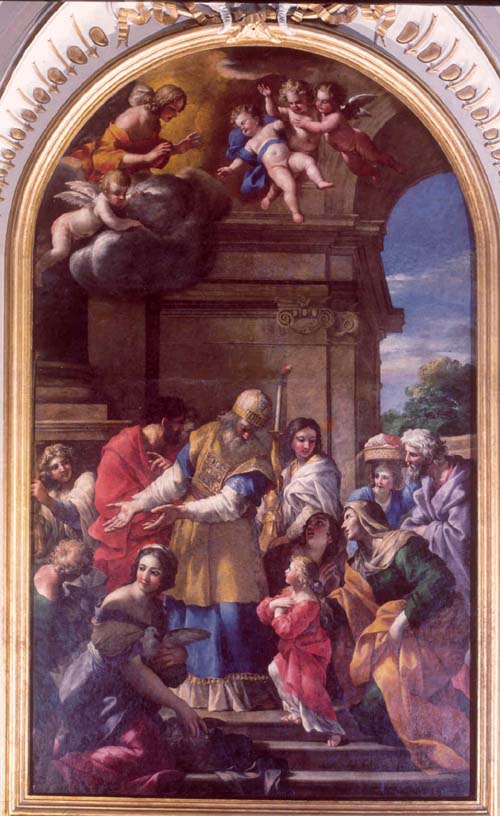
"Educated by Domenichino, he became assistant to Cortona in the Barberini ceiling, was permanently protected by the Barberini and he was given considerably large jobs that he executed with great decorative ability. It was he who introduced a watered down version of Cortona and classical style in Paris, where his paintings of mythological, allegorical and historical subjects in the gallery of the Hotel Mazarin and several rooms of the Louvre reveal an easy craft that also appears in his mid-century Roman works" (Rudolf Wittkower)
"Martyrdom of St. Sebastian" 1629 Domenico Zampieri aka Domenichino (1581/1641), painted with oil on stucco, formerly in the Chapel of St. Sebastian in St. Peter's Basilica replaced by a copy in mosaic
LEFT WALL
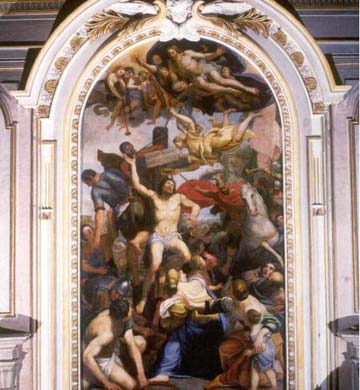
"Punishment of Ananias and Sapphira" about 1605 Cristoforo Roncalli aka Pomarancio (1552/1626) on blackboard, formerly in the passage between the transept and the Chapel of St. Clement in St. Peter's Basilica replaced by a copy in mosaic
Ananias and Sapphira, after selling a farm, had delivered to the apostles only a portion of the proceeds, mendaciously claiming to have delivered the entire sum: for this lie they were killed by God

Ananias and Sapphira, after selling a farm, had delivered to the apostles only a portion of the proceeds, mendaciously claiming to have delivered the entire sum: for this lie they were killed by God
"The way the dramatic story was represented here through a few figures relatively quiet but powerful, without the multitude of people used by the Zuccaris' imitators, also seemed to indicate a new road for the altarpieces with historical subjects that had come to a standstill at that time both among the followers of the Zuccaris and among the imitators of Barocci. It is significant that Roman painting, just before the phenomenon of the Carraccis would be known in Rome, would generate similar phenomena alone" (Hermann Voss)
"Baptism of Jesus" about 1697 Carlo Maratta, formerly in the Chapel of the Baptistery in St. Peter's Basilica replaced by a copy in mosaic
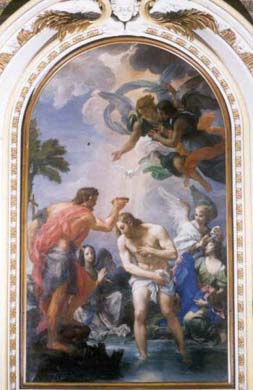
"Carlo Maratta was the prince of the Roman Academy, in whose eclectic classicism also the last stimuli of seventeenth century Baroque style are composed in a correct and formal style, especially as we see it unfolding in the great altarpieces" (Carlo Bertelli, Giuliano Briganti, Antonio Giuliano)
APSE
Vault "Assumption of the Virgin and Virtues" by the Viennese Daniele Seiter (1649/1705)
On the left "Tomb of Pope Pius IV" Medici (1559/65)
On the right "Tomb of Cardinal Giovanni Antonio Serbelloni"
Wooden altar with "Altar frontal in bronze with Deposition" 1928 by Umberto Mastroianni (1910/98)
ON THE BACK WALL
"Madonna Enthroned between the Seven Angels" 1543 Venetian painting maybe by Lorenzo Lotto (about 1480/1556)
On the left CHAPEL OF THE RELICS or CYBO CHAPEL
1742 for Cardinal Camillo Cybo titular of the church. It was built to preserve the relics of the martyrs related to construction of the baths (Sts. Ciriaco, Largo, Smaragdus, Massimo and many others) to whom Cardinal Cybo joined the relics of the four Doctors of the Church (Sts. Jerome, Ambrose, Augustine and Gregory) which he formerly kept in his palace
The paintings in the chapel are by Nicolò Ricciolini (1687/1772)
On the left of the presbytery EPIPHANY CHAPEL
"Stories of St. Bruno" and in the vault "Triumph of St. Bruno" maybe by Luigi Garzi (1638/1721)
Subscribe to:
Posts (Atom)