Showing posts with label Luigi Vanvitelli. Show all posts

Wednesday, March 14, 2018

ST. AUGUSTINE (first part)

S. AGOSTINO
The original church dates back to 1296, built for Boniface VIII Caetani (1294/1303)
Enlarged and restored in the years 1479/83 by Giacomo da Pietrasanta (active from 1452/d. about 1497) and Sebastiano Fiorentino (active 1479/83) for the powerful and extraordinary wealthy Cardinal Guillaume d'Estouteville, chamberlain of Sixtus IV Della Rovere (1471/84) and protector of the Augustinians
The FAÇADE was built with marble taken from the Colosseum
“This is one of the first Renaissance façades in Rome, really interesting because it shows, even with some disproportions and a lack of consistency on the whole, the typical desire of the time to research and experiment with new architectural solutions” (Valeria Annecchino)
Transformed in 1756/61 by Luigi Vanvitelli (1700/73) who reworked also the bell tower. He was at the same time engaged in the construction of the humongous Royal Palace of Caserta and he had therefore entrusted the work on his behalf to Carlo Murena (1713/64)
It was restored again in the nineteenth century until 1870
St. Augustine (354/430), one of the fathers of the church, was born in Africa, in Algeria and died in Ippona, in Sardinia, where he was bishop. He is buried in Pavia. He founded the Order of the Hermits focused mainly on charitable activities and the study of theology
In the past the church had a unique feature in Rome: it was the only one to admit courtesans and it houses the tombs of some of them: Fiammetta, the lover of Cesare Borgia, Giulia Campana with her daughters, Penelope and the famous Tullia d'Aragona
It was the first church in Rome for which a dome was built. The present dome was rebuilt by Luigi Vanvitelli
It was a church so important that even Michelangelo Buonarroti (1475/1564) was commissioned a painting for the church, the “Entombment”, unfinished and now in the National Gallery in London
On the left “Madonna of Childbirth” 1521 by Jacopo Tatti aka Jacopo Sansovino (1486/1570), pupil of Andrea Sansovino (he inherited his nickname) for the heirs of the Florentine merchant Giovanni Martelli who had built the chapel
The statue was originally known as Madonna del Sasso (Our Lady of the Stone) and is still very much venerated among Roman pregnant women who frequently leave messages of prayer or thanksgiving at the statue
The tradition began in 1820 after a husband, worried about the pregnancy of his wife, had his prayer answered. He had kept a lamp on in front of the statue day and night
Probably Jacopo Sansovino was inspired by an ancient statue in porphyry representing Apollo seated, kept in a Roman palace at the time and now in the Archaeological Museum of Naples
To the left of the Madonna of Childbirth “Tomb of Francesca Faggioli” d. 1661 wife of the painter Francesco Cozza (1605/82) who painted the portrait on the monument
The very large ORGAN dates back to 1905
STOUPS
Two basins shell-shaped in black marble supported by two angels in white marble: “Raphael” on the left 1650 by Cosimo Fanzago (1591/1678) and “Gabriel” on the right 1660 by pupils of Fanzago
“In the Renaissance church more light had been planned, not only from the windows now closed on the right-end side, but also from the windows, now closed as well, which opened in every chapel. Brightness was widespread and enhanced by the whiteness of the pillars, covered with travertine up to a third of their height and by the whitewashed walls. The Renaissance church expressed in full, with its harmonious proportions and its diffuse light, the ideal of composed beauty of Christian humanism, for which aesthetic was deeply connected to the values and truths of faith. Medieval reminiscences perhaps due to the building traditions of the architect and workers, are visible in the strong upward thrust of the architectural framework as well as in the use of external buttresses at the sides” (Valeria Annecchino)
The church was painted in the years 1855/68 by Pietro Gagliardi (1809/90) helped by his nephew Giovanni and Enrico Marini with the following works:
On the walls of the nave “Stories from the Life of the Virgin Mary”, whose sketches are kept at the Museum of Rome, which correspond to “Jewish Heroines” foretellers of the Virgin Mary, and on the VAULT “Abraham and David”
On the PILLARS “Five prophets authors of Marian prophecies” and in the PRESBYTERY “Scene of the triumph of Mary after her death”
3rd PILLAR ON THE LEFT
Fresco “Isaiah the Prophet” of 1512 Raffaello Sanzio (Raphael) (1483/1520) clearly inspired by the figures by Michelangelo in the Sistine Chapel
In the parchment unrolled by the prophet are these word in Hebrew: “Open the doors so people who believe enter” (Isaiah - XXVI, 2)
Below “Madonna and Child with St. Anne” 1512 by Andrea Contucci aka Andrea Sansovino (1460/1529)
There is an interesting contrast between the realistic facial features of St. Anne and the beautifully and abstractly classic look of the Virgin Mary
Both works were commissioned by Giovanni Goritz from Luxembourg
The day of St. Anne all the poets of Rome used to hung their poems around the statue, they would go to Mass and then they would all eat at Goritz's home near Capitoline Hill
PULPIT
Completed in 1644 and maybe designed by Vincenzo Della Greca (1592/1661) who, at that time, was the architect of the monastery
Magnificent polychrome marble inlays representing Augustinian symbols

         Right End Side of the Church
“Monuments of Stefano and Lorenzo Mutini” beginning of 1600s
“St. Catherine of Alexandria” oil on slate, on the right “St. Lawrence” and on the left “St. Stephen” oil on paper, about 1550/60 by Marcello Venusti (about 1512/79)
2nd RIGHT - CHAPEL OF St. JOSEPH
“Madonna of the Roses” 1589 copy by Domenico Spagnolo from the original Madonna of the Veil that Raphael did for S. Maria del Popolo. Now it is in Chantilly
In the apse three round panels “Stories of the Virgin Mary” frescoes about 1587/88 by Avanzino Nucci (1552/1629) for Cardinal G.B. Castagna later Urban VII (1590), who was pope for only twelve days, the shortest papacy in history
On the right “St. John the Evangelist” and on the left “St. John the Baptist” maybe by G.B. Montagna recently rediscovered
On the right “Tomb of Pietro Gagliardi” who had painted the two side paintings now moved into the sacristy after the discovery of the frescoes by G.B. Montagna
1672 G.B. Contini (1641/1723). S. Rita after praying to share the sufferings of Christ on the Cross was given a thorn from the crown in her forehead and kept it there for fifteen years
“Ecstasy of S. Rita” about 1674 by Giacinto Brandi (1621/91) for the princess Camilla Orsini Borghese
In the apse “S. Rita miraculously introduced into the convent by her patrons saints Augustine, Nicholas of Tolentino and John the Baptist”, on the right “S. Rita as a girl surrounded by bees” and on the left “Death of S. Rita” about 1686 by Pietro Locatelli (about 1634/about 1710), a pupil of Pietro da Cortona
Marble group “Delivery of the Keys” 1596 by G.B. Cotignola
In the pediment table “God the Father” of the end of 1400s by the school of Pinturicchio
Apse “Musical Angels”, on the right “Immaculate Conception” and on the left “Assumption” beginning of 1600s by Giuseppe Vasconio, pupil of Guido Reni
“Wooden cross” end of 1400s, before which St. Philip Neri used to pray during the period of his studies in the adjacent convent
Above the pediment “Angels in stucco with symbols of the Passion” mid seventeenth century by an anonymous seventeenth-century artist
Renovation begun in 1636 by Vincenzo Della Greca (1592/1661)
“Sts. Augustine among St. John the Evangelist and St. Paul the First Hermit” by Giovanni Francesco Barbieri aka Guercino (1591/1666)
Canvas at the sides: on the right “St. Augustine defeat heresies” and on the left “St. Augustine welcomes the Redeemer in the guise of a pilgrim” by Giovanni Lanfranco (1582/1647)
On the left “Tomb of Cardinal Giuseppe Renato Imperiali” designed by Paolo Posi (1708/76) in 1741 with sculptures by Pietro Bracci (1700/73). The mosaic portrait of the cardinal was made by Ludovico Stern (1709/77) and executed by the mosaicist of St. Peter's Basilica Pietro Paolo Cristofari (1685/1743)
Cardinal Giuseppe Renato Imperiali was the great-grandson of Cardinal Lorenzo Imperiali buried in the left transept
On the right “Baptism of St. Augustine” by Pietro Gagliardi (1809/90)
To the right of the main altar
S. Nicholas of Tolentino (1249/1305) was the first Augustinian saint to be canonized and he is patron of the souls in Purgatory
Frescoes and stucco work on the ceiling “Stories of St. Nicholas of Tolentino” about 1585/90 by G.B. Ricci (about 1550/1624) and Vincenzo Conti (second half of 1500s/about 1620)
The extraordinary decorative apparatus can well mask the fact that the right side of the chapel is longer than the left
Frescoes on the side walls, “Four Blessed of the Augustinian order”, on the right “End of the plague in Cordova” and on the left “Vision of St. Nicholas during the celebration of the Mass” about 1850 by Pietro Gagliardi (1809/90)
Altar “St. Nicholas of Tolentino” by Tommaso Salini (about 1575/1625) painter influenced by Caravaggio
1627 maybe Gian Lorenzo Bernini (1598/1680) or Orazio Torriani (about 1601/about 1657)
Extraordinary “Temple-like tabernacle with dome” made of precious marbles sent from the West Indies by the Augustinian missionaries
Altar “Madonna Odighitria” maybe Byzantine
On the broken pediment two statues of “Angels kneeling” by the great Giuliano Finelli (1602/53) from terracotta models of Gian Lorenzo Bernini
On the doors on the sides “Two pairs of putti” on the left by Pietro Bracci (1700/73) and on the right by Bartolomeo Pincellotti (known from 1735/d. 1740)
In the upper part stained glass window “St. Augustine defeats heresy” by the master glassmaker Antonio Moroni (1825/86) who also made windows in other churches in Rome

Sunday, October 1, 2017

SCIARRA PALACE

Reconstruction as a palace of the homes of the Colonna family, of which the Sciarra constitute a branch
The palace was called Palazzo Sciarra in honor of Sciarra Colonna, who gave the famous “slap” of Anagni in 1303 to Pope Boniface VIII (1294/1303)
Reconstruction began after 1550, continued in 1610 maybe with Flaminio Ponzio (1560/1613) and ended in about 1641 with Orazio Torriani (about 1601/about 1657)
Library 1745 by Luigi Vanvitelli (1700/73) who restored also other rooms for Cardinal Prospero Colonna
Restoration in the years 1875/82 by Francesco Settimj (active 1875/88) and 1882/95 by Giulio De Angelis (1850/1906) who also built in the block of the building the Teatro Quirino (it had originally built in wood in 1871) the first theater of united Italy and the Galleria Sciarra
Giulio De Angelis reduced considerably the size of the building with the opening of Via Minghetti and the construction of theater and gallery
Beautiful PORTAL 1641 by Orazio Torriani which, according to popular tradition, was carved from a single huge block of marble
In the eighteenth and nineteenth centuries it was considered one of the four wonders of the city with Palazzo Farnese, Palazzo Borghese and the Caetani Staircase in Palazzo Ruspoli
In 2010 the work of restoration of the interior finished. It was sponsored by the FONDAZIONE ROMA (Rome Foundation), which has its headquarters in the building and made it home to temporary exhibitions with the nearby Palazzo della Cassa di Risparmio di Roma also called Palazzo Cipolla
The Rome Foundation has a permanent art collection in the palace with many important works ranging from the fifteenth century to present day. Most of the works have a close connection, for the subject or for the artists responsible for them, with the city of Rome, the focus of the activity of the foundation
Among the masterpieces:
 Tempera on wood “Imago Pietatis” about 1480/82 maybe by Piermatteo Lauro Manfredo aka Piermatteo d'Amelia (1446-48/about 1506)
“The attribution to the painter from Amelia is supported by iconographic and stylistic comparison with works of different nature, but of the same subject, in Orvieto and Terni. (...) This Christ shows, in the exquisitely linearity that pervades it, the close relationship with Florentine culture, to which refers indirectly also the clear luminosity similar to the one of Piero Della Francesca and the strong geometric presence of the uncovered tomb, which is the only spacial element of the work. (...) The strong plastic emphasis seems to prove the progressive approach of the artist towards Antoniazzo Romano, with whom he worked closely in the second half of the eighties in Rome” (Laura Auciello)
Oil on board “Pieta” by Marcello Venusti (about 1512/79)
Oil painting “Madonna reading and Child with Sts. Elizabeth and John the Baptist” by Francesco de' Rossi aka Francesco Salviati (1510/63)
Oil on canvas “Moses frees the daughters of Jethro” by Ciro Ferri (1634/89)
“The oldest sources document in the biography of the artist, his outstanding erotic inclinations: “He was very dedicated... to love... He painted with great assiduity, and delight, when surrounded by vague maidens was flattered by some sweet sight...” (Passeri) (...) It is interesting to examine his overwhelming production (...) of works for private buyers, partly still on the antiquities market, painted in fifty years of activity. They attest to a plurality of interests and to an eclectic background that would associate Caroselli to the naturalists of the third decade (Valentin, Régnier, Paolini), or to Venetian models, or even to the formal paradigms of the painters from Bologna (Annibale Carracci, Domenichino). An explicit archaic will determines in some of his most beautiful works (Madonna enthroned with the Archangels Michael and Raphael) an impressive neo-Renaissance scheme (the references are to Piero Della Francesca, Bronzino, Allori, to the sixteenth century Venetian painters), as a conscious attitude of rejection and failure against the triumphant baroque absolutism” (Anna Ottani Cavina - Dizionario Biografico degli Italiani Treccani)
Oil on canvas “Achilles meets Teti near the Centaur Chiron” by Bernardino Cesari (1571/1622) brother of the Cavalier d'Arpino
Oil on canvas “Landscape with Roman ruins” by the Flemish Willem Van Nieulandt II (1584/1635)
Oil on canvas “Landscape with idealized view of Rome” by the Flemish who settled in Rome Jan Frans van Bloemen aka Orizzonte (1662/1749)
Two oils on canvas “View of St. Peter's Square” and “View of Monte Cavallo” by Giovanni Paolo Pannini (1691/1765)
Oil on canvas “Portrait of Giacinta Orsini Boncompagni Ludovisi” by the great Pompeo Batoni (1708/87)
Oil on canvas “Start of the race of Berbers in Piazza del Popolo” by the English Thomas Jones Barker (1813/82)
There are also works of the twentieth century:
“Cabins in the Pontine Marshes” by Onorato Carlandi (1848/1939)
“Pollarole (Fight of commoners)” by Alberto Ziveri (1908/90)
“Training in Parioli” by Ferruccio Ferrazzi (1891/1978)
“Hunting the Tiger I” and “Hunting the Tiger II” by Marino Mazzacurati (1907/69)
“Lungotevere Ripetta” and “S. Giorgio in Velabro” by Francesco Trombadori (1886/1961)
Bronze sculpture “Twentieth Century” by Arnaldo Pomodoro (1926)
“Allstars” by Mario Schifano (1934/98)
“The room unvoiced” by Emilio Tadini (1927/2002)
“Mirror” by Enrico Baj (1924/2003)
“Michelangelo” Tano Festa (1938/88)

Tuesday, August 1, 2017

ODESCALCHI PALACE

PALAZZO ODESCALCHI
Begun in 1622 by Carlo Maderno (1556/1629) for the Ludovisi family
He modified the courtyard of a building they had bought in the previous year from the Colonna family
The original structure was a turreted building of the fifteenth century. It belonged to the Benzoni family
FAÇADE
1664 by Gian Lorenzo Bernini (1598/1680) for Flavio Chigi, who had taken it in usufruct in 1661 and had expanded it by buying the Mandosi Palace overlooking Via del Corso
In the years 1745/50 it was extended doubling the sides and in the middle (with sixteen pillars instead of the eight by Bernini and two gates instead of one) by Nicola Salvi (1697/1751) and his assistant Luigi Vanvitelli (1700/73) for the Odescalchi family
They had bought in the same year, even if they had lived here in rent since 1693
“The additions of Salvi did not prejudice the revolutionary importance of Bernini's design. Various architectural elements were combined here in a project of true nobility and grandeur. Bernini had found the formula for the baroque aristocrat palace. And the immense influence of this building extended far beyond the borders of Italy, for example in Vienna and Leningrad” (Rudolf Wittkower)
FAÇADE ON VIA DEL CORSO
1887/89 Raffaele Ojetti (1845/1924) who repaired the damage from a fire in 1887
The palace is still owned by the Odescalchi family and they rent it out partially
The Odescalchis own and keep in the palace a stunning work of art:
“Conversion of St. Paul” 1600/01 by Michelangelo Merisi aka Caravaggio (1571/1610), oil on wood of cypress for Monsignor Tiberio Cerasi
This is the first version, mysteriously never put in place, of the canvas placed in 1605 in the Cerasi Chapel in S. Maria del Popolo
“Work of incomparable beauty, still relevant to the first ways of Caravaggio, it was all inserted in the Mannerist style, filled with a golden light that emphasizes a warm and rich palette of color. Yet some deep dark tones hint the revolution that the painter will bring about shortly thereafter in painting. The Odescalchi Conversion shines with its own light, it is made with a smooth and refined painting style that can fully respond to the narrative component of the subject which was inspired, as a homage from the artist to the more famous Conversion frescoed by Michelangelo in the Pauline Chapel. The turmoil of the characters, the wild horse, the Christ that flows from heaven and, not least, the astonishing parallelism, spotted by Cristina Acidini Luchinat, of the gestures of the group of angels in the upper right of Michelangelo's fresco with the angel holding the Christ of Caravaggio's Conversion are clear evidence” (Francesco Buranelli)

Monday, November 14, 2016

PALACE OF THE STATE ATTORNEY GENERAL

PALAZZO DELL'AVVOCATURA GENERALE DELLO STATO
It was originally the Convent of the Augustinians, next to the Church of St. Augustine, built at the end of 1400s for Cardinal Guillaume d'Estouteville
It was enlarged in 1620 by Felice Antonio Casoni (1559/1634) along Via della Scrofa, in 1652 by Domenico Castelli (1582/1657) along Via S. Agostino and in 1673 by G.B. Contini (1641/1723) along Via dei Pianellari
In the years 1746/51 it was restructured by Luigi Vanvitelli (1700/73) who, being engaged in the construction of the humongous Palace of Caserta, was helped by his assistant Antonio Rinaldi (1710/94) who continued the work until 1952 when he went to S. Petersburg in Russia to design the immense Marble Palace
The restructuring continued in the years 1752/71, directed by Carlo Murena (1713/64) another assistant of Vanvitelli

“Despite the large size the result is very light and the building, with simple elegance and without excessive monumentality fits discreetly and harmoniously into the surrounding urban context” (Valeria Annecchino)
COURTYARD
Elliptical fountain also by Luigi Vanvitelli
Scenic ATRIUM at No. 82 of Via della Scrofa maybe by Filippo Juvarra (1678/1736)
LANDING
“Marble statue of Benedict XIV Lambertini (1740/58)” 1750 by G.B. Maini (1690/1752)
VANVITELLI ROOM
Used for the meetings of the State Attorney General
Fresco “Multiplication of the loaves and fishes” by Gregorio Guglielmi (1714/73)
“His paintings are pervaded by the absence of an obvious and repetitive structure, giving importance to a powerful action on the stage represented varied and multifaceted, causing the viewer to look joyfully for 'discovery' and 'surprise'. The Curious and the Interesting are the principles that distinguish his paintings from the redundant characteristic of much art of the ephemeral eighteenth century” (Claudio Strinati)

Friday, September 27, 2013

BASILICA OF St. MARY OF THE ANGELS AND OF THE MARTYRS

BASILICA S. MARIA DEGLI ANGELI E DEI MARTIRI
In 1561 the Sicilian priest Antonio Del Duca, devoted to the worship of the angels, obtained from Pius IV Medici (1559/65) the consecration for the Carthusian Monks of St. Croce in Gerusalemme of the emposing ruins of the BATHS OF DIOCLETIAN (284/305) built in eight years, between 298 and 306
The great Michelangelo Buonarroti (1475/1564) worked from 1561 until his death in 1564 to transform those ruined structures into a huge church
His work was then continued until 1566 by his pupil Jacopo Del Duca (about 1520/1604), who was also nephew of the priest Antonio Del Duca
In the years 1700 and 1746 two entrances were closed
In 1750 reorganization by Luigi Vanvitelli (1700/73) who designed, with his pupil Clemente Orlandi (1694/1775), among other things, eight masonry columns identical to the original of the transept and a late Baroque façade removed in early twentieth century
Church of the official ceremonies of the Italian State since 1896, when the Prince of Naples and future King of Italy Victor Emmanuel III got married here
It was declared a Minor Basilica in 1920 by Benedict XV Della Chiesa (1914/22)
Corresponding to the tepidarium (pool with tepid water) of the baths, while the area outside the church in front of the façade is the caldarium (pool with hot water)
New bronze doors "Annunciation" and "Resurrection" 2005 by the Polish artist Igor Mitoraj (1944)
At the center of the vestibule sculpture "The Angel of Light" 2000 by Ernesto Lamagna (1945)
Above GLASS DOME "Light and Time" 2000 by Narcissus Quagliata (1942), gift of the Archdiocese of Baltimore the archbishop of which, Cardinal William H. Keeler, is the current titular of the Basilica
The lantern is 25 m (82 feet) high from the floor, it has a diameter of 5 m (16.4 feet) and there are three lenses aimed at south, making it an astronomical instrument designed by Salvador Cuevas of the University of Mexico: the three lenses focus the image of the sun and cast a pink disk in the middle of the floor at noon in the two solstices and two equinoxes
ON THE RIGHT
"Funerary monument to Carlo Maratta" about 1704 by Carlo Maratta (1625/1713) himself with bust by his brother Francesco Maratta
CHAPEL OF THE CRUCIFIX
"Crucifix" maybe by Giacomo Della Rocca (1592/1605) pupil of Daniele da Volterra
On the left "Monument to Pietro Tenerani" 1869 by Pietro Tenerani (1789/1869) himself
On the right "Tomb of Lilla Montobbio" Pietro Tenerani's wife
"Tomb of Cardinal Francesco Alciati" 1580 maybe by G.B. Della Porta
ON THE LEFT
"Tomb of Salvator Rosa" 1673 designed by the son of Salvator Rosa (1615/73), Augusto Rosa, with sculptures by Bernardino Fioriti (active second half of XVII century)
CHAPEL OF St. MARY MAGDALENE 1579 for Consalvo Alvaro di Giovanni
"Noli me tangere" maybe by Hendrick van der Broek (1519/97), Flemish painter also known for his "Resurrection" in the Sistine Chapel
"Tomb of Cardinal Pietro Paolo Parisio" 1604
NICHE ON THE RIGHT
Statue of "St. Bruno of Cologne" founder of the Carthusians 1768 Jean Antoine Houdon (1741/1828)
NICHE ON THE LEFT
Statue of "St. John the Baptist" 2009 by Giuseppe Ducrot (1966)
On the left CHAPEL OF St. PETER
1635 for Pietro Alfonso Avignonese
"Handing of the keys" Girolamo Muziano (1532/92)
On the left "St. Peter freed by an angel" and on the right "Sts. Peter and Paul", maybe by the Roman painter M. Carloni
In the vault "God Father" maybe by Girolamo Muziano
In the middle of the chapel contemporary sculpture "Head of St. John the Baptist" by Igor Mitoraj (1944)
On the right CHAPEL OF St. BRUNO
Marble "Stoup with angel" maybe by G.B. Rossi a pupil of Bernini
Above the arch preparatory sketch painted on cardboard "Expulsion from Paradise" last work of Francesco Trevisani (1656/1746)
Corresponding to the ancient Basilica of the Diocletian Baths
Eight huge monolithic granite columns (17.14 m high - 56 feet - including capitals) and three large original ancient concrete vaults (29 m high - 95 feet - from the ground), even more incredible when one thinks that they were 2 meters (6 feet) higher, before the raising of the floor by Michelangelo
Eighteenth century FLOOR by Giuseppe Barberi (1746/1809)
Eight altarpieces from St. Peter's Basilica have been moved here since 1727 as well as four painted cardboards 1638/45 by Francesco Trevisani, preliminary sketches of the mosaics in the dome of the Baptistery Chapel in St. Peter's Basilica
RIGHT SIDE OF TRANSVERSE HALL
On the floor "Clementine Line" 1702 sundial made by the astronomer Francesco Bianchini with the collaboration of Giacomo Maraldi for Clement XI Albani (1700/21)
It was used as the official sundial in Rome for about 150 years until 1846 when it was replaced by the cannon of Janiculum Hill
On the Right Wall
"Crucifixion of St. Peter" by Nicolò Ricciolini (1687/1772) pupil of Carlo Maratta
"Fall of Simon Magus" copy by Pierre Charles Tremollière (1703/39) from the original on blackboard by Francesco Vanni (about 1563/1610), formerly located in St. Peter's Basilica in front of the tomb of Alexander VII
On the Left Wall
"St. Peter raises Tabitha from the dead" by Francesco Mancini (1679/1758)
"Preaching of St. Jerome" end of sixteenth century by Girolamo Muziano (1532/92), his last work with landscape painted by Paul Brill (1554/1626)


"I must say that the harmony of these holy men with the serious and solemn landscape has a really touching effect, that no other artist has been able to achieve with means as simple and convincing. Muziano gives up completely the compositional tricks of the time, as well as chromatic effects and daring fore-shortenings of the figures. Only the dignified and quiet profile of the monk listening devoutly and the appearance of St. Jerome, so grandly complete in itself and for itself, must speak, must agree with the elegiac atmosphere of the background generously articulated, in which the figures fit beautifully with a soft rounding of the composition" (Hermann Voss)
MONUMENTAL TOMBS of the three main generals for the Italian victory in World War I:
"Marshal Armando Diaz" 1928 by Antonio Muñoz (1884/1960)
In the Chapel of the Blessed Niccolò Albergati, on the right "Vittorio Emanuele Orlando" 1953 and on the left "Admiral Paolo Thaon di Revel" 1953 both by Pietro Canonica (1869/1959)
Right end of the transverse hall CHAPEL OF THE BLESSED Niccolò Albergati
1746 Clemente Orlandi (1694/1775) a pupil of Luigi Vanvitelli
Vault with "Holy Spirit and Doctors of the Church, Jerome, Augustine, Ambrose and Gregory" by Antonio Bicchierai (1688/1766) and Giovanni Mezzetti
On the altar "A miracle of Blessed Niccolò Albergati" first half of eighteenth century by Ettore Graziani
On the sides large paintings "Baptism of water" and "Baptism of desire" Francesco Trevisani
Two statues in plaster of "Angels of Peace and Justice" 1835 Federico Pettrich
LEFT SIDE OF TRANSVERSE HALL
On the Right Wall
"Virgin Mary and Saints" (formerly in the Choir Chapel in St. Peter's replaced by a copy in mosaic) 1730/35 by Pietro Bianchi aka il Creatura (1694/1740), a Roman pupil of Benedetto Luti and Baciccio
"Resurrection of Tabitha" by Placido Costanzi (1702/59), previously in the right passageway to the apse of St. Peter's Basilica now replaced by a mosaic copy
On the Left Wall
"Fall of Simon Magus" 1755 by Pompeo Batoni (1708/87), which originally was to replace the ruined painting on blackboard of the same subject by Francesco Vanni in St Peter's Basilica: it never ended up in St. Peter's and it was eventually replaced with a copy of Vanni's painting by Pierre Charles Tremollière which was also replaced in 1925 with the mosaic dedicated to St. Margherita Alacoque
"Batoni from Lucca was the undisputed arbiter and leader of the Roman scene. He related to instances of Marco Benefial and further deepened the secession in the classic sense of the local figurative culture, which will find new support around mid-century in the new passionate rediscovery of antiquities and in the subsequent theoretical formulations and practices of Mengs and Winckelmann. In Batoni however, there is still a fully eighteenth-century taste for the beautiful painting nobly composed and balanced in the rational organization of means of expression, yet vibrant for the fluid brushwork, rich and precious" (Carlo Bertelli, Giuliano Briganti, Antonio Giuliano)
"Mass of St. Basil" 1743/47 by Pierre Subleyras (1699/1749) formerly in the passage between the right transept and the Gregorian Chapel in St. Peter's Basilica replaced by a copy in mosaic
"He spent the last years of his life in Rome, introducing in his work a noble simplicity and precision of design and expression, together with a limited but well-considered light range of tonal values" (Rudolf Wittkower)
"Pierre Subleyras was the favorite artist of Benedict XIV Lambertini (1740/58). His star became increasingly bright for its style refined and classical but still suffused with an intense sentimental impulse. (...) The Mass of St. Basil is a great composition but imbued with intimate recollection, all played on the clear light of the central nucleus of the pearl white robes. It displays classical rigor expressing the same humanity authoritatively professed by the pope" (Anna Lo Bianco)
Left end of the transverse hall CHAPEL OF St. BRUNO
Carlo Maratta (1625/1713) on the altar "Virgin with Sts. Peter and Bruno" about 1700 by Giovanni Odazzi (1663/1731)
In the vault "Evangelists" about 1700 by Andrea Procaccini (1671/1734)
On the right large painting "Baptism of Blood" by Francesco Trevisani: his other canvas originally on the left has been moved to the Chapel of St. Teresa since the organ was installed
On the left monumental Organ by Barthélémy Formentelli donated to John Paul II (1978/2005) from the city of Rome for the Jubilee of the year 2000
PASSAGE ROOM TO THE PRESBYTERY
On the right CHAPEL OF St. HYACINTHUS
"Virgin and Child, Angels and Sts. Hyacinthus and Raymond", on the wall to the right "Sts. Cecilia and Valerian", on the wall to the left "St. Francis receiving the Stigmata", in the vault "God the Father and Angels" all works by Giovanni Baglione (1566/1643)
On the left CHAPEL OF THE SAVIOUR
On the altar "Incarnation of Jesus and worship of the Seven Angels" by Domenico da Modena
On the side walls "Souls in Purgatory" and "Praying Pope" 1574 by Giulio Mazzoni (about 1525/after 1589) with several contemporary portraits
Frescoes in the vault 1574 by the Flemish artist Hendrick van der Broek (1519/97)
RIGHT WALL
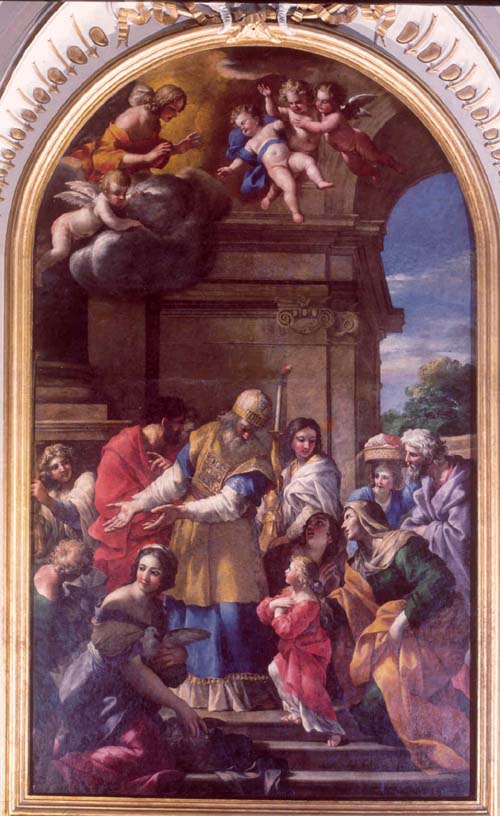
"Presentation of Mary in the temple" about 1640 by Giovanni Francesco Romanelli (1610/62) from Viterbo, a pupil of Pietro da Cortona. It was formerly in the church S. Maria Regina Coeli destroyed for the construction of the prison with the same name by the River Tiber
"Educated by Domenichino, he became assistant to Cortona in the Barberini ceiling, was permanently protected by the Barberini and he was given considerably large jobs that he executed with great decorative ability. It was he who introduced a watered down version of Cortona and classical style in Paris, where his paintings of mythological, allegorical and historical subjects in the gallery of the Hotel Mazarin and several rooms of the Louvre reveal an easy craft that also appears in his mid-century Roman works" (Rudolf Wittkower)
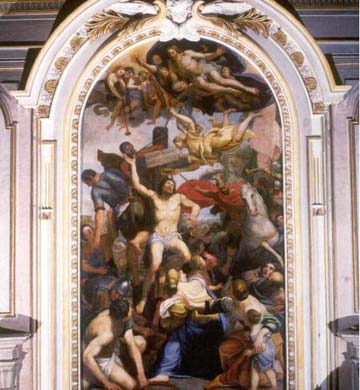
"Martyrdom of St. Sebastian" 1629 Domenico Zampieri aka Domenichino (1581/1641), painted with oil on stucco, formerly in the Chapel of St. Sebastian in St. Peter's Basilica replaced by a copy in mosaic
LEFT WALL
"Punishment of Ananias and Sapphira" about 1605 Cristoforo Roncalli aka Pomarancio (1552/1626) on blackboard, formerly in the passage between the transept and the Chapel of St. Clement in St. Peter's Basilica replaced by a copy in mosaic
Ananias and Sapphira, after selling a farm, had delivered to the apostles only a portion of the proceeds, mendaciously claiming to have delivered the entire sum: for this lie they were killed by God
"The way the dramatic story was represented here through a few figures relatively quiet but powerful, without the multitude of people used by the Zuccaris' imitators, also seemed to indicate a new road for the altarpieces with historical subjects that had come to a standstill at that time both among the followers of the Zuccaris and among the imitators of Barocci. It is significant that Roman painting, just before the phenomenon of the Carraccis would be known in Rome, would generate similar phenomena alone" (Hermann Voss)
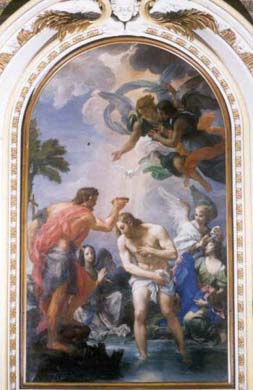
"Baptism of Jesus" about 1697 Carlo Maratta, formerly in the Chapel of the Baptistery in St. Peter's Basilica replaced by a copy in mosaic
"Carlo Maratta was the prince of the Roman Academy, in whose eclectic classicism also the last stimuli of seventeenth century Baroque style are composed in a correct and formal style, especially as we see it unfolding in the great altarpieces" (Carlo Bertelli, Giuliano Briganti, Antonio Giuliano)
APSE
Vault "Assumption of the Virgin and Virtues" by the Viennese Daniele Seiter (1649/1705)
On the left "Tomb of Pope Pius IV" Medici (1559/65)
On the right "Tomb of Cardinal Giovanni Antonio Serbelloni"
Wooden altar with "Altar frontal in bronze with Deposition" 1928 by Umberto Mastroianni (1910/98)
ON THE BACK WALL
"Madonna Enthroned between the Seven Angels" 1543 Venetian painting maybe by Lorenzo Lotto (about 1480/1556)
On the left CHAPEL OF THE RELICS or CYBO CHAPEL
1742 for Cardinal Camillo Cybo titular of the church. It was built to preserve the relics of the martyrs related to construction of the baths (Sts. Ciriaco, Largo, Smaragdus, Massimo and many others) to whom Cardinal Cybo joined the relics of the four Doctors of the Church (Sts. Jerome, Ambrose, Augustine and Gregory) which he formerly kept in his palace
The paintings in the chapel are by Nicolò Ricciolini (1687/1772)
On the left of the presbytery EPIPHANY CHAPEL
"Stories of St. Bruno" and in the vault "Triumph of St. Bruno" maybe by Luigi Garzi (1638/1721)