Showing posts with label Domenico Guidi. Show all posts

Thursday, January 4, 2018

SANT'ANGELO BRIDGE

PONTE SANT'ANGELO
Built in the years 133/134 as Pons Aelius for Hadrian (117/138) maybe by Demetrianus
Built in peperino tuff and covered with travertine marble
Originally it had three arches and it was connected with ramps to the banks
The ramps were in turn supported by three smaller arches on the left side and two on the right bank, toward the mausoleum of Hadrian, which were partially destroyed and partially buried in 1893 during the construction of the embankments and replaced by two modern arches
It is 130 m (426 feet) long and 9 m (30 feet) wide
In 1534 Clement VII Medici (1523/34) wanted to add the statues of “St. Peter” by Lorenzo Lotti aka Lorenzetto (1490/1541) on the left and “St. Paul” 1463/64 by Paolo Taccone aka Paolo Romano (about 1415/77) on the right, moved here from the loggia of the blessings of the ancient Basilica of St. Peter
The area in front of the bridge in Piazza Sant'Angelo was one of those destined for public executions by beheading
Paul III Farnese (1534/49) wanted to outline the SMALL TRIDENT consisting of the current Via Paola, Via del Banco di Santo Spirito and Via di Panico
In the years 1668/71 Clement IX Rospigliosi (1667/69) ordered the construction of a new parapet, designed by Gian Lorenzo Bernini (1598/1680), who wanted the iron gratings to allow the view of the water, element of inspiration for many works of Bernini
Above the parapet were placed ten statues of angels with the instruments of the Passion of Christ, sculpted by Bernini's followers under his direction
From the South End:
“Column” by Ercole Antonio Raggi (1624/86)
“Flagella” by Lazzaro Morelli (1608/90)
“Crown of Thorns”: the original sculpture by Gian Lorenzo Bernini and his son Paolo was never put in place and was moved in 1729 in the church of S. Andrea delle Fratte
The sculpture on the bridge is a copy by Pietro Paolo Naldini (1619/91)
The two angels sculpted by Bernini (this and the one with the Titulus Crucis) were donated to S. Andrea delle Fratte by Prospero Bernini, grandson of the master, who bought them from the heirs of Pope Clement IX who had replaced them with copies on Ponte Sant'Angelo, not to save them from the elements, as it is commonly said, but to have them shipped to Pistoia, his hometown
“Shroud or Holy Face” by Cosimo Fancelli (1620/88). The base of the inscription was hit by a cannon ball during the fall of Rome in 1870
“This angel shows in his quite voluptuous forms and in the type of head how much Fancelli owed to Cortona, while at the same time, he was quoting the current Bernini style. Unequal in his works he often tried to combine the styles of Cortona and Bernini with an emphatic simplicity of form which he shared with Ferrata, his collaborator on more than one occasion. Therefore it is often difficult to make a distinction between their works” (Rudolf Wittkower)
“Robe and Dice” by Pietro Paolo Naldini
“Nails” by Girolamo Lucenti (?/1698)
“Cross” by Ercole Ferrata (1610/86)
“Well inserted within the commissions of the Roman art scene, Ferrata worked a lot for Bernini, but also for Pietro Berrettini or for Rainaldi. Perhaps conscious of his difficulty with 'inventions', he often preferred, especially in the beginning, to execute works from designs of others and also he frequently used graphic ideas of his pupils” (Gerardo Casale - Dizionario Biografico degli Italiani Treccani)
“Titulus Crucis with INRI inscription” the original sculpture by Gian Lorenzo Bernini and his son Paolo was never put in place and was moved in 1729 in the church of S. Andrea delle Fratte
The angel on the bridge is a copy of Bernini himself, done with the help of Giulio Cartari (active 1665/78)
“The drapery of Bernini angels expresses an abstract comment on the emotional state of mourning of the angels themselves. During these years increasingly Bernini relied upon the drapery as agents of his feelings. Instead of being a simple cover made of cotton or linen, drapery becomes a chiaroscuro repetition related to a highly loaded inner feeling, the expression of which apparently exceeds the expressive potential power of faces and bodies” (Howard Hibbard)
“Sponge” by Antonio Giorgetti (active since 1660/d. 1669)
“Spear” by Domenico Guidi (1625/1701)
“Going back for a moment from these statues to the ones placed forty years before under the dome of St. Peter's, we realize that, unlike the previous works highly personal and subjective, here we are dealing with products of followers among whom Bernini looks like a solitary giant. His intense baroque not only had a leveling influence on most of these masters of the younger generation, but also reduced their ability of self-expression, and perhaps even their desire to reach it” (Rudolf Wittkower)

Monday, January 23, 2017

PALACE OF THE KNOWLEDGE (second part) - LIBRARY OF ALEXANDER

BibliotecaAlessandrina
1959/65 Francesco Borromini (1599/1667) for Alexander VII Chigi (1655/67) on the second floor to the left of the church
“It remains like Borromini had designed it. The great hall of the library is three stories high and the recessed shelves, also designed by the master, form an important part of the architecture. This was a new and important idea that he had not yet conceived when he built the library on top of the Oratory of St. Philip Neri some twenty years earlier. It was precisely this new concept that made the Biblioteca Alessandrina the prototype of the great libraries of the eighteenth century” (Rudolf Wittkower)
VAULT
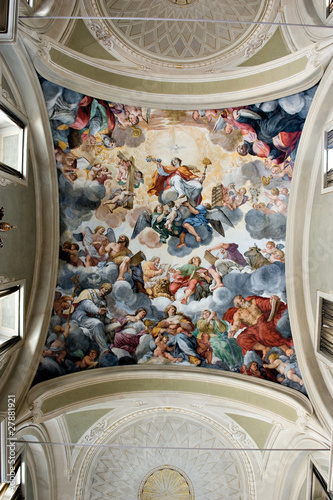
“Triumph of Religion with the three theological virtues, the four evangelists and four doctors of the Church” 1662/65 by Clemente Maioli (1634/73) from Ferrara influenced by Pietro da Cortona and close to the style of Giovanni Francesco Romanelli
“Bust of Alexander VII” in 1661 by Domenico Guidi (1625/1701) embedded into a frame of golden stucco designed by Borromini

Sunday, October 9, 2016

PALACE OF THE MOUNTAIN OF MERCY

PALAZZO DEL MONTE DI PIETÀ

1588 designed by Ottaviano Nonni aka Ottaviano Mascherino (1524/1606) for Cardinal Prospero Santacroce as a modification of previous buildings belonging to the family Santacroce
Headquarters since 1603 of the ISTITUTO DEL MONTE DI PIETÀ (Institute of Pawnshop) at the behest of Clement VIII Aldobrandini (1592/1605)
It was founded in 1539 with headquarters originally in Via dei Banchi Vecchi to lend money to the poor at low interest against usury
Expanded in the years 1603/29 by Carlo Maderno (1556/1629) who had as collaborator the then young Francesco Borromini (1599/1667)
Works continued in the years 1629/37 by Bartolomeo Breccioli (?/1639) and Francesco Peparelli (active since 1626/d. 1641)
REAR FAÇADE on Via S. Paolo alla Regola 1735/40 by Nicola Salvi (1697/1751)
It is now a branch of the Unicredit Bank and they continue to make loans in exchange for pledges, an activity carried on here without interruption for almost 500 years
Chapel of the Mountain of Mercy
1618 Carlo Maderno (1556/1629), rebuilt 1639/41 by Francesco Peparelli (active since 1626/d. 1641) and continued in the years 1660/70 in the decorations by his pupil Giovanni Antonio De Rossi (1616/95): he transformed the plan from rectangular to elliptical
Decoration continued 1696/1725 with marble and stuccos by Francesco Carlo Bizzaccheri (1655/1721)
It was consecrated in 1730
VESTIBULE
Oval panel in the vault “Eternal God Surrounded by Angels” 1701 maybe by Michel Maille aka Michele Maglia (active in Rome the second half of the seventeenth century)
“Bust of St. Charles Borromeo” 1657 by Domenico Guidi (1625/1701). St. Charles Borromeo in 1564 was protector of the Monte and wrote its statutes
Four oval panels with “History of the Monte di Pietà” and central oval panel “Holy Spirit in glory” decoration began in 1696 by Francesco Carlo Bizzaccheri who coordinated Lorenzo Ottoni (1648/1736), Simone Giorgini (active in Rome 1677/1712), Michel Maille, Andrea Bertoni and Andrea Berrettoni
“While referring to the examples of Bernini's S. Andrea al Quirinale and St. Thomas of Villanova, the dome sunken-shaped, doesn't have similar monumentality, but it appears lighter as ornamental elements have no structural function” (Susanna Misiano)
STATUES IN THE NICHES ON EITHER SIDE OF THE ENTRANCE
On the right “Faith” 1724 by Francesco Moderati (about 1680/after 1724)
On the left “Hope” 1724 by Agostino Cornacchini (1683/1740)
“One of his best works in which the Baroque vehemence is contained in a subdued elegance, infusing lightness and painterly effects in the stone” (Susanna Misiano)
“His best work is the life-size figure of Hope in the chapel of the Monte di Pietà. The body moves with the slight wave of Rome 'Barocchetto' as it is crossed, in an almost musical counterpoint, by the folds of the wet drapery gathered brightly which also serves to reveal the soft underlying shapes” (Robet Engass - Dizionario Biografico degli Italiani Treccani)
RELIEFS ABOVE THE SIDE DOORS
On the right “Tobias lends money to Gabelo” 1704 by Pierre Legros (1666/1719)
On the left “Joseph lends the grain to the Egyptians” 1702 by Jean-Baptiste Théodon (1646/1713)
MAIN ALTAR
Relief “Pietà (Mercy)” 1661/76 by Domenico Guidi
“Guidi was largely responsible for the change from the Roman Baroque to the new Late Baroque idiom: this composition, which rises in a curve from the Magdalene at the bottom on the right to the Figure of God the Father at the top, is not without merit, but there isn't discrimination between the degrees of spiritual importance of the sacred characters, nor the individual figures are sufficiently articulated to put the viewer in a position to discern exactly the movements and even to decide whether the drapery belongs to a figure or another: the result is a lively jumble of plastic form” (Rudolf Wittkower)
STATUES IN THE NICHES ON EITHER SIDE OF THE MAIN ALTAR
On the right “Begging” 1724 by Bernardino Cametti (1669/1736)
On the left “Charity” 1721/24 by Giuseppe Mazzuoli (1644/1725) who maybe coordinated the other sculptors
“Very similar to the Bernini's group of the tomb of Alexander VII in St. Peter, the work, marked by a great dynamism, reveals the artist's effort to show, in a complex and redundant form, his virtuous ability even in his very old age” (Susanna Misiano)
Chapel of S. Mary of the Rescue
1759, in Via Arco del Monte with three paintings by an unknown artist of the eighteenth century:
ON THE RIGHT “Adoration of the Magi”
MAIN ALTAR “Virgin and Child bowing to St. John”
ON THE LEFT “Presentation in the Temple”

Friday, November 15, 2013

CHURCH OF JESUS AND MARY

CHIESA DI GESÙ E MARIA
Begun in the years 1633/36 by the Milanese architect Carlo Buzio (1608/59)
Completed 1671/80 by Carlo Rainaldi (1611/91) for Monsignor Giorgio Bolognetti bishop of Rieti
It was open to the public only after the death of Monsignor Bolognetti in 1687
"Carlo Rainaldi unified the whole interior not only architecturally but also in terms of colors. His black, brown and reddish marbles, interrupted by the sparkle of white figures, are perhaps the last resoundingly loud symphony of colors of the Baroque style" (Rudolf Wittkower)
Seven canvases "Assumption of the Virgin" at the center and at the sides "Groups of Blessed" and "Evangelists" 1685 by Giacinto Brandi (1621/91)
On the right "Tomb of Monsignor Giulio Del Corno" with Time tearing up the plaque by Ercole Ferrata (1610/86)
Above "King David singing with the harp" Michel Maille aka Michele Maglia (active in Rome in the second half of the seventeenth century)
On the left "Tomb of Monsignor Camillo Del Corno" by Domenico Guidi (1625/1701) with a skeleton that looks at the hourglass. Camillo was Giulio's nephew and client of the two tombs
Above "Moses with the Tablets of the Law" by Girolamo Gramiglioli
FUNERARY MONUMENTS OF THE BOLOGNETTI FAMILY
1681/83 designed by Carlo Rainaldi
On the right "Pietro e Franceso Bolognetti" by Francesco Aprile (?/1685) and "Mario Bolognetti" by Francesco Cavallini (active 1672/1703)
On the left "Giorgio Bolognetti" (the client) by Francesco Cavallini and "Ercole and Luigi Bolognetti" believed to be sculpted by Michel Maille but eventually proved to be the work of Lorenzo Ottoni (1648/1736)
"As in Bernini's Cornaro Chapel, here there are no coffins, and there is nothing to remember the dead: the illusion had to be as complete as possible. The six dead are represented in subtly different stages of religioƒus enthusiasm. But if you compare these figures with Bernini's Fonseca, one can not see that they are far less convincing and that the more agitated, that of Mario, the closest in style to the late Bernini, appears almost melodramatic in its reverent exuberance. The spatial concepts of the Baroque style found in this church a triumphant achievement, but the religious sentiment that had supported them began to decline" (Rudolf Wittkower)
MAIN ALTAR
1678/80 "Coronation of the Virgin" and presbytery vault "Holy Spirit" by Giacinto Brandi (1621/91)
Statues on either side "St. John the Baptist" and "St. John the Evangelist" by Giuseppe Mazzuoli (1644/1725)
1824 Giuseppe Valadier (1762/1839)
SACRISTY
Paintings maybe by Giovanni Lanfranco (1582/1647)