Showing posts with label Via della Conciliazione. Show all posts

Friday, March 29, 2019

St. MARY IN TRASPONTINA

S. MARIA IN TRASPONTINA
FAÇADE (made with travertine taken, in part, from the Colosseum) and CHURCH UNTIL THE 4th CHAPEL built in 1566 by Giovanni Sallustio Peruzzi (?/1573), son of Baldassare Peruzzi 
It replaced an earlier church with the same name built closer to Castel Sant'Angelo 
1581/87 building up to the front pillars of the dome by Ottaviano Nonni aka Ottaviano Mascherino (1524/1606)
1635/68 building of the BELL TOWER, TRANSEPT and DOME by Francesco Peparelli (active since about 1626/d. 1641)
The construction of the church lasted therefore 102 years
It was the parish of the gunners of the nearby Castel Sant'Angelo who wanted a low dome, so as not to have their line of fire obstructed

“Glory of the Virgin Mary” 1894 by Cesare Caroselli (1847/1927)

Above the altar “St. Barbara” 1597 one of the masterpieces by Giuseppe Cesari aka Cavalier d'Arpino (1568/1640) for Pietro Aldobrandini
Frescoes “Stories of St. Barbara” 1610/20 by Cesare Rossetti (active 1593/1620) designed by Cavalier d'Arpino
Decorations with military guns, coats of arms and cannons
The breast in full view of the saint worried the patron Pietro Aldobrandini who didn't want his uncle, the Pope Clement VIII (1592/1605), to see the painting
The breast was covered only in the nineteenth century and revealed again in the twentieth century
“The fact that Caravaggio might have found ridiculous the St. Barbara painted by his former employer, can be guessed by the way he quoted her in the first version of St. Matthew and the Angel, destroyed in Berlin during the Second World War: in his cheeky androgynous angel Caravaggio mimicked the drapery and the curvy posture of the plump body of Barbara, a posture known among Mannerist as serpentine, and in particular he mimicked the way the flimsy fabric clung to the soft underbelly and to the just raised thigh, as well as her tousled hair” (Peter Robb)
2nd RIGHT - CHAPEL OF St. CANUTE
On the altar “Ecstasy of St. Canute” 1686 by the Viennese Daniel Seiter (1649/1705)
S. Canute (about 1042/1086) was a Danish king, who was canonized in 1101. He planned to invade England and tried to increase the power of monarchy and church at the expense of nobility and common people
He was murdered in the wooden church of St. Albany in the city of Odense during a popular rebellion

3rd RIGHT - CHAPEL OF OUR LADY OF CARMEL
In the nineteenth century the “Statue of Our Lady of Mount Carmel” was put here for veneration
The throne dates to 1922 and the statue, blessed by Pope Pius XI Ratti (1922/39), was crowned on the eve of the Feast of Mount Carmel (July 16) in 1928
On 12 September 2001, the day after the tragedy of the Twin Towers in the U.S., it was once again crowned by Pope John Paul II (1978 /2005), in St. Peter's Square, on the occasion of the 750th anniversary of the gift of the Scapular

4th RIGHT - CHAPEL OF THE CROSS
Above the altar “Wooden Crucifix” from the old church
Frescoes “Stories of the Christ” 1649 by Bernardino Gagliardi (1609/1660)

5th RIGHT - CHAPEL OF St. ALBERT OF TRAPANI
Canvas on the altar “St. Albert of Trapani” and frescoes in the vault “Stories of St. Albert of Trapani” 1614/20 by Antonio Circignani aka Pomarancio (about 1568/1629), son of Niccolò Circignani

RIGHT TRANSEPT or CHAPEL OF St. MARY MAGDALENE DE' PAZZI
Built in 1626 on the occasion of the beatification of the Florentine saint
Above the altar “Trinity, Virgin Mary, St. Mary Magdalene de' Pazzi and St. Joseph” by Giovanni Domenico Cerrini (1609/81) or G.B. Ricci (about 1550/1624)
Vault “Cross and angels with symbols of the Passion of Christ” by Cesare Caroselli (1847/1927)

1674 Carlo Fontana (1634/1714)
Altarpiece “Icon with the Virgin Mary and Child” 1216 brought from the Holy Land by the Carmelites
Superb ALTAR FRONTAL in opus sectile (inlaid marble)
“Angels” in stucco on the ciborium and in marble at the center by Leonardo Retti (active 1670/1709)
Statues on the doors of jasper at the sides of the ciborium:
On the right “Prophet Elijah” by Antonio Lavaggi (active in Rome in the second half of the seventeenth century) and “Prophet Elisha” by Vincenzo Felice (about 1657/1715)
On the left “St. Angelo martyr” by Alessandro Rondoni and “St. Albert of Trapani” by Michel Maille aka Michele Maglia (active in Rome in the second half of the seventeenth century)
“An absolute masterpiece is the altar for the Carmelites of S. Maria in Traspontina (...). having started from the very simple idea of a tabernacle, Fontana built a magnificent small temple with double columns in Sicilian jasper, a broken pediment on which there are two angels, by Leonardo Retti, flanking a monumental bronze dome shaped as a crown. The impression made on his contemporaries is evidenced by the initiative of the Confraternity of the Agonizing of S. Maria del Pianto that, in 1675, commissioned to Fontana 'a small temple with columns and a crown as dome' to celebrate the release of a person sentenced to death” (Helmut Hager - Dizionario Biografico degli Italiani Treccani)
CHOIR BEHIND THE ALTAR
“Stalls in walnut” 1651 by Filippo Gagliardi (about 1607/1659) also known as Filippo Bizzarro or Filippo delle Prospettive
On the walls to the left “Sacrifice of the Prophet Elijah on Mount Carmel” and “Birth of Jesus”, to the right “Liberation from the plague of the island of Cyprus thanks to S. Pier Tommaso” and “Birth of Mary” 1760/61 by Angelo Papi

LEFT TRANSEPT or CHAPEL OF St. ANDREW CORSINI
Above the altar “Virgin Mary appears to St. Andrew Corsini” by Giovanni Paolo Melchiorri (1664/1745)
Vault “Apparition of St. Andrew Corsini in the Battle of Anghiari” 1697 by Biagio Puccini (1673/1721)

5th LEFT - CHAPEL OF St. ANGELO OF SICILY
Above the altar “Preaching of St. Angelo martyr” and on the sides and vault “Stories of St. Angelo” 1612 by G.B. Ricci (about 1550/1624), who was buried in this chapel in a tomb now lost

4th LEFT - CHAPEL OF St. THERESA OF JESUS
Above the altar “Ecstasy of St. Theresa” 1698 masterpiece by Antonio Gherardi (1638/1702)
Ovals to the side of the beginning of the eighteenth century by Placido Celi

Columns to which St. Peter and St. Paul would have been tied
Above the altar “Flagellation of Sts. Peter and Paul” and frescoes “Stories of Sts. Peter and Paul” by G.B. Ricci

2nd LEFT - CHAPEL OF St. ELIJAH
Above the altar “Prophet Elijah between St. Antonio Abate and the blessed Carmelite Franco Lippi from Siena” by Giacinto Calandrucci (1646/1707) a pupil of Carlo Maratta

1st LEFT - CHAPEL OF THE PIETÀ
Above the altar “Pietà” in terracotta of the fifteenth century
“Angels in wood” painted in imitation of marble by artists of the school of Ercole Ferrata (1610/86)
Frescoes of the years 1700/16

ORATORIO OF THE CHRISTIAN DOCTRINE
To the right of the church
Frescoes by the brothers Luigi Garzi (1638/1721) and Sebastiano Garzi
“Glorification of St. Albert” by Carlo Maratta (1625/1713)

Wednesday, February 27, 2019

St. LAWRENCE IN PISCIBUS

S. LORENZO IN PISCIBUS
First mentioned by the sources in the twelfth century, although tradition has it that it was founded in the sixth century by St. Galla
In 1950 it was incorporated into the building of one of the Propylaea of Via della Conciliazione that hides the façade of the church
It is also known as S. LORENZINO
The name piscibus derives from the fact that in this area there used to be a fish market
Almost entirely rebuilt in 1659 and restored in 1735
It was deconsecrated after the construction of Via della Conciliazione and consecrated again in 1983 by John Paul II Wojtyla (1978/2005)
The columns inside were taken from ancient Roman buildings 
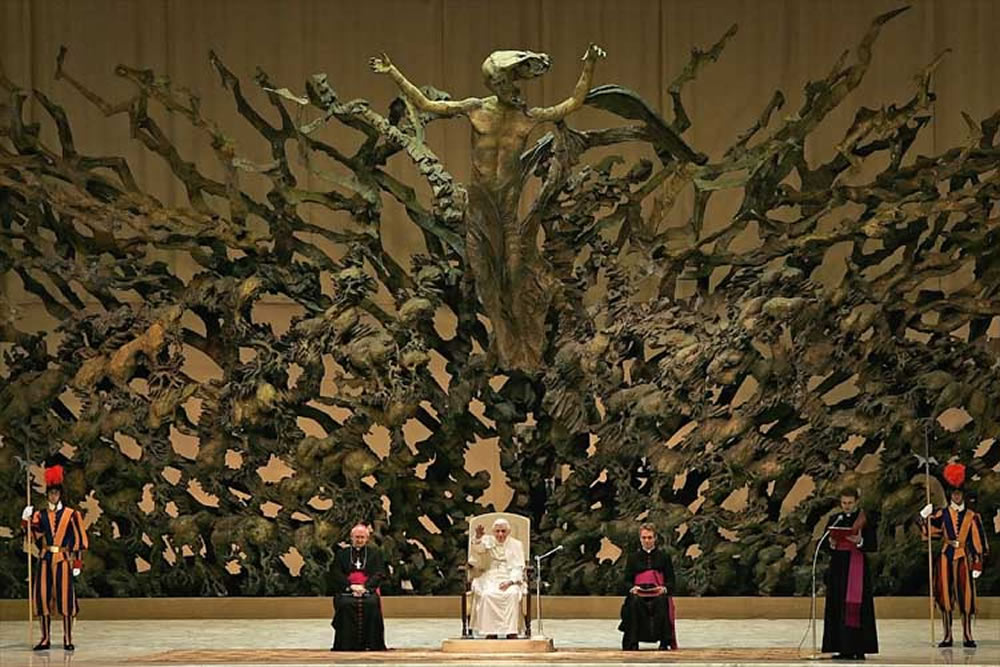
It was used by the sculptor Pericle Fazzini (1913/87) in the years 1970/75 to put together his giant sculpture “Resurrection” for the Paul VI Audience Hall

Friday, November 10, 2017

TORLONIA PALACE

PALAZZO TORLONIA
Begun about 1500 by Cardinal Adriano da Corneto Castellesi secretary of Alexander VI Borgia (1492/1503) with a project maybe by Donato Bramante (1444/1514)
The works were completed in about 1520 maybe by Andrea Bregno (1418/1503)
It was donated unfinished in 1505 to the King of England, Henry VIII, who had commissioned the now disappeared external paintings to Polidoro Caldara aka Polidoro da Caravaggio
It was the seat of the English Embassy and was seized by the apostolic chamber after the Anglican schism
Between 1609 and 1635 it belonged to the Borghese family
In 1760 it was bought by the French bankers Giraud and was called PALAZZO GIRAUD
Since 1820 it belongs to the Torlonia family who restored it and built the rear wing. They are still the owners to this day

Monday, October 9, 2017

SERRISTORI PALACE

PALAZZO SERRISTORI
1555, Averardo Serristori ambassador of Tuscany during the reign of Pius IV Medici (1559/65) on the site of an earlier building that had belonged to Cesare Borgia, son of Pope Alexander VI Borgia (1492/1503)
It was the Embassy for the Medici family and later the Tuscan embassy in Rome until 1830 when it became papal barracks
On 22 October 1867 here took place the terrorist attack of Giuseppe Monti and Gaetano Tognetti that killed many Zouaves (soldiers of the pope) and destroyed a corner of the building. It should have been an act to support the campaign for the liberation of Rome resulted in the defeat at Villa Glori of 76 volunteers and the death of the Cairoli brothers
The two bombers were beheaded at the order of Pius IX the following year
Their story inspired the 1977 film by Luigi Magni In Nome del Papa Re (In the name of the Pope King) with Nino Manfredi
Since 1870 the building was still being used as a barracks by the Italian troops and in 1902 it was dedicated to Luciano Manara
After the First World War it was used by the municipality to accommodate the evicted
In 1929 it was granted to the Holy See, which had it restored by Alberto Calza Bini (1881/1957) to adapt it as school building
Now it is the ELEMENTARY, MIDDLE AND HIGH SCHOOL PIUS IX

Saturday, September 23, 2017

RUSTICUCCI PALACE

PALAZZO RUSTICUCCI
1584/88 Domenico Fontana (1543/1607) and Carlo Maderno (1556/1629) for Cardinal Girolamo Rusticucci, who also paid for the construction of new church of S. Susanna
To build the palace, the cardinal had bought all the buildings in the area except the house of an old woman, Mrs. Moscetti, who had categorically refused to sell it. The cardinal did, however, made his architects build the palace anyway, incorporating the property of the old woman who found herself with her house surrounded by a cardinal's palace
The original palace was built on the now disappeared Piazza Rusticucci which used to be between Via del Mascherino and Borgo Sant'Angelo
In the seventeenth century the palace became the property of the Accoramboni family
It was rebuilt approximately as it was here in 1950 with some original elements


Thursday, August 31, 2017

PIUS PALACE

PALAZZO PIO
1942 Marcello Piacentini (1881/1960) and Attilio Spaccarelli (1890/1975) in collaboration with Gino Cipriani
Built at the same time of the “twin” INA PALACE on the opposite side of the road
It is partly used by Vatican Radio and partly leased to the RAI (the Italian national broadcast service) to host radio and television studios
AUDITORIO PIO
1947/51 Marcello Piacentini and Giorgio Calza Bini (1908/99), formerly rented for decades to the Academy of St. Cecilia. The greatest interpreters of classical music of the whole world have performed here
Windows on the stairs by Giorgio Quaroni (1907/60)
FOUNTAIN
1957. In front of Largo Giovanni XXIII

Friday, September 2, 2016

PALACE OF THE CONFESSORS

PALAZZO DEI PENITENZIERI

Begun in about 1480 maybe by Baccio Pontelli (about 1450/92) for Cardinal Domenico Della Rovere from Turin, distant cousin of Sixtus IV Della Rovere (1471/84)
It hosted the King of France Charles VIII in 1495
After the death of Domenico Della Rovere in 1501 it went to Cardinal Francesco Alidosi who, suspected of treason, was assassinated in 1511 by the Duke of Urbino Francesco Maria Della Rovere, who later lived in the palace himself
Later it belonged to Cardinal Giovanni Salviati
It took its present name for the confessors transferred here by Alexander VII Chigi (1655/67)
Now it is the HOTEL COLUMBUS and the headquarters of the Equestrian Order of the Holy Sepulcher of Jerusalem
Ceiling of the ROOM OF THE DEMIGODS in the right wing with frescoes of mythological figures maybe by Bernardino di Betto aka Pinturicchio (1454/1513) who had also painted the façade with decorations now obviously disappeared
In the other four rooms on the first floor decorations also maybe by Pinturicchio and his school
On the second floor ROOM OF APOLLO with fresco in the ceiling “Apollo driving the horses of the Sun” painted in 1552 maybe by Francesco de' Rossi aka Francesco Salviati (1510/63) for Cardinal Giovanni Salviati

Sunday, August 28, 2016

PALACE OF THE ONES ABOUT TO CONVERT

PALAZZO DEI CONVERTENDI

Built as PALAZZO CAPRINI in the years 1501/10 by Donato Bramante (1444/1514) for the Spinola family from Genoa
Originally it used to face the now disappeared Piazza Scossacavalli and it was also known as PALACE OF RAPHAEL because it was the house where Raffaello Sanzio (Raphael) (1483/1520) lived in the last years of his life and where he died
As the nearby Palazzo Branconio Dell'Aquila by Raphael it became a founding prototype of Renaissance civil architecture that had many imitations and also inspired Andrea Palladio
In the second half of the sixteenth century a new building was built that incorporated the old which was known in the seventeenth century as Palazzo dei Convertendi for the hospice established here by Cardinal Girolamo Gastaldi in favor of the heretics who wanted to become Catholics and here were subjected to a renewed catechesis
In 1938 it was destroyed and rebuilt rotated of 90° with only the central balcony and the ashlar around the door that resemble the original
It is owned by the Holy See and it is home to the Congregation for the Oriental Churches

Sunday, June 5, 2016

CESI PALACE

PALAZZO CESI

Early sixteenth century for Cardinal Francesco Armellini Medici treasurer of Clement VII Medici (1523/34) over a building of the previous century
Armellini was a Cardinal very powerful but hated for the taxes he imposed. During the sack of Rome in 1527 he fled to Castel Sant'Angelo and he entered it lifted in a basket. He died soon after of a broken heart
Paul III Farnese (1534/49) gave the palace to various relatives of his
1545/50 arrangement of the GARDEN maybe by Guidetto Guidetti (about 1498/1564) for the collection of antiquities of Cardinal Federico Cesi to whom family the palace had passed
The Cesi family had it restored in the years 1570/77 by Martino Longhi the Elder (1534/91)
Cardinal Pier Donato Cesi turned it into a museum of antiquities and art objects of which only a marble ancient “Lion's Head” remains, nestled in the upper part of the corner with Via Pfeiffer
The palace is now the property of the Salvatorians Fathers
The frescoes inside the building were painted in the years 1930/50