Showing posts with label Pius IX. Show all posts

Monday, October 9, 2017

SERRISTORI PALACE

PALAZZO SERRISTORI
1555, Averardo Serristori ambassador of Tuscany during the reign of Pius IV Medici (1559/65) on the site of an earlier building that had belonged to Cesare Borgia, son of Pope Alexander VI Borgia (1492/1503)
It was the Embassy for the Medici family and later the Tuscan embassy in Rome until 1830 when it became papal barracks
On 22 October 1867 here took place the terrorist attack of Giuseppe Monti and Gaetano Tognetti that killed many Zouaves (soldiers of the pope) and destroyed a corner of the building. It should have been an act to support the campaign for the liberation of Rome resulted in the defeat at Villa Glori of 76 volunteers and the death of the Cairoli brothers
The two bombers were beheaded at the order of Pius IX the following year
Their story inspired the 1977 film by Luigi Magni In Nome del Papa Re (In the name of the Pope King) with Nino Manfredi
Since 1870 the building was still being used as a barracks by the Italian troops and in 1902 it was dedicated to Luciano Manara
After the First World War it was used by the municipality to accommodate the evicted
In 1929 it was granted to the Holy See, which had it restored by Alberto Calza Bini (1881/1957) to adapt it as school building
Now it is the ELEMENTARY, MIDDLE AND HIGH SCHOOL PIUS IX

Monday, January 9, 2017

PALACE OF THE MANUFACTURE OF TOBACCO

PALAZZO DELLA MANIFATTURA DEI TABACCHI
1859/63 Antonio Sarti (1797/1880) for Pius IX Mastai-Ferretti (1846/78)
Restored in 1927 by Pier Luigi Nervi (1891/1979) for the transformation of the building in the seat of the State Monopolies. A roof for the large room of the selection of tobacco was built
Renovated again in 1958 by Cesare Pascoletti (1898/1986) who demolished the original wings of the building
It is now the seat of the AMMINISTRAZIONE AUTONOMA DEI MONOPOLI DI STATO (Indipendent Administration of the State Monopolies) that, according to the official definition, “controls the public gaming sector in Italy through a constant check on the work of dealers and a targeted action against irregularities. It has in addition the faculty to control the production, distribution and sale of tobacco products and the collection and payment of taxes that burden it”
Just like the popes who speculated in the past on the deadly habit of tobacco, so today the Italian state profit handsomely from the same vice, albeit without monopoly, and gorges itself obscenely of the proceeds of gambling that causes havoc for many families

Wednesday, December 28, 2016

PALACE OF THE APOSTOLIC DATES GIVERS

PALAZZO DELLA DATARIA APOSTOLICA
End of the sixteenth century for Cardinal Orazio Maffei
1615 renovated for Paul V Borghese (1605/21) when it became the seat of the Dataria Apostolica (Apostolic Date Givers) the office of the Curia who had the task of affixing the date on papal documents
1860/61 rebuilt by Andrea Busiri Vici (1818/1911) for Pius IX Mastai-Ferretti (1846/78)
It was an important center of power with exceptional financial importance: this is where handouts were conceded and where benefits and ecclesiastical roles were assigned
In 1652 the sub-datario Mascambruno, sentenced to death on charges of having forged the signature of Innocent X Pamphilj (1644/55) on some documents, before being beheaded, was conducted in front of the Palazzo della Dataria and here his right hand was cut
The institution was abolished in 1968 by Paul VI Montini (1963/78)
Since 1973 is home to ANSA the main Italian news agency and the fifth in the world

Sunday, April 19, 2015

VATICAN MUSEUMS - MUSEUMS OF THE APOSTOLIC VATICAN LIBRARY (first part)


MUSEI DELLA BIBLIOTECA VATICANA

Room of the messages to Pius IX


1877, the messages for presents received by Pius IX (1846/78) used to be kept here
Byzantine liturgical vestments and fabrics

“Frontal of altar and elements in silk and golden silver threads” from the mass vestments of Clement VIII Aldobrandini (1592/1605) woven as tapestries by Guasparri di Bartolomeo Papini of the Florentine Grand Ducal Manufactures from cartoons of the years 1593/97 by Alessandro Allori aka Bronzino (1533/1607) a pupil of Agnolo di Cosimo aka Bronzino

Important “Original Greek marble bas-relief of a knight” of the fourth century BC


Chapel of St. Pius V


For St. Pius V Ghislieri(1566/72)

Frescoes “Stories of St. Peter Martyr” 1570 by Jacopo Zucchi (about 1542/96) designed by his master Giorgio Vasari (1511/74)

Objects of the treasury of the Sancta Sanctorum of the Lateran dating from the fourth to the eleventh century


Room of the Messages


It used to keep the messages for presents received by Leo XIII Pecci (1878/1903) and St. Pius X Sarto (1903/14)

Early Christian and Roman glass and enamels, ivories and metals from Medieval to Modern times:

“Glass” of the fourth century with scale-like marine animals from Cologne

“Disk” with the oldest depiction of Sts. Peter and Paul

“Enamels of Limoges” with stories of Christ from the old Basilica of St. Peter

“Diptych from Rambona” tenth century, from the Abbey of St. Mary Rambona in the province of Macerata in the Marche region

The name comes from the altar of the Bona Dea, which was replaced at the end of the ninth century with the Abbey

“Ivory pyx” from Milan, sixth century


Room of the Aldobrandini Wedding


Designed by Flaminio Ponzio (1560/1613) for Paul V Borghese (1605/21)

On the ceiling “Stories of Samson” 1607/08 by Guido Reni (1575/1642) who, during the same period, also the frescoed the ceiling of the HALL OF DAMES with the “Pentecost”

On the floor mosaic “Achilles drags Hector's body” third century AD

The room contains an impressive collection of paintings at least 1,800 years old:

Frescoes

Wedding scene with “The Marriage of Alexander and Roxane” also known as Nozze Aldobrandini (Aldobrandini Wedding) of the Augustan period found in 1605 by the Arch of Gallienus
It was preserved in the Villa Aldobrandini at Magnanapoli and since 1818 in the Vatican
It is one of the most beautiful and best preserved paintings that we have from antiquity

“Heroines of Tormarancia” third century AD found in 1816 in the ruins of a villa. There are various heroines of Greek tragedy represented

“Odyssey Landscapes” first century BC from the frieze of a room discovered in 1848 on the Esquiline Hill

“Cargo Ship with wheat” third century AD found in Ostia in 1865

“Processions of children” third century AD found in Ostia in 1868

Mosaics

“Garlands of leaves and fruits” from Villa Adriana in Tivoli

“Landscape and animals” from the Aventine Hill

Tuesday, February 24, 2015

VATICAN MUSEUMS - ROOM OF THE IMMACULATE CONCEPTION


SALA DELL'IMMACOLATA CONCEZIONE
 
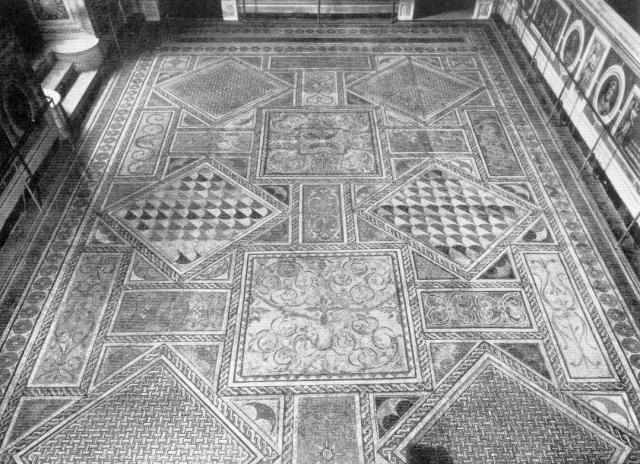
Huge and beautiful floor with “Ancient Roman mosaic” from the so called Imperial Palace in Ostia

“Cycle of frescoes dedicated to Holy Mary” 1856/65 by Francesco Podesti (1800/95) from Ancona for Pius IX Mastai-Ferretti (1846/78) who had pronounced the dogma of the Immaculate Conception on December 31, 1854
The dogma is not the fact that Mary has conceived Jesus as a virgin, as is commonly and erroneously believed, but that she was born without original sin

In the vault, six octagons with “Faith”, “Doctrine” and four episodes of the Old Testament:
“Castaways with the Ark of Noah in the background”, “Jael kills Sisera”, “Esther fainting before Ahasuerus” and “Judith with the head of Holofernes”

In the large wall to the right “Proclamation of the dogma of the Immaculate Conception” with two registers, earthly and heavenly, inspired by the masterpieces of Raphael

On the left into the wall with the windows “Stories and allegorical figures”

Opposite the entrance “Crowning of the image of the Immaculate Coronation” in the Chapel of the Choir of the Basilica of St. Peter's


Francesco Podesti tore down a ceiling with an attic above enlarging in this way the walls of the room
During the discussion that took place for the proclamation of the dogma Podesti drew from life with almost photographic details all participants he would have later painted in his “Discussion”

He included a certain Father Passaglia, who had expressed unorthodox ideas, but Podesti insisted to include him as well, reminding that Judas was included in all representations of the Last Supper despite having done much worse than poor Father Passaglia

“A cultured and civilized work that is, however, outside of history, it floats above history as an anachronism perfect in his own way. Some might say that the Chapel of the Immaculate Conception can be taken as a mirror and metaphor for the long pontificate of Pius IX, also hung between the Old Regime and modernity, between the progressive openings and conservative closings. In a schematic view of history would be easy to argue that also the Mastai-Ferretti pontificate is unresolved and pending on the events of the century in a state of substantial irrelevance, in precarious and stunned balance between the ancient Church which ends with Gregory XVI Cappellari and the modern Church that with Leo XIII and Pius XI, will be a protagonist in the dramatic heart of the twentieth century. In fact, the personality of Pope Pius IX is more nuanced and complex than historiographical stereotypes would allow us to understand. (...) We can say with Micol Forti, that the Hall of Francesco Podesti (...) has an eminently documentary value. It is the valuable testimony of a commission that - not without culture, or ineffectively, it is also fair to say - was trying to counter impending and unavoidable historical events” (Antonio Paolucci)

At the center of the room “Precious cabinet” from Paris made of wood, metal, porcelain and semiprecious stones designed by Emile Auguste Reiber and executed by Charles and Paul Christofle in 1877
In the cabinet there are precious books with translations of the bull Ineffabilis Deus of 1854 in all languages of the Catholic populations of the world, donated to the Pope in 1877