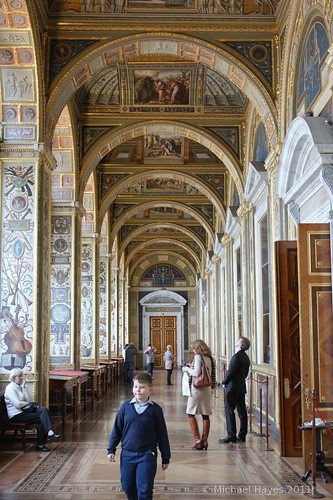
Loggia di Raffaello
The LOGGE VATICANE were begun in the years 1512/18 by Donato Bramante (1444/1514) who could only built the
first floor (Doric order) with decorations by Giovanni Ricamatore aka Giovanni da Udine (1487/1564)
They were continued after Bramante's death by Raffaello Sanzio (Raphael) (1483/1520) who built the
central dome of the first floor and the other two floors
SECOND FLOOR (Ionic order)
Known as Loggia di Raffaello, it has thirteen bays
(twelve with the Old Testament, one with the New) with fifty-two panels using
cloister vaults instead of the domes designed by Bramante to increase the
surface to be frescoed
Raphael gave the scheme and provided the drawings for the
first eight spans and its influence is visible up to the tenth
1) Genesis: “Separation of Light from Darkness”, “Separation
of land from the waters”, “Creation
of the sun and moon”, “Creation of the Animals”
2) Adam and Eve: “Creation of Eve”, “Original Sin”, “Expulsion
from Eden”, “Work of Adam and Eve”
3) Noah: “Building the Ark”, “Flood”, “Out of the ark”, “Sacrifice
of Noah”
4) Abraham and Loth: “Abraham and Melchizedek”, “God's
Promise of a long posterity”, “Meeting with the three angels”, “Escape from
Sodom”
5) Isaac: “God appears to Isaac”, “Isaac and
Rebecca spied upon by Abimelech”,
“Blessing of Jacob”, “Birthright to Esau”
6) Jacob: “Jacob's
Dream”, “Meeting
with Rachel at the Well”, “Covenant with Laban”, “Jacob's
Journey to Canaan”
7) Joseph: “Explanation of the dreams to his brothers”, “Joseph
sold by his brothers”, “Temptation by Potiphar's Wife”, “Explanation of the
dreams to Pharaoh”
8) Moses: “Moses
saved from the waters”, “Burning Bush”, “Passage of the Red
Sea”, Mmiracle of the spring water from the cliff”
9) Moses: “Delivery of the tablets of the Law”, “Adoration
of the Golden Calf”, “Column of smoke”, “Presentation to the Jews of the
tablets of the Law”
10) Joshua: “Passage of the Jordan”, “Fall of Jericho”, “Joshua
stopping the sun and the moon”, “Division of the Promised
Land”
11) David: “Samuel consecrating David”, “Fight with Goliath”,
“Triumph on the Assyrian”, “Toilet of Bathsheba”
12) Solomon: “Consecration of Solomon”, “Judgment
of Solomon”, “Meeting with the Queen of Sheba”, “Construction
of the Temple”
13) Christ: “Nativity”,
“Epiphany”, “Baptism”, “Last Supper”
Although the precise attributions are debated, they were
executed by eleven disciples of Raphael: Giovanni
da Udine (1487/1564), Giulio Pippi aka Giulio
Romano (1499/1546), Giovanni Francesco Penni
(about 1496/1528), Pietro Bonaccorsi aka Perin del Vaga
(1501/47), Polidoro Caldara aka Polidoro da Caravaggio
(about 1495/1543), Raffaellino Del Colle (about
1490/1566), Tommaso Vincidor (d. 1536) Pellegrino da Modena (about 1464/1523), Vincenzo Tamagni (about 1492/1530), Guillaume de Marcillat (about
1469/1529) e Pedro Machuca (d. 1550)
Raphael would have wanted to integrate architecture and
painting with sculptures consisting in the stucco reliefs and ancient statues
he intended to place in the aediculae
“Raphael is the absolute greatest painter of the past millennium,
and the Loggias are his most significant legacy” (Antonio Paolucci)
“The great festoons by Raphael with still lives in the
Vatican Loggias denote that the still life genre was gaining independence,
according to a process that, after its disappearance, was rediscovered in
Lombardy, and especially in Rome, around 1590” (Federico Zeri)
“The artistic influence exerted by the loggias was spread
over three centuries, until the neoclassical time, and they constituted a
source of inspiration for countless artists interested in the art of decoration
and restoration of the old. These artists worked in a dimension that can be
defined choral - where it is difficult to single out the individual
personalities who painted side by side, creating almost a common language -
created for the Pope in a private setting, for its intellectual digressions,
which could revive the old through architecture, painting and the many statues
that adorned the gallery, forming a sort of private museum” (Andrea Pomella)
The architect Giacomo Quarenghi (1744/1817) from Bergamo
designed and built in record time in the first half of the eighties of 1700s
for the Empress Catherine of Russia in the Palace of the Hermitage in St.
Petersburg a Loggia that was the exact copyof the Loggia of Raphael
In Rome, the painter Cristoforo Unterberger (1732/98), a
pupil of Anton Raphael Mengs, made copies of the frescoes along with Felice Giani (1758/1823), G.B. Dall'Era, Andrea Nesserthaler,
Peter Wenzel and others
Catherine had never seen the Loggia in Rome and she had
admired only on the prints by Giovanni Volpato
It is frustrating to find out that in St. Petersburg the
copy of the Loggia is one of the great attractions of the Hermitage, whereas
here the original Loggia hasn't even been open to the public for decades
III FLOOR (Corinthian order)
Painted by Giovanni da Udine
(1487/1564)