Showing posts with label Federico Zeri. Show all posts

Saturday, February 28, 2015

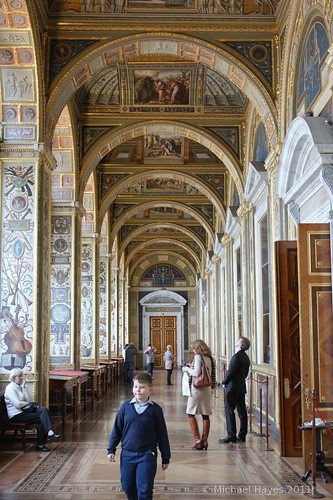
VATICAN MUSEUMS - RAPHAEL'S LOGGIA


Loggia di Raffaello
 
The LOGGE VATICANE were begun in the years 1512/18 by Donato Bramante (1444/1514) who could only built the first floor (Doric order) with decorations by Giovanni Ricamatore aka Giovanni da Udine (1487/1564)

They were continued after Bramante's death by Raffaello Sanzio (Raphael) (1483/1520) who built the central dome of the first floor and the other two floors

SECOND FLOOR (Ionic order)

Known as Loggia di Raffaello, it has thirteen bays (twelve with the Old Testament, one with the New) with fifty-two panels using cloister vaults instead of the domes designed by Bramante to increase the surface to be frescoed
Raphael gave the scheme and provided the drawings for the first eight spans and its influence is visible up to the tenth

1) Genesis: “Separation of Light from Darkness”, “Separation of land from the waters”, “Creation of the sun and moon”, “Creation of the Animals”

2) Adam and Eve: “Creation of Eve”, “Original Sin”, “Expulsion from Eden”, “Work of Adam and Eve”

3) Noah: “Building the Ark”, “Flood”, “Out of the ark”, “Sacrifice of Noah”

4) Abraham and Loth: “Abraham and Melchizedek”, “God's Promise of a long posterity”, “Meeting with the three angels”, “Escape from Sodom”

5) Isaac: “God appears to Isaac”, “Isaac and Rebecca spied upon by Abimelech”, “Blessing of Jacob”, “Birthright to Esau”

6) Jacob: “Jacob's Dream”, “Meeting with Rachel at the Well”, “Covenant with Laban”, “Jacob's Journey to Canaan”

7) Joseph: “Explanation of the dreams to his brothers”, “Joseph sold by his brothers”, “Temptation by Potiphar's Wife”, “Explanation of the dreams to Pharaoh”

8) Moses: “Moses saved from the waters”, “Burning Bush”, “Passage of the Red Sea”, Mmiracle of the spring water from the cliff”

9) Moses: “Delivery of the tablets of the Law”, “Adoration of the Golden Calf”, “Column of smoke”, “Presentation to the Jews of the tablets of the Law”

10) Joshua: “Passage of the Jordan”, “Fall of Jericho”, “Joshua stopping the sun and the moon”, “Division of the Promised Land”

11) David: “Samuel consecrating David”, “Fight with Goliath”, “Triumph on the Assyrian”, “Toilet of Bathsheba”

12) Solomon: “Consecration of Solomon”, “Judgment of Solomon”, “Meeting with the Queen of Sheba”, “Construction of the Temple”

13) Christ: “Nativity”, “Epiphany”, “Baptism”, “Last Supper”

Although the precise attributions are debated, they were executed by eleven disciples of Raphael: Giovanni da Udine (1487/1564), Giulio Pippi aka Giulio Romano (1499/1546), Giovanni Francesco Penni (about 1496/1528), Pietro Bonaccorsi aka Perin del Vaga (1501/47), Polidoro Caldara aka Polidoro da Caravaggio (about 1495/1543), Raffaellino Del Colle (about 1490/1566), Tommaso Vincidor (d. 1536) Pellegrino da Modena (about 1464/1523), Vincenzo Tamagni (about 1492/1530), Guillaume de Marcillat (about 1469/1529) e Pedro Machuca (d. 1550)

Raphael would have wanted to integrate architecture and painting with sculptures consisting in the stucco reliefs and ancient statues he intended to place in the aediculae

“Raphael is the absolute greatest painter of the past millennium, and the Loggias are his most significant legacy” (Antonio Paolucci)


“The great festoons by Raphael with still lives in the Vatican Loggias denote that the still life genre was gaining independence, according to a process that, after its disappearance, was rediscovered in Lombardy, and especially in Rome, around 1590” (Federico Zeri)


“The artistic influence exerted by the loggias was spread over three centuries, until the neoclassical time, and they constituted a source of inspiration for countless artists interested in the art of decoration and restoration of the old. These artists worked in a dimension that can be defined choral - where it is difficult to single out the individual personalities who painted side by side, creating almost a common language - created for the Pope in a private setting, for its intellectual digressions, which could revive the old through architecture, painting and the many statues that adorned the gallery, forming a sort of private museum” (Andrea Pomella)

The architect Giacomo Quarenghi (1744/1817) from Bergamo designed and built in record time in the first half of the eighties of 1700s for the Empress Catherine of Russia in the Palace of the Hermitage in St. Petersburg a Loggia that was the exact copyof the Loggia of Raphael

In Rome, the painter Cristoforo Unterberger (1732/98), a pupil of Anton Raphael Mengs, made copies of the frescoes along with Felice Giani (1758/1823), G.B. Dall'Era, Andrea Nesserthaler, Peter Wenzel and others

Catherine had never seen the Loggia in Rome and she had admired only on the prints by Giovanni Volpato

It is frustrating to find out that in St. Petersburg the copy of the Loggia is one of the great attractions of the Hermitage, whereas here the original Loggia hasn't even been open to the public for decades

III FLOOR (Corinthian order)

Painted by Giovanni da Udine (1487/1564)

Thursday, January 29, 2015

VATICAN MUSEUMS - GREGORIAN EGYPTIAN MUSEUM (third part)


Room VI - Votive bronzes of the first millennium BC
 
“Magic stele” to heal the bites of scorpions and snakes, with a representation of the child god Harpokrates

“Ibis of God Thoth” late period 712/332 BC in gilded bronze

“The bird ibis was an animal common in the Nile Valley. It is identified with Thoth, the patron god of writing and calculating, the divine scribe and patron of scribes. In Egyptian funerary speculation, Thoth is the one who weighs the heart of the deceased before the divine tribunal of the afterlife. This beautiful ibis in gilt bronze was restored in 2002 thanks to a grant of the Patrons of the Arts in the Vatican Museums” (Web site of the Vatican Museums - mv.vatican.va)

“Fishes”, “Crocodile god Sobek”, “Bull Apis and the cow his mother”, “Icneumone (called “rat of the pharaohs”), animal sacred to the sun god of Heliopolis Atum, “Scorpion of the goddess Selket”, “Hawk of the god Horus”, “Female cat of the goddess Bastet”, “Some aspects of the snake-goddess”

“Imhotep” the famous vizier of the pharaoh Zoser of the Third Dynasty, the architect who built his pyramid at Saqqara and was deified in the Late Period

Room VII - Bronze and clay figurines of Hellenistic and Roman Egypt


“Aurora Goddess” minor Greek deity becoming more important in Hellenistic Egypt in syncretism with other Egyptian goddesses

Alexandrian Triad, Serapis, Isis and Harpokrates represented in various forms: “God Harpokrates sitting on a lotus flower”. Harpokrates was the Hellenized god Horus

“Priest in the guise of the god Anubis”

Number of molded terracotta figurines called Alexandrian

Christian objects from Coptic Egypt dating from the fifth to the eighth century AD, including oil lamps, incense containers and clay phial for holy water

Egyptian Islamic objects from the eighth to the fourteenth century AD

Room VIII - Mesopotamia, Syria-Palestine and Federico Zeri Collection from Palmyra


“Sale of a piece of land” about 2500 BC by Fara in Central Iraq

“Nail” 1865/1833 BC from Uruk, Southern Iraq, with the name and title of the King Sin-Kashid of Uruk

“List of rations of dates” from Central Iraq

“Cylindrical seals of Mesopotamia” used since the third millennium BC to authenticate the cuneiform documents

Extraordinary “Clay cylinder” of the famous Neo-Babylonian king Nebuchadnezzar II (605/552 BC) in which he recalls the foundation of the Temple of God Lugal-Marda in the town of Maradda
Nebuchadnezzar II subdued the kingdom of Judah, destroyed the Temple of Solomon and deported the Jews to Babylon

“Mesopotamia is the place which gave birth to cities, to writing, to the idea of state. Of the extraordinary process of formation of the first civilization are eloquent witnesses the tablets written in cuneiform writing and cylindrical seals, which were used to validate the documents produced by the first public administration in history” (Web site of the Vatican Museums - mv.vatican.va)

“Kit of a tomb of the Bronze Age I” 3150/3050 BC from Bab edh-drĂ¡ha in Jordan, one of the largest cemeteries in the Early Bronze Age I

“Vase from burial ornaments of the Early Bronze Age IV” 2300/2200 BC from the Necropolis of Jericho

“The Early Bronze Age IV is the period of Palestinian history in which the region's population abandons the system of urban life to return to the agricultural economy of the village” (Web site of the Vatican Museums - mv.Vatican.va)

“Group of thirteen funerary reliefs” first to third century AD, ten of which left by the will of the late art historian Federico Zeri, exhibited since 2000 in a display inspired by the niches of the family tombs of Palmyra
They illustrate some of the most common types of extraordinary sculptural production of the city of Palmyra

“Red Ceramic Pitchers ingubbiata” (covered with a thick layer of liquid clay just before cooking, forming a coating film) and polished (rubbed with a wooden or cloth), a characteristic production of the Syro-Palestinian's Iron Age II (1000/800 BC)

“Six bronze arrowheads” of a type characteristic of the Iron Age II B and C (800/586 BC) found in Jerusalem near the fortifications and probably referable to one of the attacks suffered by the city by the Assyrians (702 BC) or Babylonians (589 and 586 BC)

Room IX - 883/612 BC - Reliefs from Assyria (Northern Iraq)


The exploits of kings who extended the boundaries of the first great empire in history from Persia to the Mediterranean, from Anatolia to Egypt were celebrated in grand palaces decorated with cycles of reliefs

ASHURNASIRPAL II (883/859 BC)

“Winged Genius kneeling adoring the tree of life” and “Winged Genius as eagle's head” in limestone alabaster from Nimrud room I of the Northwest Palace of Ashurnasirpal II (883/859 BC)

“The kingdom of Ashurnasirpal II marks the first great flowering of neoassirian figurative, art which is expressed in the decoration of the monumental Royal Palace that the King built on the north-west of the Acropolis of Nimrud, the ancient Khalku. The two reliefs belong to the exposed plates dedicated to the mythical-symbolic theme of the worship of the Sacred Tree, a symbol of royalty bringer of fertility and life” (Web site of the Vatican Museums - mv.vatican.va)

SARGON II (721/705 BC)

“Brick with inscription of Sargon II” (721/705 BC) 706 BC in fired clay, glazed and stamped by the Royal Palace of Khorsabad. The inscription extols the unique construction of the Palace

SENNACHERIB (704/681 BC)

“Assyrian soldiers carrying stools” part of the spoils of a conquered city (perhaps in Syria), in limestone alabaster from Nineveh (Kuiunjik), South-West Palace of Sennacherib (704/681 BC)


“Workers involved in the transport of a colossal human-headed bull” from Nineveh, Southwest Palace

ASHURBANIPAL (680/636 BC)

“Tents of the Arabs in the desert burned by Assyrian soldiers” in limestone alabaster from Nineveh, North Palace of the Arab Hall of Ashurbanipal (680/636 BC)

It is a celebration for the victories against the Syro-Arabian desert nomads

Other reliefs from Ashurbanipal's North Palace including: “Dead bodies floating on a river”, “Grooms hold horses” and “Chaldeans prisoners conducted in a palm grove”