Showing posts with label Perin Del Vaga. Show all posts

Tuesday, December 17, 2019

St. STEPHEN OF THE CACCO

S. STEFANO DEL CACCO
Via di S. Stefano del Cacco 26

Built in the early ninth century at the time of Paschal I (817/824) on the site of the TEMPLE OF ISIS (Iseum Campense)

The name of the church comes from the statue of the dog-headed god Thoth found here, now in the Egyptian Museum at the Vatican and mistaken for a macacco or a macaque monkey

Also known as S. Stefano in Pinea (St. Stephen in Pinea) from the pigna (pine cone) symbol of the district represented on top of the bell tower

 Restorations at the beginning of the twelfth century at the time of Paschal II (1099/1118)

Romanesque BELL TOWER with a bell dating back to 1480 and PORCH added about 1160 at the behest of the brothers Nicola and Quinzio Papareschi, nephews of Pope Innocent II Papareschi (1130/1143)

Restorations in the years 1607/17 and 1638/43 by Antonio Canziani who maybe designed​​the FRONT and Matteo Riva for the Sylvestrine monks to whom the church had been assigned in 1563 by Pope Pius IV Medici (1559/65)

PORTAL in travertine maybe by Paolo Marucelli (1594/1649)

Other restorations in 1725 and 1865

FLOOR
1865 with marble pieces from the Basilica of St. Paul Outside the Walls, destroyed by fire in 1823

VAULT
Ornamental reliefs and fresco “Trinity and St. Sylvester in glory” 1857 by an unknown nineteenth-century artist

TO THE RIGHT OF THE ENTRANCE
“Tomb of the architect Ludovico Rusconi Sassi” d. 1736

NAVE
Twelve ancient columns reused here maybe from the Temple of Isis
Organ dating back to 1642

1st RIGHT - CHAPEL OF THE GUARDIAN ANGEL
Above the altar “Guardian Angel” eighteenth-century copy from the original by Pietro da Cortona exhibited in the National Gallery of Ancient Art at the Barberini Palace

2nd RIGHT - CHAPEL OF St. JOSEPH
Above the altar “Death of St. Joseph” by an unknown eighteenth-century artist

ON THE RIGHT WALL AFTER THE 2nd CHAPEL
Fresco “Pietà” 1519 by Pietro Bonaccorsi aka Perin del Vaga (1501/47) heavily restored also with the addition of the landscape that surrounds it

It is the first extant solo work by Perin del Vaga and it was executed soon after his collaboration with Raphael in the Vatican Loggia

“Here Perino, apart from the obvious inspiration from the group by Michelangelo in St. Peter's, is showing the narrative and dramatic power of Raphael and Giulio Romano not in the sense of emotional expression but mainly in grace and ornament” (Antonio Vannugli)

AT THE END OF THE RIGHT AISLE
Altar with devotional picture “Our Lady Comforter of the Afflicted” in wood dressed with silk dress, maybe dating to the seventeenth century. Tradition has it that this image wept on July 9, 1796 shortly before the invasion of the French soldiers of Napoleon

APSE
Originally there were mosaics dating from the time of Paschal I (817/824), destroyed in 1607 and replaced by the current decoration
At the center “Martyrdom of St. Stephen” about 1585 by Cesare Nebbia (1536/1614)
On the sides “St. Charles Borromeo” and “St. Frances of Rome” about 1610 by Cristoforo Casolani (1587/1629), a pupil of Cristoforo Roncalli aka Pomarancio
“Golden stuccos” 1608 by Rocco Solari
“Choir in walnut wood” 1668 by the Cecconali brothers

AT THE END OF THE LEFT AISLE
“Wooden Crucifix” beginning of the seventeenth century and ruined fresco “Saints” maybe by Cristoforo Casolani (1587/1629)

3rd CHAPEL ON THE LEFT
Above the altar “St. Matthew” and frescoes on spandrels and dome by Cesare Mariani (1826/1901)

2nd CHAPEL ON THE LEFT
Above the altar “St. Benedict delivers the rule to St. Sylvester” maybe by Carlo Maratta (1625/1713)
On the left “Miraculous healing by St. Sylvester” and on the right “St. Sylvester receives communion from the Virgin Mary” by Cesare Mariani
Frescoes on the lunettes and on the side walls by Cesare Mariani

1st CHAPEL ON THE LEFT
Above the altar modern “Holy Face”
Stuccos by G.B. Ferrabosco
On the left “Sts. Charles Borromeo and Filippo Neri” and on the right “Sts. Stephen and Paul the First Hermit” 1639 two late works by Giovanni Baglione (1566/1643)

SACRISTY
Altar piece “St. Nicholas” 1695 by Giovanni Odazzi (1663/1731) formerly in the third chapel on the left
Oval panel “St. Aurea taken to martyrdom” by Luigi Garzi (1638/1721)
Preparatory sketch “Birth of the Virgin Mary” maybe by Sebastiano Conca (1680/1764)

MONASTERY
General Curia (headquarters) of the Sylvestrine Fathers
“St. Stephen” by Giovanni De Vecchi (about 1537/1615)
“Adoration of the Magi” by the painter from Antwerp Jan Miel (1599/1663)

Tuesday, March 26, 2019

St. MARY IN DOMNICA

S. MARIA IN DOMNICA
Maybe built in the seventh century over the BARRACKS OF THE FIFTH COHORT OF THE FIRE FIGHTERS, part of the Praedia Dominica, i.e. the areas belonging to the emperor, hence the name of the church
Rebuilt in about 820 for Pope Paschal I (817/824)
Restored 1514 by Andrea Contucci aka Andrea Sansovino (1460/1529) for Leo X Medici (1513 /21)

Wood paneled with symbols inspired by the Marian litanies 1566 for Cardinal Ferdinando de' Medici
Frieze by Pietro Bonaccorsi aka Perin del Vaga (1501/47) and Giulio Pippi aka Giulio Romano (1499/1546)

Decorative frescoes with “Litany to the Virgin” 1876 by Alessandro Mantovani, Giovanni Brunelli and Luigi Roncati

Sixteen made out of gray granite and two of pink granite of Aswan

1920/30 Gisberto Ceracchini (1889/1982)
“He interrupted his studies after primary school to devote himself to painting as an autodidact. As he himself said, (Marsan, 1983) he had no other masters but nature and himself. His Tuscan origin was also instrumental in orienting him towards studies and the choice of the great artistic-figurative local tradition as a source of inspiration. Since 1915 he settled in Rome, where he met the circle of artists and writers hanging out in the 'third room' of the Aragno Coffee Bar (in Via del Corso), a circle which would have great influence in his cultural formation” (Susanna Zatti - Dizionario Biografico degli Italiani)
Above the arch “Christ between two Angels and Apostles”, below “Moses and Elijah”, in the apse “Mary and Child Enthroned with Angels and Pope Paschal I kneeling down” dating back to the years 817/824 during the pontificate of Paschal I
“Looking at the people, Paschal I (depicted with the square nimbus to indicate that he was living when the mosaic was made) appears as if he is delivering the Virgin Mary to the faithful and, through Her, Jesus. (...) The features of both the Virgin Mary and the angels are executed according to the artistic canon Byzantine and monastic and not according to the Roman iconography of Mary as Queen. It could be the work of Asian artists who came to Rome during the iconoclast persecution” (Official web site of S. Maria in Domnica - www.santamariaindomnica.it )
In small lateral lunettes “St. Zachary with priestly vestments and censer, with, in the lower part, St. John the Baptist and the angel inspiring St. John the Evangelist” maybe by Lazzaro Baldi (about 1624/1703) or by his pupil G.B. Lenardi. The paintings were irretrievably ruined by some repainting applied in later periods
“In the paintings of S. Maria in Domnica are present some of the compositional features typical of both Lazzaro Baldi and G.B. Lenardi as the construction of a space created with a vanishing point, denied, however, by architectural elements which make up almost wings of a stage set within which the scene takes place. It is a scheme also appearing in the canvas by Baldi 'Solomon worships idols' and 'St. John of God cure plague victims' kept in the Galleria Spada in Rome” (Andreina Draghi)
At the end of the naves “Ancient Roman Sarcophagi”

Sunday, September 10, 2017

RIVALDI PALACE

PALAZZO RIVALDI
About 1540/47 Antonio Cordini aka Antonio da Sangallo the Younger (1483/1546) as Villa Silvestri for Eurialo Silvestri from Cingoli butler of Pope Paul III Farnese (1534/49) on the area of the VELIA HILL ​​
The palace was built consciously on pre-existing archaeological remains consisting of a housing complex of mid-first century AD, used and refurbished until the fifth century
Renovated in 1586 by Jacopo Del Duca (about 1520/1604), who also rearranged the gardens for Alessandro de' Medici, the future Pope Leo XI (1605)
Restored in about 1612 by Jan Van Santen aka Giovanni Vasanzio (1550/1621)
It belonged to the Gonzaga family (1621/26), to the House of Savoy (1626/60) and then to the Archbishop Ascanio Rivaldi who used it as the Conservatory of the poor women beggars who were employed here working the wool with the name PIO INSTITUTE RIVALDI
The garden was reduced when the Velia Hill was mostly removed in 1932
Many sculptures found here are now at the Vatican Museums and at the Centrale Montemartini
It is being renovated and there are plans to exhibit here the Torlonia collection of statues if it would be finally acquired and pulled out of the basement of Palazzo Torlonia alla Lungara where it is currently sadly stored
ROOM WITH FRESCOED FRIEZE “The Story of Cupid and Psyche” first half of 1500s maybe by Pietro Bonaccorsi aka Perin del Vaga (1501/47) or by his pupil Pellegrino Tibaldi (1527/96)

Friday, April 28, 2017

MACCARANI STATI PALACE

PALAZZO MACCARANI STATI
About 1523 Giulio Pippi aka Giulio Romano (1499/1546) for Cristoforo Stati, Registrar of Rome
Formerly known as Palazzo Stati Cenci
It belonged to the Cenci family, to the Maccarani family and to the counts of Brazzà
Since 1972 it belongs to the government and it houses SENATORS OFFICES, SERVICES AND LOCAL GOVERNMENT OFFICES
COURTYARD
Grotesque decoration of the sixteenth century
LIVING ROOM ON THE MAIN FLOOR
Frieze “Lovers beloved of the gods”
GREAT HALL
Frieze “Stories of Caesar” fresco dating back to the sixteenth century maybe by Pietro Bonaccorsi aka Perin del Vaga (1501/47), and artists of his workshop including Luzio Romano and Prospero Fontana (1512/97), father of Lavinia Fontana

Sunday, June 12, 2016

COLONNA PALACE - COLONNA GALLERY (third part)

GALLERIA COLONNA

The collection was put together from 1650 by Cardinal Girolamo I Colonna (his grandfather was Marcantonio II Colonna the victor of Lepanto)
It was continued from 1666 by his nephew Grand Constable Lorenzo Onofrio Colonna and by his son Filippo II Colonna, who inaugurated the gallery in 1703
The building of the gallery was begun in 1654 by Antonio Del Grande (about 1625/79)
A document written by Antonio Del Grande mentions a collaboration with Gian Lorenzo Bernini (1598/1680) but the active presence here of the great genius of Baroque art is not otherwise documented
Continued in the years 1693/1703 by Girolamo Fontana (1668/1701)

“It is the most spectacular work designed by Antonio Del Grande in the palace, which was gradually assuming the form of a huge complex with several courtyards, for which only in the eighteenth century, with the intervention first of Nicola Michetti, and then of Paolo Posi, there will be attempts to impose uniformity. The gallery (...) will be finished by Girolamo Fontana, but the wide body, divided into three spaces by two pairs of free Corinthian columns, demonstrates the ability of Del Grande to interpret courtly themes avoiding any rhetorical excess” (Manfredo Tafuri - Dizionario Biografico degli Italiani Treccani)
The 210 paintings dating from the fifteenth to the eighteenth century and the about 150 sculptures mostly ancient are shown to the public for one morning a week since the seventeenth century
STAIRS
“Isabella Colonna Salviati” by Pompeo Batoni (1708/87)
Antechamber
“St. Julian Hospitaller” maybe by Pietro Bonaccorsi aka Perin del Vaga (1501/47)
“Christ Crowned with Thorns” by Francesco Trevisani (1656/1746)
“Vision of St. Jerome” by Pier Francesco Mola (1612/66)
“Time steals away beauty” by Giuseppe Cesari aka Cavalier d'Arpino (1568/1640)
“He stands out thanks to a sensibility, become rare, for noble tranquility and grandeur. In contrast to the broken lines of the Zuccaris' school, he loves long lines that runs uninterrupted, with a distinctly melancholy ductus. In line with this approach, in him the modeling of bodies and of drapery does not show, as in his predecessors, the absolute tension toward a strong plastic fullness, but instead something consciously superficial. (...) Even in chiaroscuro, however treated with great care, he does not seek, as it happened for example in the school of Barocci, a surprising effect in patches, but he puts larger areas of well shaded tones alongside each other. Thanks to these qualities, Cavalier d'Arpino's works have an aristocratic touch” (Hermann Voss)

Wednesday, December 23, 2015

BALDASSINI PALACE

PALAZZO BALDASSINI
1514/20 early masterpiece by Antonio Cordini aka Antonio da Sangallo the Younger (1483/1546) for the jurist Melchiorre Baldassini
It was later became property of the Palma family and the name changed to PALAZZO PALMA
Giuseppe Garibaldi stayed there in 1875
Now is the headquarters of the ISTITUTO LUIGI STURZO who had the building restored
Luigi Sturzo (1871/1959) was an Italian priest and politician, founder of the Italian Popular Party in 1919. He vigorously opposed Mussolini
Under the loggia in a metope there is the depiction of an elephant, Annone. The elephant really existed and was given in 1513 as a gift to Leo X (1513/21) by the king of Portugal Manuel de Aviz
Annone became an exotic celebrity in Rome, but died after three years and, apparently, he was buried at the Vatican
GROUND FLOOR
Vault with “Grotesque” 1517/19 by Giovanni Ricamatore aka Giovanni da Udine (1487/1564)
FIRST FLOOR
Friezes and frescoes by Pietro Bonaccorsi aka Perin del Vaga (1501/47) and Giovanni da Udine

Friday, April 17, 2015

VATICAN MUSEUMS - ROOMS NEAR THE SISTINE CHAPEL (first part)

ROOMS NEAR THE SISTINE CHAPEL
 
Open to the public only with special permission


Sala Regia

Royal Room

1540/73 begun by Antonio Cordini aka Antonio da Sangallo the Younger (1483/1546). It is next to the Sistine Chapel and it was used to receive monarchs

Stucco coffered barrel vault by Pietro Bonaccorsi aka Perin del Vaga (1501/47)

Stuccos on the walls by Daniele da Volterra (1509/66)

All the paintings depict papal victories designed to remind the visiting monarchs of the papal primacy

Large historical frescoes

“Battle of Lepanto” and “Return of Gregory XI Beaufort (1370/78) from Avignon” 1571 and “Night of St. Bartholomew” 1572 by Giorgio Vasari (1511/74)

“Submission of Barbarossa to Alexander III Bandinelli (1159/81)” by Francesco de' Rossi aka Francesco Salviati (1510/63)
“Capture of Tunis” and “Henry IV in front of Gregory VII (1073/85)” and panel over the door with “Donation of Charlemagne” by Taddeo Zuccari (1529/66) with his brother Federico Zuccari (about 1542/1609)

“The culmination of the artistic activity of Taddeo Zuccari coincides with the work at the Sala Regia. (...) Of his Donation of Charlemagne both the pleasing arrangement of color and the cleverly harmonious composition were appreciated. (...) Overall it is hardly a masterpiece, but compared to the work of his competitors it is pleasant, thanks to the lightness and safety of the stroke. The Taking of Tunis also shows a similar mix of strengths and weaknesses. The fresco with Henry IV in front of Gregory VII, after the death of the artist, was completed by his brother, while the two allegorical figures above the door still betray the style of Taddeo” (Hermann Voss)

“Triumph of Faith over Unfaithfulness” by Lorenzo Sabatini (about 1530/76)

Smaller pictures

“Return of the provinces to Agapito” by Orazio Sammachini (1532/77)
“Donation of Ravenna” by Girolamo Siciolante da Sermoneta (1521/80)
“The offer of Pietro d'Aragona to Eugene III (1145/53)” by Livio Agresti (about 1508/79)
“Single perfect figures, such as the warrior standing in the left foreground, are isolated, while the protagonists of the scene do not reach the same level” (Hermann Voss)
Other paintings by Marco Pino aka Marco da Siena (about 1525/87)

Aula delle Benedizioni

Room of the Blessings

Next to the Royal Room above the Atrium of St. Peter, with the same size

Damaged fresco in the upper part “Boat of the apostles” 1627/28 by Giovanni Lanfranco (1582/1647) formerly in the passage to the Chapel of Sts. Michael and Petronilla in the Basilica of St. Peter, placed here in 1721 when it was substituted with a copy in mosaic by Pietro Paolo Cristofari (1685/1743). It had in turn replaced a 1605 fresco by the poor Bernardo Castello

Wednesday, March 11, 2015

VATICAN MUSEUMS - BORGIA'S APARTMENT (second part)


Room V – Of the Saints

Masterpiece by Pinturicchio: friezes in stucco and gilded with representations of the “Myth of Osiris, and Io and the bull Apis” an allusion to the bull, a symbol of the Borgia family

From the lunette above the entrance towards left:

“Visitation”, “St. Paul the Hermit and St. Anthony Abbot in the Thebaid”, “Disputation of St. Catherine of Alexandria with the philosophers before the Emperor Maximilian” (with self-portrait by Pinturicchio on the far left), “Legend of St. Barbara”, “Legend of the chaste Susanna”, “Martyrdom of St. Sebastian” with, in the background, Colosseum, Palatine Hill and the church of Ss. Giovanni e Paolo

Above the door round panel with “Madonna and Child with cherubim”


Room VI – Of the Mysteries of the Faith


Painted by Pinturicchio with pupils maybe Tiberio d'Assisi (about 1460-70/1524) and Bartolomeo di Giovanni

In the vault stuccos and paintings, “David”, “Solomon”, “Isaiah”, “Jeremiah”, “Malachi”, “Zephaniah”, “Micah” and “Joel”

In the lunettes from right Seven Mysteries of the Faith, the mysteries of Christ's life as opposed to the joyful mysteries of the life of Mary:

“Resurrection” with on the lower left portrait of Alexander VI kneeling, one of the finest Renaissance portraits, a true masterpiece of the highest quality


Portraits of the twentieth century sculpted by artists such as Francesco Messina (1900/95), Alberto Giacometti (1901/66), Giovanni Prini (1877/1958) and Emilio Greco (1913/95)


Room VII – Of the Popes


It was the largest room, where the official papal ceremonies were held

The ceiling collapsed disastrously in 1500 during a ceremony with the pope present. Alexander VI was miraculously safe but many people died

It was rebuilt in 1521 with stucco and frescoes by Giovanni Ricamatore aka Giovanni da Udine (1487/1564) and Pietro Bonaccorsi aka Perin del Vaga (1501/47) who painted the “Center of the ceiling with four angels in foreshortening” for Leo X Medici (1513/21)

“They go beyond the effects of light inaugurated by Raphael, while the accent on the elegant graphic elements must be ascribed to his Florentine education” (Carlo Bertelli, Giuliano Briganti, Antonio Giuliano)


“The assistant of Perin del Vaga was Giovanni da Udine, but the invention of the whole set comes exclusively from him. The task was of great importance, but it was only designed in a decorative way, not with that purity of taste that would have been worthy of Raphael. The subject - the seven planets - looks like just an excuse to create a system of panels with grotesques and small ovals with scenes containing figures, all well balanced although rich in variations. At the center is a circle with four Victories, whose garments take on a rhythmic and wonderful grace; the distribution of the whole receives from this central point its accent and its valuable support” (Hermann Voss)

The OTHER ROOMS from Room VIII to Room LV do not have significant decorations, and house, like the first seven, the marvelous Collection of Religious Modern Art

Saturday, February 28, 2015

VATICAN MUSEUMS - RAPHAEL'S LOGGIA


Loggia di Raffaello
 
The LOGGE VATICANE were begun in the years 1512/18 by Donato Bramante (1444/1514) who could only built the first floor (Doric order) with decorations by Giovanni Ricamatore aka Giovanni da Udine (1487/1564)

They were continued after Bramante's death by Raffaello Sanzio (Raphael) (1483/1520) who built the central dome of the first floor and the other two floors

SECOND FLOOR (Ionic order)

Known as Loggia di Raffaello, it has thirteen bays (twelve with the Old Testament, one with the New) with fifty-two panels using cloister vaults instead of the domes designed by Bramante to increase the surface to be frescoed
Raphael gave the scheme and provided the drawings for the first eight spans and its influence is visible up to the tenth

1) Genesis: “Separation of Light from Darkness”, “Separation of land from the waters”, “Creation of the sun and moon”, “Creation of the Animals”

2) Adam and Eve: “Creation of Eve”, “Original Sin”, “Expulsion from Eden”, “Work of Adam and Eve”

3) Noah: “Building the Ark”, “Flood”, “Out of the ark”, “Sacrifice of Noah”

4) Abraham and Loth: “Abraham and Melchizedek”, “God's Promise of a long posterity”, “Meeting with the three angels”, “Escape from Sodom”

5) Isaac: “God appears to Isaac”, “Isaac and Rebecca spied upon by Abimelech”, “Blessing of Jacob”, “Birthright to Esau”

6) Jacob: “Jacob's Dream”, “Meeting with Rachel at the Well”, “Covenant with Laban”, “Jacob's Journey to Canaan”

7) Joseph: “Explanation of the dreams to his brothers”, “Joseph sold by his brothers”, “Temptation by Potiphar's Wife”, “Explanation of the dreams to Pharaoh”

8) Moses: “Moses saved from the waters”, “Burning Bush”, “Passage of the Red Sea”, Mmiracle of the spring water from the cliff”

9) Moses: “Delivery of the tablets of the Law”, “Adoration of the Golden Calf”, “Column of smoke”, “Presentation to the Jews of the tablets of the Law”

10) Joshua: “Passage of the Jordan”, “Fall of Jericho”, “Joshua stopping the sun and the moon”, “Division of the Promised Land”

11) David: “Samuel consecrating David”, “Fight with Goliath”, “Triumph on the Assyrian”, “Toilet of Bathsheba”

12) Solomon: “Consecration of Solomon”, “Judgment of Solomon”, “Meeting with the Queen of Sheba”, “Construction of the Temple”

13) Christ: “Nativity”, “Epiphany”, “Baptism”, “Last Supper”

Although the precise attributions are debated, they were executed by eleven disciples of Raphael: Giovanni da Udine (1487/1564), Giulio Pippi aka Giulio Romano (1499/1546), Giovanni Francesco Penni (about 1496/1528), Pietro Bonaccorsi aka Perin del Vaga (1501/47), Polidoro Caldara aka Polidoro da Caravaggio (about 1495/1543), Raffaellino Del Colle (about 1490/1566), Tommaso Vincidor (d. 1536) Pellegrino da Modena (about 1464/1523), Vincenzo Tamagni (about 1492/1530), Guillaume de Marcillat (about 1469/1529) e Pedro Machuca (d. 1550)

Raphael would have wanted to integrate architecture and painting with sculptures consisting in the stucco reliefs and ancient statues he intended to place in the aediculae

“Raphael is the absolute greatest painter of the past millennium, and the Loggias are his most significant legacy” (Antonio Paolucci)


“The great festoons by Raphael with still lives in the Vatican Loggias denote that the still life genre was gaining independence, according to a process that, after its disappearance, was rediscovered in Lombardy, and especially in Rome, around 1590” (Federico Zeri)


“The artistic influence exerted by the loggias was spread over three centuries, until the neoclassical time, and they constituted a source of inspiration for countless artists interested in the art of decoration and restoration of the old. These artists worked in a dimension that can be defined choral - where it is difficult to single out the individual personalities who painted side by side, creating almost a common language - created for the Pope in a private setting, for its intellectual digressions, which could revive the old through architecture, painting and the many statues that adorned the gallery, forming a sort of private museum” (Andrea Pomella)

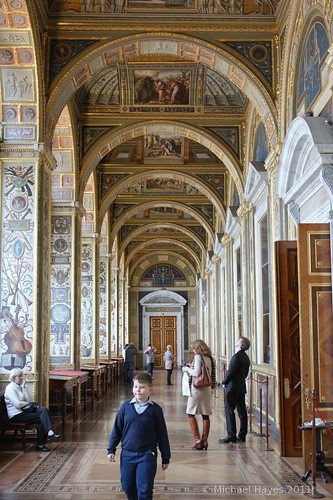
The architect Giacomo Quarenghi (1744/1817) from Bergamo designed and built in record time in the first half of the eighties of 1700s for the Empress Catherine of Russia in the Palace of the Hermitage in St. Petersburg a Loggia that was the exact copyof the Loggia of Raphael

In Rome, the painter Cristoforo Unterberger (1732/98), a pupil of Anton Raphael Mengs, made copies of the frescoes along with Felice Giani (1758/1823), G.B. Dall'Era, Andrea Nesserthaler, Peter Wenzel and others

Catherine had never seen the Loggia in Rome and she had admired only on the prints by Giovanni Volpato

It is frustrating to find out that in St. Petersburg the copy of the Loggia is one of the great attractions of the Hermitage, whereas here the original Loggia hasn't even been open to the public for decades

III FLOOR (Corinthian order)

Painted by Giovanni da Udine (1487/1564)