Showing posts with label Cesare Pascoletti. Show all posts

Monday, January 8, 2018

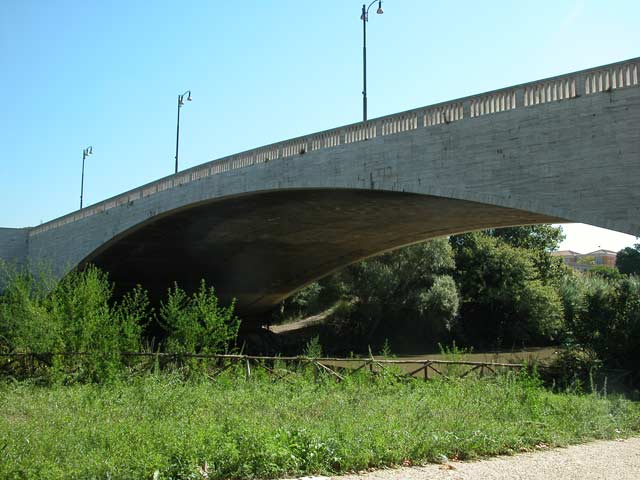
TESTACCIO DISTRICT BRIDGE

PONTE TESTACCIO
1937/48 designed and begun by Cesare Pascoletti (1898/1986), a student of Marcello Piacentini
It was completed by the engineer Bastianelli and the engineer and mathematician from Trieste Giulio Krall (1901/71)
It is 121.90 m (400 feet) long
It should have been called Bridge of Africa and it would have to connect the continuation of Viale Aventino with Trastevere Station, after the planned demolition of the Slaughterhouse
In 1949, the year after the inauguration, metal bars were added into the openings of the railings to prevent children from sneaking through and falling into the river

Monday, January 9, 2017

PALACE OF THE MANUFACTURE OF TOBACCO

PALAZZO DELLA MANIFATTURA DEI TABACCHI
1859/63 Antonio Sarti (1797/1880) for Pius IX Mastai-Ferretti (1846/78)
Restored in 1927 by Pier Luigi Nervi (1891/1979) for the transformation of the building in the seat of the State Monopolies. A roof for the large room of the selection of tobacco was built
Renovated again in 1958 by Cesare Pascoletti (1898/1986) who demolished the original wings of the building
It is now the seat of the AMMINISTRAZIONE AUTONOMA DEI MONOPOLI DI STATO (Indipendent Administration of the State Monopolies) that, according to the official definition, “controls the public gaming sector in Italy through a constant check on the work of dealers and a targeted action against irregularities. It has in addition the faculty to control the production, distribution and sale of tobacco products and the collection and payment of taxes that burden it”
Just like the popes who speculated in the past on the deadly habit of tobacco, so today the Italian state profit handsomely from the same vice, albeit without monopoly, and gorges itself obscenely of the proceeds of gambling that causes havoc for many families

Monday, October 10, 2016

PALACE OF THE MUSEUM OF ROMAN CIVILIZATION

PALAZZO DEL MUSEO DELLA CIVILTÀ ROMANA
Begun in the years 1939/41
Completed in 1952 by Pietro Aschieri (1889/1952), Domenico Bernardini (active 1939/52), Cesare Pascoletti (1898/1986) e Gino Peressutti (1883/1940) for FIAT and donated to the city of Rome to be used as a museum
Museum of Roman Civilization
Educational museum designed by Giulio Quirino Giglioli (1886/1957) and opened in 1955
In the vestibule “Bust of Giovanni Agnelli” by Edoardo Rubino (1871/1954)
FIFTY-NINE ROOMS filled exclusively with beautiful and interesting copies of original sculptures and well done and enlightening models of ancient Roman buildings
There is no original ancient piece but the fact that many of the copies are from originals that are scattered in museums all over the world, makes it unique, complete and perfect from the teaching point of view
Among the most important pieces:
“Model of Rome at the beginning of the fourth century AD” (200 m² - 2,150 square feet) by Italo Gismondi (1887/1974) in scale 1:250
Planetarium and Astronomy Museum
SIX ROOMS opened in 2004 with educational material on earth, moon, rocky planets, gaseous planets and interstellar space
ROOM I
Model of the Earth, its geological history and human attempts to conquer space
ROOM II
Model of the Moon, human missions to win it
ROOM III
Rocky Planets: Mercury, Venus, Earth and Mars with documentation of spacecraft Magellan, Galileo and Pioneer
SALA IV
Gaseous Planets: Saturn, Jupiter, Uranus, Neptune and Pluto
Information on Europa, a satellite of Jupiter
ROOM V
Interstellar Space with stars, nebulae, galaxies, and the representation of the cosmic distance scale
ROOM VI
Multi-vision exhibit of the observation of the sky through the centuries, using the pictorial imagination of Giotto, Goya and Van Gogh and images of the Hubble Space Telescope

Saturday, October 26, 2013

BLOCK-HOUSE IN VIALE ERITREA

CASE A BLOCCO DI VIALE ERITREA
1938/40 Cesare Pascoletti (1898/1986), pupil of Marcello Piacentini, for the Società Generale Immobiliare
"While not participating in the lively architectural debate after the war and finding his works of architecture little space in magazines, many of Cesare Pascoletti's works are left, built often in strategic locations in urban centers, and it is these that have helped to create the face of Italian cities, shaping their character, testifying the architect's work" (Beatrice Bocci - design.rootiers.it/tecniche2012/blog)