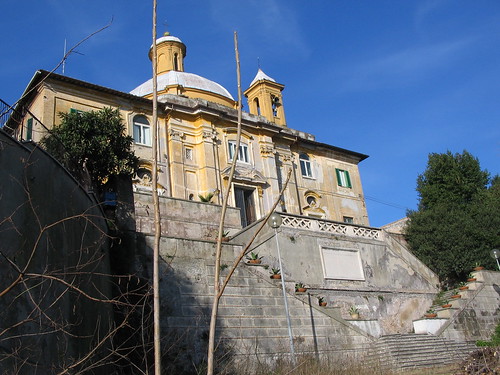
Showing posts with label Biagio Puccini. Show all posts

Tuesday, December 17, 2019

St. STEPHEN OF THE ABYSSINIANS

S. STEFANO DEGLI ABISSINI
Città del Vaticano

Maybe originally built in the fifth century at the time of Leo I the Great (440/461) 
Restored in the eighth century at the time of Hadrian I (772/795)

It is also known as S. Stefano Maggiore (St. Stephen Major) or S. Stefano degli Indiani (St. Stephen of the Indians)

In 1479 Sixtus IV Della Rovere (1471/84) gave it to the Coptic monks coming from Abyssinia and known, at that time, as Indians

Restructured and reduced in size in 1706 by the Roman Antonio Valeri (1648/1736) for Clement XI Albani (1700/21) 
Restored in the years 1927/28 and 1931/33 by Gustavo Giovannoni (1873/1947)

“Jambs and lintel” of the entrance portal made out of ancient Roman marble sculpted again and modified at the end of the twelfth century

“Ancient columns” embedded in the right wall maybe moved here in the twelfth of thirteenth century

RIGHT ALTAR
“S. Silverius Pope” by Biagio Puccini (1673/1721)

MAIN ALTAR
“St. Stephen stoned” by an unknown seventeenth-century artist

Thursday, July 25, 2019

St. PAUL AT THE REGOLA

S. PAOLO ALLA REGOLA
Founded according to tradition at the time of Pope Sylvester I (314/355) in a house that had already been converted into a chapel
It was known as SCHOLA PAULI (Paul's School) for the tradition according to which St. Paul lived here for two years. Tradition has it also that he wrote here his letters to the Philippians, Colossians, Ephesians and to Philemon which are part of the New Testament
The church was home to corporations including the ones of the Cappellari (hat makers), Vinai (wine makers), Barbieri (barbers), Cicoriari (chicory pickers) and Vaccinari (cowmen) 
Rebuilt since 1687 by G.B. Bergonzoni (1629/92) for the Third Regular Order of St. Francis of the Sicilian Nation
Consecrated in 1728

FAÇADE
Finished in 1721 with a project by Giacomo Cioli (?/1734) executed by Giuseppe Sardi (1680/1753)

1st RIGHT - CHAPEL OF St. ROSALIA
Above the altar “Sts. Chiara, Rose of Viterbo and Rosalia” maybe by Cristoforo Creo
Oval painting on the right “Martyrdom of St. Erasmus” by Biagio Puccini (1673/1721)

BETWEEN 1st AND 2nd CHAPEL ON THE RIGHT
“Tomb of Bishop Pietro Gioeni” d. 1761

2nd RIGHT - CHAPEL OF St. FRANCIS
Above the altar “St. Francis Receiving the Stigmata” 1695 by Michele Rocca (about 1675/1751) from Parma
Formerly erroneously attributed to Francesco Mazzola, who, just like Michele Rocca, was nicknamed Parmigianino

3rd RIGHT - CHAPEL OF THE CROSS
Above the altar “Bronze crucifix” attributed to Alessandro Algardi (1598/1654) or Pietro Bracci (1700/73)

ABOVE THE DOOR OF THE ORATORY
Oval painting “St. Thomas Aquinas admires St. Bonaventure who had fallen into a trance” by Biagio Puccini

ORATORY OF St. PAUL
Oldest area of the church built on the ruins of the house, maybe prison, of St. Paul
Rebuilt 1931 by Antonio Muñoz (1884/1960)
Mosaic “St. Paul” by Eugenio Cisterna (1862/1933)

MAIN ALTAR
At the center “Conversion of St. Paul”, on the right “Martyrdom of St. Paul”, on the left “Preaching of St. Paul” about 1701 frescoes by Luigi Garzi (1638/1721), a pupil of Andrea Sacchi later influenced by Carlo Maratta
“Luigi Garzi went to Rome from Pistoia when he was very young (...) He was at the school of Andrea Sacchi whose teachings helped to direct him towards classicism. Sacchi in particular advised him to study the works of Raphael, Domenichino and Nicolas Poussin. Garzi studied also other classicists Emilian painters such as Guido Reni, and he preferred Giovanni Lanfranco above all. He was, however, decisively influenced by Carlo Maratta, 'so that he can be considered, as a painter, on a minor parallel line to Carlo Maratta, but with interesting differences and anticipations of the eighteenth century' (Sestieri, 1994)” (Gerardo Casale - Dizionario Biografico degli Italiani Treccani)
Eighteenth-century choir made out of walnut wood
ORGAN 1763 by Hans Conrad Wehrle (beginning eighteenth century/1771), German organ builder designer of numerous organs for churches in Rome and in the Lazio region, including that of St. Mary Magdalene
Marble tabernacle for the holy oils made in 1535

3rd LEFT - CHAPEL OF OUR LADY OF GRACE
Above the altar fresco beginning of fifteenth century “Our Lady of Grace” believed to be miraculous, formerly at the entrance of the old church
Above the door of the sacristy
Oval painting “Virgin Mary delivering the Child to St. Clare of Assisi” by Biagio Puccini

2nd LEFT - CHAPEL OF St. ANNA
Above the altar “St. Anna receives the Child Jesus from the arms of the Virgin” by Giacinto Calandrucci (1646/1707) a pupil of Carlo Maratta
In the vault frescoes “Glory of St. Anna” and “Prophets” by Salvatore Monosilio (active since 1744/d. 1776) who was also a pupil of Maratta

1st LEFT - CHAPEL OF St. ANTHONY OF PADUA
Above the altar “St. Anthony of Padua with the Child in his arms” by Giacinto Calandrucci
Oval painting on the left “Miracle of the healing of the foot by St. Anthony” by Giacomo Dio
In the aedicula of the altar “Redeemer” fragment of a larger painting by an anonymous artist of the Veneto-Lombardy area

SACRISTY
1712 Alessandro De Grandis
Vault “St. Paul points out to St. John Chrysostom the Virgin Mary in Glory” by Ignazio Stern (1679/1748)
Walnut cabinets of 1736

Insula Romana di S. Paolo alla Regola

Ancient Roman Apartment Block of St. Paul at the Regola
Under PALAZZO SPECCHI, the building dating back to the sixteenth century to the right of the church, archaeologists found in the years 1978/82 a large brick building made out of four floors dating back to the imperial age with medieval phases of construction
Two of the ancient four floors are below the current street level 
The building was originally built at the time of Domitian (81/96 AD) to be used as a warehouse, maybe the HORREA VESPASIANI, used as part of the port and trading activities that took place along the nearby Tiber River
Two rooms in opus latericium (concrete covered with bricks) and two rooms with mosaic floors arranged on roads parallel to the Tiber and slightly sloping towards the river 
In the Severan period (early third century AD), the building was renovated and new warehouses, spacious halls and residential apartments were built. The new structures made the building rise to four stories in height
In the twelfth century on the ancient building a house with a tower was built, which is still visible behind Palazzo Specchi

Friday, March 29, 2019

St. MARY IN TRASPONTINA

S. MARIA IN TRASPONTINA
FAÇADE (made with travertine taken, in part, from the Colosseum) and CHURCH UNTIL THE 4th CHAPEL built in 1566 by Giovanni Sallustio Peruzzi (?/1573), son of Baldassare Peruzzi 
It replaced an earlier church with the same name built closer to Castel Sant'Angelo 
1581/87 building up to the front pillars of the dome by Ottaviano Nonni aka Ottaviano Mascherino (1524/1606)
1635/68 building of the BELL TOWER, TRANSEPT and DOME by Francesco Peparelli (active since about 1626/d. 1641)
The construction of the church lasted therefore 102 years
It was the parish of the gunners of the nearby Castel Sant'Angelo who wanted a low dome, so as not to have their line of fire obstructed

“Glory of the Virgin Mary” 1894 by Cesare Caroselli (1847/1927)

Above the altar “St. Barbara” 1597 one of the masterpieces by Giuseppe Cesari aka Cavalier d'Arpino (1568/1640) for Pietro Aldobrandini
Frescoes “Stories of St. Barbara” 1610/20 by Cesare Rossetti (active 1593/1620) designed by Cavalier d'Arpino
Decorations with military guns, coats of arms and cannons
The breast in full view of the saint worried the patron Pietro Aldobrandini who didn't want his uncle, the Pope Clement VIII (1592/1605), to see the painting
The breast was covered only in the nineteenth century and revealed again in the twentieth century
“The fact that Caravaggio might have found ridiculous the St. Barbara painted by his former employer, can be guessed by the way he quoted her in the first version of St. Matthew and the Angel, destroyed in Berlin during the Second World War: in his cheeky androgynous angel Caravaggio mimicked the drapery and the curvy posture of the plump body of Barbara, a posture known among Mannerist as serpentine, and in particular he mimicked the way the flimsy fabric clung to the soft underbelly and to the just raised thigh, as well as her tousled hair” (Peter Robb)
2nd RIGHT - CHAPEL OF St. CANUTE
On the altar “Ecstasy of St. Canute” 1686 by the Viennese Daniel Seiter (1649/1705)
S. Canute (about 1042/1086) was a Danish king, who was canonized in 1101. He planned to invade England and tried to increase the power of monarchy and church at the expense of nobility and common people
He was murdered in the wooden church of St. Albany in the city of Odense during a popular rebellion

3rd RIGHT - CHAPEL OF OUR LADY OF CARMEL
In the nineteenth century the “Statue of Our Lady of Mount Carmel” was put here for veneration
The throne dates to 1922 and the statue, blessed by Pope Pius XI Ratti (1922/39), was crowned on the eve of the Feast of Mount Carmel (July 16) in 1928
On 12 September 2001, the day after the tragedy of the Twin Towers in the U.S., it was once again crowned by Pope John Paul II (1978 /2005), in St. Peter's Square, on the occasion of the 750th anniversary of the gift of the Scapular

4th RIGHT - CHAPEL OF THE CROSS
Above the altar “Wooden Crucifix” from the old church
Frescoes “Stories of the Christ” 1649 by Bernardino Gagliardi (1609/1660)

5th RIGHT - CHAPEL OF St. ALBERT OF TRAPANI
Canvas on the altar “St. Albert of Trapani” and frescoes in the vault “Stories of St. Albert of Trapani” 1614/20 by Antonio Circignani aka Pomarancio (about 1568/1629), son of Niccolò Circignani

RIGHT TRANSEPT or CHAPEL OF St. MARY MAGDALENE DE' PAZZI
Built in 1626 on the occasion of the beatification of the Florentine saint
Above the altar “Trinity, Virgin Mary, St. Mary Magdalene de' Pazzi and St. Joseph” by Giovanni Domenico Cerrini (1609/81) or G.B. Ricci (about 1550/1624)
Vault “Cross and angels with symbols of the Passion of Christ” by Cesare Caroselli (1847/1927)

1674 Carlo Fontana (1634/1714)
Altarpiece “Icon with the Virgin Mary and Child” 1216 brought from the Holy Land by the Carmelites
Superb ALTAR FRONTAL in opus sectile (inlaid marble)
“Angels” in stucco on the ciborium and in marble at the center by Leonardo Retti (active 1670/1709)
Statues on the doors of jasper at the sides of the ciborium:
On the right “Prophet Elijah” by Antonio Lavaggi (active in Rome in the second half of the seventeenth century) and “Prophet Elisha” by Vincenzo Felice (about 1657/1715)
On the left “St. Angelo martyr” by Alessandro Rondoni and “St. Albert of Trapani” by Michel Maille aka Michele Maglia (active in Rome in the second half of the seventeenth century)
“An absolute masterpiece is the altar for the Carmelites of S. Maria in Traspontina (...). having started from the very simple idea of a tabernacle, Fontana built a magnificent small temple with double columns in Sicilian jasper, a broken pediment on which there are two angels, by Leonardo Retti, flanking a monumental bronze dome shaped as a crown. The impression made on his contemporaries is evidenced by the initiative of the Confraternity of the Agonizing of S. Maria del Pianto that, in 1675, commissioned to Fontana 'a small temple with columns and a crown as dome' to celebrate the release of a person sentenced to death” (Helmut Hager - Dizionario Biografico degli Italiani Treccani)
CHOIR BEHIND THE ALTAR
“Stalls in walnut” 1651 by Filippo Gagliardi (about 1607/1659) also known as Filippo Bizzarro or Filippo delle Prospettive
On the walls to the left “Sacrifice of the Prophet Elijah on Mount Carmel” and “Birth of Jesus”, to the right “Liberation from the plague of the island of Cyprus thanks to S. Pier Tommaso” and “Birth of Mary” 1760/61 by Angelo Papi

LEFT TRANSEPT or CHAPEL OF St. ANDREW CORSINI
Above the altar “Virgin Mary appears to St. Andrew Corsini” by Giovanni Paolo Melchiorri (1664/1745)
Vault “Apparition of St. Andrew Corsini in the Battle of Anghiari” 1697 by Biagio Puccini (1673/1721)

5th LEFT - CHAPEL OF St. ANGELO OF SICILY
Above the altar “Preaching of St. Angelo martyr” and on the sides and vault “Stories of St. Angelo” 1612 by G.B. Ricci (about 1550/1624), who was buried in this chapel in a tomb now lost

4th LEFT - CHAPEL OF St. THERESA OF JESUS
Above the altar “Ecstasy of St. Theresa” 1698 masterpiece by Antonio Gherardi (1638/1702)
Ovals to the side of the beginning of the eighteenth century by Placido Celi

Columns to which St. Peter and St. Paul would have been tied
Above the altar “Flagellation of Sts. Peter and Paul” and frescoes “Stories of Sts. Peter and Paul” by G.B. Ricci

2nd LEFT - CHAPEL OF St. ELIJAH
Above the altar “Prophet Elijah between St. Antonio Abate and the blessed Carmelite Franco Lippi from Siena” by Giacinto Calandrucci (1646/1707) a pupil of Carlo Maratta

1st LEFT - CHAPEL OF THE PIETÀ
Above the altar “Pietà” in terracotta of the fifteenth century
“Angels in wood” painted in imitation of marble by artists of the school of Ercole Ferrata (1610/86)
Frescoes of the years 1700/16

ORATORIO OF THE CHRISTIAN DOCTRINE
To the right of the church
Frescoes by the brothers Luigi Garzi (1638/1721) and Sebastiano Garzi
“Glorification of St. Albert” by Carlo Maratta (1625/1713)

Tuesday, March 5, 2019

St. MARY OF THE ROSARY ON MONTE MARIO

S. MARIA DEL ROSARIO A MONTE MARIO
About 1650 Camillo Arcucci (active since 1646/d. 1667)
Decorative architecture about 1726 almost certainly by Filippo Raguzzini (1680/1771) for Benedict XIII Orsini (1724/30)
EXTERNAL STAIRCASE built in 1838
Since 1931 the church passed to the Cloistered Dominican Sisters of Sts. Dominic and Sixtus in Magnanapoli, who moved in the CONVENT next to the church, renovated and enlarged

ON THE RIGHT
“Madonna and Child” by the school of Antonio Aquili aka Antoniozzo Romano (about 1435-40/1508)
“Death of St. Joseph” 1710 by Biagio Puccini (1673/1721)

ON THE LEFT
“Sts. Dominic and Catherine of Siena” by Michelangelo Cerruti (1663/1748)

MONASTERY
Relic of the left hand of St. Catherine of Siena with the sign of the stigmata
Copy of the painting on wood of Syro-Palestinian school “Madonna of St. Luke” seventh or eighth century, brought to Rome by St. Dominic in 1219
The original is at the back of the copy, facing the nuns' choir, and it is only shown on request
In the monastery the pianist and composer Franz Liszt (1811/86) stayed from 1863 to 1868 and composed here some of his works

Monday, January 14, 2019

St. EUSTACE

S. EUSTACHIO
Maybe founded by Constantine (306/337) on the site where St. Eustace was martyred and buried with his wife and two children, according to tradition, at the time of the reign of Hadrian (117/138)
This is impossible of course, because during the reign of Hadrian there was, according to historical sources, no persecution. Moreover, according to pagan sources such as the Historia Augusta, Hadrian, shortly before his death, had decided to recognize Christianity and was ready to dedicate temples without statues to Christ
St. Eustace, according to tradition, was a Roman army officer named Placido who had a vision of the crucifix between the antlers of a deer as he was hunting
Mentioned as a diaconia at the time of Gregory II (715/731)
A diaconia was an establishment for the care of the poor and distribution of the church's charity in the Middle Ages
Restored and re-consecrated in 1196 by Celestine III Orsini (1191/98), who also built the bell tower reusing the base dating back to about 1090
Complete reconstruction begun in the years 1701/03 by Cesare Crovara (active from 1682/d. 1703) from a design of 1692 by G.B. Contini (1641/1723)
1703/08 further works directed by G.B. Contini after the death of Crovara. He designed the chapels and the porch
1724/27 completion of work with transept and apse by Antonio Canevari (1681/1759), by Nicola Salvi (1697/1751) and, in the years 1728/30, by Giovanni Domenico Navone (known from 1706/d. 1770), thanks to a legacy of Pope Innocent XIII Conti (1721/24)
The construction of the church therefore lasted about 29 years
Restoration in 1861, in the years 1930/40 and 1992

FAÇADE
1701/03 by Cesare Crovara
It was restored in 1992 with the original so-called “color of the air”, a beautiful celestial hue
Above the pediment sculpture “Deer Head” by Paolo Morelli (known from 1712/d. 1719)
The head was not considered similar to that of a deer by most people, so much that there was a lampoon who claimed to not understand why one would confuse deers with donkeys

TO THE LEFT OF THE ENTRANCE
“Funerary monument of Giovanni Giraud” 1843 by Giuseppe Barba
“The interior is a splendid set of architectural structures, figurative elements and ornamental solutions of the more mature Baroque style. Visitor is immediately inserted into a space 'animated' by the intertwining of real or illusory lines and a pleasant harmony of colors and gilding, on which the light is diffused in a game of refractions and references. It seems clear, in this way, as the decoration is not an extrinsic and distracting component, but contributes fully to organize a perfect environment balanced between exuberant magnificence and measured sobriety” (Vincenzo Francia)

COUNTER FAÇADE
Spectacular “Organ” 1764 by Johannes Conradus Werle (1701/77)
Stained glass window with “Penitent Magdalene” of the end of the nineteenth century by Gabriel and Louis Gesta from Toulouse

1st RIGHT - CHAPEL OF THE HOLY FAMILY
Above the altar “Holy Family in the Temple of Jerusalem” about 1854 by Pietro Gagliardi (1809/90)
On the right “Funerary monument of Luigi Greppi” 1673
In the two ovals on the sides there were two paintings unfortunately stolen not long ago

2nd RIGHT – ANNUNCIATION CHAPEL
Designed by Ferdinando Fuga (1699/1782)
On the altar “Annunciation” about 1620 by Ottavio Lioni (1578/1630)

3rd RIGHT - CHAPEL OF THE SACRED HEART OF JESUS
Above the altar “Sacred Heart of Jesus”, on the right “Christ on the Cross and St. Longinus”, on the left “Supper at Emmaus” and other decorations 1934/37 by Corrado Mezzana (1890/1952)
“In his artistic production (...) it is apparent a crystallization of formulas of classical academic style, especially in the works with sacred subjects (...), while in the stamps' designs, to which he devoted himself assiduously since the thirties, Mezzana was able to synthesize the compositional complexity of the details and the expressive immediacy of allegory” (Rosanna Ruscio - Biographical Dictionary of Italian Treccani)

RIGHT TRANSEPT
“St. Jerome penitent” 1725 by Giacomo Zoboli (1681/1767) from Modena
Under the canvas fine “Confessional in wood” by Corrado Mezzana

1739 by Nicola Salvi (1697/1751) for Cardinal Neri Corsini
On the altar “Martyrdom of St. Eustace” 1725 by Francesco Fernandi aka Imperiali (1679/1740)
The nickname comes from the fact that the artist was protected by Cardinal Giuseppe Renato Imperiali
Under the altar “porphyry urn” which contains the bodies of St. Eustace, his wife Theopista and his son Agapito and his daughter Theopista

CANOPY
1746 Ferdinando Fuga
He devised a remarkable and innovative suspended canopy so not to burden the space

APSE
In the upper part plaster relief “Triumph of the Cross” by Galileo Parisini (1872/1949)
In the niches at the sides plaster statues “Redeemer” and “Immaculate” 1900 by Augusto Foli
“An interesting and original architectural solution can be admired in the transept: the edges are beveled so as to evolve the layout of the church toward an elliptical plan. The elliptical impression is accentuated by the shallow depth of the apse. Elegant balconies accompany, with a smooth convex line, the concavity of the rounded corners” (Vincenzo Francia)

VAULT OF THE TRANSEPT
Fresco with fake dome of 1930

LEFT TRANSEPT
“Meeting of the Virgin and St. Elizabeth” 1725 by Giacomo Zoboli
Under the canvas fine “Confessional in wood” by Corrado Mezzana

PULPIT
Decorated in polychrome marble. Built in memory of the preaching here of Bishop Giacomo Della Chiesa who later became Pope Benedict XV (1914/22)

3rd RIGHT - CHAPEL OF THE IMMACULATE HEART OF MARY
1771 Melchiorre Passalacqua, son of Pietro Passalacqua, and Agostino Penna (active since 1768/d. 1800)
On the altar ovate painting “Immaculate Heart of Mary” of the Venetian G.B. Casanova (1730/95) copy from an original donated to the church by Charles Emmanuel IV of Savoy
On the right “Holy Family” 1774 by Tommaso Maria Conca (1734/1822) who was a pupil of his uncle, the great Sebastiano Conca
On the left “Flight into Egypt” 1774 maybe by Étienne de La Vallée Poussin (1735/1802) or Michele Paolini

2nd LEFT - CHAPEL OF St. MICHAEL THE ARCHANGEL
1714/19 Giuseppe Sardi (1680/1753) designed by Alessandro Sperone
Above the altar “St. Michael the Archangel” 1817 copy by Giovanni Bigatti (1774/1817) from the world famous original by Guido Reni in St. Mary of the Immaculate Conception
To the left “Funeral Monument of Teresa Tognoli Samonati Canale” d. 1807
To the right “Funeral Monument of Silvio Cavalleri” d. 1717 Alessandro Sperone with sculptures by Lorenzo Ottoni(1648/1736)

1st LEFT - CHAPEL OF St. JULIAN HOSPITALLER
Above the altar “S. Julian” in 1706 by Biagio Puccini (1673/1721)

Saturday, August 25, 2018

St. BERNARDINO OF SIENA


S. BERNARDINO DA SIENA
1625 for Cardinal Giangarzia Mellini who also paid to build the monastery for the Franciscan Tertiaries Nuns
INTERIOR
Renovations in 1823 and in the years 1963/65
DOME
“Glory of S. Bernardino and Franciscan saints” about 1639 by Bernardino Gagliardi (1609/1660)

“In the busy and successful career as a fresco painter in various churches in Rome that the painter, who came to Rome from Umbria in the wake of fellow Umbrian Avanzino Nucci, began in the fourth decade of the seventeenth century as a lesser exponent of Classicism in Baroque, the frescoes of S. Bernardino represent an important episode, witness of Gagliardi's effort of adapting to the new Roman style of Domenichino, Lanfranco and Sacchi” (Angela Catalano)

1st RIGHT - CHAPEL OF St. FRANCIS
Above the altar “St. Francis Receiving the Stigmata” first half of 1600s by the Bolognese Emilio Savonanzi (1580/1660)
2nd RIGHT - CHAPEL OF THE PASSION
Above the altar “Christ Carrying the Cross between the Virgin Mary, Veronica and St. John the Evangelist” maybe by Giovanni Alberti (1558/1601)

MAIN ALTAR
Canvas “S. Bernardino in Glory” 1736/38 by Antonio Amorosi (1660/1738)
On the right “Preaching of St. Bernard”, on the left “Funeral of S. Bernardino”, on the apse “Assumption of Mary”, on the pilasters “Saints”, under the arch “Virtues” and, outside the arch, “Prudence” and “Fortress” 1663 by Clemente Maioli (1634/73) from Ferrara, follower of Pietro da Cortona close to the style of Giovanni Francesco Romanelli

2nd LEFT - CHAPEL MAFFEI
Above the altar “Immaculate Conception” 1717 by Biagio Puccini (1673/1721)
“The canvas, with compositional influence from Carlo Maratta, shows a softening of the first way of the artist, more expressive and with more contrasts of light” (Angela Catalano)
1st LEFT – ATTAVANTI CHAPEL
Above the altar “S. Verdiana and Mr. and Mrs. Attavanti” second half of the sixteenth century by an anonymous sixteenth-century artist
ON THE DOOR OF THE SACRISTY
“Eternal Father and an angel with Sts. Anthony, Elizabeth of Hungary and Agatha” 1617 by Giovanni Baglione (1566/1643)
ON THE RIGHT SIDE DOOR
“Blessed Elena and Francis in adoration of the Cross” 1631 by an anonymous seventeenth-century artist