Showing posts with label Pericle Fazzini. Show all posts

Wednesday, February 27, 2019

St. LAWRENCE IN PISCIBUS

S. LORENZO IN PISCIBUS
First mentioned by the sources in the twelfth century, although tradition has it that it was founded in the sixth century by St. Galla
In 1950 it was incorporated into the building of one of the Propylaea of Via della Conciliazione that hides the façade of the church
It is also known as S. LORENZINO
The name piscibus derives from the fact that in this area there used to be a fish market
Almost entirely rebuilt in 1659 and restored in 1735
It was deconsecrated after the construction of Via della Conciliazione and consecrated again in 1983 by John Paul II Wojtyla (1978/2005)
The columns inside were taken from ancient Roman buildings 
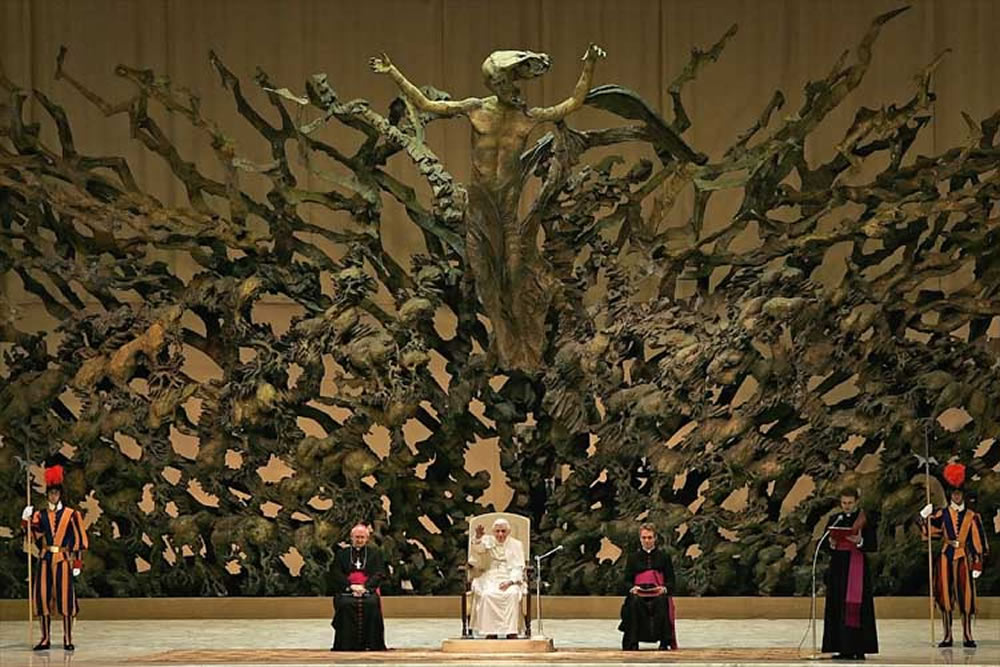
It was used by the sculptor Pericle Fazzini (1913/87) in the years 1970/75 to put together his giant sculpture “Resurrection” for the Paul VI Audience Hall

Tuesday, February 19, 2019

St. GREGORY VII

S. GREGORIO VII
1960/61 Mario Paniconi (1904/73) and Giulio Pediconi (1906/99)

On the portal “Gregory VII (1073/85)” by Antonio Biggi (1904/66)
On one side “The Parable of the feast” by Alfio Castelli (1917/92)

MAIN ALTAR
Hanging group in bronze “Crucifix surrounded by angels, Virgin Mary and St. Francis” by Pericle Fazzini (1913/87)
Around the altar “Ten panels” in fresco by the Florentine Luigi Montanarini (1906/98)

Monday, January 14, 2019

St. EUGENIUS

S. EUGENIO
1943/50 Enrico Pietro Galeazzi (1896/1986) and Mario Redini (1911/80)
It was built to celebrate the 25th anniversary of the episcopal consecration of Pius XII Pacelli (1939/58), whose baptismal name was Eugenio
It is one of the largest churches in Rome, with an area for the faithful of about 1,400 m² (15,000 square feet)
It is theoretically possible to accommodate in it about 4,000 people

FAÇADE
Sculptural reliefs “Figures of angels” in the center and “Allegory of Justice and Peace” at the sides by Alessandro Monteleone (1897/1967)
Sculptural reliefs “Four Evangelists” in the upper part by Francesco Nagni (1897/1977)
It is the Church of the Opus Dei controversial and powerful organization of the Catholic Church founded by the Spaniard S. Josemaria Escrivà (1902/75) who was canonized in 2002 by John Paul II (1978/2005)
The tomb of St. Josemaria Escrivà is in the nearby big church of S. MARIA DELLA PACE (Our Lady of Peace) incorporated in the building of the Opus Dei in Viale Bruno Buozzi 75
“Certainly the architects of St. Eugene were also positively influenced by the character of the place chosen for the new church, located between very special sights: the Vineyard of Pope Julius III, the little house by Pirro Ligorio with the fountain by Ammannati and the architecture of Vignola; everything would in fact inevitably and quite naturally lead them to the design of a work made of elements manifesting a certain solidity and a clear definition of forms: in a nutshell, to a kind of architecture being classic but also modern at the same time” (Website of the Parish of St. Eugene - www.parrocchiasanteugenio.it)
“Stations of the Cross” in bronze by Attilio Torresini (1884/1961) (stations 1-4), Alfredo Biagini (1886/1952) (5-7), Antonio Berti (1904/90) (8-10) and Giacomo Manzù (1908/91) (11 - 14)

1st CHAPEL ON THE RIGHT
Bronze “St. Frances Xavier Cabrini and an Angel” by Pericle Fazzini (1913/87)
“The dynamic group of the saint and of the angel crowning her is very compact in a composition 'arrow'-shaped and it is made lighter by the insistent pictorial style with which the assiduous folds of the garments are modeled” (Website of the Parish of St. Eugenio - www.parrocchiasanteugenio.it)

2nd CHAPEL ON THE RIGHT
Altar made out of red marble from the Timava River in Slovenia
Gilded bronze statue “St. Francis of Assisi back from heaven to earth” by Domenico Rambelli (1886/1972)
“Summoner, glorifier and transformer of life, his statues and bas-reliefs have a strong tone of stylistic abstraction which can only be seen in Romanesque or Egyptian sculptures” (Carlo Carrà)

3rd CHAPEL ON THE RIGHT
Altarpiece “St. Agnes and her stories” by Venanzo Crocetti (1913/2003)
“His graceful feminine images, earthly creatures caught in attitudes that make them protagonists of stories set in the immediacy of their becoming - the tying of a shoe, the drying after bathing, the combing and the undressing, but also the resting after the dance or the contemplation of the sea - are presented in rhythms of a mobile and musical geometry from which derive a wide variety of compositional inventions” (Website www.scultura-italiana.com)

RIGHT TRANSEPT
Mosaics in the upper part “Sacred Heart of Jesus”, in the lower part “Works of Mercy” and in the altar frontal “Last Supper” by Bruno Saetti (1902/84)

MAIN ALTAR
Huge and spectacular bronze statue “St. Eugene I (654/657)” and in the altar frontal relief “Deposition” by Attilio Selva (1888/1970)

IN THE APSE AND UNDER THE ARCH
“Triumph of the Cross and symbols of the Passion” 1951 by Ferruccio Ferrazzi (1891/1978)
“An artist with such a fecund career should be the pivot of every book about the history of Italian art of the twentieth century. Why, then, is he not known to most people as well as his colleagues of his time, Mario Sironi, Massimo Campigli or Gino Severini? Or at least as his followers who would in fact derive prolific teaching from him (technical annotations are also relevant, consistent and intuitive experiments recorded in his diaries) as Renato Guttuso, Alberto Ziveri or Mario Mafai (from whom, however, it looks as if he himself drew inspiration)? Yet the brush is firm and distinctive, some ideas are extraordinarily original (especially in the tones, but also in the modernity of some nervous gestures) and represent the best painting of the '20s and '30s in Italy” (Cristiana Curti - www.artincontro.com)

CHAPEL TO THE LEFT OF THE MAIN ALTAR
Frescoes “Stories of St. Joseph” by Gisberto Ceracchini (1889/1982)
“A primitive language, with squared and often monumental volumes, rather rigid in the engraved signs of the sharp contours, smooth and brilliant in the shades of color, full of references to fifteenth century models and, still, with influences from Giotto and Masaccio; a rugged design, 'passionately expressive' - as described by Roberto Longhi (1929) - which embodies 'obsolete and anachronistic feelings' for their ingenuity and candor” (Susanna Zatti - Biographical Dictionary of Italian Treccani)

CHAPEL OF OUR LADY OF FATIMA
Designed by the Portuguese architect Luiz Benavente (1902/93) for the government of the Republic of Portugal
At the center “Statue of Virgin Mary” by Leopoldo de Almeida (1898/1975)
Around paintings with, in the upper part, “Portuguese saints Antonio, Nuno Alvares Pereira, Queen Elizabeth and John of God”, in the lower part “Madonna with angels and people in the act of worship, after the vision” by Martins Barada

3rd CHAPEL ON THE LEFT
Statue “St. Philip Neri” 1951 and bronze candlesticks by Francesco Messina (1900/95)

2nd CHAPEL ON THE LEFT
Relief “St. Catherine of Siena in ecstasy” by Enrico Castelli (1890/?)
Frescoes “Stories of St. Catherine” by Giorgio Quaroni (1907/60)

1st CHAPEL ON THE LEFT
Statue “St. Nikolaus of Flue” by Corrado Vigni (1888/?)
S. Nicholas of Flue (1417/87) was a Swiss politician and a judge who lived for twenty years in meditation. He was canonized in 1947 by Pius XII Pacelli (1939/58) who also proclaimed him the patron saint of Switzerland

CLOISTER WITH BAPTISTERY IN THE CENTER
Outside of the baptistery there is a mosaic “Proclamation of the Dogma of the Assumption” by the Bavarian Josef Oberberger (1905/94)
Bronze group “Baptism of Jesus with angels” by Giovanni Prini (1877/1958) and ancient Roman mosaic floor with “Dove”
On the walls of the baptistery frescoes “Stories of the Old Testament alluding to baptism” by Giovanni Brancaccio (1903/75)

Saturday, November 19, 2016

ENI PALACE

PALAZZO DELL'ENI
1960/62 Marco Bacigalupo (1922) and Ugo Ratti, Milanese architects
So called Grattacielo (Skyscraper) of twenty-one floors plus two underground (85.5 m - 280.5 feet) in front of EUR Lake
It is the seat of the ENTE NAZIONALE IDROCARBURI (National Hydrocarbons Institution), state-owned company engaged in the activities of finding, producing, transporting, transforming and marketing oil and natural gas
It was founded in 1953 under the chairmanship of Enrico Mattei until his violent death in 1962
From 1995 to 2001 the Italian government has sold the shares, keeping a share of more than 30% and holding, in any case, the effective control of the company
It is the fifth largest oil group worldwide in terms of turnover
BRONZE FOUNTAIN in front of the palace 1961/65 by Pericle Fazzini (1913/87)
In the fields surrounding the EUR Lake there are about 1,000 cherry trees donated by the city of Tokyo because of its partnership with Rome

Monday, January 20, 2014

NATIONAL GALLERY OF MODERN ART (first part)

GALLERIA NAZIONALE D'ARTE MODERNA


Housed in the Palazzo delle Belle Arti (Palace of Fine Arts) 1908/11 by Cesare Bazzani (1873/1939). Established in 1883 at the Palazzo delle Esposizioni (Exhibitions' Palace) in Via Nazionale and then moved here in 1915
Enlarged in 1934 again by Bazzani and in 2004 by Roger Diener
Since World War Two for over thirty years the museum was managed by Palma Bucarelli
The works in the Gallery belong to the nineteenth and twentieth century
There are about 1,100 works on display and about 3,300 more kept in the vaults of the museum
FRIEZES
On the right “Procession of life and work” by Adolfo Laurenti (1856/1944)
On the left “Procession of beauty and strength” by Ermenegildo Luppi
In the center “The artist and the artistic battles” by Giovanni Prini (1877/1958)

On the right “Boat - Wall of Europe” 1979 by Fabio Mauri (1926/2009) e “Big Spiral” 1962 by Ettore Colla (1896/1968)
On the left “Peace on Earth” by the Lithuanian by Jacques Chaim Lipchitz (1891/1973) and “Roma 2010” 2011 by Mauro Staccioli (1937) from Volterra
Across the street from the Gallery there are the STEPS OF VILLA BORGHESE 1911 by Cesare Bazzani

COURT OF SATURNALIA
Bronze group “The Saturnalia” 1888/89 by Ernesto Biondi
The huge group received an award at the Paris Universal Exhibition of 1900 and earned the sculptor from the Frosinone area the coveted Legion of Honor
Nevertheless, the striking sculpture with ten characters in real life size is not appreciated and it is indeed almost completely hidden in the courtyard by a tropical plant

COURT OF THE ROMANS
Group of bronze, marble and limestone “The Romans (Triumph of Germanicus)” about 1899 by Francesco Jerace (1854/1937)
“The angry” 1884 by Mario Rutelli (1859/1943)
Bronze statue “Sad motherhood” 1887 by Emilio Marsili (1841/1926)

INTRODUCTION TO THE MUSEUM


Room 0 - Atrium


Photographical installation on the counter façade:
“On the line of time” 2011 by Mara Celani (1959)
Sculptures:
Marble “To Giovanni Segantini (beauty freed from matter or the Alps)” 1908/15 by Leonardo Bistolfi (1859/1933)
Marble “Idealism and materialism (the soul above!)” 1911 by Giulio Monteverde (1837/1917)

“The group represents allegorically the theme of progress (the wheel). (...) The personification of idealism (the woman soaring) and the rampant materialism (the running man) are accompanied by Masonic symbols as the head of Minerva, the branches of oak and laurel intertwined, the owl, the horse's head and the monkeys, placed at the base and on the back of the sculpture, alluding to the wisdom, the glory and the greed of man” (Stefania Frezzotti)

Bronze “Julius Caesar as a Youth” 1880 by Benedetto Civiletti (1845/99)
Bronze “Two Archeologists” 1968 by Giorgio de Chirico (1888/1978)

Room 01 - The artist interprets the museum


Installation “Steps” 2011 by Alfredo Pirri (1957)
It covers the entire floor of the large room with crushed mirrors on which marble statues of the nineteenth century are placed

“Within this work, I feel suspended in the absence of gravity, raised from the same soil that I trample. I perceive to be in a warm place, filled with inert memory, and at the same time in a cold place. I feel infinite in the middle of a great complexity” (Vicenzo Altaio)

“Fabiola” 1868 by Girolamo Masini (1840/85)
“Euclid” 1883 by Giacomo Ginotti (1845/97)
“Eve after the Sin” 1881 by Antonio Allegretti

“From his studies he had derived a naturalism still tinged with a romantic sensitivity. His most famous work, Eve after the Sin, depicting a naked young woman collapsed with a dramatic gesture, enjoyed a certain appreciation for his captivating conventionality” (Stefania Frezzotti)

“Mask of Antonio Canova” by an unknown artist
Statues by Alfonso Balzico (1825/1901):
“Norma” 1884/86, “The Happiness (The Owl)” about 1858, “Elvira” 1884/86, “The Poor” 1856/60, “Juliet” 1884/86, “The Sleepwalker” 1884/86, “The Lost (the Naïve)” 1856/60, “The Avenger” 1856/60

Room 02 - Excuse me, is this art?


Provocative works now considered historical that have provoked negative reactions for their eccentric diversity, far from the canons of the figurative tradition
They are, however, all works of artists famous all over the world and that this exhibition tries successfully to contextualize in the heart of the museum, at the center of a historical-artistic journey encompassing two hundred years
By Alberto Burri (1915/95):
“Tar” 1950
“He is the Italian artist with Lucio Fontana, to have given the greatest Italian contribution to the international art scene after World War II. His research goes from painting to sculpture with the sole end of the investigation of the expressive qualities of matter. This makes him fully occupy a place of pride in the trend known as 'informal'“ (Francesco Morante - www.francescomorante.it)

By Piero Manzoni (1933/63):
“Some of his debunking works as 'Artist's Shit' (produced in 90 copies in 1961) entered the collective imagination, like Duchamp's upside down urinal. The conception of Manzoni's art recalls the inventions of the Dada movement” (Martina De Luca)

By Lucio Fontana (1899/1968):
Two sculptures “Spacial Concept - Nature” 1959/60

“In 1949 he created the first 'holes', to which he gave the title of Spatial Concepts, namely 'the new concept of seeing the mental fact'. Puncturing the canvas 'which was the basis of all arts' he created 'a new infinite dimension..., corresponding to the cosmos ... And the cuts'- continued the artist -'the hole really..., it was not the destruction of the framework, the informal gesture... it was just a dimension beyond the framework, freedom of understanding art through any means, through any form'“ (Alessandra Ponente - Dizionario Biografico degli Italiani Treccani)

“Ready-made” art by Marcel Duchamp (1887/1968):
“Obligations pour la roulette-de Monte-Carlo” 1924
“Boîte en valise” 1936/41
“Apolinère enameled” 1965 second series, from a unique original of 1916/17
“Roue de bicyclette” 1964 fifth copy in the Schwarz series from the 1913 lost original
“3 stoppage - étalon” 1964
“In advance of the broken arm” 1915
“Pliant de voyage” 1916
“Porte-chapeau” 1964 from original of 1917
“Trébuchet” from original of 1917
“Air de Paris” from original of 1919
“Fresh widow” 1920
“Paysage à Blainville” 1902
One of the versions of “Fountain” from the lost original of 1917
He was one of the most important and influential artists of the XX century. In December 2004, Duchamp's Fountain was voted the most influential artwork of the 20th century by 500 selected British art world professionals

“Futurism was the impressionism of the mechanical world. (...) I was not interested in this. (...) I wanted to make sure that the painting would serve my purpose and I wanted to get away from its physical side. I was interested in the ideas not only visual products. I wanted to return the painting to the service of the mind. (...) In fact, up to a hundred years ago all the painting had been literary or religious: it had all been in the service of the mind. During the last century this feature was lost little by little. The more sensual charm offered a painting - the more animalistic it was - all the more it was appreciated. (...) Painting should not only be retinal or visual, should have to do with the gray matter of our understanding” (Marcel Duchamp)

By Emilio Vedova (1919/2006):
Venetian artist friend of the composer Luigi Nono, whose twelve-tone music has many similarities with the fierce artistic expression of Vedova


"Painting becomes gestural expression, functional to translate firmly on a pictorial space the sense of living in the contemporary world. (...) The expressive power of the pictorial gesture, evident in the brushstrokes spread wide and fast for the entire composition, communicates strongly a desire to participate, which is renewed from moment to moment, to the drama of contemporary life" (Francesca Sborgi - Catalog of the exhibition Bellezza Divina)


By Ettore Colla (1896/1968):
“Genesis” 1955/56
“Industrial Divinity” 1966
“The sculptor collects metal scrap from deposits in the outskirts of the city, useless waste of industrial machinery. In this first period these are mainly materials coming mostly from the ruins of war, constituting a significant and dramatic testimony. After choosing some pieces the artist mounts them together seconding, during the operation, the creative image that the object 'found' suggests. This type of transaction has its antecedent in the Dadaist poetry. The action of Colla, however, is based on a creative process that moves away from every casuality and automatism in its strict discipline, in its referring to specific criteria both manual and conceptual” (Nicoletta Cardano - Dizionario Biografico degli Italiani Treccani)

In the room there are also:

Installation in wood, metal and adhesive printed material "Great Scenic Wall Vibrant" 1966 by Jesús Rafael Soto (1923/2005)

"The work was created for the Venice Biennale in 1966. Before arriving at the gallery the ‘Wall’ was exhibited at the Lumière et Mouvement exhibit held at the Musée d'Art Moderne de la Ville de Paris in 1967. Soto's research explores lighting effects and the interrelation between the vertical elements that often are part of his works" (Mariastella Margozzi)

“Cuadro 172” 1962 by the Spanish Manolo Millares (1926/72)
“Up - Tempo” 1957 by Mimmo Rotella (1918/2006) from Calabria
“T 1956-19” 1956 by the German Hans Hartung (1904/89)
“No title” 1965 by the American John Chamberlain (1927)
“The Gift” 1990 by the American Joseph Kosuth (1945)
Plastic laminate on wood "30 Rods" 1967 by Sergio Lombardo (1939)
“Duchamp dis – enameled (the wrong and the right bed)” 1983/84 by the Roman Luca Maria Patella (1938)
“Bandes” 1969 by the French Daniel Buren (1938)

Rooms 03 a & 03 b - Western Exedra: Portraits of artists


“Self-pain” 1947 by Giacomo Balla (1871/1958)
“Self-portrait” 1934 by Mario Broglio (1891/1948)
“Self-portrait” 1942/43 by Renato Guttuso (1911/87)
“Self-portrait” 1880/85 and “Self-portrait almost twenty-year-old” about 1843 by Domenico Morelli (1823/1901)
“Self-portrait” about 1935 by Afro (Afro Basaldella) (1912/76)

“The acid tone of the chromatic rendition, the elongated shape of the figure, which hark back to sixteenth-century Venetian tradition of El Greco and Tintoretto, as well as the solid draughtsmanship of the painting struck his contemporaries who saw in the young Afro an already mature talent” (Maura Picciau)

Bronze bust “Portrait of Filippo Palizzi” 1895 by Achille D'Orsi (1845/1929)
“Portrait of Bernardo Celentano” 1859 by Domenico Morelli (1823/1901)
“Portrait of a man sitting (Mattia Moreni)” 1942 by Enrico Paulucci (1901/99)
Photograph “India (en route vers l'Indie d'après Pierre Loti)” 1978 by Luigi Ontani (1943)
Marble bust “Self-portrait” 1862 by Pietro Tenerani (1789/1869)
“In the studio” 1868/70 by Napoleone Nani (1839/99)
Terracotta statue “Portrait of Francesco Paolo Michetti” 1873/74 by Vincenzo Gemito (1852/1929)
Pastel on paper “Self-portrait” about 1880 by Antonio Mancini (1852/1930)

“Antonio Mancini paints between 1878 and 1882 many self-portraits. These were the years of mental illness, the artist portrays himself always in front and half-length, but with endless variations of expressions and hairstyles, as if to record the different stages of madness” (Martina De Luca)

“Self-portrait in uniform” 1915 by Armando Spadini (1883/1925)

“Self-taught, not highly educated, perhaps, but sensitive to the influences of Pre-Raphaelites and Impressionism, Armando Spadini was for many years after his death, an important reference point for the painters of the younger generation, at least until, in the decades of second World War, a more intellectual trend took over that declassified Spadini's work as too intimate and too tied to everyday life” (Luca Ceccarelli)

Bronze bust “Arnold Böcklin” 1899 by Filippo Cifariello (1864/1936)
“Self-portrait naked” 1945 e “Self-portrait in black costume” 1948 by Giorgio de Chirico (1888/1978)
“Figure in black” about 1935 by Luigi Trifoglio (1888/1939)
Large painting “The costellation of the Lion” 1981 by Carlo Maria Mariani (1931)

“It represents the Roman art scene in the early eighties in the form of a modern Parnassus. The painter portrays, besides himself, Luigi Ontani, Mario Merz, Cy Twombly, Sandro Chia, Francesco Clemente and inserts quotes from the works of Paolini, Kounellis, De Dominicis. Gallery owners and critics also appear as Gian Enzo Sperone and Mario Diacono, while Achille Bonito Oliva, dressed as a Roman emperor, dominates the left side of the scene” (GNAM Website - www.gnam.beniculturali.it)

“Le déjeuner sur l'herbe” 1964 by Alain Jacquet (1939/2008)
In a glass case in the center of the room:
Three notebooks printed and die-cut "Love's fragment" 1980, "The painted diamonds" 1991 and "Kailedoscopio" 1988 by Lia Drei (1922/2005)
"Aspen Leaf" 1993 by the Austrian artist Greta Schödl (1929)
"Stories of Dreams" 1994 by Virginia Fagini (1945/2003)
"There once was a god" 1990 by Maria Lai (1919/2013)
At the end of the corridors three installations:
“Room 63”, “Room 64” e Room 65” 2013 by Marina Paris (1965)

"In the opening of the simulated gates time is not considered; the juncture that is in the shot of the image is eternal. The precision and detail of the frames simulate the doors, in wood or travertine, which give access to the exhibition areas. The deception camouflage is complete, and for the viewer to discover the element alien to the context, the intruder, becomes a game, a challenge and a call of attention. The research on the historical archives of Marina Paris, in dialogue with the architectural and aesthetic soul of our lives as citizens, thus enters into an institutional place - the home par excellence of the art of the nineteenth and twentieth centuries - to play with as many icons of architecture, such as St. Ivo alla Sapienza, the Oratorio dei Filippini and the State Archives in the Eur district" (Ilaria Piccioni - www.seroxcult.com)

Room 11 - Western Corridor: Portraits of artists


For this and for the following three rooms the suggested itinerary does not coincide with the numbers of the rooms
“Spouses” 1939 by Gino Severini (1883/1966)

“The painting portrays his daughter Gina and the sculptor Nino Franchina, who became husband and wife at the time of the painting. (...) It clearly cites the 'Portrait of the spouses' (Pacuvio and his wife) from Pompeii, stopping in an image posted a time of deep emotion, to perpetuate the memory” (Maura Picciau)

“The painter and his wife” 1910 by Armando Spadini (1883/1925)
“Self-portrait” about 1831 by Natale Schiavoni (1777/1858)
 “His son Eduardo with Egisto Fabbri e Alfredo Muller” 1895 by Michele Gordigiani (1830/1909)

Room 12 - Ordinary people


High-relief in bronze “The victims of work” 1882 (completed in bronze 1895) by Vincenzo Vela (1820/91)

“A work of sculpture in which the message passes through a language based on the rejection of every canon of ideal beauty: the deformities in the bodies of miners carrying a fallen comrade take to the extreme formal consequences its realism direct and brutal in some ways” (Carlo Bertelli, Giuliano Briganti, Antonio Giuliano)

“Emigrants” 1896 by the Tuscan Angelo Tommasi (1858/1923)

“Naturalistically and minutely descriptive in the crowded groups of figures on the pier sadly awaiting boarding at the port of Livorno. It is precisely the exceptional size of the painting to make it an epic and monumental representation of the era of Italian emigration. The large size combined with its lack of appreciation enjoyed by the work in the past, has meant that the Emigrants were not given proper placement in the exhibition halls before the last display” (Elena di Majo)

Room 13 a - The ways of art through emotions


Four important paintings by Balla, Simi, Kandinsky and Burri presented with words, music, thermoformed reproductions through auditory, tactile, olfactory and emotional perception

Room 13 b - Eastern Exedra: Portraits of writers and intellectuals


“Portrait of canonical Nicola Giordano” 1827/28 by Gaetano Forte (1790/1871)
Model for the monument in Milan “Cesare Beccaria” 1871 by Giuseppe Grandi (1843/91)
“Portrait of young woman” 1830/35 by Michelangelo Grigoletti (1801/70)
“Portrait of Pasquale Villari as a youth” about 1856 by Domenico Morelli (1823/1901)
Bronze Group “Ugo Foscolo after the Treaty of Campo Formio” 1867 by Odoardo Tabacchi (1831/1905)
Bronze statue “G.B. Niccolini” 1864 by Augusto Rivalta (1837/1925)
“Portrait of Ciro Menotti's daughter” 1869 by Adeodato Malatesta (1806/91)
“Portrait of Alessandro Manzoni” in bronze 1875 by Ercole Rosa (1846/93) who also sculpted the monument to Victor Emmanuel II in Piazza Duomo in Milan
“Bust of Cesare Correnti” in bronze and gold 1880 by Vincenzo Gemito (1852/1929)

“Gemito's work comes at a time of transition from the classical tradition of sculpture characterized by smooth and polished surfaces to the use of a vibrant molded technique, obtained with rough surfaces where the light produces effects similar to those produced by the Macchiaioli Tuscan painters” (Carlo Bertelli, Giuliano Briganti, Antonio Giuliano)

“Portrait of Giosuè Carducci” about 1880 by Adriano Cecioni (1836/86)
Bronze portrait “Guido Baccelli” 1895 by Giulio Tadolini (1849/1918)
Guido Baccelli (1830/1916) was Minister of Education and established the National Gallery of Modern Art
“Friends at the Coffee Bar” 1929/30 by Amerigo Bartoli Natinguerra (1890/1971)
Representation of the Aragno Coffee Bar in Rome, a place of meeting of the editorial staff of “Plastic Values” and a meeting place for artists and writers
Sculpture in colored plaster “Portrait of Alberto Moravia” about 1932 by Quirino Ruggeri (1883/1955)
“Portrait of Giuseppe Ungaretti” 1930 by Scipione (Gino Bonichi) (1904/33)
Wonderful expressionistic portrait of the great poet, friend of the unfortunate artist who died of tuberculosis at the untimely age of 29
“Self-portrait” about 1943 by Francesco Menzio (1899/1979)
Bronze head “Portrait of the writer Riccardo Bacchelli” 1935/36 Francesco Messina (1900/95) 
Bronze head “Sibilla Aleramo” 1938/39 and wooden bust “Portrait of Giuseppe Ungaretti” 1936 by Pericle Fazzini (1913/87)
Sibilla Aleramo was an Italian writer and poet very active in the feminist movement

“The sculpture of Ungaretti was done in a few months on a block of walnut wood, whose hardness offered the sculptor the chance to get a barbaric, chipped surface and compact volumes” (Maura Picciau)

Two bronze sculptures: “Portrait of Vasco Pratolini” about 1941 and “Portrait of Alfonso Gatto” 1941/42 by Marino Mazzacurati (1907/69)
“Portrait of Eugenio Montale” 1938 by Renato Guttuso (1911/87)
“Portrait of Riccardo Gualino” 1932 by Cesarina Gualino (1890/1992)
“Portrait of Mario Soldati” 1925/28 by Nella Marchesini (1901/53)
“Portrait of Palma Bucarelli” 1945 e “Portrait of Paolo Monelli” 1951 by Alberto Savinio (1891/1952)
“Self-portrait” 1942 by Mario Mafai (1902/65) 
“Portrait of Umberto Saba” about 1950 by Carlo Levi (1902/75)
This portrait cleverly investigates the psychology of one of the greatest Italian poets of the twentieth century
“Portrait of Luigi Pirandello” 1936 by Fausto Pirandello (1899/1975)

Portrait of the celebrated Italian playwright painted by his son Fausto, a talented and significant painter